
Simple Future Tense
The simple future is a very common verb tense used to talk about plans and expectations in English. Read about the rules for using it, how we form it, and tons of example sentences!
The simple future is a very common and useful verb tense. It is the third most common verb form in English, after the simple present and simple past. Just under 10% of verbs in spoken English are in the simple future.
Using the Simple Future
Simple future verbs are used for actions that will happen at a specific time in the future, after the current moment. This includes plans, predictions, promises, willingness, and decisions.
There are two forms of the simple future tense: the first is formed using will and the second is formed using going to. The meaning of the two forms is generally the same, but it is more typical to use will in some situations and going to in other situations.
Chart for Simple Future Tense in English
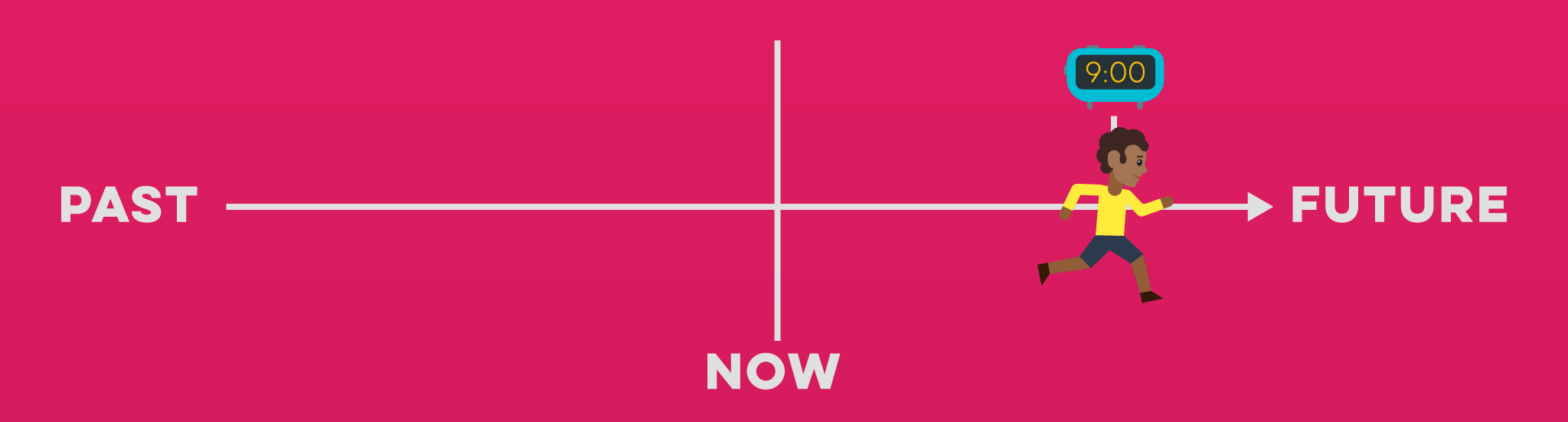
The examples below illustrate the rules for how we usually use the simple future tense.
Examples
Examples of Simple Future with Will
Here are lots of example sentences showing different ways that we can use the simple future tense tense.
To make predictions and promises:
I will give you a ride to the station.
My staff will help you with that.
I'll answer the phone.
The news says it will rain tomorrow.
I think Real Madrid will win.
When we have just now made a decision to do something:
[the doorbell rings]
I’ll get it!
A: We’re going to the mall.
B: Oh! I’ll come, too!
In these situations above, the speaker makes a decision and announces it immediately.
Examples of Simple Future with Going To
To talk about plans:
I'm going to exercise this evening.
We're going to visit my sister.
For things we can see are just about to happen:
Nancy: The wind is going to blow those papers away
Tonya: Ah, I’ll take them inside.
Esperanza: What are you going to do this weekend?
Mathilda: I’m going to go hiking in Maine. What about you?
Esperanza: I’m just going to stay home.
Forming the Simple FUTURE
Formula with Will
The simple future with will is the same with any subject. Just use the helping verb will, followed by the base form of the main verb.
subject + will + VERB
Conjugation
The table below shows the complete conjugation of the verb work in the simple future with will.
| Singular | Plural | |||
|---|---|---|---|---|
| 1st person | I | will work. | we | will work. |
| 2nd person | you | will work. | you | will work. |
| 3rd person | he | will work. | they | will work. |
| she | will work. | |||
| it | will work. | |||
Formula with Going to
The simple future with going to is just a little more complicated. Conjugate the helping verb be based on the subject. After that, just use going to and the base form of the verb.
subject + am/is/are + going to + VERB
Conjugation
This table shows the complete conjugation of work with going to.
| Singular | Plural | |||
|---|---|---|---|---|
| 1st person | I | am going to work. | we | are going to work. |
| 2nd person | you | are going to work. | you | are going to work. |
| 3rd person | he | is going to work. | they | are going to work. |
| she | is going to work. | |||
| it | is going to work. | |||
Other Forms of the Simple Future
Negative Sentences
To make a negative sentence in the simple future, you do not need to add do, because will works as a helping verb. Add not after will or the be verb.
I will not help you
I am not going to drink tonight.
Questions
If you are forming a question in the simple future tense with will, put will before the subject of the sentence.
Will you help me?
When will the rain stop?
How will she pay all those bills?
To form a question in the simple future with going to, put the conjugated form of be before the subject.
Are you going to go out tonight?
Who is she going to work with?
What are we going to do?
Passive Voice
To form a passive sentence in the simple future, put the verb to be in the simple future (will be or is/are going to be) and then put the main verb in the perfect participle form:
A new parking garage will be built at this intersection.
Joan is going to be promoted!
You can find more explanation and examples in our guide to the English passive voice.
Notes
Generally, when we use the simple future tense, it is important that the speaker and listener know the specific time. For example, just saying I am going to the movies is unusual.
Many experts will say that English does not technically have a future tense. When they say this, they mean that we don't inflect verbs to talk about the future like many other languages do. Instead, we talk about the future using modal verbs (will/going to). For students learning English, it is easier to just think of the future as a tense.
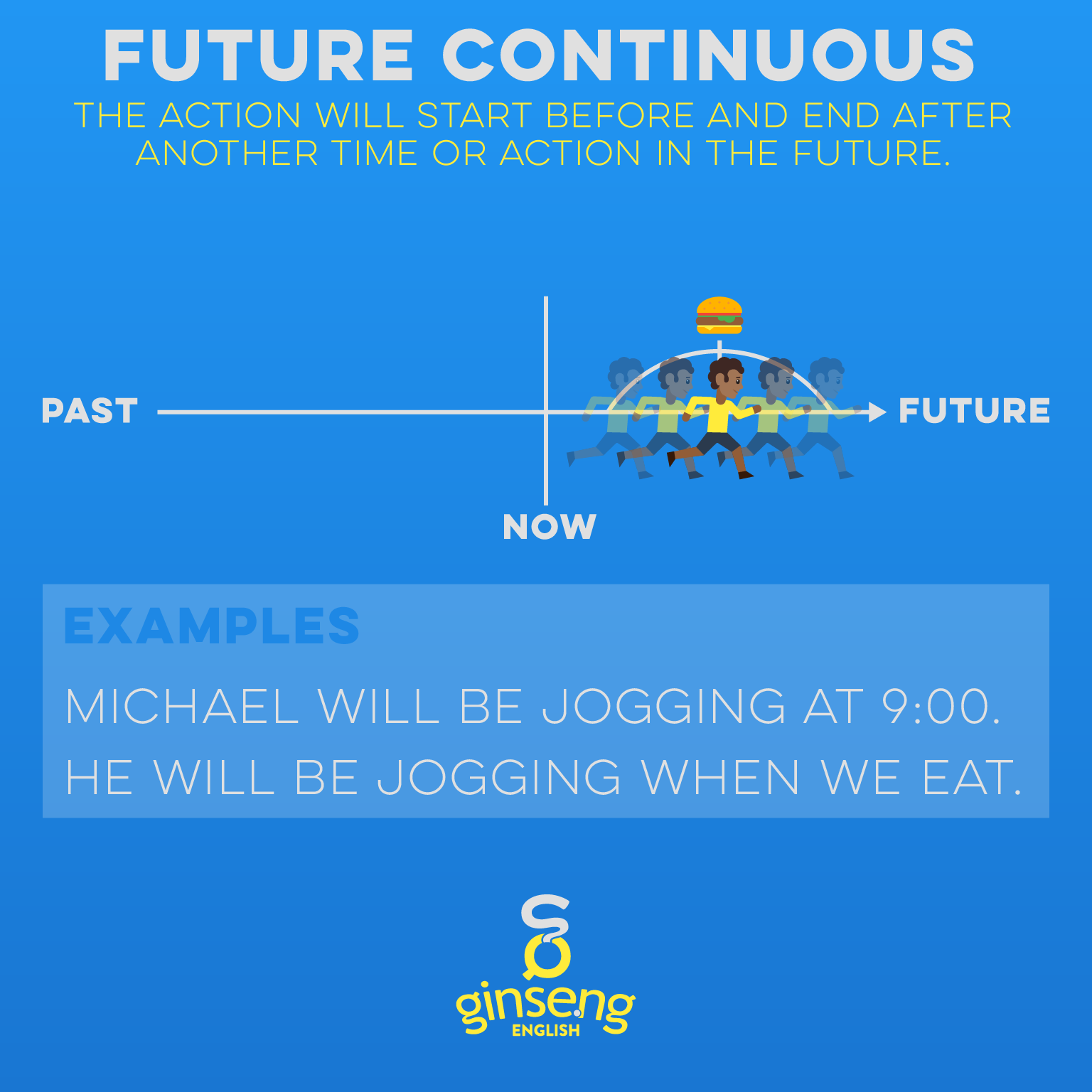
...And Sometimes Y?
How Many Vowels Are There?
How many vowels are there in English? Five? Six? Twenty? Five and a half?
If you ask an American what the English vowels are, we will almost all say the exact same thing that we learned in school as children:
A, E, I, O, U, and sometimes Y.
Ellen Degeneres recently tweeted at NSYNC, and she jokingly congratulated for making a major accomplishment "without a vowel" in their band name. However, as many people (including Ginseng) explained, Y is a vowel in NSYNC. Ellen was just making a joke, of course, but many people, learners and native speakers alike, really don't understand what it means when we say that Y is "sometimes" a vowel.
Let's look a little closer at what exactly we mean when we say "and sometimes Y" in order to help us understand several important aspects of English pronunciation and spelling.

Vowels and Consonants
Before we can say how many vowels there are, we need to clarify what exactly a vowel is. The answer is not as simple as you may think. The most common dictionary definitions say something like this:
vowel (n.)
1. a speech sound in which air flows out through the mouth and is not blocked by the teeth, tongue, or lips;
2. a letter representing one of these sounds.
On the other hand, consonant is usually defined something like this:
consonant (n.) - any speech sound or letter that is not a vowel.
So a vowel is a sound made with your mouth open, and a consonant is basically every other sound.
Sounds and letters
You may have noticed that the definitions of consonant and vowel above talk about both sounds and letters, and this is where the confusion comes from. Sounds and letters are different things. Letters are written and are meant to represent the sounds in a language.
However, you have probably noticed that English sounds and letters don't have a perfect correspondence. For example, sometimes the letter C sounds like S (as in city) but other times it sounds like K (as in cat).
This is especially true about vowels. If we ignore Y for a moment, there are 5 vowel letters: A, E, I, O, U. However, if we look at vowel sounds there are between 14 and 21 (depending on the accent).
How is this possible? Think about the different sounds that A makes in the words father, bake, and cap, and the different U sounds in put, cup, and nuke.
The most important idea here is that letters can make different sounds.
Why is Y Special?
Okay, but we're talking about Y, right? Is it a consonant or a vowel!? How many vowels are there!? We need a number!
So, like many other letters, the letter Y represents many different sounds. You can see the most common ones in the words only, cry, myth, and yet.
Let's look more closely at those examples: in only, Y makes the long E sound /i/, the same sound E makes in we. In cry, Y makes the long I sound /aɪ/, pronounced like the I in mine. In myth, Y makes the short I sound /ɪ/, the same sound as the I in kid. As you can see, these are all vowel sounds.
The Y in yet is different. It isn't really a sound that other letters frequently make. Its "the Y sound" /j/. And this is a consonant sound. If you make this sound, you will feel that the back of your tongue rises up toward the top of your mouth. Remember, when we block or obstruct the air to make a sound, this is what makes a consonant.
So the reason that the letter Y is sometimes a vowel and sometimes a consonant is that it makes several different sounds. Some of these sounds are vowel sounds, and one is a consonant sound. In the words only, cry, and myth, Y is a vowel. In yet, yellow, and you it is a consonant.
In case you were still wondering about Ellen's NSYNC tweet, the Y in NSYNC is definitely a vowel.
Y is Almost Always a Vowel
So we know why Y is sometimes a vowel, but we were curious: How often is Y a vowel and how often is it a consonant. How common are the different sounds that Y makes? The answer was not easy to find, but eventually we came across an academic paper that contained the answer we needed.
It turns out that Y is not just "sometimes" a vowel. It is almost always a vowel. It is only a consonant around 2.5% of the time. That means about 97.5% of the time it is a vowel. By far, the most common sound it makes is long E /i/. As you might guess, this is probably because -y and -ly are very common suffixes in English.
Next time you hear someone say "A, E, I, O, U, and sometimes Y," you can correct them: "A, E, I, O, U, and 97.5% of the time Y!"

用英语描述人
在这篇文章中,我们介绍40多个用英语单词以及6个句型来描述人。前三个句子句型是基本句型(A1级)。另外三个则稍微高级一些(A2-B1级)。所有的词汇都是基本的(A1到A2级)。(如果你不知道A1、A2、B1和B2是什么意思,了解CEFR!)
什么是句型?
句型是我们学习说英语的一个很有用的方法。一个句型是一个空的位置,许多不同的词可以在许多不同的情况下放进去使用。例如,如果你学习了 I feel [ADJECTIVE] 的句型,你可以造出几百个不同的句子。你所需要做的就是学习一个新的形容词,放到合适的地方:我觉得饿。我觉得累。我觉得生气。我感觉不舒服。对于基础水平的学生,学习句型是学习英语的好方法!
句型1 -描述人的基本句子。
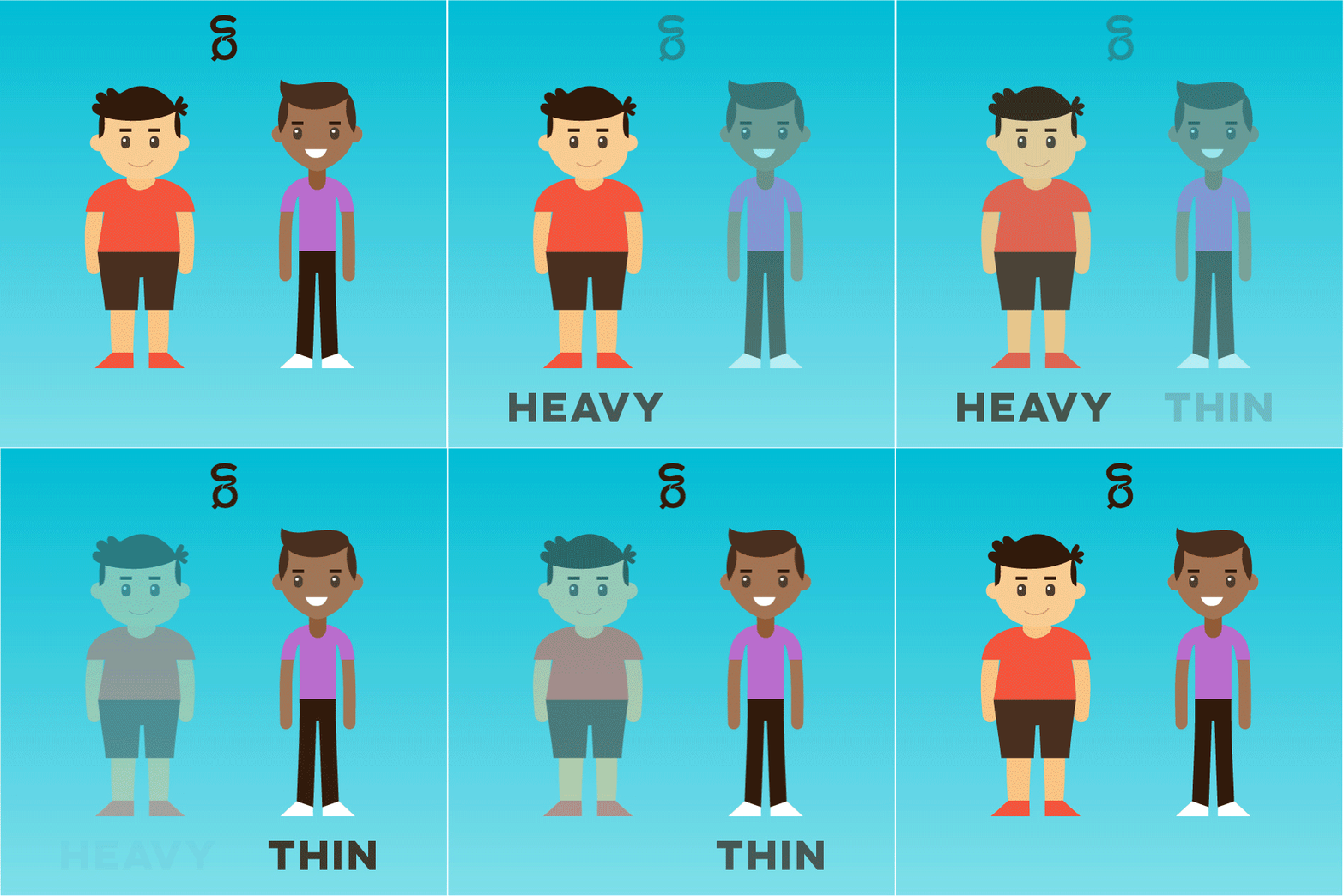
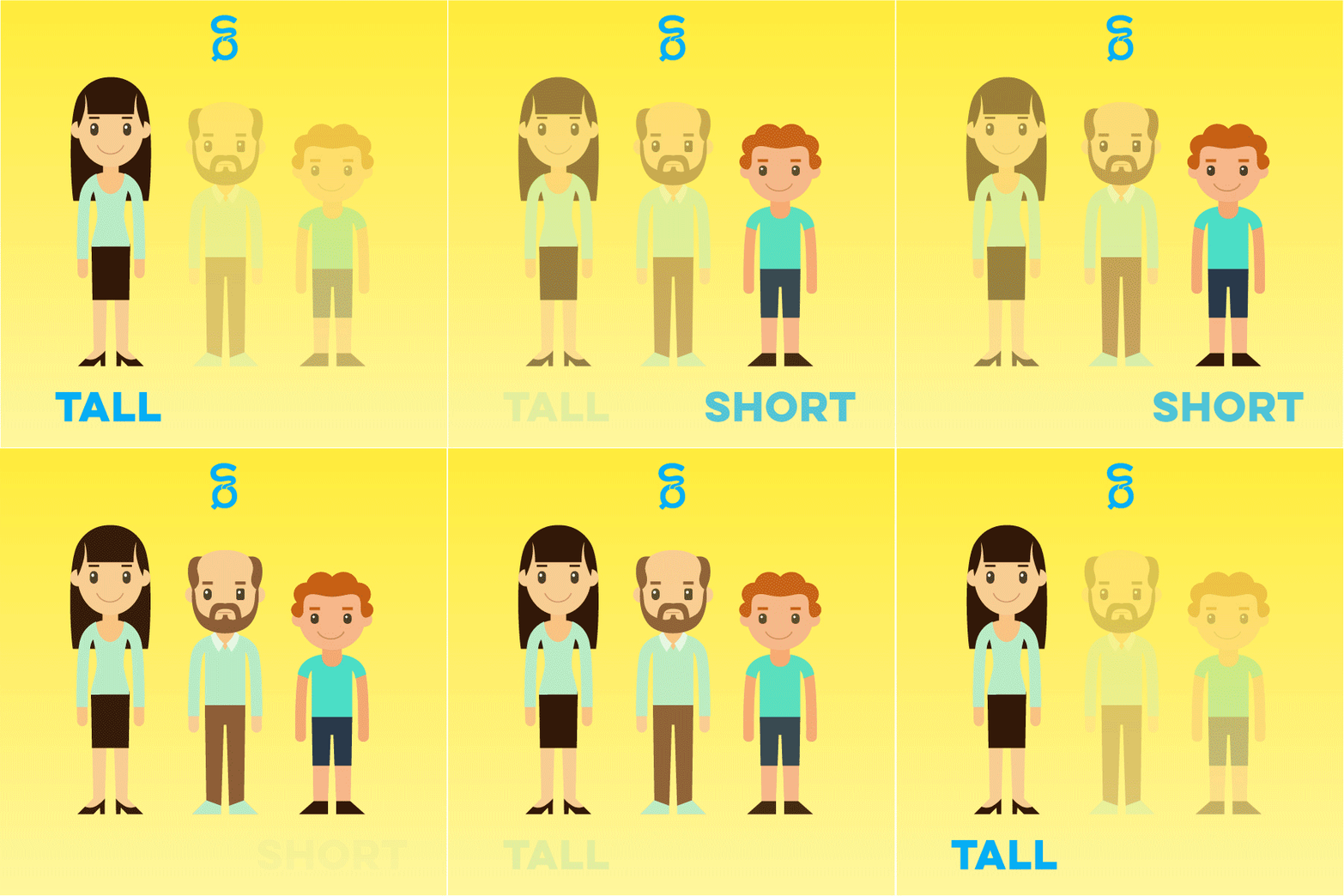
我们要看的前三个句子是简单句。形容人的最常用的方式之一是使用形容词:高、矮、胖、瘦、漂亮、英俊、丑陋。在一个句子中使用这些常用的形容词,试试这个句型:
The man is [ADJECTIVE].
这个人[形容词]。
The man is tall. (这个男人个子高。) The man is fat. (这个男人胖。) The man is ugly. (这个男人丑。) The man is in shape. (这个男人体型好。) 你可以把任何人放在那个位置。
重要的是要知道,The man男人这个词是可以替换的。这个女人个子高。我朋友个子高。我爸爸个子高。简个子高。她个子高。你可以把任何人放在那个位置。
现在让我们看看一些可以放在这个位置上用来描述人的形容词:
| 英语 | 发音 | 中文 |
|---|---|---|
| tall | /tɔl/ | 高 |
| short | /ʃɔrt/ | 矮 |
| thin | /θɪn/ | 瘦 |
| fat | /fæt/ | 胖 |
| old | /oʊld/ | 老 |
| young | /jʌŋ/ | 年轻 |
| in shape | /ɪn ʃeɪp/ | 状态良好 |
| out of shape | /aʊt ʌv ʃeɪp/ | 变形 |
| beautiful | /ˈbjutəfəl/ | 漂亮 |
| ugly | /ˈʌgli/ | 好丑 |
| handsome | /ˈhænsəm/ | 英俊 |
| bald | /bɔld/ | 秃 |


句型2 -描述特征的基本句子
下一个基本句型是通过某项特征来描述人的基本句型:眼镜,卷发,黑头发,蓝眼睛,胡子,马尾辫。要谈论一个人的特点,可以用以下句子:
The woman has [FEATURE].
这女人有[特点]。
用这个句子句型,你可以造出很多不同的句子:这个女人有一头卷发。这个女人戴眼镜。这个女人留着长发。这个女人扎马尾辫。
同样,你也可以改变人的位置:那男人有一头长发。我的朋友有一头长发。我妹妹有一头长发。克拉拉有一头长发。
以下是一些可以适用于这个句型的特征(名词或形容词名词):

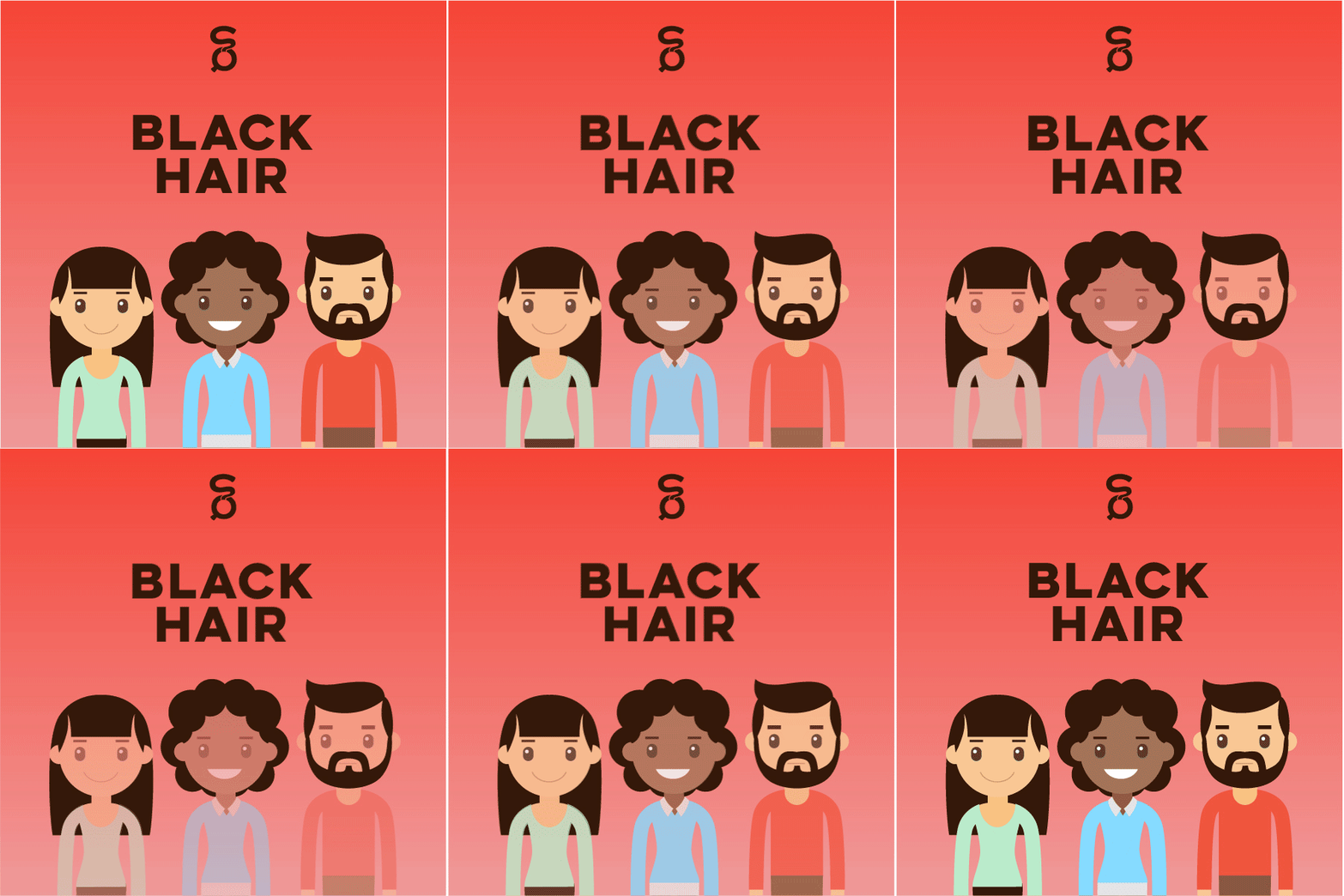


句型3 -描述衣服的基本句子。
我们要讲的最后一个句子是通过衣服来描述人的句子。谁不喜欢衣服!?黑色的鞋子!灰色的裤子!蓝色的领带!绿色的裙子!让我们用它们来做完整的句子。这是句型:
The woman is wearing [CLOTHES].
这女人穿着[衣服]。
下面是一个可以加进这个句子的衣服列表:
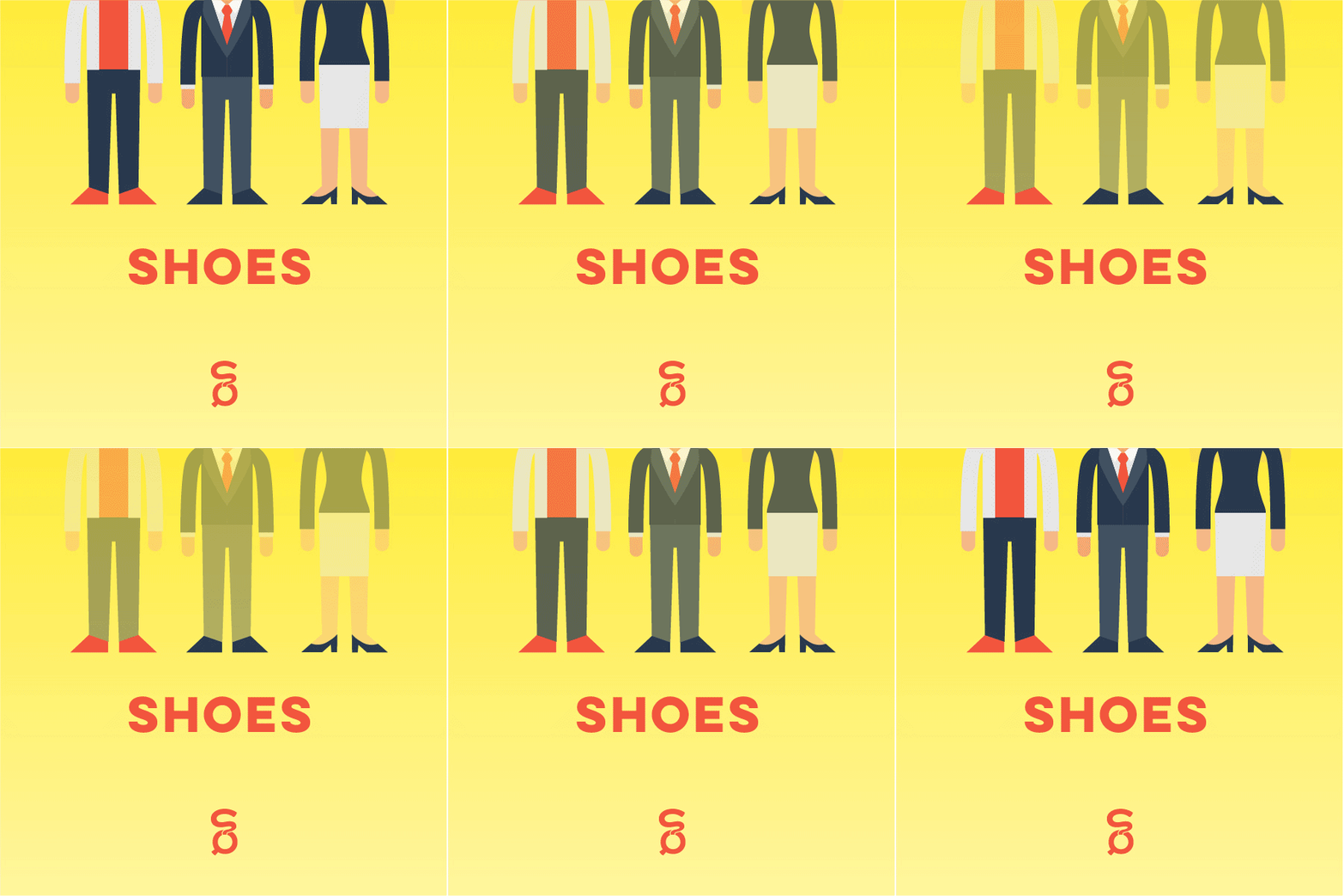

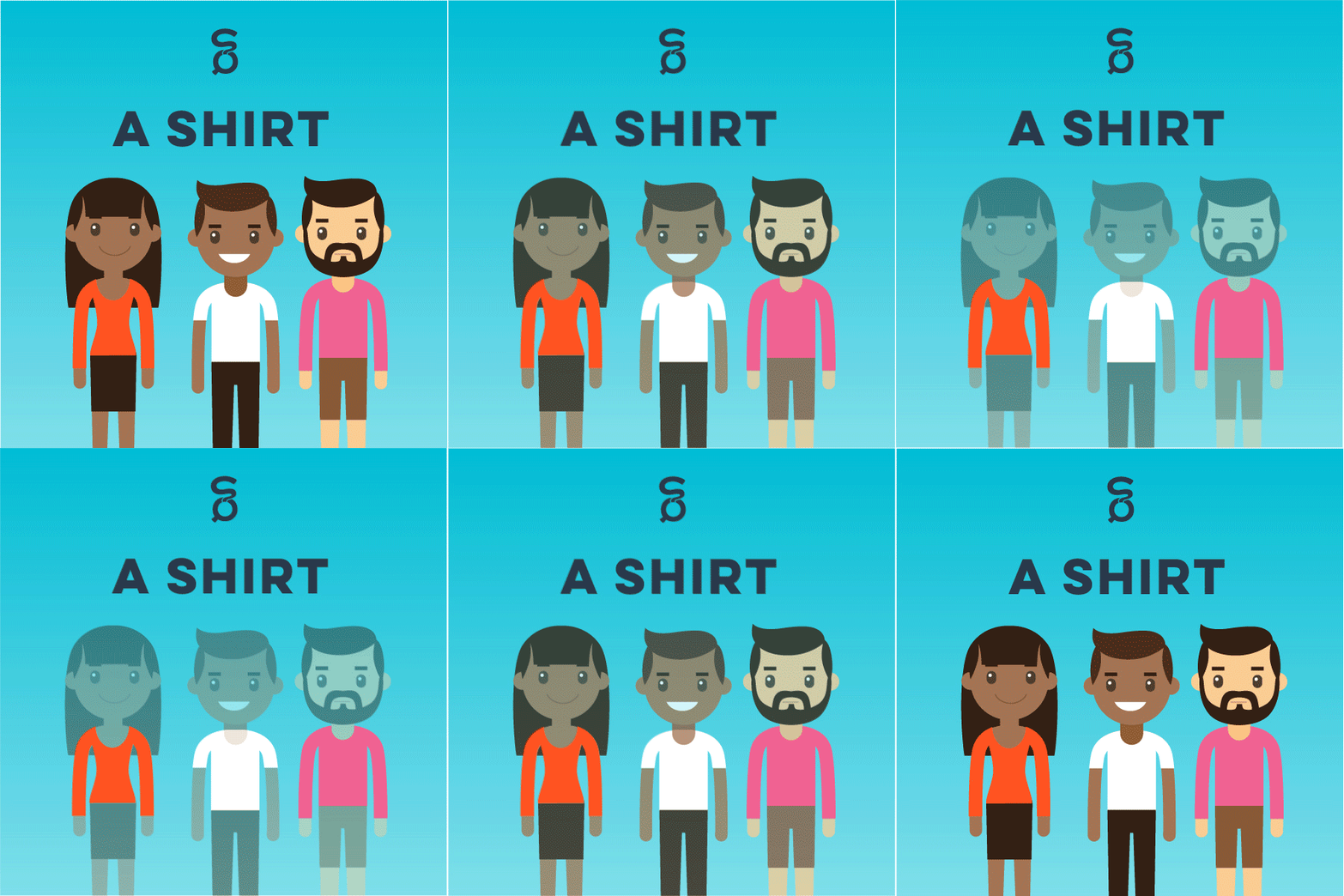


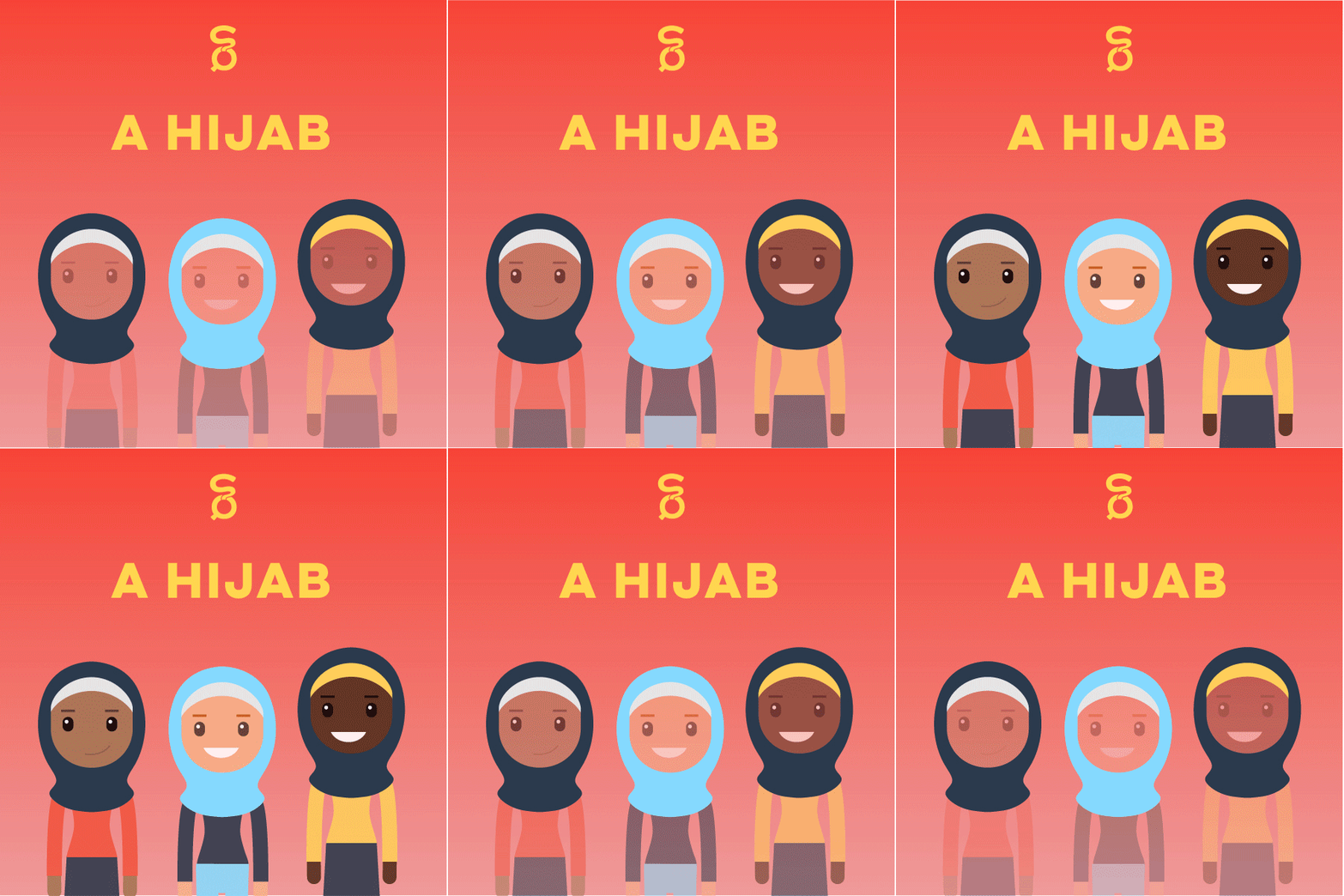

所有这些衣服都可以用颜色词语来描述。The woman is wearing black shoes. (这个女人穿着黑色的鞋。) The man is wearing a yellow tie. (这个男人戴着黄色的领带。)
所以,这三个句型,加上这些词汇,让你可以造出几百个不同的句子来描述人。如果你是初学者,而且这是你学的新知识,你可以在这里暂停一下。
但是,如果你已经知道这些知识,而且你想学一些难度更高的英语句子,那就继续读下去吧!
描述人的复杂句型
前三个句型是关于名词,特征和服装,这个顺序对吧?接下来的三个句型将会以更复杂的方式谈论这三件事情。以上章节提到的三个句型的所有词汇都可以用同样的顺序在以下三个句型使用。
在前三个句型中,每个句子主要是描述人。这些句子是关于描述人的。我想告诉你关于这个男人的是他个子高。但是有时候我们想用一句话来描述这个人的其他事情,而描述并不是句子中最重要的部分。例如,也许我想告诉你这个人是我的邻居,但我也想说他个子高。以下的句型会在这样的情况下有所帮助。
句型4 -形容词之前的名词
让我们用回这个例子。我想告诉你这个人是我的邻居,我也想把他形容成一个高个子。我可以把形容词放在名词前:那个高个子的男人是我的邻居。你也可以把上面的任何一个形容词放在那个括号处。
The [ADJECTIVE] man is my neighbor.
这个[形容词]的人是我的邻居。
The handsome man is my neighbor. (那个英俊的男人是我的邻居。) The old man is my neighbor. (那位老人是我的邻居。) The fat man is my neighbor. (那个胖子是我的邻居。)同样,句子的结尾(我们称之为谓语)也是一个可填充的位置,你可以在那里放进不同的动词:那个高个男人喜欢足球。那个高个子正在吃东西。那个高个男人有一辆汽车。
句型5 -特点和“with”
如果你想在同一个句子里谈论某人的特征,我们需要使用介词 “with”。我们可以说,戴眼镜的那个男人是我的邻居。任何其他特点都可以放入相同的位置:
The man with [FEATURE] is my neighbor.
有[特征]的人是我的邻居。
The man with red hair is my neighbor. (红头发的那个男人是我的邻居。 The man with a mustache is my neighbor. (留胡子的那个男人是我的邻居。)
句型6 -衣服和 “in”
当我们想谈论衣服时,我们需要另一个介词。我们用 “in”来取代“with”。穿蓝衬衫的那个男人是我的邻居。上面的任何一个服装词汇都可以放进同一位置上:
The man in [CLOTHES] is my neighbor.
那个穿着[衣服]的人是我邻居。
The man in the tie is my neighbor. (那个戴领带的男人是我的邻居。)The man in the grey pants is my neighbor. (穿灰色裤子的那个男人是我的邻居。)The woman in the red hat is my neighbor. (那个戴红帽子的女人是我的邻居。)
总结
就是这样!学习这六个句型和词汇,你现在可以造出数百个新的句子来描述人!稍后回来看看,我们会有一个小测验来测试一下你学到了什么!
Rob Sheppard is the founder and Chief Executive Teacher at Ginseng. Over the past ten years, he has taught English in Taiwan, South Korea, and his hometown of Boston. Now he teaches online at Ginseng while traveling the world.
You can email Rob at rob@ginse.ng.

The Idiomatic Fridge
English Idiom - The Idiomatic Fridge
We came across this fantastic cartoon by John Atkinson, from his site Wrong Hands, and thought it would be the perfect topic for a vocabulary lesson. It’s called The Idiomatic Fridge because all of the “foods” in here are actually idioms in English!
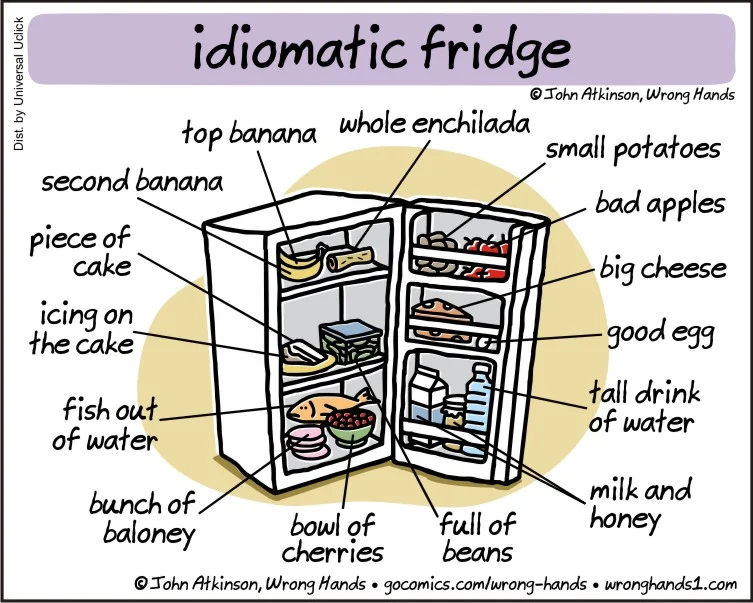
Before we get started, take a look! Do you know any of these?
fish out of water
icing on the cake
piece of cake
top banana
second banana
tall drink of water
milk and honey
full of beans
bowl of cherries
bunch of baloney
whole enchilada
small potatoes
bad apples
good egg
big cheese
Definitions and Example Sentences
top banana 🍌
The idiom top banana is used to describe the best or most popular person in a show, group or organization.
Of all the comedians in the world, Robin Williams was the top banana. Would you agree?
second banana 🍌🍌
Going hand in hand with top banana is second banana which means the second best or most popular person in a show group or organization.
President Obama was top banana, but he would be nowhere without his second banana, Vice President, Joe Biden.
whole enchilada 🌮
The whole enchilada is a funny way of explaining that something is complete and comes all packaged together.
When considering vacation packages, I decided to go for the whole enchilada and get a deal that included the room, transportation to the airport, and unlimited food and alcohol. I didn’t regret it, I had an amazing trip!
small potatoes 🥔
If something is small, insignificant, or cheap, we might say that it’s just small potatoes.
The price we pay for health insurance is small potatoes compared to what we would pay for medicine without it.
bad apples 🍎
If a bad apple is stored in a container with good apples, it will typically cause the other apples to rot faster. Someone who is very negative can make people around them very negative as well, so we call a negative or badly behaved person a bad apple or a rotten apple.
Joey always complained about his homework in class, and then I started noticing my other students didn’t want to do their work either. I think he’s a bad apple!
good egg 🥚
A good egg is pretty much the opposite of a bad apple. If you someone is just all around (like an egg!) a nice, helpful, and responsible person, he or she is considered a good egg.
When I broke my leg, my neighbor mowed my lawn and made me dinner without me even asking! What a good egg!
big cheese 🧀
If someone is very important and successful, we might call them the big cheese, or a big shot.
After Alex got promoted, he thought it was the big cheese around the office, but he quieted down once he realized he still wasn’t such a big shot...
tall drink of water 🚰
This isn’t an expression that we use very often anymore, but it’s still a funny one! If someone is very beautiful, handsome, and overall just very attractive, you could say that they are a tall drink of water. Imagine drinking a tall glass of water on a hot day. This is how some people feel when seeing someone very attractive!
Even after all these years of marriage, when my wife comes into the room I still think she’s a tall drink of water!
milk and honey 🥛 🍯
This term is used to explain a land that has plenty of everything that you could possibly need to survive, and is therefore considered a perfect place to live.
When I moved to Florida, it had everything I could want, beaches, friendly people, and good food! I thought it was the land of milk and honey until I realized that I missed snow!
full of beans 🥫
If you have a ton of energy, are very happy, and can't sit still you’re full of beans.
On this beautiful summer day, we were full of beans and couldn't wait to go play outside!
bowl of cherries 🍒
When something is very nice, and everything is going perfectly in your day, or your life, we might say that it’s like a bowl of cherries.
Today I found $100 on the sidewalk! Life is a bowl of cherries!
However, this expression is actually used more often in a sarcastic or ironic way, meaning exactly the opposite of perfect.
My car broke down, and I was late for work so I lost my job. Life is a bowl of cherries, huh?
bunch of baloney 😡
If someone is telling you lies, or a fake story, we call this a bunch of baloney.
The car salesman promised me a good price on a car, but when I went to actually buy it, it was much more expensive than he originally said. What a bunch of baloney!!
fish out of water 🎣
A fish out of water is very uncomfortable, doesn’t know what to do and usually can’t survive. When someone is in a situation that they are unfamiliar with, or very uncomfortable with, we call them a fish out of water.
When Lexi visited China for the first time, she felt like a fish out of water because she didn't know anyone, couldn't speak Chinese, and had no idea where to find her hotel.
icing on the cake 🎂
This is another idiom that can be used positively or sarcastically. The icing on the cake is the colorful, sugary cream that goes on the top of the cake. It is the last thing done to make the cake look perfect.
We use this positively to talk about the final thing that made a situation just perfect:
The dinner was already amazing, but the waiter gave us a free bottle of wine, which was really the icing on the cake.
We also use it negatively, sarcastically, or ironically when a situation seems like it can’t get any worse, but then it does:
It rained on my wedding day, my mom couldn’t come because her flight was delayed, and the caterer canceled but the icing on the cake was that my husband got food poisoning! It’s ok though, the honeymoon was amazing!
piece of cake 🍰
Something that is very easily accomplished or achieved is known as a piece of cake.
I got the job! I had the right qualifications and had great answers prepared for their questions, so the interview was a piece of cake.
Other free English resources:


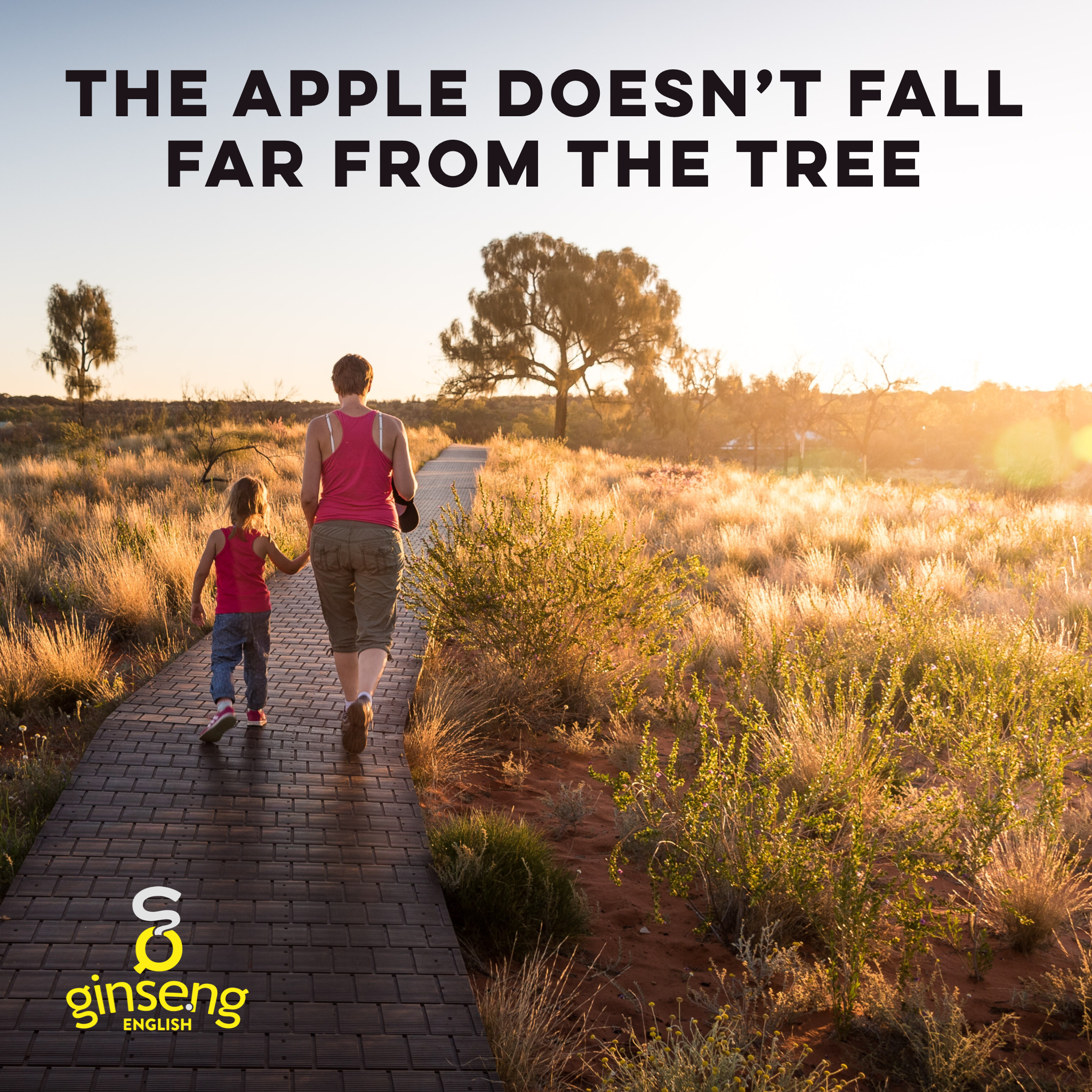
Idiomatic Fridge

Check out this blog post to learn what "going hand in hand" means!
Silent E Words
English spelling is crazy but there are patterns. Silent E words follow a very common pattern. Check out this explanation with charts and over 200 of examples.
As we have established, English pronunciation is crazy, and silent letters can sometimes seem extra crazy. Silent E isn't quite as crazy as some other words. Silent N and silent B and silent K are a little useless in English.
But silent E is different. It's a very useful pattern to learn. Unlike some other letters, silent E tells us some very important information about the other vowels in the word.
C-V-C Words
Before reading on about silent E, we really recommend reviewing consonant-vowel-consonant (C-V-C) words. This article will give you a strong background for understanding how silent E works in English.
However, if you don't have time for that, the short version is this: In 3-letter words that are made of a consonant, then a vowel, then a consonant, the vowel is usually pronounced with a short vowel sound.
Silent E Words
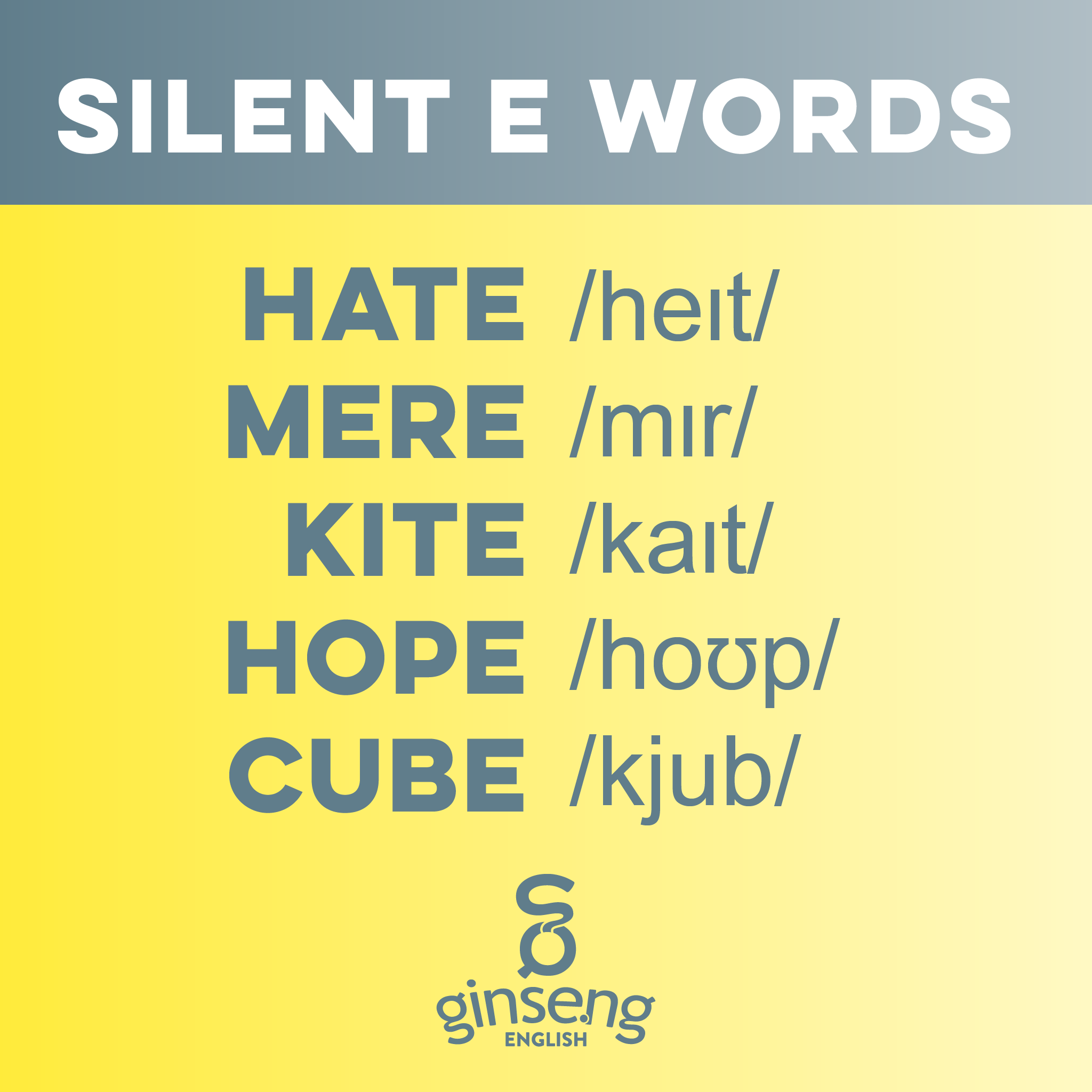
Silent E words follow the C-V-C pattern, but with an E at the end, so they become C-V-C-E words. Adding the -E at the end changes the short vowel sound to a long vowel sound.
For example:
Hat /hæt/ has a short A sound, and hate /heɪt/ has a long A sound.
Bid /bɪd/ has a short I sound, and bide /baɪd/ has a long I sound.
Hop /hɑp/ has a short O sound, and hope /hoʊp/ has a long O sound.
Adding Suffixes to Silent E Words
So when we learned about C-V-C words, we learned that you must double the last consonant. For example, rap, becomes rapped in the simple past and rapping in the present continuous. When you see an unfamiliar word with a double consonant before the suffix -ed or -ing (maybe stropped or thrumming, for example), you can safely guess that the vowel sound is short and that the base form is a C-V-C word (that is, strop and thrum).
With silent E (or C-V-C-E words), we do not double that last consonant when adding a suffix, such as -ed or -ing (or -er or -est for adjectives). Compare these examples of C-V-C and C-V-C-E words to notice the pattern:
hope ➞ hoped and hoping (no E)
hop ➞ hopped and hopping (double P)
Here's another:
pine ➞ pined and pining (no e)
pin ➞ pinned and pinning (double N)
Complete list of Silent E Words
Here are over 200 examples of silent E words:
Silent E Words with Long A
babe, bade, bake, bale, bane, bare, cage, cake, came, cane, cape, care, case cave, dale, dame, dare, date, daze, face, fade, fate, fake, fame, fare, fate, faze, gale, gape, gate, gave, gaze, hare, hate, have, haze, jade, jane, kale, lace, lake, lame, lane, late, mace, made, mage, make, male, mane, mare, mate, maze, name, nape, nave, pace, page, pale, pane, pare, pate, race, rage, rake, rape, rare, rate, rave, raze, safe, sage, sale, same, sane, sate, save, take, tale, tame, tape, tase, tare, vale, vane, vape, vase, wade, wage, wake, wane, ware, wave
Silent E Words with Long E*
cede, here, lede, meme, mere, mete, we're, we've
*see note below.
Silent E Words with Long I
bide, bike, bile, bite, cite, dice, dike, dime, dine, dire, dive, fife, file, fine, fire, hide, hike, hire, hive, jibe, jive, kite, lice, life, like, lime, line, lite, live, mice, mike, mile, mime, mine, mire, mite, nice, nine, pike, pile, pine, rice, ride, rile, ripe, side, sire, site, tide, tile, time, tine, tire, vile, vine, vise, wide, wile, wine, wipe, wire, wise, wive
Silent E Words with Long O
bode, bone, bore, code, coke, cone, cope, core, cove, dole, dope, dote, doze, fore, hole, home, hone, hope, hose, joke, lobe, lode, lone, lore, mode, mole, mope, mote, node, nope, note, poke, pole, pope, pore, robe, rode, role, rope, rose, rote, rove, sole, toke, tore, tote, vote, woke, wore, wove
Silent E Words with Long U
cube, cuke, cure, cute, dude, duke, dune, dupe, fume, huge, june, lube, luge, lure, mule, muse, mute, nude, nuke, puke, pure, rube, rude, rule, sure, tube, yule
Exceptions and notes
-ORE words do not have a long O sound. Bore, core, fore, lore, more, tore, and wore rhyme with four.
You may notice that there are very few silent E words with a long E in the middle. This is because we have many other common ways to spell the long E, such as the -EA- in dear and meal and the -EE- in seen and feet.
More Free English Resources
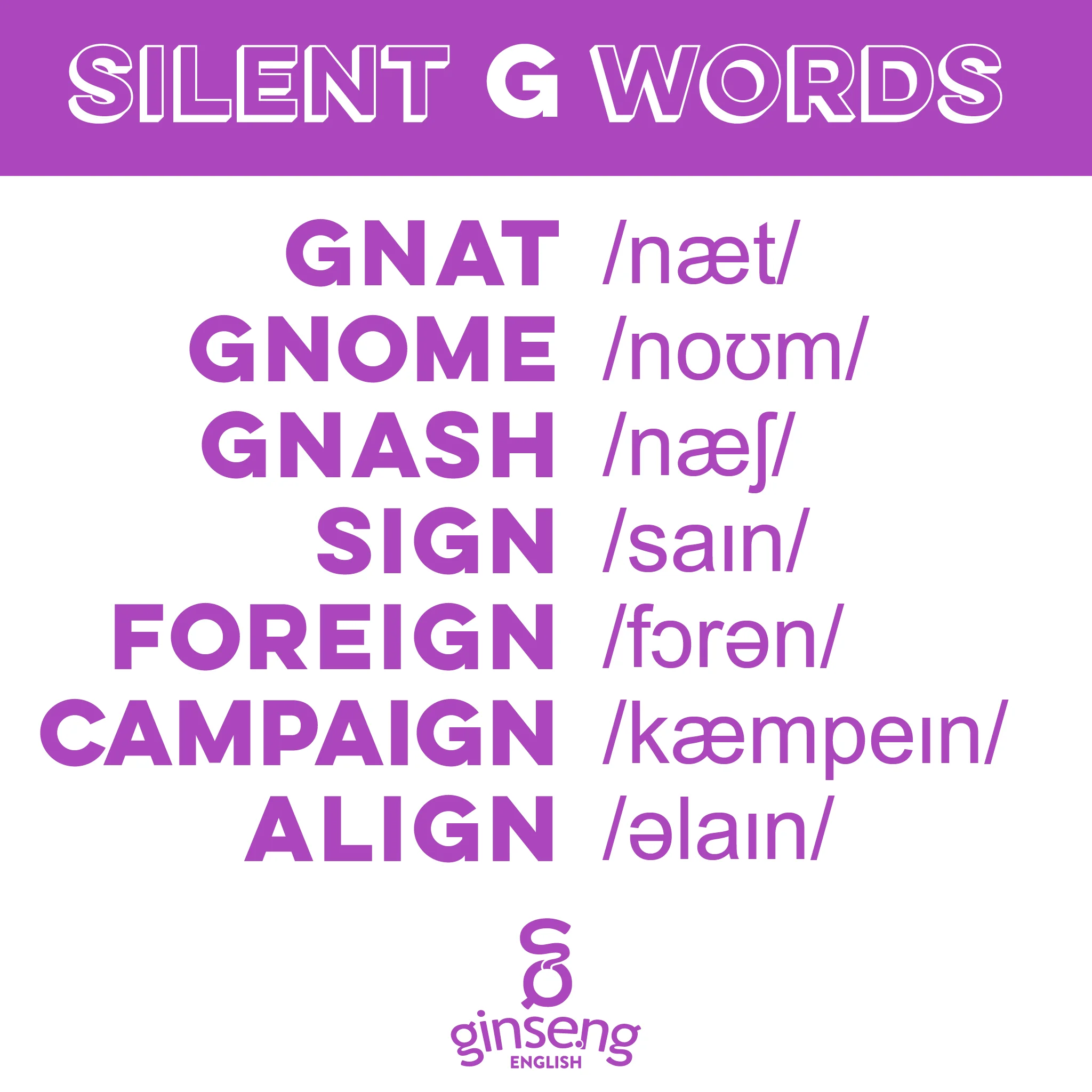
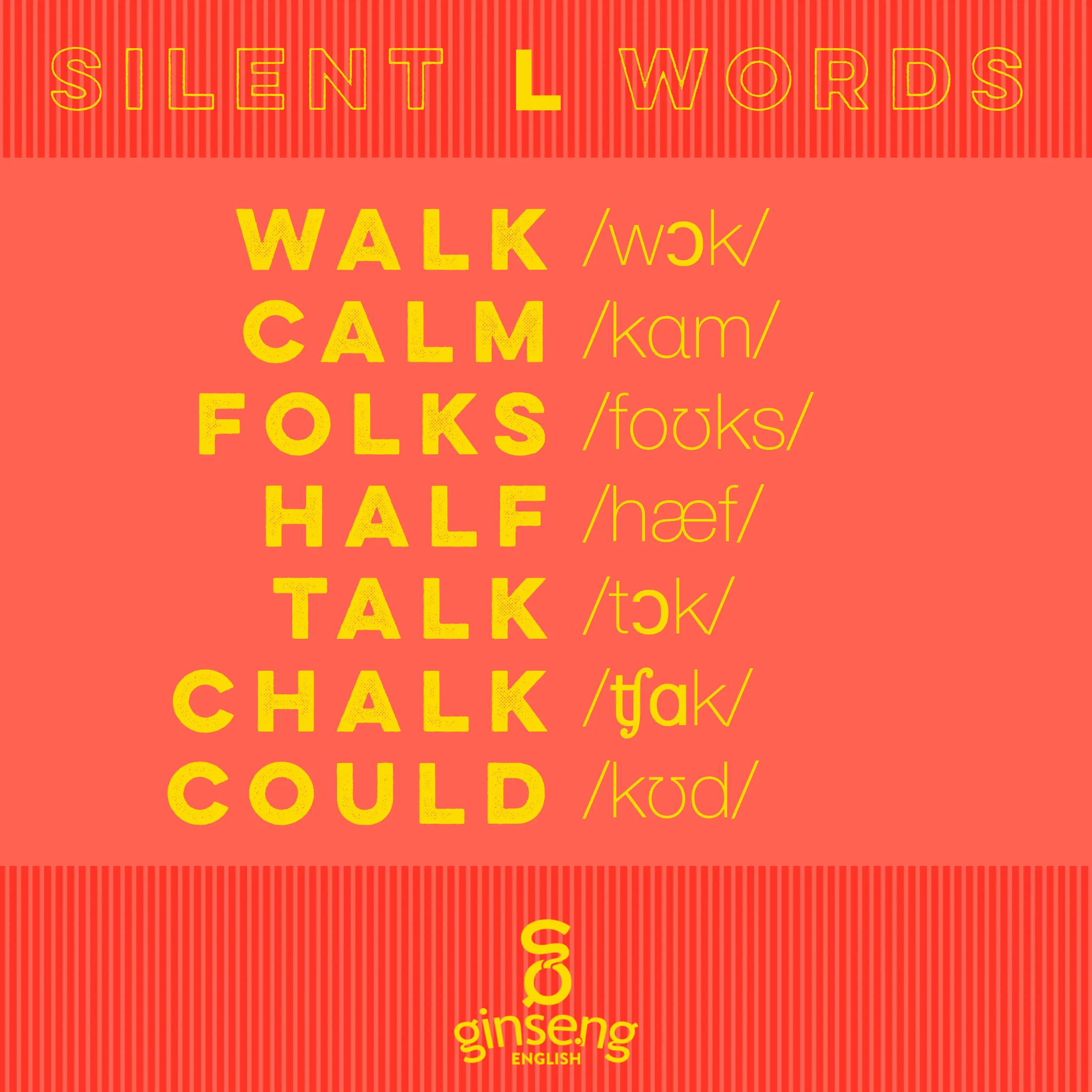
Have you read our other posts on English pronunciation? If not, take a look at Silent K, Silent N, Silent G and Silent L, and Deleted Syllables.
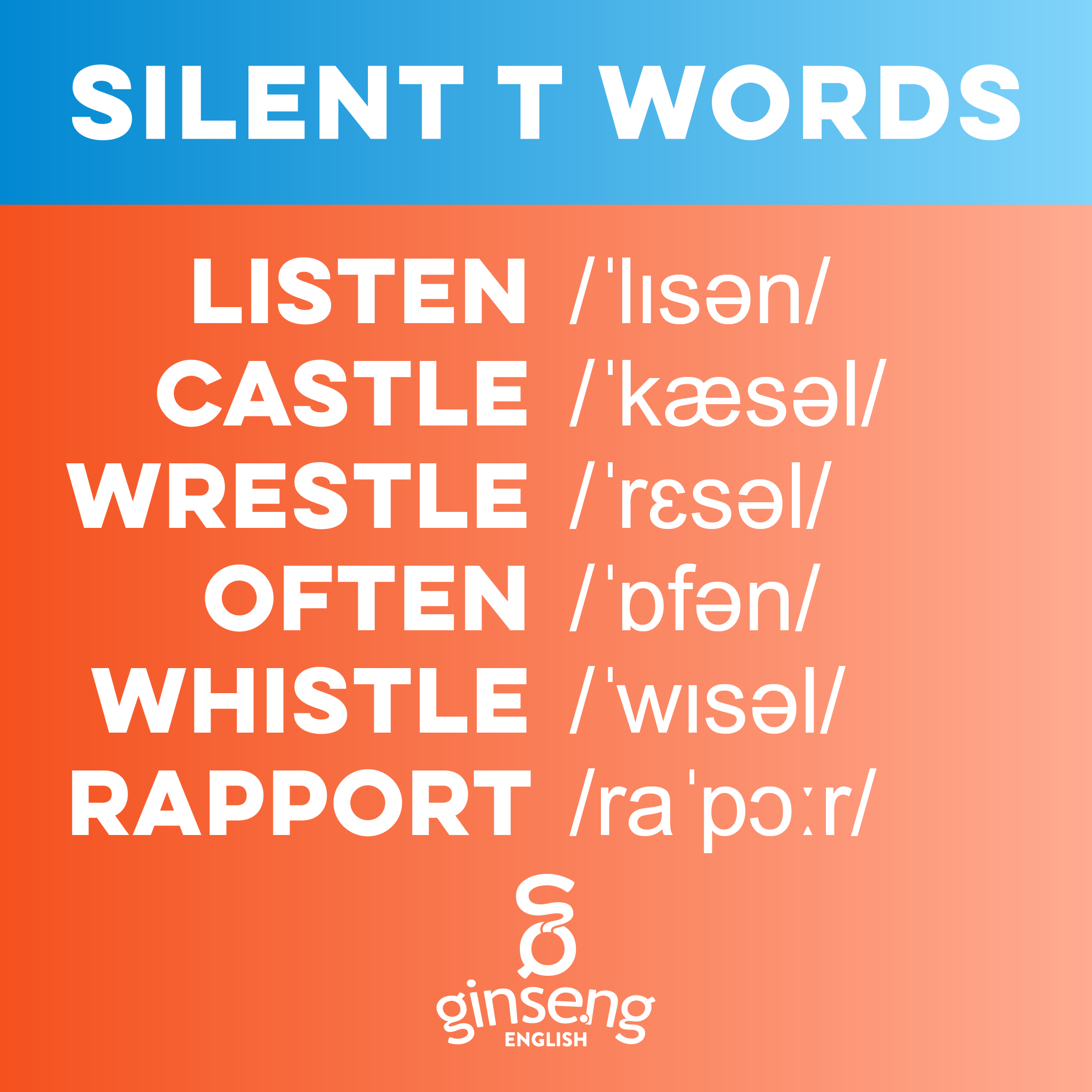

Silent E Words in English
Give, Take, Borrow, and Lend
Give, take, borrow, and lend are all extremely useful verbs in English, but the grammar can be confusing. This post teaches all four words with examples and illustrations!
Give, take, borrow, and lend are all extremely useful verbs in English. This post teaches all four words with examples and illustrations!
Give and Take
The meaning is simple. I have something, and I want you to have it so I put it in your hand. I give it to you. You take it from me.
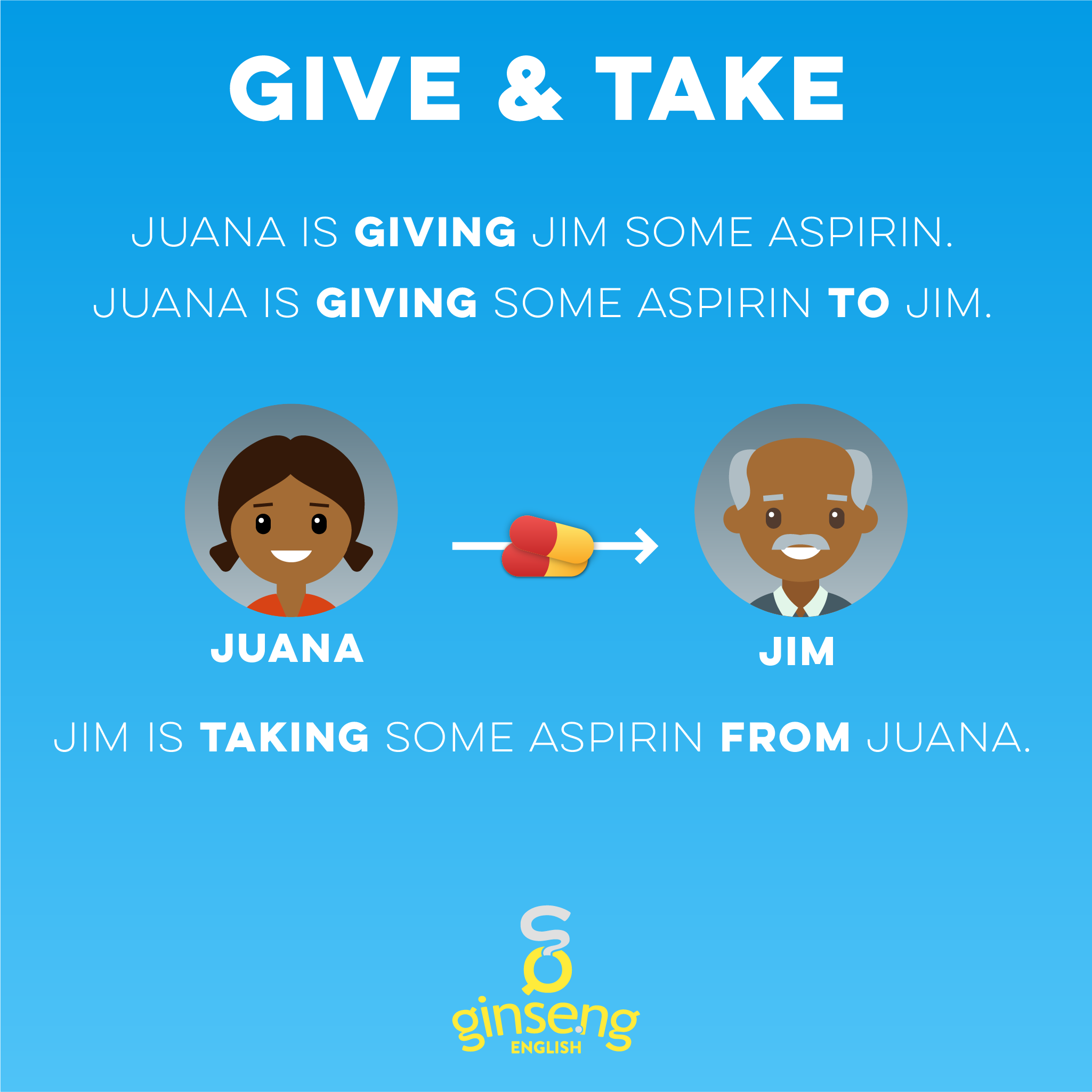
But the grammar is a little more difficult. Look at the sentences in the picture:
In the first sentence, Juana is giving Jim some aspirin. The word give is tricky because can have two objects, a person and a thing. The objects here are Jim and some aspirin. The thing that you give, aspirin, is called the direct object. The person who you give it to, the one who receives the action, is called the indirect object, is Jim.
We can put the indirect object just after the verb or at the end of the sentence, using to. Look at the two sentences:
Juana is giving Jim some aspirin.
Juana is giving some aspirin to Jim.
Take is much simpler. It doesn't really have an indirect object, but you can use the preposition from to indicate the person who is giving, like this:
Jim is taking some aspirin from Juana.
Borrow and Lend
Let's start with borrow. Borrow is like take, but when you borrow something, you give it back later. I can borrow your pencil now, and give it back to you when I am finished. There are two common ways to use borrow. The first works just like take:
Carlo is taking a pen from Kate.
Carlo is borrowing a pen from Kate.
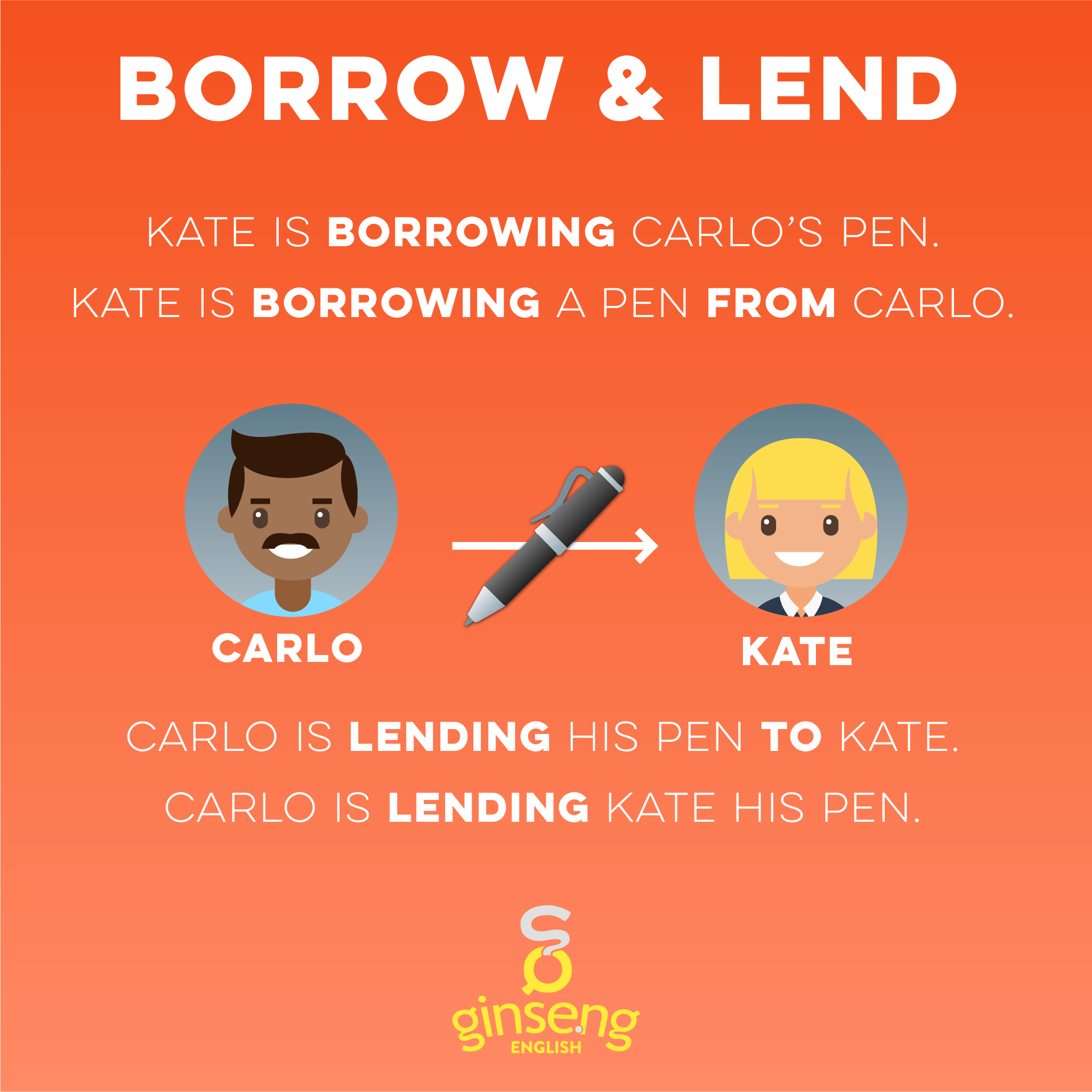
Notice the preposition from. A person borrows a thing from another person. Another way to use from is with the possessive form. The pen belongs to Kate. It is Kate's pen. So we can also simply say:
Carlo is borrowing Kate's pen.
Many people make mistakes with borrow. Many people say Please borrow me a pen. But we can not say borrow a person! The word here is lend. Similarly, lend is like give , but when you lend something, you take it back later. I can lend you my car now, and you can give it back to me tomorrow.
Carlo is giving Kate his pen.
Carlo is lending Kate his pen.
We can also move the indirect object (Kate) to the end of the sentence with both lend and give :
Carlo is giving his pen to Kate.
Carlo is lending his pen to Kate.
What you can say
In daily life, the useful sentences you may want to use are these:
May I borrow your __?
Could you lend me a __?
Can you borrow me a pen.
check out these other free grammar resources:


What is Ginseng?
Well, you already know that Ginseng is an online English school. But as we talk to more and more people around the world about Ginseng, we’ve learned that more and more people want to know about the word ginseng:
What does it mean?
How do you pronounce it?
Why is it the name of an English school!?!?
Well, ask and you shall receive. Let's get some answers to those questions!
What is Ginseng?

Ginseng Root
Ginseng is a plant! And it's a funny plant because the root—the underground part of the plant—is more famous than the flowers and leaves.
Ginseng has been used in Chinese medicine for centuries to help people relax. Some people even say it improves your memory!
The word ginseng comes from the Hokkien pronunciation (/jîn-sim/)of the Chinese word (人参) for the plant. That literally translates to person-root, because the root often has two “legs” and looks like a person.
How do You Pronounce Ginseng?
First, that G is soft. This means it sounds like an English J, as in jump. G is often—but not always—pronounced this way when it is before either an E or an I.
The first syllable sounds exactly like the word gin, a common alcohol. It also sounds like the first syllable in ginger, another root.
The last syllable sounds exactly like the English word sing. The E is pronounced like a short I sound. (Note: some people pronounce the -seng with a short E sound, but that's not what we say for Ginseng English).
The stress in the word is on the first syllable. So all together, the word ginseng is pronounced jin-sing (IPA: /ˈdʒɪn sɪŋ/).
Why did you name the school Ginseng?
Lots of reasons! Many of the best brands out there are not literal descriptions of what the company does. Think about Google, Nike, Mercedes. This was the type of brand we wanted. We didn't want to be Rob’s Online English School. We wanted something more abstract and suggestive, something evocative.

Early logo for Engma English
The first idea was Engma, the name for this symbol: ŋ. After a while, we decided that this was a little too esoteric and just didn't work for our company.
Ginseng worked better for a couple of reasons:
We first started considering this name because of its sound. It’s one of the only other words in which the letters E-N-G are pronounced /ɪŋ/ like they are in Eng-lish.
Also, ginseng has lots of positive connotations: it's relaxing and it helps your memory. These are two very important things for learning a language!
What about that logo?
Ginseng root is often made into a relaxing tea, so our logo is a steaming cup of tea to help you relax while you learn English with us! As you may have noticed, it’s also our letter G, upside-down!
More about Ginseng English


Learning English on Instagram
Learning English online isn't easy, and your best options are generally actual online classes with real teachers, but Instagram does have some great ESL sites to help you improve your English! Here's a list of our favorite accounts.

The internet is giving us all kinds of fun new ways to learn English from home. Instagram is one platform with a ton of free resources for studying. There are teachers sharing pronunciation videos, grammar charts, new vocabulary words each day.
Below we have assembled a list of the best ones you will find. We looked at accounts that are creating their own content and sharing it regularly. Some of these accounts are in English only, and some others are bilingual, but every account on the list shares content that should be useful, regardless of your first language.
Please share and let us know in the comments if there are other accounts we should add! We will update this list periodically.
Powerful English 🇧🇷
Professor Alves of Powerful English posts a strong mix of explainer videos (in Portuguese), blackboard captures of lexical chunks and illustrations, nicely designed idiom cards, and of course the occasional promotional post. It’s a relatively new account, but quality content from the very start!
English Today 🇮🇩
English Today Bandung posts a variety of content, from general study tips, to illustrated idioms and sayings, to synonyms for developing a more advanced vocabulary. And if you speak Indonesian, check out the videos from Mr. D!
Jessica Sunny side
Jessica Sunny Side intermixes photos from her daily life in Vietnam with English content shared on theme-based days, including Homophonic Monday, Idiomatic Tuesday, Phonetic Wednesday, Phrasal Friday, and Conversational Saturday.
Pronunciation with Emma
Emma is a teacher from England. Each video is very short and focused on a particular challenging word in English. She pronounces the word, shares a specific tip related to its sound, pronounces it once more, and that’s it! A bite-sized way to improve your pronunciation!
English with Benjamin
Benjamin is an English teacher with a great sense of humor and some hilarious facial expressions. He shares a lot of colloquial British phrases and idioms to help you sound like a native speaker. Benjamin clearly enjoys what he’s doing and his positive energy is contagious!
Ginseng English
We had to include our own account! We wouldn’t be doing this if we didn’t think we could produce some of the best content out there. We focus on a variety of bright, eye-catching visuals that teach and engage at the same time.
Tolya English
This is an awesome account. Tolya edits together clips from some of your favorite TV shows—Family Guy, Brooklyn 99, Friends—with his own explanation of practical English phrases that you can use in your daily life.
my little english page
Marine of My Little English Page is a teacher living in Seville, Spain. What sets her account apart is that she focuses a great deal on scheduled live broadcasts that you can tune in for! She also shares a whole lot of quizzes and conversation questions!
Andreina Baroni
Andreina Baroni shares lots of nicely designed graphics that you ought to be saving for reference! Easily confused words (like quiet, quite, quit), historical quotations, and useful phrases for particular situations!
EnglishDom 🇷🇺
Englishdom posts a bit in Russian, but there’s plenty of stuff on their for learners from any country. Their weekly word searches are a really fun way to kill some time and their series of “Other Ways to Say” will keep you from sounding like a broken record!
Easy Peasy English 🇷🇺
This one is good for Russian speakers. Easy Peasy English has a simple formula for their posts, but they do it well. Each post is a vivid photo or still from a familiar movie. Beneath that, they print the translation and phonetic pronunciation of the word.
English Words & Daily Videos 🇯🇵
Doston's well-produced videos are bilingual in English and Japanese. He has a great format. He’ll introduce a phrase and its translation, then explain it for a moment, and then give you some real-world examples, often from familiar movies.
Cambridge University Press Spain 🇪🇸
Cambridge University Press is one of the biggest names in English teaching, but their Spanish language account produces some of their best content. Clear, well-designed graphics and bilingual explanations. Don’t miss this one!
Open English 🇪🇸
Another great bilingual Spanish/English account, Open English posts tons of brightly colored, clear posts featuring high quality photography and clear explanations. One thing that makes them stand out is their emphasis on pronunciation!
Fun & Functional English
This account has a nice consistent visual theme: everything is “written” on a chalkboard, often with fun expressions from your teacher, Nataly, in the corner. Idioms, quotes, activities, and lots of writing tips!
English Worm 🇮🇷
This is a bilingual Persian/English account. Simple posts, alternating pink and blue, with English phrases, sentences, and inspirational quotations. Check them out!
safir language academy mazand 🇸🇦
Safir Language Academy’s Manzadaran branch posts some great bilingual Persian/English content! The strongest thing about this account is variety. You get book recommendations, idioms, practical phrases, inspirational quotes, all in the same place!
Engoo online English 🇨🇳
Engoo’s Taiwanese account is a great Chinese/English bilingual account to follow. Lots of clean, nicely branded content, each with a cartoon illustration and a word or phrase or quiz. A newer account, but they’re starting strong!
Oxford Reading tree korea 🇰🇷
This account has one particular type of post that they share, but it’s a good one. Their posts contain two to three sentences in English with words missing. At the bottom are words you can choose to complete the sentences. These exercises, called cloze exercises are a great way to practice your grammar!
englishism
Englishism shares a diverse selection of quotes (think everyone from Eminem to Dickens), lots of casual British English and slang, and plenty of jokes to keep you laughing while you learn!
Inglês Nativo
This is a simple, consistent account. Phrases in English translated into Portuguese, with the occasional inspirational quote thrown in to keep you motivated. All on bright gradients with nice design.
Save Me Teacher 🇧🇷
Teacher Carla with the ever-changing hair color shares all kinds of practical, funny English tips and phrases. There is a lot of focus on practical, everyday English, rather than idioms and sayings. Also check out her schedule of live classes!
Biga Amerikan Kültür 🇹🇷
The best thing about this account is their nicely designed, informative series of phrasal verbs, each translated into Turkish and accompanied by an example of the word in use. They also share photos of their students in action, a great personal touch!
Avcılar ingiliz Kültür 🇹🇷
This great account out of Turkey shares some inspirational quotes in English, plenty of phrasal verbs translated into English, and lots of fun graphics. They don’t have many followers yet, so let’s change that!
Good vibes english 🇵🇱
This bilingual Polish/English site has the usual English phrases and pronunciation tips, but they also share occasional riddles to get you thinking. Oh, and the best thing about this account? Plenty of food vocabulary!
Studying with Ginseng is easy! Click the FREE DEMO CLASS button to request your demo. Then you will get an email from one of our staff to schedule your class. Then just log in and meet your teacher! | ||
| Request Demo Class | Meet Ginseng Teacher | Schedule First Class! |
| 1 | 2 | 3 |
Confusing words: Rise, raise, and arise

Hi there! Remember me? I'm Yentelman, the blogger who's been helping Spanish students with their English (and even their Spanish!) for quite a few years now. I'm back at Ginseng English to try and teach you the differences between a trio of confusing words. As an English teacher whose mother tongue is Spanish, I am well aware which words students of English struggle with. Been there, done that myself!
Today's confusing words are three common verbs: rise, arise and raise. Look at them. Just look at them. They look like they're actually mocking you, don't they? They are like, "We’re so confusing that you'll never use us right!" Well, let's prove them wrong!

The Sun Also Rises - Ernest Hemingway
Rise

How about the cocktail of the same name? Yeah, I thought so.
Pronounced /raɪz/, its simple past is rose and past participle risen when it's working as a verb. When I try to use this one properly, I always link it to the noun sun. It's a perfect collocation, actually. You may remember it from such books as Hemingway's The Sun Also Rises. You don't? OK, what about the movie, Tequila Sunrise? No? C'mon guys, the one with Mel Gibson? Michelle Pfeiffer? An all-slicked-back Kurt Russell? OK, whatever.
Anyway, the point I am trying to make is that, if you remember rise with sun, it will be easier for you to distinguish rise from the other two verbs that are going to show up here. You can also tell the difference between rise and raise in that the former is an intransitive verb, i.e. it's not followed by a direct object. For example, keeping with the sun topic, in the sentence:
The sun rises in the east.
We can clearly see the verb rise is not followed by an object (a noun or pronoun). If you have no direct object, you need rise, not raise.
Rise can also be used to indicate that something abstract is going up, as for example in
Gas prices are rising again!

I bet it was not the only thing that rose...
This sense can convey a positive meaning when we are speaking, for instance, of moods or expectations.
My expectations rose when the pretty blonde girl at the bar looked at me.
You may have noticed that in the two examples above the meanings of rise were, respectively, "to ascend above the horizon", and "to increase in degree, intensity, or force". I'm crediting Dictionary.com for the meanings, and if you bother to look at the definitions they give of rise, you'll see there are more than 50!
So, you reaaaally need to observe each context properly when you are going to use any of the three verbs in this post. As long as you remember rise is intransitive and you pay good attention to what goes after the verb, you should be good to go. If in doubt, check a good dictionary.
I'll wrap up this section saying that rise can also be a noun. As is the case of the verb, its meaning is related to ascending or increasing. We can also use it to talk about value, prices, or temperature, as in the following example:
Sam couldn't help complaining about the rise in temperature. What did he expect of our holidays in Mount Doom?
Raise
You should be able to easily distinguish raise (/reɪz/) from rise if you just remember raise is transitive, which means it will be followed by a direct object.
The student raised his hand to answer the question.
As you can see in the example, raise is followed by the direct object, his hand. Remember you can find out whether there's a direct object after the verb in a sentence by asking the verb, "what?" What did the student raise? His hand. There you go. We have a direct object, so you need to use raise, not rise.
| Base Verb | Pronunciation | Simple Past | Perfect |
|---|---|---|---|
| rise | /raɪz/ | rose | risen |
| raise | /reɪz/ | raised | raised |
| arise | /əˈraɪz/ | arose | arisen |
Another thing you may have noticed in the above example is the verb is in the simple past, ending in -ed. This could be another hint to help you distinguish between the two confusing verbs. While rise is irregular, raise is regular and both its past and past participle end in -ed. Check out the chart for a conjugation of all three verbs.

A random worker in the USA.
Raise can be a noun, too, especially talking about salaries, as in the following example:
I hate that bastard Pete. He's been given yet another pay rise. It's his third this year, for fuck's sake!
I'd ask you to pardon my French (or my English in this case), but I always try to use real-life examples. Now I think of it, has anybody been given a pay raise in real life? Not here in Spain, that's for sure...
Arise
Last but not least, we have a third verb: arise. Everything seems to hint that there are plenty of similarities with rise: it is also intransitive, irregular (with a past and past participle forms that are very similar to those of rise: arose and arisen) and it's also pronounced similarly: /əˈraɪz/. One would say it's just rise with an a- at the beginning of the word.
And its meaning? While it's true that it can replace rise, meaning "to get up from sitting, lying, or kneeling", this usage is fairly outdated and only used in very formal contexts.
"Arise, Lord Snow!" - Said Queen Daenerys after Jon Snow had bent his knee.
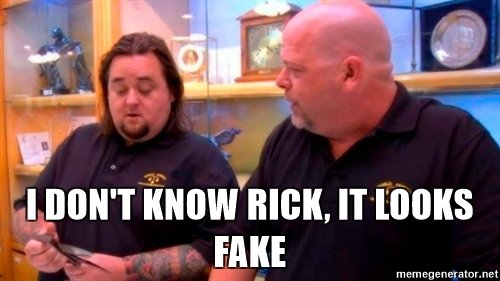
Always. Just in case.
When do we use arise, then? Mainly when we want to convey the meaning of something coming into being, originating or occurring. That "something" will usually be a problem, an occasion, a necessity, a situation or difficulty of some sort, etc. Even in this context, arise is a verb with quite an abstract meaning, indicating that something not only becomes evident but people are also aware of it happening.
The opportunity arose for Rick to purchase a 1554 Spanish shipwreck gold bar.
Exercises
Here are a couple of exercises for you to check whether, after reading this, you have a better understanding of these three verbs:
http://random-idea-english.blogspot.com.es/2010/11/confusing-words-quiz-verbs-rise-raise.html
https://www.quia.com/quiz/287248.html?AP_rand=632983826
https://www.englishclub.com/vocabulary/cw-raise-rise-quiz.htm
Contractions in English
One challenging aspect of learning English is that there are different registers: we have spoken English and written English, formal English and informal English. Some words are okay in every register, but others are only okay in speech. Some only sound right in writing.
Contractions are a big part of distinguishing between these different forms of English. If you ever go to an English-speaking university, you'll find that you can't use can't or don't or isn't in your academic writing. Let's take a look at what contractions are and how they can make your English more or less formal.
What are Contractions?
Contractions are words that combine two or more other words together into a new shortened version, usually using an apostrophe ('). Contractions are very common in spoken English. You have probably heard some of these common contractions: I'm, can't, aren't, don't, didn't.
The apostrophe is small, but important. In writing you must use the apostrophe. You do not pronounce it, but it is important in writing. Notice that the apostrophe represents some letters that are missing from the longer form of the word. For instance, the apostrophe in didn't is in place of the O in did not and the apostrophe in I'm is in the place of the A in I am.
Be careful, because not every word with an apostrophe is a contraction. Possessive nouns in English end with apostrophe -s, (Bob's house, Carla's mom) but these are not contractions.
Why Do We Have Contractions?
Contractions originate in speech. We are lazy when we speak English! When we are speaking quickly, we reduce certain sounds (make them shorter and quieter), and over time we elide them completely (we don't pronounce them at all). So over time, she will becomes she'll, I have becomes I've, going to becomes gonna.
When do we use contractions?
This question has a slightly complicated answer.
We frequently use contractions in spoken English, and you should try to use common contractions in your speech to make your English more fluent. We generally do not use any contractions in formal writing (academic papers, for examples).
In between casual speech and formal written English, there is a gray area: we have more formal spoken English, like presentations and business meetings. We have less formal writing, like emails and letters. In this case, you have more of a choice. Some people use contractions and some do not. In this gray area, we should also talk about different types of contractions!
Standard Contractions
Not all contractions are the same. Some are more standard and acceptable than others. Standard contractions include the following:
Great poem by Shel Silverstein about informal contractions
- there's
- wasn't
- we'd
- we'll
- we're
- we've
- weren't
- won't
- wouldn't
- you'd
- you'll
- you're
- he's
- how'd
- how's
- I'd
- I'm
- I've
- isn't
- let's
- she'd
- she'll
- she's
- shouldn't
- aren't
- can't
- couldn't
- didn't
- doesn't
- don't
- hadn't
- hasn't
- haven't
- he'd
- he'll
- he's
Some Standard English Contractions
You can use these in anything but formal writing. This means they are common in speech, creative writing, emails, text messages, notes, and letters. Try to pay attention when you are reading online. Are there contractions in what you are reading? If there are no contractions, you are probably reading a more formal style of writing.
Nonstandard Contractions
But there are other contractions that are nonstandard. These contractions have evolved more recently and haven't become as acceptable in written English yet. Nonstandard contractions should only be used in very informal situations (text messages with friends, for instance) or to be funny. Here are some examples:
gimme
gonna
gotta
hafta
I'd've
I'm'a
must've
there're
there've
those're
wanna
we'd've
what're
who'd've
why'd
This is not a complete list. People can often get creative and make their own contractions like these, so watch and see if you can identify new contractions!

Should You Still Say "You're Welcome"?
When we study English, one of the first things we learn is that the response to thank you is you're welcome, right? A recent article in The Huffington Post says the :you're welcome" is slowly disappearing.

When we study English, one of the first things we learn is that the response to thank you is you're welcome, right?
A recent article in The Huffington Post says the you're welcome is slowly disappearing, and phrases like no worries, no problem, of course, and sure thing are replacing it. Is it because we are becoming rude? Not according to the writer. Rather, it's that you're welcome doesn't sound humble enough. It sounds like the thanks was necessary and appropriate, like you're tooting your own horn. On the other hand, no problem downplays things, making it seem like it really was no problem.
Since it sounds like you shouldn't say you're welcome all the time anymore, here's some other phrases you can consider using! Some alternatives are "no problem," "no worries," or "you got it." Check the graphic out for more!
Are you already using any of these? Are any new to you?
Other free English Resources


Studying with Ginseng is easy! Click the FREE DEMO CLASS button to request your demo. Then you will get an email from one of our staff to schedule your class. Then just log in and meet your teacher! | ||
| Request Demo Class | Meet Ginseng Teacher | Schedule First Class! |
| 1 | 2 | 3 |
What is a Free Demo Class, Anyway?
Free Demo Class
You may have seen this button on the Ginseng homepage and wondered, what is a "free demo"? What happens if I click this button!? Is it really FREE? Are there any strings attached? What happens next? Well, let me see if I can help to answer your questions!
We think our classes are pretty great, but you can't know that this is true unless you try one out, right?! That is where a free demo class comes in.
Demo is short for demonstration, which means we are showing you something. You might go for a demo, or a test drive, at a car dealership if you're thinking about buying a car, or you could get a free demo of a new computer software that your company is considering buying.
A "demo class" at Ginseng is a short, 30 minute sample of an online class class. You get to meet one of our teachers, see some of our fancy materials, and check out the follow-up emails we'll send you.

So, what happens when I actually click that button?
When you click on this button, you will need to fill out a short form and then I will get an alert from you. But wait, who am I?! Great question.

My name is Sarah, and I work for Ginseng. It is my job to help you with pretty much anything that you need from our online English school! You can ask me anything you want about our school, and I will do my best to help you out!
When I receive your free demo request, I will e-mail you to set up a time to video chat 📹 to learn more about what you are looking for. We can talk on Skype, Google Hangouts, WeChat, WhatsApp, Facetime—you name it!
I'll ask you questions about yourself, like:
- Where are you from?
- How long you've been studying English?
- Why is learning English important to you?
- What part of English do you want to study the most?
- What time is good for you to have classes?
(It's ok if you don't know, or even if you just want to study EVERYTHING!)
It is up to you to choose what you want your free class to be about. It can be focused on just about anything English, such as pronunciation, grammar, writing and conversation! We will also talk about what times are good for your free class.
After we speak, I will talk to our team here at Ginseng and find you the best online English teacher for your educational goals, and your availability.
But wait, is it really free?
Yes! Your 30 minute demo class is completely free. If you like what you see, we would love for you to share Ginseng English with your friends, and maybe even sign up for a class or two!
Ok, Now you've got me curious...
Great! So, take a moment to click the "request demo" button and fill out the form. Soon, you'll be hearing from me! Who knows, we might even become friends!
👇🏽👇🏽👇🏽👇🏽👇🏽👇🏽👇🏽👇🏽👇🏽👇🏽👇🏽👇🏽
Studying with Ginseng is easy! Click the FREE DEMO CLASS button to request your demo. Then you will get an email from one of our staff to schedule your class. Then just log in and meet your teacher! | ||
| Request Demo Class | Meet Ginseng Teacher | Schedule First Class! |
| 1 | 2 | 3 |
If have any questions about Ginseng, e-mail me at sarah@ginse.ng
My name is Sarah and I have 8 years of experience working with international students studying in the United States, most recently at Berklee College of Music in Boston. I share your passion for adventure, and am currently traveling through Asia as part of the Ginseng English Anywhere tour!
Simple Past Tense
The simple past is a very common English verb tense used to talk about actions that happened at a specific time in the past. Read about the rules for using it, how we form it, and tons of example sentences!
The simple past (sometimes called the second verb form) is a very common verb form in English. Almost 20% of verbs in English are in this form. It is the second most common verb form, after the simple present.
Using the Simple Past
The simple past is used for actions that happened at a particular time in the past. They started and finished in the past. When you are telling a story about something that happened in the past, most main verbs will be in the simple past.
Chart for Simple Past Tense in English
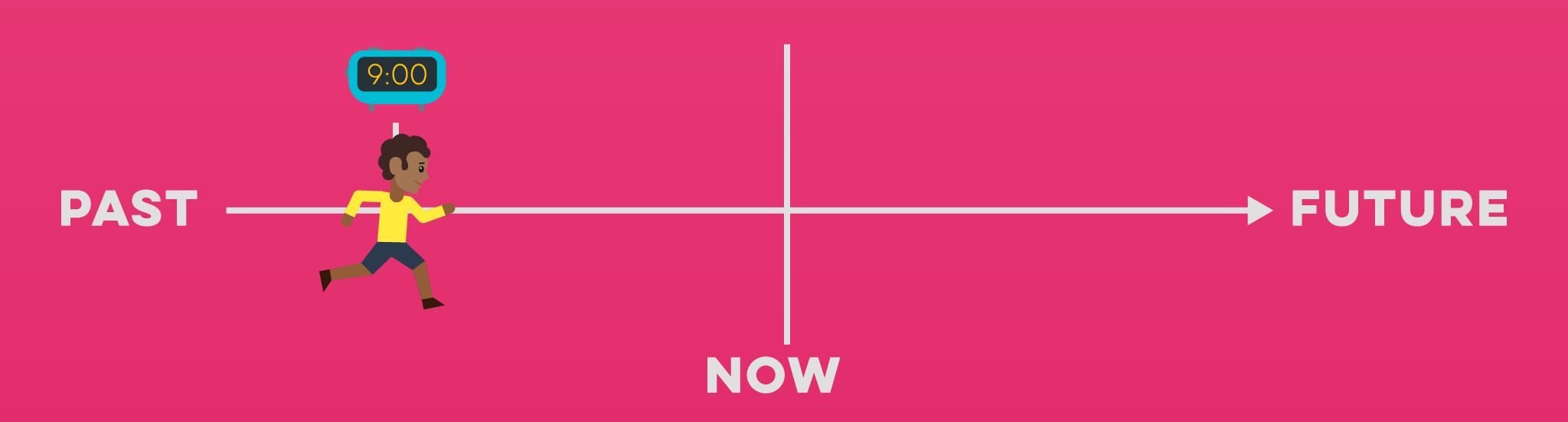
The examples below illustrate the rules we generally follow when using this verb form
Examples
Here are some examples of regular verbs in the simple past:
Magellan landed in the Philippines in 1521.
Susan cooked us an amazing dinner last night!
I wanted a puppy when I was a child.
We needed lots of money to buy the new car.
England defeated Spain in the match last night.
Here are some examples of irregular verbs in the simple past:
Last night I saw a movie.
Back in June, I went to Paris.
I had a party last weekend. All my friends came.
We lost the match by three points.
I found my t-shirt under the bed.
Forming the Simple past Tense
Formula
Regular verbs take -ed to form the simple past tense.
subject + VERBed
In some cases, this requires doubling the last consonant in the word. Irregular verbs do not follow this pattern.
When you use this verb form, you almost always need to identify a specific time in the past when the action happened. Sometimes this tense is referred to as the second verb form.
Conjugation
The table below shows the complete conjugation of the verb work in the simple past:
| Singular | Plural | |||
|---|---|---|---|---|
| 1st person | I | worked. | we | worked. |
| 2nd person | you | worked. | you | worked. |
| 3rd person | he | worked. | they | worked. |
| she | worked. | |||
| it | works. | |||
Notes
Generally, when we use the past tense, it is important that the speaker and listener know the specific time. For example, just saying I went to the movies is unusual.
Other Forms
Negative Sentences
If the verb is a form of be, make a negative sentences in the simple past, by putting not after the verb.
That was not Rebecca.
She wasn’t at school on Tuesday.
We were not excited.
If the verb is not a form of be, put did not before the main verb to make a negative.
We did not feel hungry at dinnertime.
I didn’t go to school yesterday.
They did not want to come.
Questions
Exactly like the questions in the simple present, if the simple past verb is a form of be, move the verb to before the subject to form a question.
Was that girl Rebecca?
Was that pork?
Were they angry?
Where were you?
How was the pizza?
For other verbs, add did before the subject.
Did you like the movie?
Did Claire go home?
Where did you go?
What did you make for lunch?
Passive Voice
To form the passive voice in the simple past, use the verb be in the simple past (was or were) and then the perfect form of the main verb:
The factory was built in 1909.
A new island was discovered.
See our complete guide to the passive voice in English for more details and examples.
More free english resources
The Only Letter in English that is Never Silent
We have talked a whole lot about silent letters in English here. Silent B can make you feel dumb. And that damn silent N is terrible! I don't even walk to talk about silent L, folks. Silent G makes me gnash my teeth! 😵
But, as a recent article in Reader's Digest points out, nearly every letter in the English language is silent sometimes. There is only one letter in the language that is never silent. Can you guess what it is?
The letter is V! There are various very valuable v-words, and that V is never silent!
If you're thinking, "Wait, but what about A!? What about X!?" you can check out Wikipedia's list of silent letters from A to Z. (You might notice that they do have something listed under V, but it's the name of a town in Scotland, which isn't exactly an English word in the way we generally think of things.)
More free English resources
The only letter in English that's never silent

Describing People in English
This article introduces basic vocabulary for describing people in the English language, including adjectives, words for features, and words for clothing items.. This article is appropriate for beginner and low-intermediate ESL students.
If you are studying English online by yourself, a good place to start is by learning how to describe the people around you, your friends, your family, and yourself!
In this post we introduce over 40 vocabulary words for describing people in English, along with 6 sentence frames to use them in. The first three sentence frames are basic (level A1). The other three are a little more advanced (level A2-B1). All of the vocabulary is basic (levels A1 to A2). (If you don't know what A1 and A2 and B1 and B2 mean, learn about the CEFR!)
Note: Reading this article in English will be difficult for A1 and A2 students. We will soon translate this article into many different languages!
What is a Sentence Frame?
Sentence frames are a really useful way to learn how we speak English. A sentence frame is a sentence with an empty slot that many different words can go in for many different situations. For example, if you learn the sentence frame I feel [ADJECTIVE], you can make hundreds of different sentences. All you need to do is learn a new adjective that fits in that slot: I feel hungry. I feel tired. I feel angry. I feel sick. At a basic level, sentence frames are a great way to learn English!
Frame #1 - Basic Sentences for Describing People
The first three sentence frames we will look at are simple sentences. One of the most common ways to describe people is with adjectives: tall, short, fat, skinny, pretty, handsome, ugly. To use these common adjectives in a sentence, try this frame:
The man is [ADJECTIVE].
The man is tall. The man is fat. The man is ugly. The man is in shape. These are all good sentences in English.
It is important to know that The man is another slot that you can change. The woman is tall. My friend is tall. My dad is tall. Jane is tall. She is tall. You can put any person in that slot.
Now let’s take a look at some adjectives describing people that can fit into this slot:
| Word | Pronunciation | Definition |
|---|---|---|
| tall | /tɔl/ | greater in height than the average person; not short |
| short | /ʃɔrt/ | lesser in height than the average person; not tall |
| thin | /θɪn/ | not having lots of extra flesh; not fat |
| fat | /fæt/ | having lots of extra flesh; not thin |
| old | /oʊld/ | having lived many years; not young |
| young | /jʌŋ/ | not having lived many years; not old |
| in shape | /ɪn ʃeɪp/ | healthy and physically strong |
| out of shape | /aʊt ʌv ʃeɪp/ | not healthy or physically strong |
| beautiful | /ˈbjutəfəl/ | attractive; good looking (mainly for females) |
| ugly | /ˈʌgli/ | not attractive; not good looking |
| handsome | /ˈhænsəm/ | attractive; good-looking (usually for males) |
| bald | /bɔld/ | not having hair on the top of the head |
Frame #2 - Basic Sentences Describing Features
The next basic sentence frame for describing people in English focuses on a specific feature: glasses, curly hair, black hair, blue eyes, a mustache, a ponytail. To talk about a person’s features, use this sentence:
The woman has [FEATURE].
With this sentence frame, you can make lots of different sentences:The woman has curly hair. The woman has glasses. The woman has long hair. The woman has a ponytail.
Again, you can change the person slot as well: The man has long hair. My friend has long hair. My sister has long hair. Clara has long hair.
Here are some features (nouns or nouns with adjectives) that can fit into this sentence frame:
Frame #3 - Basic Sentences Describing Clothes
The last sentence we will talk about for describing people focuses on clothes. Who doesn’t love clothes!? Black shoes! Gray pants! Blue ties! Green skirts! But let’s make complete sentences with them. Here is the sentence frame:
The woman is wearing [CLOTHES].
And here is a list of clothes that can go into this sentence:
All of these clothing items can be used with color words to be even more descriptive. The woman is wearing black shoes. The man is wearing a yellow tie.
So, those three sentence frames, combined with this vocabulary, allow you to make hundreds of different sentences to describe people. If you are a beginner, and this is mostly new information for you, you can stop here.
But, if you know most of this stuff, and you want to learn some more advanced English sentences, read on!
Complex Sentence Frames Describing People
The first three frames talked about nouns, features, and clothes, in that order, right? The next three frames will be used to talk about the same three things, but in a more complex way. All of the same vocabulary from the sections above can be used with the next three frames, in the same order.
In the first three sentence frames, the main idea of each sentence was describing people. The sentences were about describing people. The thing that I want to tell you about the man is that he is tall. But sometimes we want to describe people in a sentence about something else, and the description is not the most important idea in the sentence. For example, maybe I want to tell you that the man is my neighbor, but I also want to mention that he is tall. These next sentence frames will help in situations like that.
Frame #4 - Adjectives Before Nouns
Let’s use that example. The I want to tell you that the man is my neighbor, and I also want to describe him as tall. I can put the adjective before the noun: The tall man is my neighbor. You can also put any of the other adjectives from above into that slot.
The [ADJECTIVE] man is my neighbor.
The handsome man is my neighbor. The old man is my neighbor. The fat man is my neighbor. And again, the end of the sentence (which we call the predicate) is a slot, too, and you can put different verbs in there: The tall man likes football. The tall man is eating. The tall man has a car.
Frame #5 - Features and With
If you want to talk about someone’s features in that same sentence, we need to use the preposition with. We could say The man with glasses is my neighbor. Any of the other features can go into that same slot:
The man with [FEATURE] is my neighbor.
The man with red hair is my neighbor. The man with a mustache is my neighbor.
Frame #6 - Clothing and in
When we want to talk about clothes, we need another preposition. Instead of with, we use in. The man in the blue shirt is my neighbor. Any of the clothing vocabulary above can go into that same slot:
The man in [CLOTHES] is my neighbor.
The man in the tie is my neighbor. The man in the grey pants is my neighbor. The woman in the red hat is my neighbor.
Wrap-Up
That's it! Study these six sentence frames and the vocabulary, and you can now make hundreds of new sentences to describe people! Check back soon and we'll have a quiz to check what you have learned!
Rob Sheppard is the founder and Chief Executive Teacher at Ginseng. Over the past ten years, he has taught English in Taiwan, South Korea, and his hometown of Boston. Now he teaches online at Ginseng while traveling the world.
You can email Rob at rob@ginse.ng.