
Immediate Family
This post teaches basic English vocabulary for describing our closest family members. Lots of examples and images!
English Vocabulary - Immediate Family
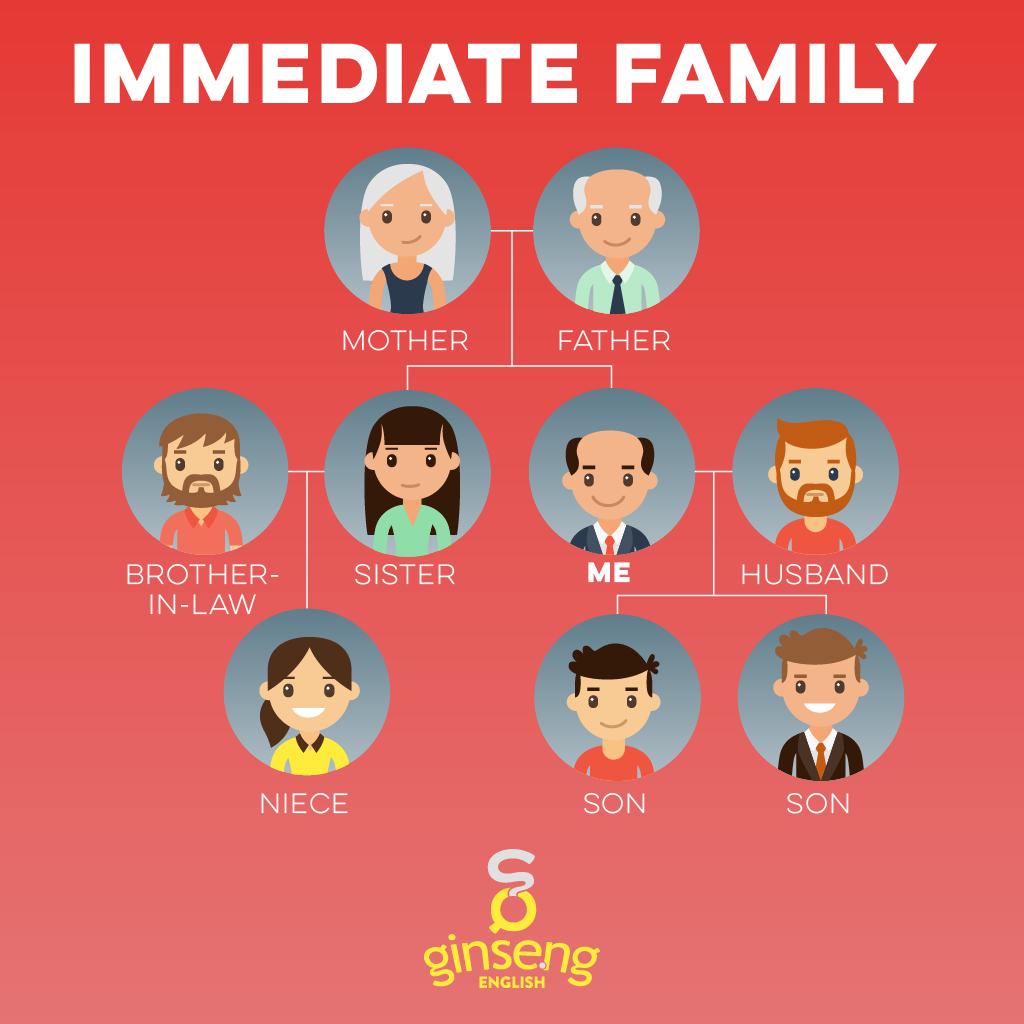
One of the most important topics in any language is family. This post will discuss vocabulary we use to talk about your immediate family. Immediate means very close in this situation. In a future post, we will talk about your bigger extended family.
Parents
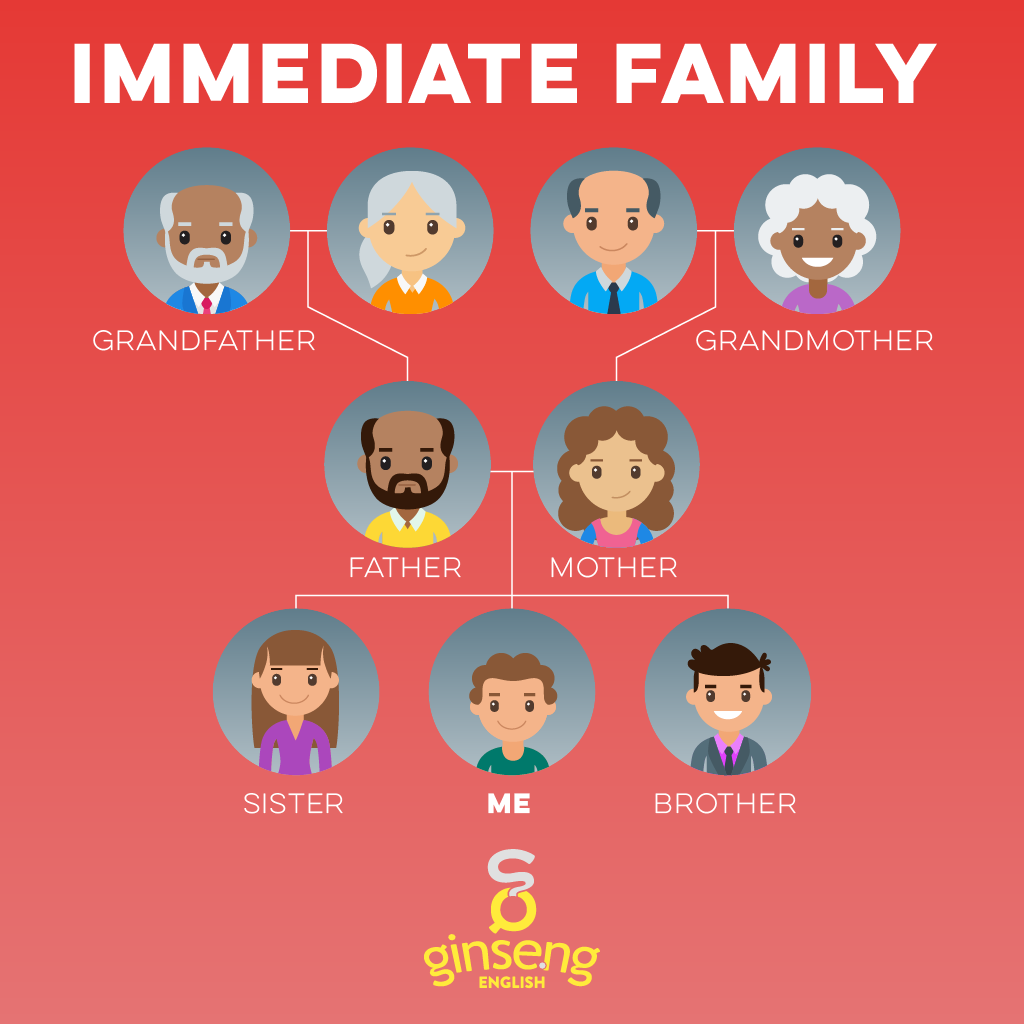
First, let’s talk about parents. Parents are the people who take care of us when we are babies. A parent who is a man is called your father. A parent who is a woman is called a mother. Some families have a mother and a father. Some families only have one father or one mother. And some families have two mothers or two fathers.
A more familiar word for father is dad. Children might say daddy. A more familiar word for mother is mom. Children sometimes say mommy.
Grandparents
Your parents’ parents are called your grandparents. Your father’s mother or your mother’s mother is called your grandmother. Your father’s father or your mother’s father is called your grandfather.
Most people have two parents and four grandparents.
Siblings
If your parents have more than one child, then you have siblings! A male sibling is called your brother. A female sibling is called your sister. If you have no siblings, then you are an only child.
In English, we cannot use the word brothers to talk about siblings of both sexes. We say siblings or brothers and sisters. You can ask someone these questions:
Do you have any brothers and sisters?
How many brothers and sisters do you have?
Do you have any siblings?
How many siblings do you have?
You can answer like this:
I have 2 brothers and 2 sisters.
I have 4 siblings.
Notice that we generally use the simple present when talking about family members.
Spouses and Partners
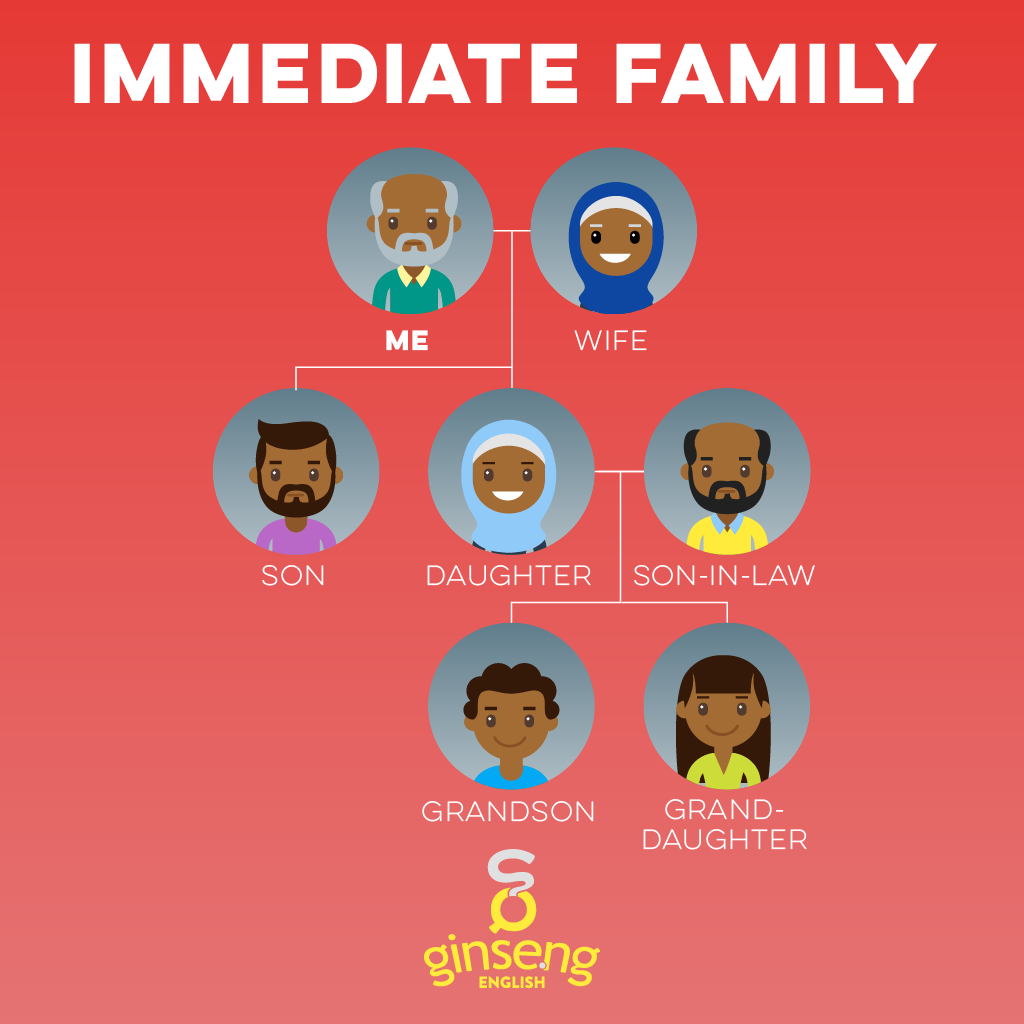
If you get married or live with a boyfriend or girlfriend, this person can be part of your immediate family, too.
If you are married to a woman, this person is called your wife. If you are married to a man, this person is called your husband. If you don’t want to mention gender, you can say spouse or partner:
All the employees and their partners are invited to joing us for dinner.
My wife is pregnant. We’re having twins.
If you are not married, but are dating someone, you can use the word boyfriend for a man, or girlfriend for a woman. It is okay to use these words when you are an adult, but some people think that the words boy and girl in them sound immature, so they prefer partner.
If you need a general word that includes husbands, wives, boyfriends, and girlfriends, then partner or significant other is the best word to use.
More Free English Vocabulary Resources


Watch Your Mouth: Hidden Brain Podcast
Podcasts are not only a great way to enjoy a car ride with friends, make a task like cleaning the kitchen more bearable, and help pass a long bus ride. They are also a great way to learn English!
Watch Your Mouth: Hidden Brain Podcast
Podcasts are not only a great way to enjoy a car ride with friends, make a task like cleaning the kitchen more bearable, and help pass a long bus ride. They are also a great way to learn English!
There are hundreds of great podcasts out there, but when we heard Hidden Brain’s podcast, Watch Your Mouth, we had to share it! This podcast is about whether the structure of languages we speak can change how we see the world, and “how the constantly evolving nature of languages can give us different ways of understanding ourselves as well as the world we live in.” The transcript of this episode is great read too!
A favorite quote from this podcast is, “If you're bilingual or you're learning a new language, you get what Jennifer experienced - the joy of discovering a phrase that helps you perfectly encapsulate a feeling or an experience. The phrase brings an entire world with it - its context, its flavor, its culture. Today, we explore the many facets of this idea. Languages are not just tools to describe the world. They are ways of seeing the world.”
We hope that you enjoy this interesting podcast! If you’re looking for more podcasts suggestions to help you learn English, FluentU has a great list to get you started.
Other FREE English Resources



Nicknames for America
Today’s post is about all the different nicknames that Americans have for their country.
Nicknames for America
Have you ever asked someone where they are from and they answered “the States,” and you wondered, huh…? What state? Where? What does that even MEAN!?
Well, that’s because Americans have many different nicknames for their country. Before you come and study in the U.S., learn more about those names. To avoid future confusion, and maybe to even sound a little more fluent, here are the most popular names for America!
And on that note, today is America’s Independence Day, so Happy July 4th everyone! 🇺🇸
The United States of America
The full, official name of the country, as it’s written on our money and government buildings
The United States
A shorter but still pretty formal way to refer to the country.
America
We often just call the country America. Some of our neighbors in the other countries of North and South America object to our claiming this name, but it’s what we say!
The U.S.
A very common way that many Americans answer the question “Where are you from?”
U.S.A.
This one isn’t so common in speech, but it’s good for when you need to be a little bit clearer. Common in signs and Olympics chants!
The States
A very common, informal abbreviation.
U.S. of A.
A little funny and artistic. We don’t say this too often, but in songs where you need to make U.S.A. into four syllables, this does the trick!
The Land of Opportunity
An old nickname for the U.S. Still true?
The Melting Pot
This nickname refers to the fact that America is a land of immigrants who come together to produce a new culture. Recently, its been proposed that perhaps a stew is a better metaphor, showing that people don’t just “melt” and assimilate, but retain the beautiful aspects of their home culture.
‘Murica
This is a funny one, mimicking the lazy pronunciation you might hear from some hillbillies or rednecks. Often used to make fun of overly patriotic people.
Other English Resources
Give, Take, Borrow, and Lend
Give, take, borrow, and lend are all extremely useful verbs in English, but the grammar can be confusing. This post teaches all four words with examples and illustrations!
Give, take, borrow, and lend are all extremely useful verbs in English. This post teaches all four words with examples and illustrations!
Give and Take
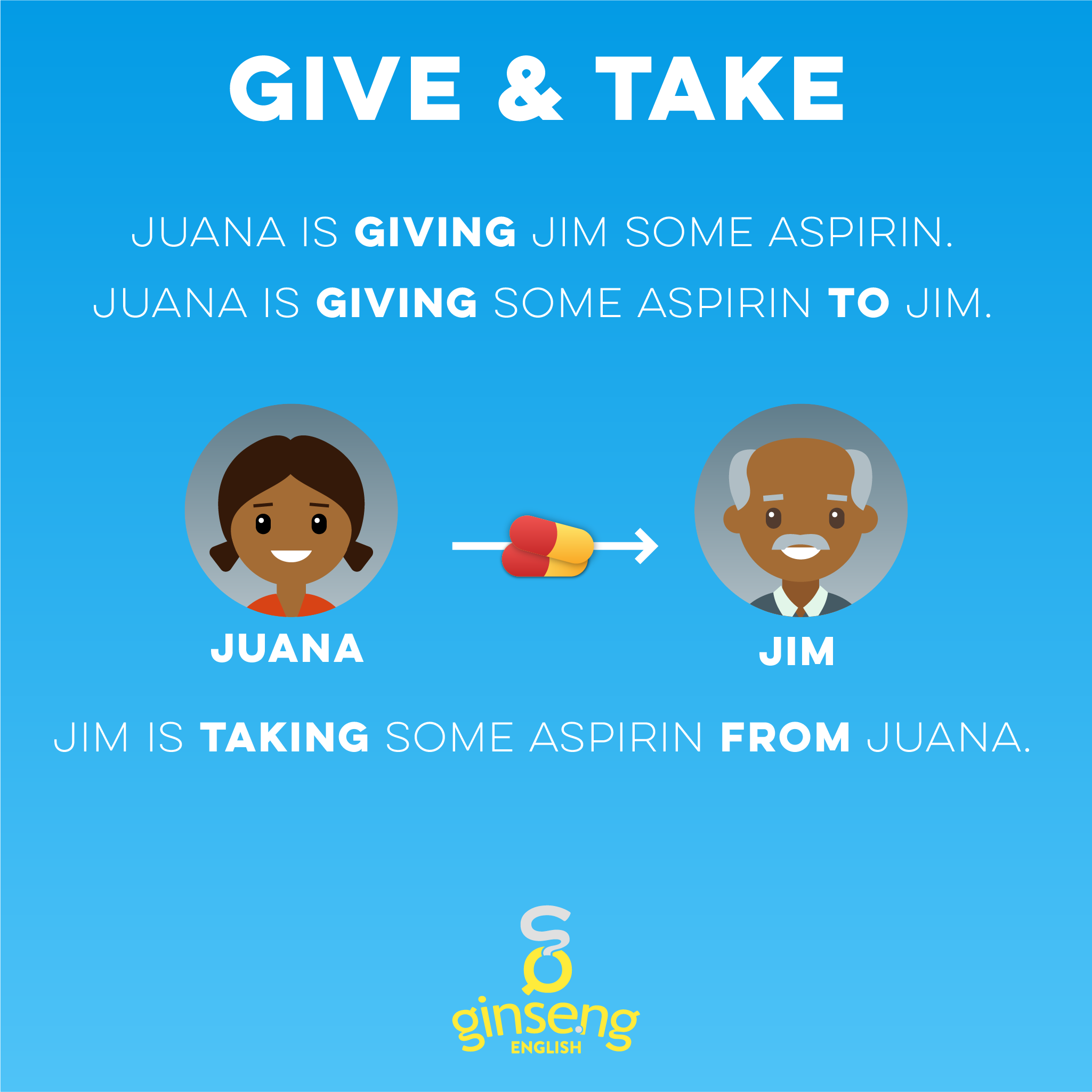
The meaning is simple. I have something, and I want you to have it so I put it in your hand. I give it to you. You take it from me.
But the grammar is a little more difficult. Look at the sentences in the picture:
In the first sentence, Juana is giving Jim some aspirin. The word give is tricky because can have two objects, a person and a thing. The objects here are Jim and some aspirin. The thing that you give, aspirin, is called the direct object. The person who you give it to, the one who receives the action, is called the indirect object, is Jim.
We can put the indirect object just after the verb or at the end of the sentence, using to. Look at the two sentences:
Juana is giving Jim some aspirin.
Juana is giving some aspirin to Jim.
Take is much simpler. It doesn't really have an indirect object, but you can use the preposition from to indicate the person who is giving, like this:
Jim is taking some aspirin from Juana.
Borrow and Lend
Let's start with borrow. Borrow is like take, but when you borrow something, you give it back later. I can borrow your pencil now, and give it back to you when I am finished. There are two common ways to use borrow. The first works just like take:
Carlo is taking a pen from Kate.
Carlo is borrowing a pen from Kate.
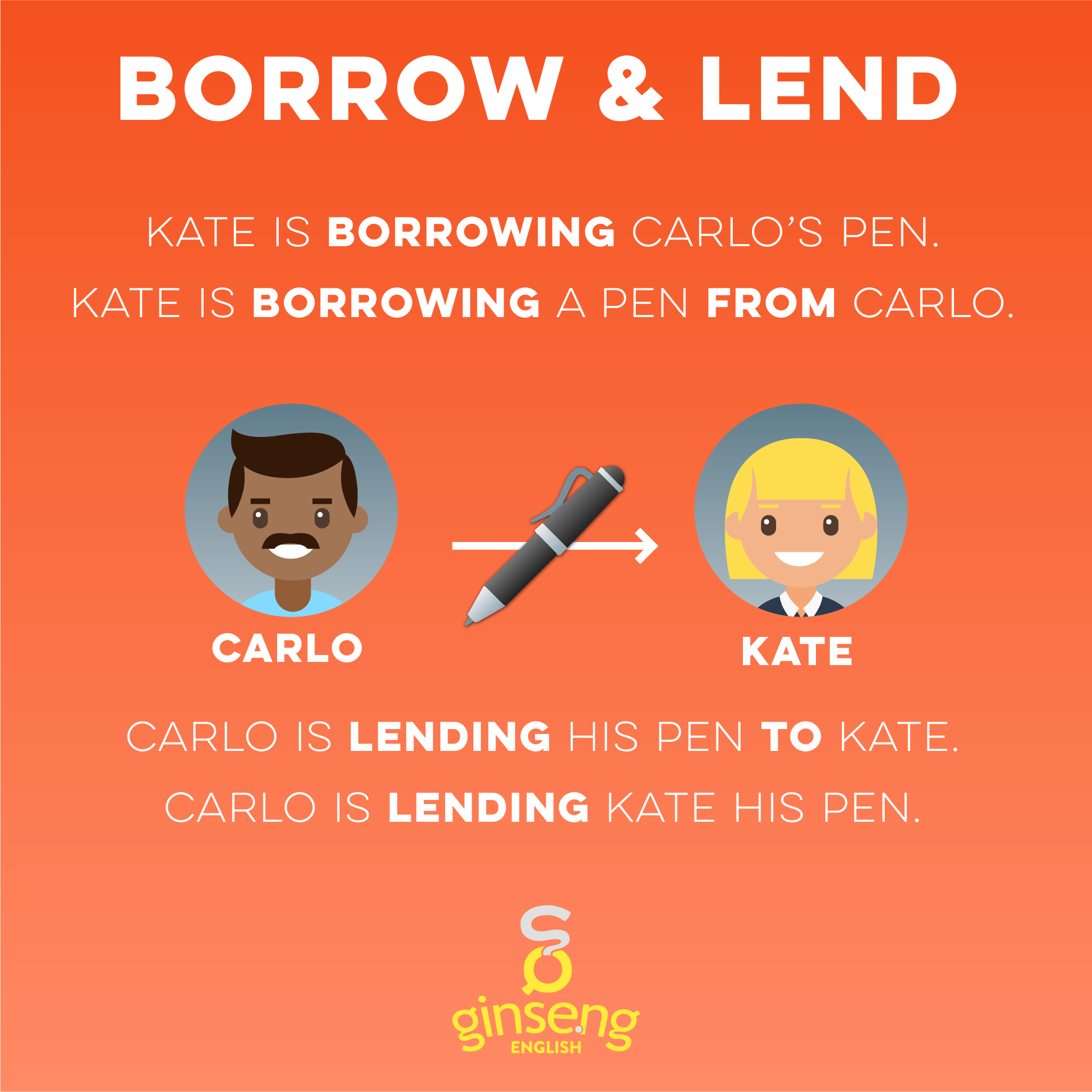
Notice the preposition from. A person borrows a thing from another person. Another way to use from is with the possessive form. The pen belongs to Kate. It is Kate's pen. So we can also simply say:
Carlo is borrowing Kate's pen.
Many people make mistakes with borrow. Many people say Please borrow me a pen. But we can not say borrow a person! The word here is lend. Similarly, lend is like give , but when you lend something, you take it back later. I can lend you my car now, and you can give it back to me tomorrow.
Carlo is giving Kate his pen.
Carlo is lending Kate his pen.
We can also move the indirect object (Kate) to the end of the sentence with both lend and give :
Carlo is giving his pen to Kate.
Carlo is lending his pen to Kate.
What you can say
In daily life, the useful sentences you may want to use are these:
May I borrow your __?
Could you lend me a __?
Can you borrow me a pen.
check out these other free grammar resources:


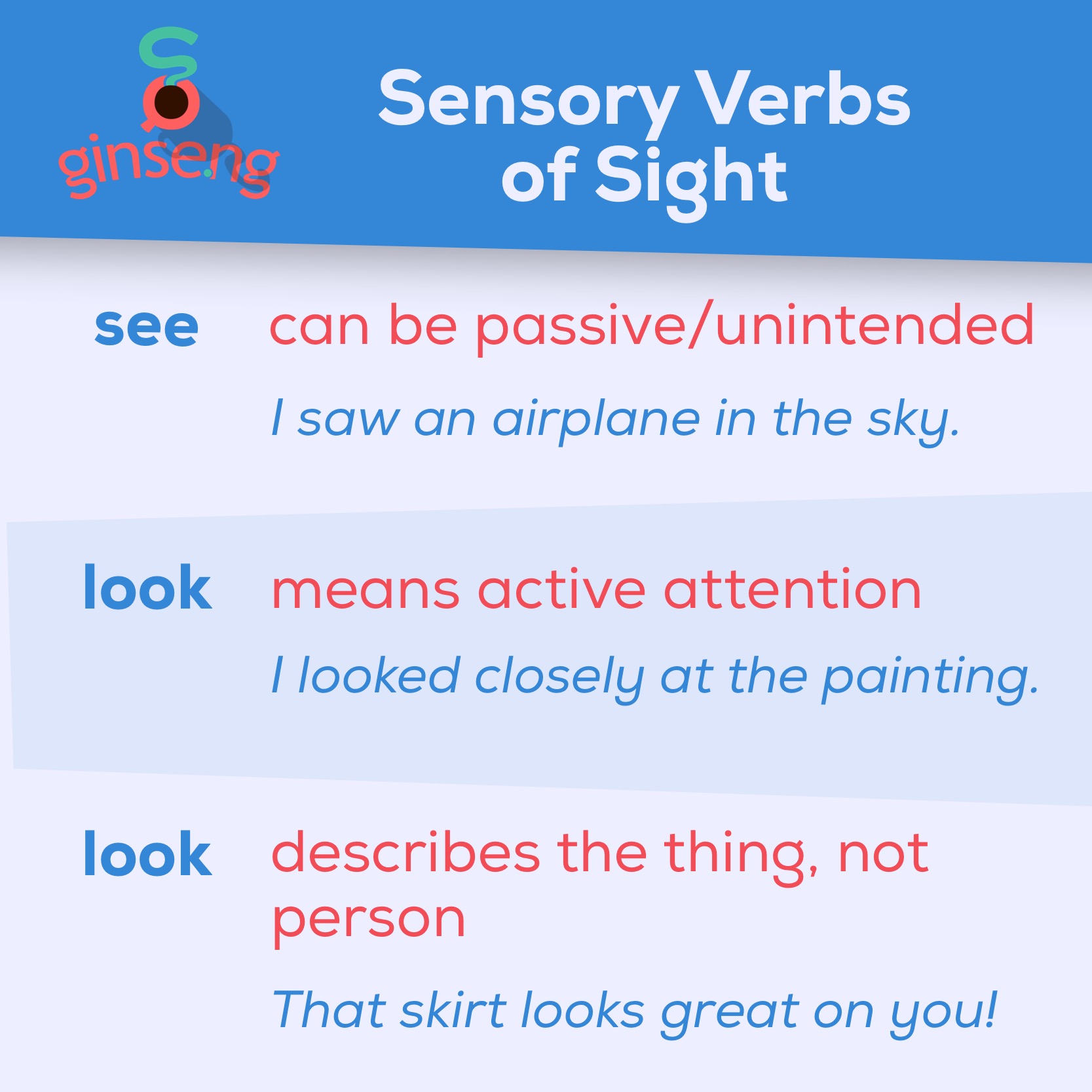
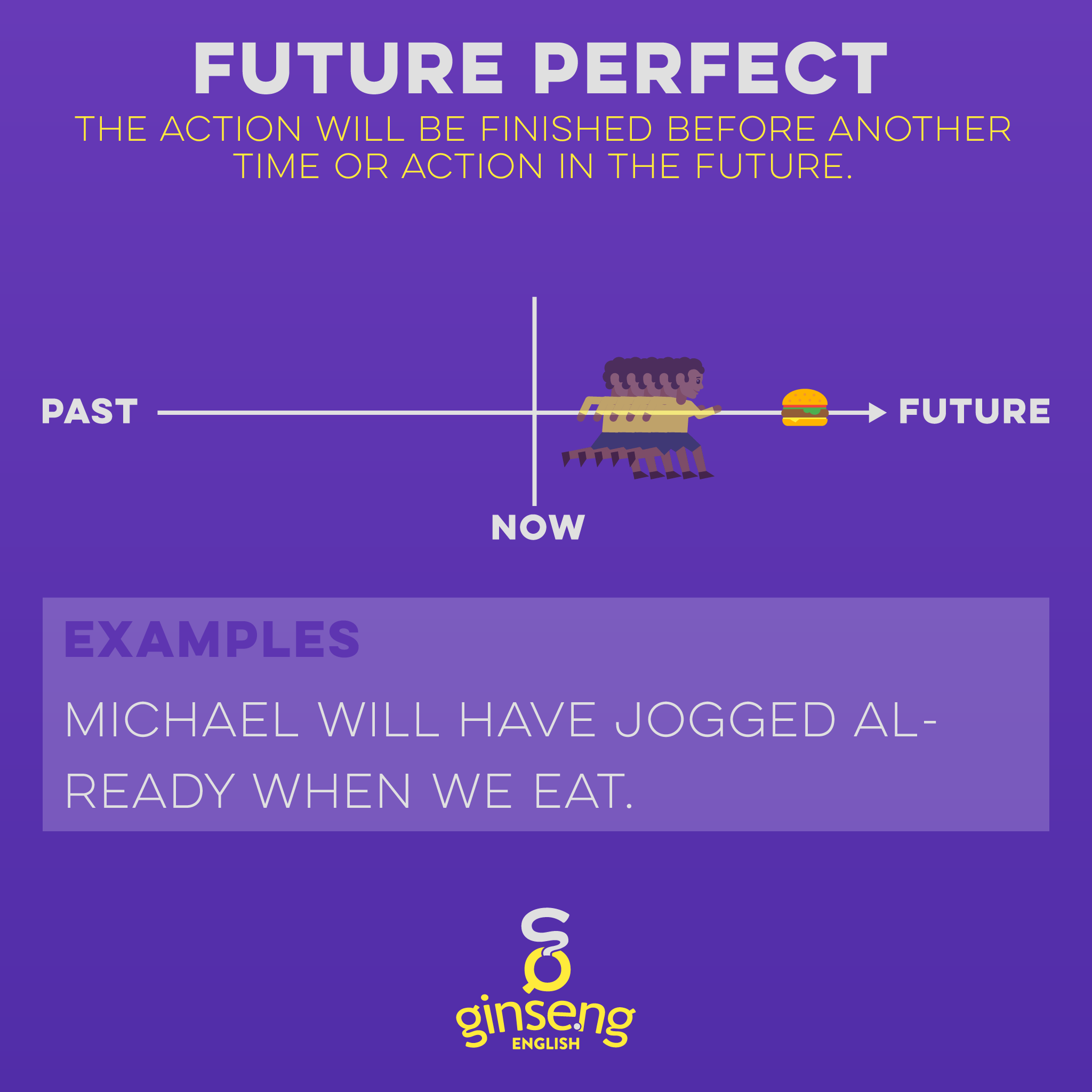
Learning English on Instagram
Learning English online isn't easy, and your best options are generally actual online classes with real teachers, but Instagram does have some great ESL sites to help you improve your English! Here's a list of our favorite accounts.
The internet is giving us all kinds of fun new ways to learn English from home. Instagram is one platform with a ton of free resources for studying. There are teachers sharing pronunciation videos, grammar charts, new vocabulary words each day.
Below we have assembled a list of the best ones you will find. We looked at accounts that are creating their own content and sharing it regularly. Some of these accounts are in English only, and some others are bilingual, but every account on the list shares content that should be useful, regardless of your first language.
Please share and let us know in the comments if there are other accounts we should add! We will update this list periodically.
Powerful English 🇧🇷
Professor Alves of Powerful English posts a strong mix of explainer videos (in Portuguese), blackboard captures of lexical chunks and illustrations, nicely designed idiom cards, and of course the occasional promotional post. It’s a relatively new account, but quality content from the very start!
English Today 🇮🇩
English Today Bandung posts a variety of content, from general study tips, to illustrated idioms and sayings, to synonyms for developing a more advanced vocabulary. And if you speak Indonesian, check out the videos from Mr. D!
Jessica Sunny side
Jessica Sunny Side intermixes photos from her daily life in Vietnam with English content shared on theme-based days, including Homophonic Monday, Idiomatic Tuesday, Phonetic Wednesday, Phrasal Friday, and Conversational Saturday.
Pronunciation with Emma
Emma is a teacher from England. Each video is very short and focused on a particular challenging word in English. She pronounces the word, shares a specific tip related to its sound, pronounces it once more, and that’s it! A bite-sized way to improve your pronunciation!
English with Benjamin
Benjamin is an English teacher with a great sense of humor and some hilarious facial expressions. He shares a lot of colloquial British phrases and idioms to help you sound like a native speaker. Benjamin clearly enjoys what he’s doing and his positive energy is contagious!
Ginseng English
We had to include our own account! We wouldn’t be doing this if we didn’t think we could produce some of the best content out there. We focus on a variety of bright, eye-catching visuals that teach and engage at the same time.
Tolya English
This is an awesome account. Tolya edits together clips from some of your favorite TV shows—Family Guy, Brooklyn 99, Friends—with his own explanation of practical English phrases that you can use in your daily life.
my little english page
Marine of My Little English Page is a teacher living in Seville, Spain. What sets her account apart is that she focuses a great deal on scheduled live broadcasts that you can tune in for! She also shares a whole lot of quizzes and conversation questions!
Andreina Baroni
Andreina Baroni shares lots of nicely designed graphics that you ought to be saving for reference! Easily confused words (like quiet, quite, quit), historical quotations, and useful phrases for particular situations!
EnglishDom 🇷🇺
Englishdom posts a bit in Russian, but there’s plenty of stuff on their for learners from any country. Their weekly word searches are a really fun way to kill some time and their series of “Other Ways to Say” will keep you from sounding like a broken record!
Easy Peasy English 🇷🇺
This one is good for Russian speakers. Easy Peasy English has a simple formula for their posts, but they do it well. Each post is a vivid photo or still from a familiar movie. Beneath that, they print the translation and phonetic pronunciation of the word.
English Words & Daily Videos 🇯🇵
Doston's well-produced videos are bilingual in English and Japanese. He has a great format. He’ll introduce a phrase and its translation, then explain it for a moment, and then give you some real-world examples, often from familiar movies.
Cambridge University Press Spain 🇪🇸
Cambridge University Press is one of the biggest names in English teaching, but their Spanish language account produces some of their best content. Clear, well-designed graphics and bilingual explanations. Don’t miss this one!
Open English 🇪🇸
Another great bilingual Spanish/English account, Open English posts tons of brightly colored, clear posts featuring high quality photography and clear explanations. One thing that makes them stand out is their emphasis on pronunciation!
Fun & Functional English
This account has a nice consistent visual theme: everything is “written” on a chalkboard, often with fun expressions from your teacher, Nataly, in the corner. Idioms, quotes, activities, and lots of writing tips!
English Worm 🇮🇷
This is a bilingual Persian/English account. Simple posts, alternating pink and blue, with English phrases, sentences, and inspirational quotations. Check them out!
safir language academy mazand 🇸🇦
Safir Language Academy’s Manzadaran branch posts some great bilingual Persian/English content! The strongest thing about this account is variety. You get book recommendations, idioms, practical phrases, inspirational quotes, all in the same place!
Engoo online English 🇨🇳
Engoo’s Taiwanese account is a great Chinese/English bilingual account to follow. Lots of clean, nicely branded content, each with a cartoon illustration and a word or phrase or quiz. A newer account, but they’re starting strong!
Oxford Reading tree korea 🇰🇷
This account has one particular type of post that they share, but it’s a good one. Their posts contain two to three sentences in English with words missing. At the bottom are words you can choose to complete the sentences. These exercises, called cloze exercises are a great way to practice your grammar!
englishism
Englishism shares a diverse selection of quotes (think everyone from Eminem to Dickens), lots of casual British English and slang, and plenty of jokes to keep you laughing while you learn!
Inglês Nativo
This is a simple, consistent account. Phrases in English translated into Portuguese, with the occasional inspirational quote thrown in to keep you motivated. All on bright gradients with nice design.
Save Me Teacher 🇧🇷
Teacher Carla with the ever-changing hair color shares all kinds of practical, funny English tips and phrases. There is a lot of focus on practical, everyday English, rather than idioms and sayings. Also check out her schedule of live classes!
Biga Amerikan Kültür 🇹🇷
The best thing about this account is their nicely designed, informative series of phrasal verbs, each translated into Turkish and accompanied by an example of the word in use. They also share photos of their students in action, a great personal touch!
Avcılar ingiliz Kültür 🇹🇷
This great account out of Turkey shares some inspirational quotes in English, plenty of phrasal verbs translated into English, and lots of fun graphics. They don’t have many followers yet, so let’s change that!
Good vibes english 🇵🇱
This bilingual Polish/English site has the usual English phrases and pronunciation tips, but they also share occasional riddles to get you thinking. Oh, and the best thing about this account? Plenty of food vocabulary!
Studying with Ginseng is easy! Click the FREE DEMO CLASS button to request your demo. Then you will get an email from one of our staff to schedule your class. Then just log in and meet your teacher! | ||
| Request Demo Class | Meet Ginseng Teacher | Schedule First Class! |
| 1 | 2 | 3 |
Should You Still Say "You're Welcome"?
When we study English, one of the first things we learn is that the response to thank you is you're welcome, right? A recent article in The Huffington Post says the :you're welcome" is slowly disappearing.

When we study English, one of the first things we learn is that the response to thank you is you're welcome, right?
A recent article in The Huffington Post says the you're welcome is slowly disappearing, and phrases like no worries, no problem, of course, and sure thing are replacing it. Is it because we are becoming rude? Not according to the writer. Rather, it's that you're welcome doesn't sound humble enough. It sounds like the thanks was necessary and appropriate, like you're tooting your own horn. On the other hand, no problem downplays things, making it seem like it really was no problem.
Since it sounds like you shouldn't say you're welcome all the time anymore, here's some other phrases you can consider using! Some alternatives are "no problem," "no worries," or "you got it." Check the graphic out for more!
Are you already using any of these? Are any new to you?
Other free English Resources
Studying with Ginseng is easy! Click the FREE DEMO CLASS button to request your demo. Then you will get an email from one of our staff to schedule your class. Then just log in and meet your teacher! | ||
| Request Demo Class | Meet Ginseng Teacher | Schedule First Class! |
| 1 | 2 | 3 |
What is a Free Demo Class, Anyway?
Free Demo Class
You may have seen this button on the Ginseng homepage and wondered, what is a "free demo"? What happens if I click this button!? Is it really FREE? Are there any strings attached? What happens next? Well, let me see if I can help to answer your questions!
We think our classes are pretty great, but you can't know that this is true unless you try one out, right?! That is where a free demo class comes in.
Demo is short for demonstration, which means we are showing you something. You might go for a demo, or a test drive, at a car dealership if you're thinking about buying a car, or you could get a free demo of a new computer software that your company is considering buying.
A "demo class" at Ginseng is a short, 30 minute sample of an online class class. You get to meet one of our teachers, see some of our fancy materials, and check out the follow-up emails we'll send you.

So, what happens when I actually click that button?
When you click on this button, you will need to fill out a short form and then I will get an alert from you. But wait, who am I?! Great question.
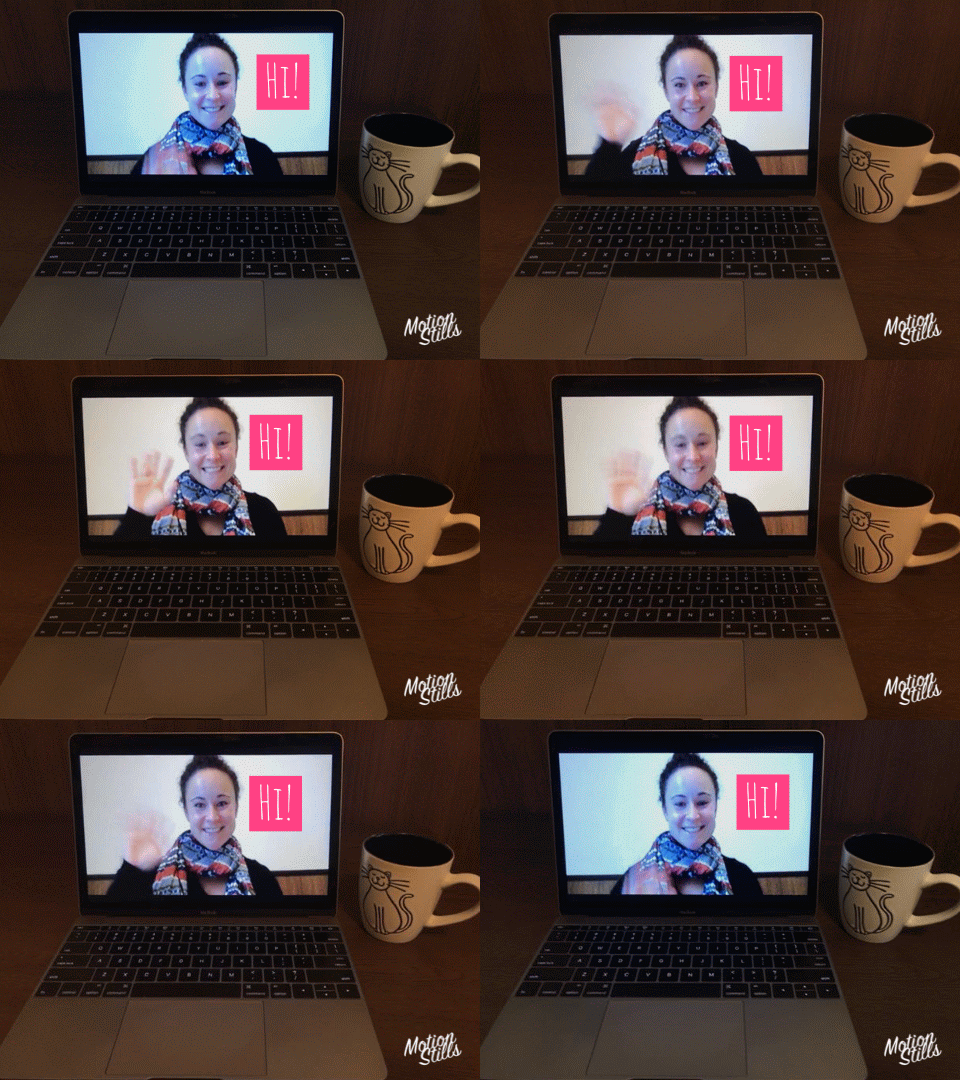
My name is Sarah, and I work for Ginseng. It is my job to help you with pretty much anything that you need from our online English school! You can ask me anything you want about our school, and I will do my best to help you out!
When I receive your free demo request, I will e-mail you to set up a time to video chat 📹 to learn more about what you are looking for. We can talk on Skype, Google Hangouts, WeChat, WhatsApp, Facetime—you name it!
I'll ask you questions about yourself, like:
- Where are you from?
- How long you've been studying English?
- Why is learning English important to you?
- What part of English do you want to study the most?
- What time is good for you to have classes?
(It's ok if you don't know, or even if you just want to study EVERYTHING!)
It is up to you to choose what you want your free class to be about. It can be focused on just about anything English, such as pronunciation, grammar, writing and conversation! We will also talk about what times are good for your free class.
After we speak, I will talk to our team here at Ginseng and find you the best online English teacher for your educational goals, and your availability.
But wait, is it really free?
Yes! Your 30 minute demo class is completely free. If you like what you see, we would love for you to share Ginseng English with your friends, and maybe even sign up for a class or two!
Ok, Now you've got me curious...
Great! So, take a moment to click the "request demo" button and fill out the form. Soon, you'll be hearing from me! Who knows, we might even become friends!
👇🏽👇🏽👇🏽👇🏽👇🏽👇🏽👇🏽👇🏽👇🏽👇🏽👇🏽👇🏽
Studying with Ginseng is easy! Click the FREE DEMO CLASS button to request your demo. Then you will get an email from one of our staff to schedule your class. Then just log in and meet your teacher! | ||
| Request Demo Class | Meet Ginseng Teacher | Schedule First Class! |
| 1 | 2 | 3 |

If have any questions about Ginseng, e-mail me at sarah@ginse.ng
My name is Sarah and I have 8 years of experience working with international students studying in the United States, most recently at Berklee College of Music in Boston. I share your passion for adventure, and am currently traveling through Asia as part of the Ginseng English Anywhere tour!

Describing People in English
This article introduces basic vocabulary for describing people in the English language, including adjectives, words for features, and words for clothing items.. This article is appropriate for beginner and low-intermediate ESL students.
If you are studying English online by yourself, a good place to start is by learning how to describe the people around you, your friends, your family, and yourself!
In this post we introduce over 40 vocabulary words for describing people in English, along with 6 sentence frames to use them in. The first three sentence frames are basic (level A1). The other three are a little more advanced (level A2-B1). All of the vocabulary is basic (levels A1 to A2). (If you don't know what A1 and A2 and B1 and B2 mean, learn about the CEFR!)
Note: Reading this article in English will be difficult for A1 and A2 students. We will soon translate this article into many different languages!
What is a Sentence Frame?
Sentence frames are a really useful way to learn how we speak English. A sentence frame is a sentence with an empty slot that many different words can go in for many different situations. For example, if you learn the sentence frame I feel [ADJECTIVE], you can make hundreds of different sentences. All you need to do is learn a new adjective that fits in that slot: I feel hungry. I feel tired. I feel angry. I feel sick. At a basic level, sentence frames are a great way to learn English!
Frame #1 - Basic Sentences for Describing People
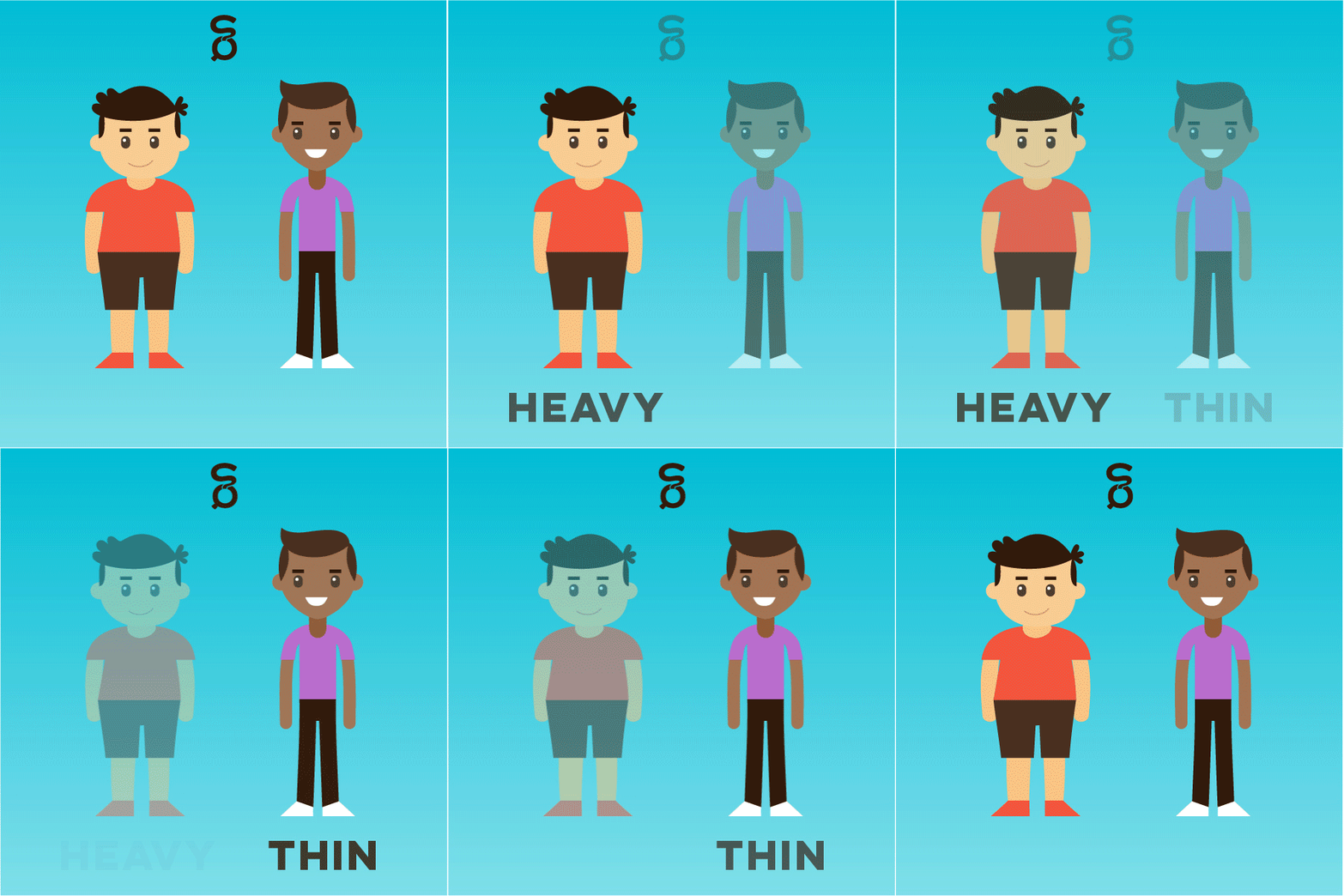
The first three sentence frames we will look at are simple sentences. One of the most common ways to describe people is with adjectives: tall, short, fat, skinny, pretty, handsome, ugly. To use these common adjectives in a sentence, try this frame:
The man is [ADJECTIVE].
The man is tall. The man is fat. The man is ugly. The man is in shape. These are all good sentences in English.
It is important to know that The man is another slot that you can change. The woman is tall. My friend is tall. My dad is tall. Jane is tall. She is tall. You can put any person in that slot.
Now let’s take a look at some adjectives describing people that can fit into this slot:
| Word | Pronunciation | Definition |
|---|---|---|
| tall | /tɔl/ | greater in height than the average person; not short |
| short | /ʃɔrt/ | lesser in height than the average person; not tall |
| thin | /θɪn/ | not having lots of extra flesh; not fat |
| fat | /fæt/ | having lots of extra flesh; not thin |
| old | /oʊld/ | having lived many years; not young |
| young | /jʌŋ/ | not having lived many years; not old |
| in shape | /ɪn ʃeɪp/ | healthy and physically strong |
| out of shape | /aʊt ʌv ʃeɪp/ | not healthy or physically strong |
| beautiful | /ˈbjutəfəl/ | attractive; good looking (mainly for females) |
| ugly | /ˈʌgli/ | not attractive; not good looking |
| handsome | /ˈhænsəm/ | attractive; good-looking (usually for males) |
| bald | /bɔld/ | not having hair on the top of the head |


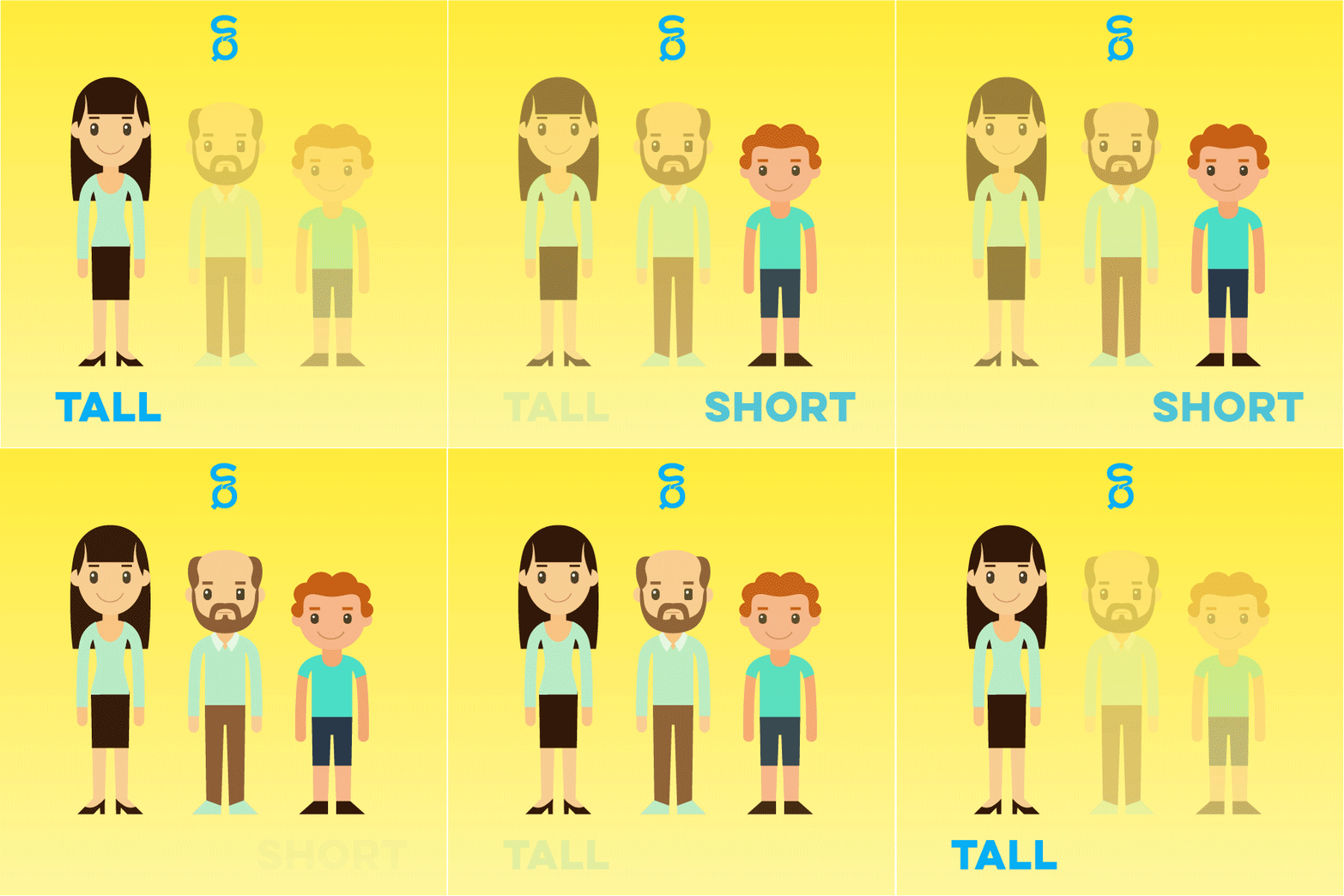
Frame #2 - Basic Sentences Describing Features
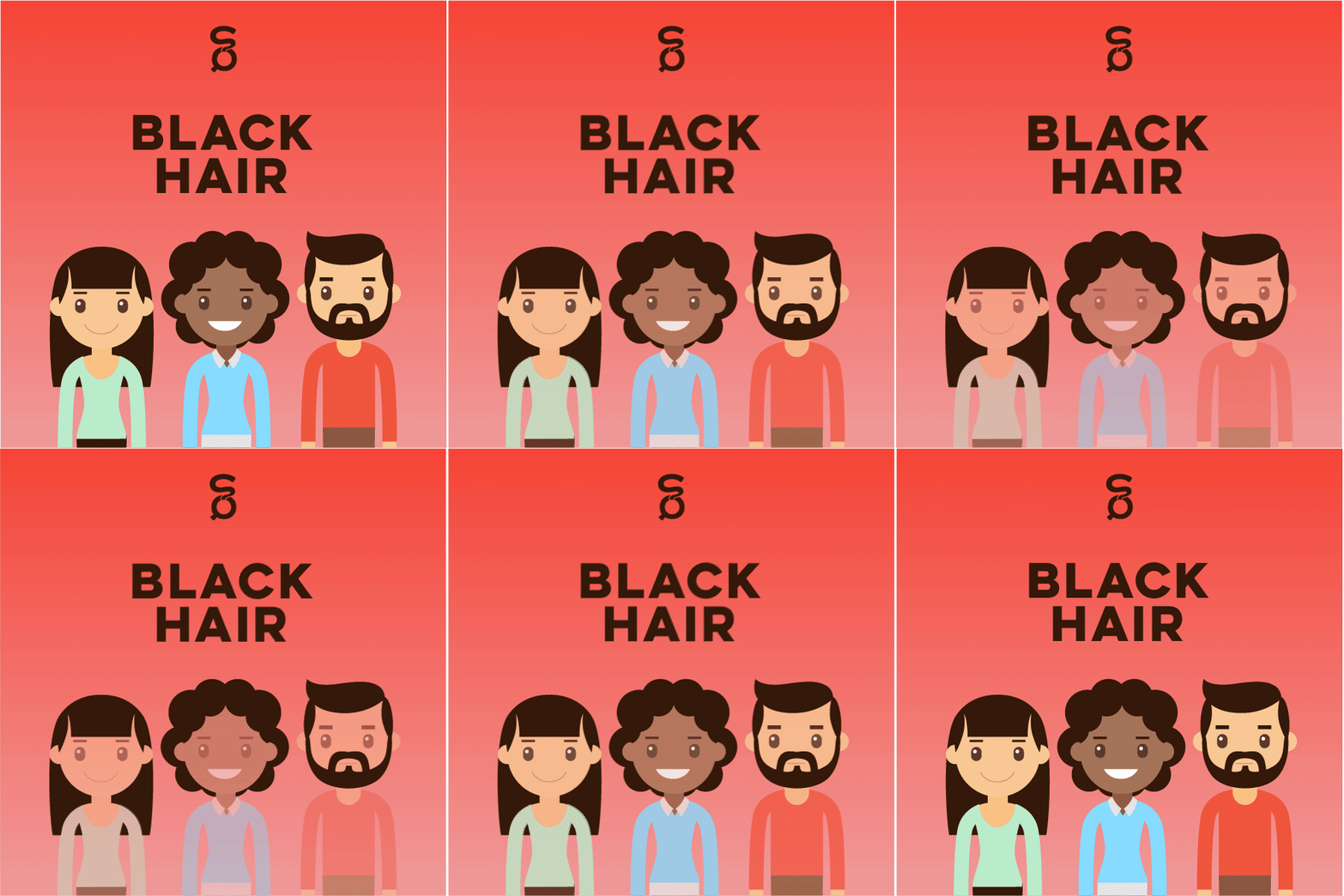
The next basic sentence frame for describing people in English focuses on a specific feature: glasses, curly hair, black hair, blue eyes, a mustache, a ponytail. To talk about a person’s features, use this sentence:
The woman has [FEATURE].
With this sentence frame, you can make lots of different sentences:The woman has curly hair. The woman has glasses. The woman has long hair. The woman has a ponytail.
Again, you can change the person slot as well: The man has long hair. My friend has long hair. My sister has long hair. Clara has long hair.
Here are some features (nouns or nouns with adjectives) that can fit into this sentence frame:



Frame #3 - Basic Sentences Describing Clothes
The last sentence we will talk about for describing people focuses on clothes. Who doesn’t love clothes!? Black shoes! Gray pants! Blue ties! Green skirts! But let’s make complete sentences with them. Here is the sentence frame:
The woman is wearing [CLOTHES].
And here is a list of clothes that can go into this sentence:
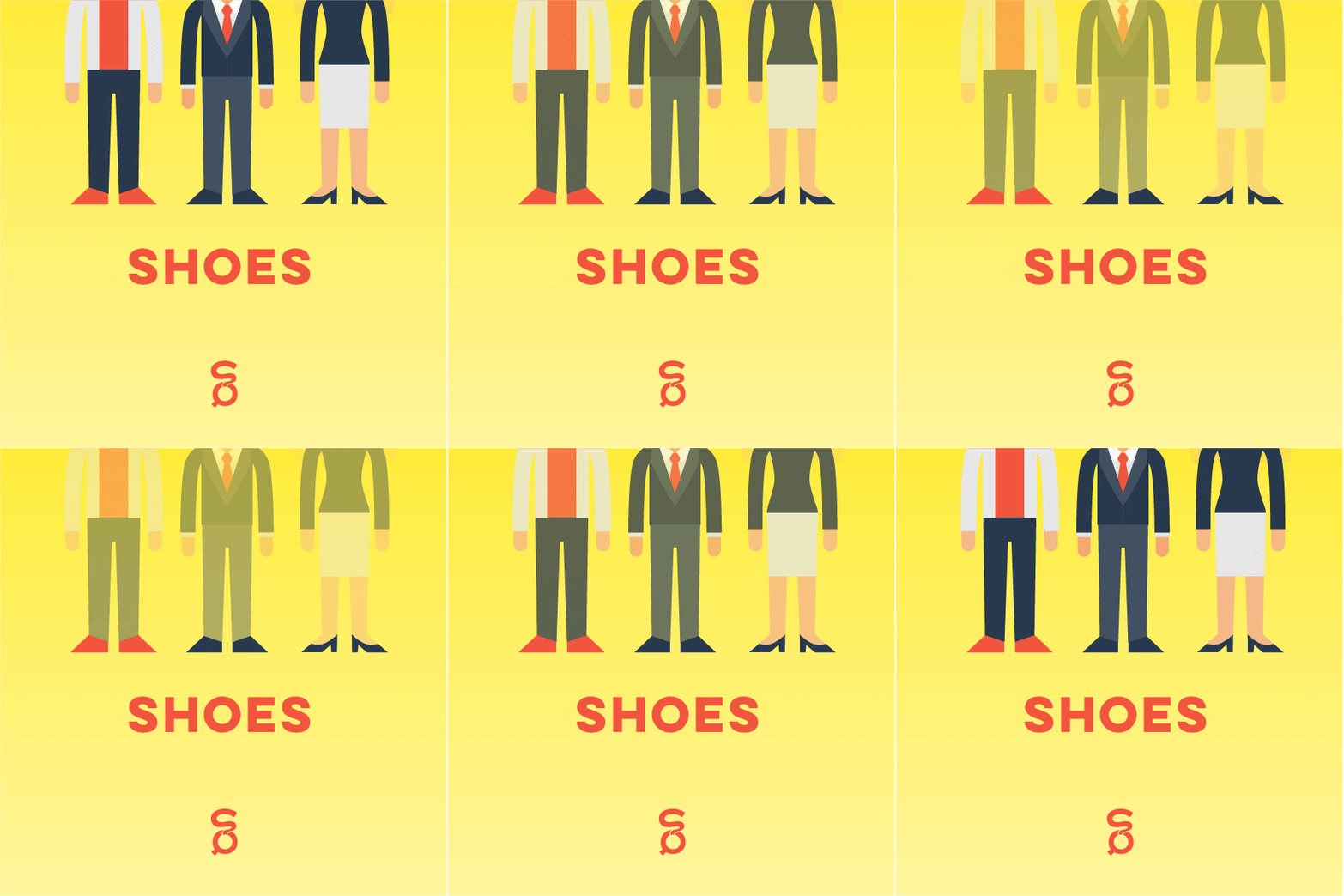

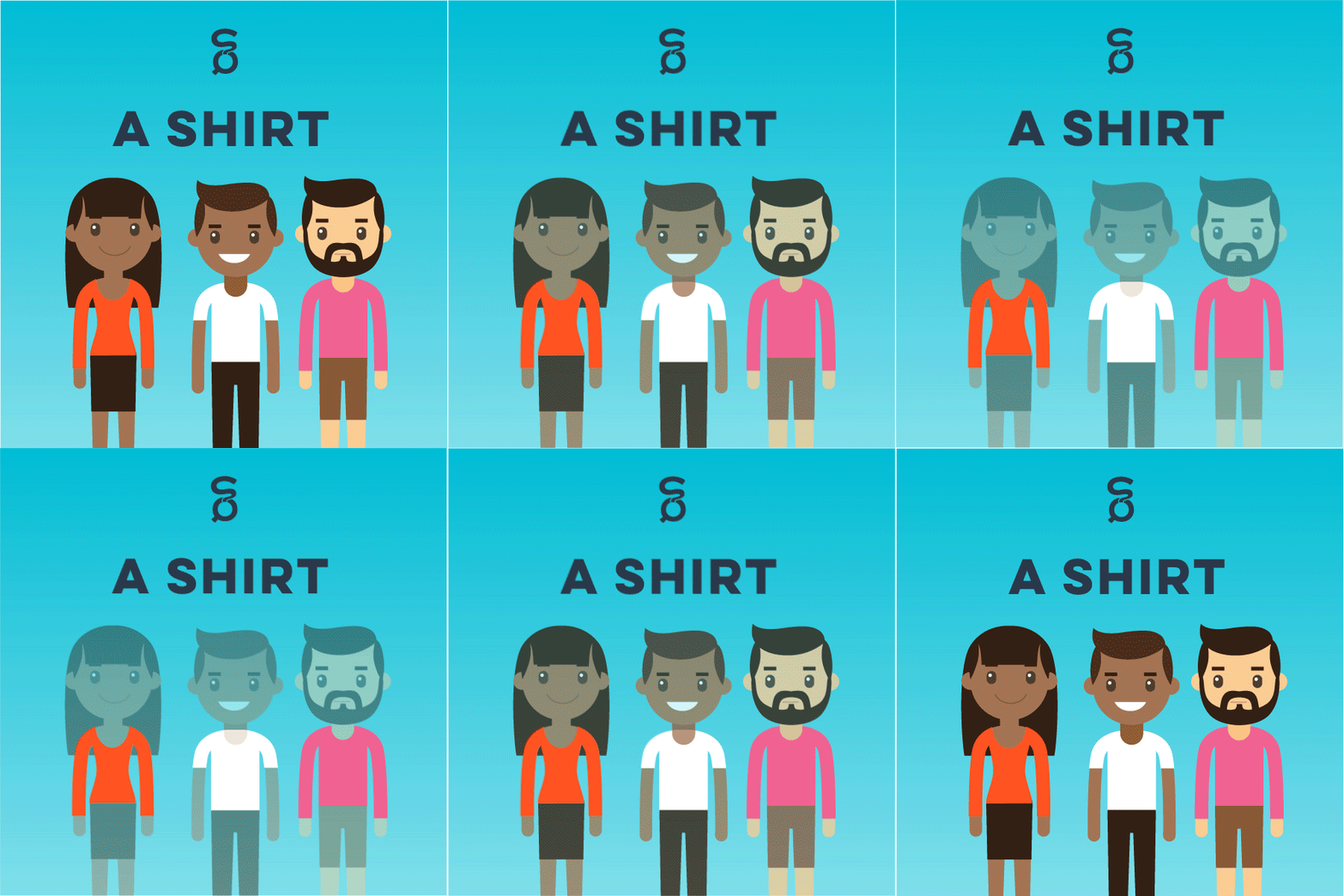



All of these clothing items can be used with color words to be even more descriptive. The woman is wearing black shoes. The man is wearing a yellow tie.
So, those three sentence frames, combined with this vocabulary, allow you to make hundreds of different sentences to describe people. If you are a beginner, and this is mostly new information for you, you can stop here.
But, if you know most of this stuff, and you want to learn some more advanced English sentences, read on!
Complex Sentence Frames Describing People
The first three frames talked about nouns, features, and clothes, in that order, right? The next three frames will be used to talk about the same three things, but in a more complex way. All of the same vocabulary from the sections above can be used with the next three frames, in the same order.
In the first three sentence frames, the main idea of each sentence was describing people. The sentences were about describing people. The thing that I want to tell you about the man is that he is tall. But sometimes we want to describe people in a sentence about something else, and the description is not the most important idea in the sentence. For example, maybe I want to tell you that the man is my neighbor, but I also want to mention that he is tall. These next sentence frames will help in situations like that.
Frame #4 - Adjectives Before Nouns
Let’s use that example. The I want to tell you that the man is my neighbor, and I also want to describe him as tall. I can put the adjective before the noun: The tall man is my neighbor. You can also put any of the other adjectives from above into that slot.
The [ADJECTIVE] man is my neighbor.
The handsome man is my neighbor. The old man is my neighbor. The fat man is my neighbor. And again, the end of the sentence (which we call the predicate) is a slot, too, and you can put different verbs in there: The tall man likes football. The tall man is eating. The tall man has a car.
Frame #5 - Features and With
If you want to talk about someone’s features in that same sentence, we need to use the preposition with. We could say The man with glasses is my neighbor. Any of the other features can go into that same slot:
The man with [FEATURE] is my neighbor.
The man with red hair is my neighbor. The man with a mustache is my neighbor.
Frame #6 - Clothing and in
When we want to talk about clothes, we need another preposition. Instead of with, we use in. The man in the blue shirt is my neighbor. Any of the clothing vocabulary above can go into that same slot:
The man in [CLOTHES] is my neighbor.
The man in the tie is my neighbor. The man in the grey pants is my neighbor. The woman in the red hat is my neighbor.
Wrap-Up
That's it! Study these six sentence frames and the vocabulary, and you can now make hundreds of new sentences to describe people! Check back soon and we'll have a quiz to check what you have learned!
Rob Sheppard is the founder and Chief Executive Teacher at Ginseng. Over the past ten years, he has taught English in Taiwan, South Korea, and his hometown of Boston. Now he teaches online at Ginseng while traveling the world.
You can email Rob at rob@ginse.ng.

More free English Vocabulary Resources
The Most Common English Adjectives
If you want to quickly expand your English vocabulary, adjectives are a great place to start! Adjectives are a really important part of speech. An adjective is a word used to describe a noun.
It is a good idea to focus on the most common ones in the language. Below are lists of the 50 most common words in both American and British English.
| No. | Adjective |
|---|---|
| 1 | OTHER |
| 2 | NEW |
| 3 | GOOD |
| 4 | AMERICAN |
| 5 | GREAT |
| 6 | BIG |
| 7 | HIGH |
| 8 | OLD |
| 9 | DIFFERENT |
| 10 | NATIONAL |
| 11 | SMALL |
| 12 | LITTLE |
| 13 | BLACK |
| 14 | IMPORTANT |
| 15 | POLITICAL |
| 16 | SOCIAL |
| 17 | LONG |
| 18 | YOUNG |
| 19 | RIGHT |
| 20 | BEST |
| 21 | REAL |
| 22 | WHITE |
| 23 | PUBLIC |
| 24 | SURE |
| 25 | ONLY |
| 26 | LARGE |
| 27 | ABLE |
| 28 | HUMAN |
| 29 | LOCAL |
| 30 | EARLY |
| 31 | BAD |
| 32 | BETTER |
| 33 | ECONOMIC |
| 34 | FREE |
| 35 | POSSIBLE |
| 36 | WHOLE |
| 37 | MAJOR |
| 38 | MILITARY |
| 39 | FEDERAL |
| 40 | INTERNATIONAL |
| 41 | TRUE |
| 42 | FULL |
| 43 | HARD |
| 44 | SPECIAL |
| 45 | RECENT |
| 46 | RED |
| 47 | OPEN |
| 48 | PERSONAL |
| 49 | GENERAL |
| 50 | CLEAR |
| No. | Adjective |
|---|---|
| 1 | OTHER |
| 2 | NEW |
| 3 | GOOD |
| 4 | OLD |
| 5 | DIFFERENT |
| 6 | LOCAL |
| 7 | GREAT |
| 8 | SMALL |
| 9 | SOCIAL |
| 10 | IMPORTANT |
| 11 | NATIONAL |
| 12 | HIGH |
| 13 | BRITISH |
| 14 | POSSIBLE |
| 15 | LARGE |
| 16 | RIGHT |
| 17 | LONG |
| 18 | LITTLE |
| 19 | YOUNG |
| 20 | POLITICAL |
| 21 | ABLE |
| 22 | GENERAL |
| 23 | ONLY |
| 24 | PUBLIC |
| 25 | AVAILABLE |
| 26 | FULL |
| 27 | EARLY |
| 28 | BEST |
| 29 | BIG |
| 30 | MAIN |
| 31 | MAJOR |
| 32 | ECONOMIC |
| 33 | SURE |
| 34 | REAL |
| 35 | LIKELY |
| 36 | BLACK |
| 37 | PARTICULAR |
| 38 | INTERNATIONAL |
| 39 | SPECIAL |
| 40 | DIFFICULT |
| 41 | CERTAIN |
| 42 | CLEAR |
| 43 | WHOLE |
| 44 | FURTHER |
| 45 | WHITE |
| 46 | OPEN |
| 47 | EUROPEAN |
| 48 | FREE |
| 49 | CENTRAL |
| 50 | SIMILAR |
Most of the most common adjectives are the same in the US and the UK (78% of the top 50 and 92% of the top 25 words appear in both lists). Notice that American is the 4th most common adjective in American English and British is the 13th most common adjective in British English. We shouldn't read too much into these simple lists, but it is interesting to note that military, federal, and personal all appear in the American list. Do you notice any other patterns?
That's all for now! Start studying!
If you're looking for something similar, check out the most common verbs in English.
Sources: The primary sources for compiling this article were the Corpus of Contemporary American English (COCA) and the British National Corpus.
more free english tips
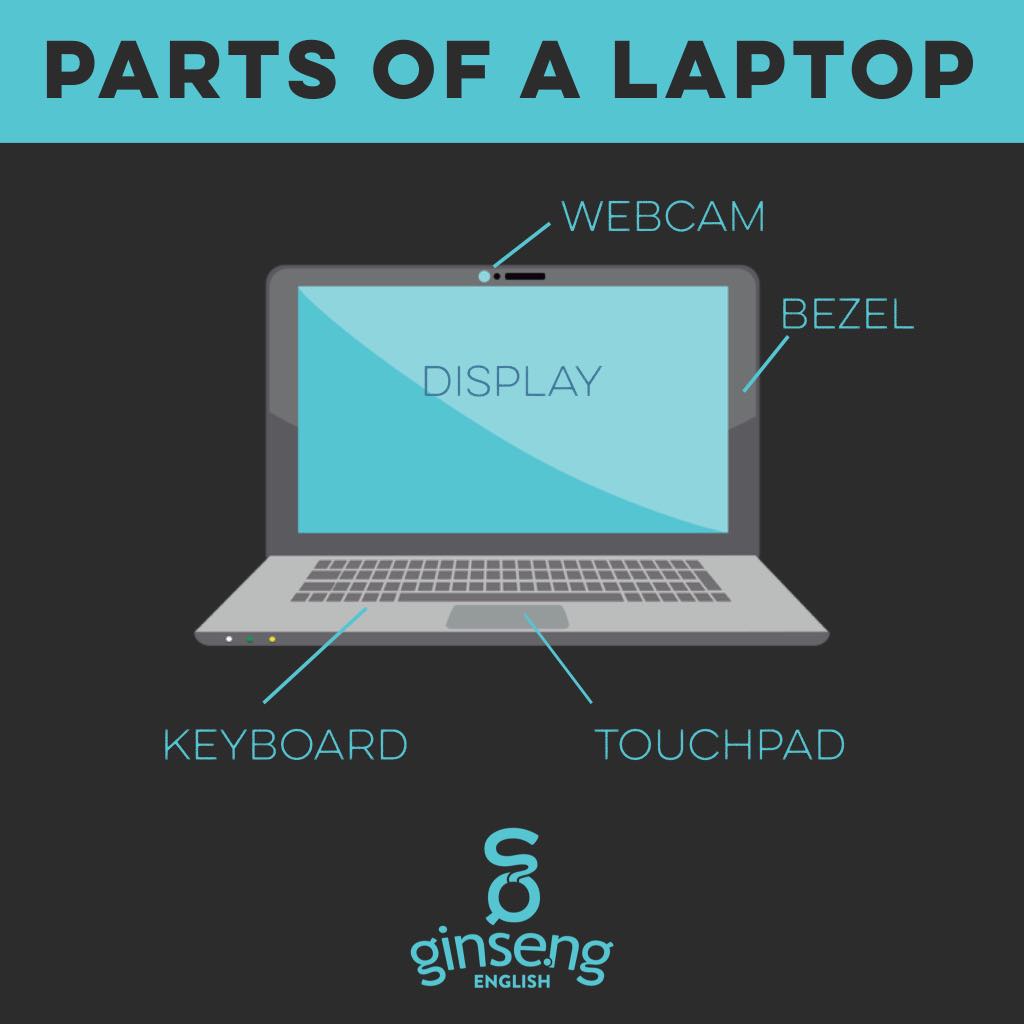
Parts of a Laptop
English Vocabulary - Parts of a Laptop
Today lets learn English words to talk about parts of a laptop. As you may know, a laptop is a computer you can close like a book and take with you. Larger computers that you cannot take with you are called desktops, because they sit on top of a desk. A laptop sits on top of your lap (your lap is the upper part of your legs, which is horizontal when you sit!
The part of the laptop that you look at is called the display. Display is also a verb: your computer displays pictures, videos, and websites. Some people call this a screen, too. Screen is a more general word—your TV has a screen, there is a screen at the movies—but display is better for computers. On most laptops, there is an area around the display that doesn't show pictures, like a frame. We call this the bezel. In the middle of the bezel, above the display, you probably have a webcam: a camera that you can use on the web.
The part of the laptop with the letters is called the keyboard. A board is a flat surface, and this board is covered with buttons called keys; that's why we say keyboard! In front of the keyboard is a touchpad, which you can touch to move your cursor (the arrow on your computer screen).
On the sides of the laptop (not shown in this picture) you may have many different ports to plug in your power cord, headphones, or a USB cord.
More free English resources
Parts of a Laptop Computer
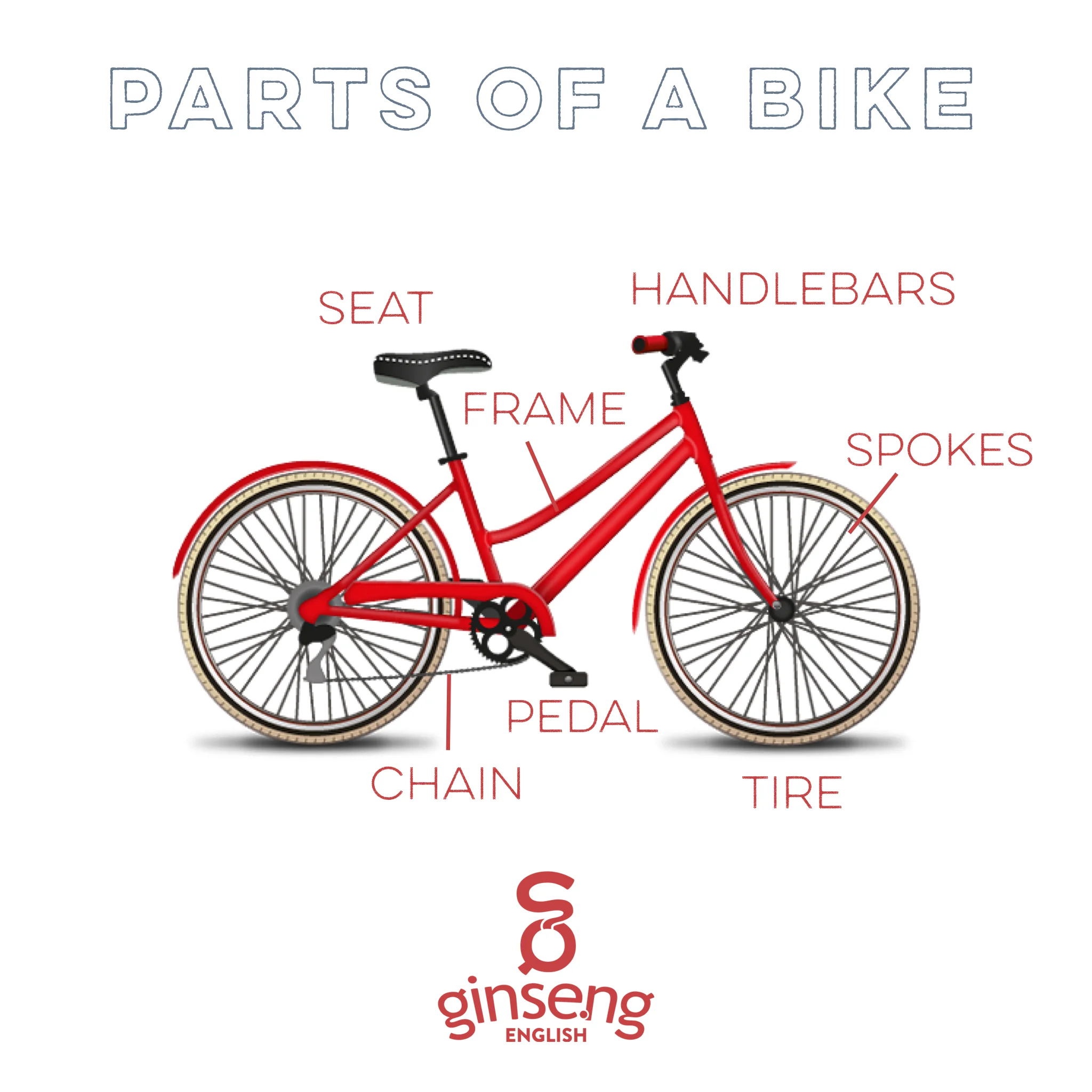
Parts of a Bike
English Vocabulary - Parts of a Bike
As you probably know, bike is a common short word for bicycle in English. Let's build our bicycle vocabulary by learning English names for parts of a bike!
The place where you sit is the seat, just like at the movies or in a car. You put your hands on the handlebars. Notice that this word is a combination of two other useful words: handle (something you hold in your hand) and bar (a long straight piece of metal). You put your feet on the two pedals.
The word bicycle actually means two (bi-) wheels (cycle). The rubber part of the wheel that touches the ground is called the tire. The thin metal pieces that connect to the middle of the wheel are called spokes.
The pedals connect to the rear wheel with a chain and many different circular gears. All of this is held together on a metal frame, the red part in this picture.
More free English vocabulary resources
Take a look at the different parts of a bike in English!
Parts of a Shoe
English Vocabulary - Parts of a Shoe
Next up in our Ginseng English series Parts of a... is shoes! Do you know the names for the parts of your shoes? Read on and you soon will!
Three parts of a shoe actually have the same names as parts of your body. The toe is the part of the shoe where your toes are. The heel is the part of the shoe where your heel (the back of your foot) goes. The third one is a little less expected. The part on top that comes from the inside is called the tongue! Your foot doesn't have a tongue of course, but this part of the shoe looks a little like a tongue! 👅
On top of the tongue, the strings that you tie together are called the laces. Finally, the part on the bottom that touches the ground is called the sole of the shoe.
Other free English vocabulary resources
Parts of a House
Across the world, everyone has some kind of home, though they all look very different! This post will describe the parts of a typical American house.
Parts of a House
Let's take a look at some common words to describe parts of a house!
To go into a house, you use the door. Many houses have a front door and a back door. When you want to look outside, you can look out the window. Windows bring in lots of light and make a house brighter. If it's too bright, or if there's a storm, your house might have shutters on each side of the windows. If you shut the shutters, the windows are protected, and it becomes darker inside.
On the top of each house is a roof. The roof keeps you dry if it is raining! The roof is supported by walls.
Some houses have a fireplace inside so that you can have a fire to keep warm. But if you have a fireplace, it is important to have a chimney, too! The chimney takes smoke from the fire outside so your house isn't smoky!
Things In A Living Room
Let’s talk about the things in this living room. But, before we even get to that, you may be wondering, what exactly is a living room? Well, in America, we call the room where the family hangs out and relaxes the living room. The living room is usually on the first floor of the house. 🏡 There are typically comfortable chairs or couches in it, and it is just a nice room to spend time together. 👨👩👧👦
Take a look at the picture, and follow with me as we go left to right identifying things in this living room.
First you will see a floor lamp. A lamp is the machine that makes light, usually with a lightbulb. 💡 This type of lamp is called a floor lamp because it sits on the floor.
This family really likes a bright room because they have 3 lights in it! Next to the pole lamp is the overheard light. Overhead means over your head! 👆🏼 You may remember this from the Ginseng Blog post “Things in the Kitchen.” This overhead light is hanging above the couch.
Next to the overheard light is a nice piece of art or artwork. 🖼 You can also call this a painting. 🎨
To the right of the artwork is the bookcase. A bookcase is a piece of furniture that is usually tall and made out of wood, and we put books on, or other things that we want to display or organize.
This bookcase has a small pink lamp on top of it. Next to the lamp is a house plant. 🌿 A house plant is just what it sounds like, a plant that lives in your house! This room actually has a couple of house plants.
On the second shelf from the top there two vases. 🏺🏺 Vases are containers for plants or flowers. But some are just decorative, meaning they don’t actually hold flowers. They just look pretty!
Under the vases and books are two more house plants, including a cactus.🌵 A cactus is that plant that grows in the desert and has sharp spikes on it.
In the middle of the room is the big soft piece of furniture that we all love to sit on. In America we call this either a sofa or couch. 🛋 A couch can usually fit two or three people on it. On the couch you will find throw pillows which are usually just decorative! Under the throw pillows are the cushions which are the big soft pillows that are a part of the couch.
Things In A Living Room 2
Here is a different living room, with some new English vocabulary for you. Let’s start in the center of this picture and work our way around it. In the center, you will see a piece of art with trees on it. 🖼🌳 You can also call this a painting.
To the right, we have a bookshelf. In the picture above, we talked about a bookcase. A bookcase is a piece of furniture that has many bookshelves in it. But you can also just have a bookshelf on your wall, like we see here! On this bookshelf, you will find a blue vase and are a couple of books ⚱️📚.
On the floor, under the artwork is a lounge chair. A lounge chair is different from a couch because it usually fits only one person. Lounge means to to sit back and relax, which is exactly what you’re supposed to do in a living room! On the lounge chair there are two throw pillows.
Next to the lounge chair is a footrest. A footrest is a small piece of furniture next to a chair that you can rest (or relax) your feet on. On top of the foot rest is a cushion.
To the left of the lounge chair is a side table. We call it a side table because it is a small table that we keep on the side of a couch or chair. On top of the side table is another vase with some flowers. 💐Next to the flowers is an old radio, which plays music or the news. 📻
Things In An office
Now you will learn all about the things in a typical American office! An office centers around the desk, which is the big piece of furniture in the middle of this picture that everything sits on.
On the top of this picture you’ll see an overhead light hanging from the ceiling. It is casting a pleasant glow of light over the desk. Good lighting is very important in an office!
Right under the light is a wall clock. We call this a wall clock because it is hung on the wall. Instead of the usual numbers on this clock, there are Roman numerals. This clock is showing that it is almost 11:20. We could also say that it is twenty past eleven, or almost half past eleven.
To the right and left of the clock are shelves.
On the right shelf there are books stacked on top of each other, and also leaning against one another. To the right of the books is an organizer. We can’t see what’s inside of it, but my guess is that there are office suppliesinside. Common office supplies are rubber bands, which are those stretchy rubber strings that hold things together, paper clips, which are wire devices used to hold sheets of paper together, and maybe some stamps for mailing letters.
Note that office supplies are different than office equipment. Office supplies, as mentioned above, will be used up and need to be replaced or replenished. It is usually someones job as office manager to re-order the office supplies. Office equipment, such as the lamps, desks, chairs, and computers, are things that will (hopefully!) last much longer and only need to be replaced every five or so years.
On the left shelf there are decorations or artwork.
Underneath the right shelf is a small plant, or to be more specific, a cactus. Everyone needs to stay caffeinated while working, so of course, there is a a mug of coffee (or tea!) on the desk next to the plant!
To the left of the coffee cup is the desktop computer. We call it a desktop because it sits on top of the desk! This is different than a laptop, which is portable, and can sit in your lap.
Hanging on the desktop is a pair of headphones to listen to music. There is also a mouse, sitting next to the computer. If you notice, neither of these have wires or cords coming out of them, which means that they are wireless and connect to the computer using bluetooth.
Stuck on the computer is a Post-it ® note. We use these, or sticky notes, to write ourselves reminders of tasks or information that we don’t want to forget! Another important office item to help us stay organized is a calendar. A calendar keeps track of the date so that we can make sure to meet our deadlines.
To the left of the calendar you will see a pencil holder or jar which holds more office supplies: a pair of scissors, a ruler, pens, and pencils.
Underneath the desk there is desk chair which is hopefully comfortable! You'll also see a trash can, or garbage can to put unwanted things in to be thrown out.
Lastly there are electric outlets underneath the desk which are used to plug the cords or wires into the wall. On this electric outlet there is a power strip, something that is used to turn one outlet into many so that you can plug multiple devices into the wall.
The style in this office is modern and minimal, which means it is very simple with clean lines and muted colors. You'd probably see furniture exactly like this at Ikea!
Things In A Bedroom
This has been a super long post and you’re probably ready for a nap now! Let’s wrap up this post by talking about the bedroom.
The most important thing in a bedroom is the bed, so let's start there!
In the center of the room you can see the bed. For your reference, when talking about a bed, we typically call the top of the bed where your head goes the head of the bed and the bottom of the bed where your feet go is known as the foot of the bed.
A bed has different parts. There is the bed frame, which sits on the floor and holds the mattress, the soft thing that we sleep on! Bed frames can be made out of wood or metal. At the head of the bed, there is a piece of furniture called the headboard. According to Wikipedia, bed frames "historically, served to isolate sleepers from drafts and cold in less insulated buildings, and thus were made of wood." Nowadays, we hope that your room is warm enough that the headboard is just decorative!
The bed has two blue pillows on it at the head of the bed. On top of the bed there is a nice warm bedspread, or blanket. We can also call this a comforter, or a duvet cover.
At the foot of the bed, on the floor, you will see a box with a cushion on top. This box can open up and be used to hold things. We might call this box either a an ottoman or a hope chest.
You might notice that both the bed and the stool have legs which are the little pieces of wood that hold the furniture off the ground.
Things in a Kitchen
More free English Vocabulary Resources
Parts of a Car
Basic English Vocabulary - Parts of a Car
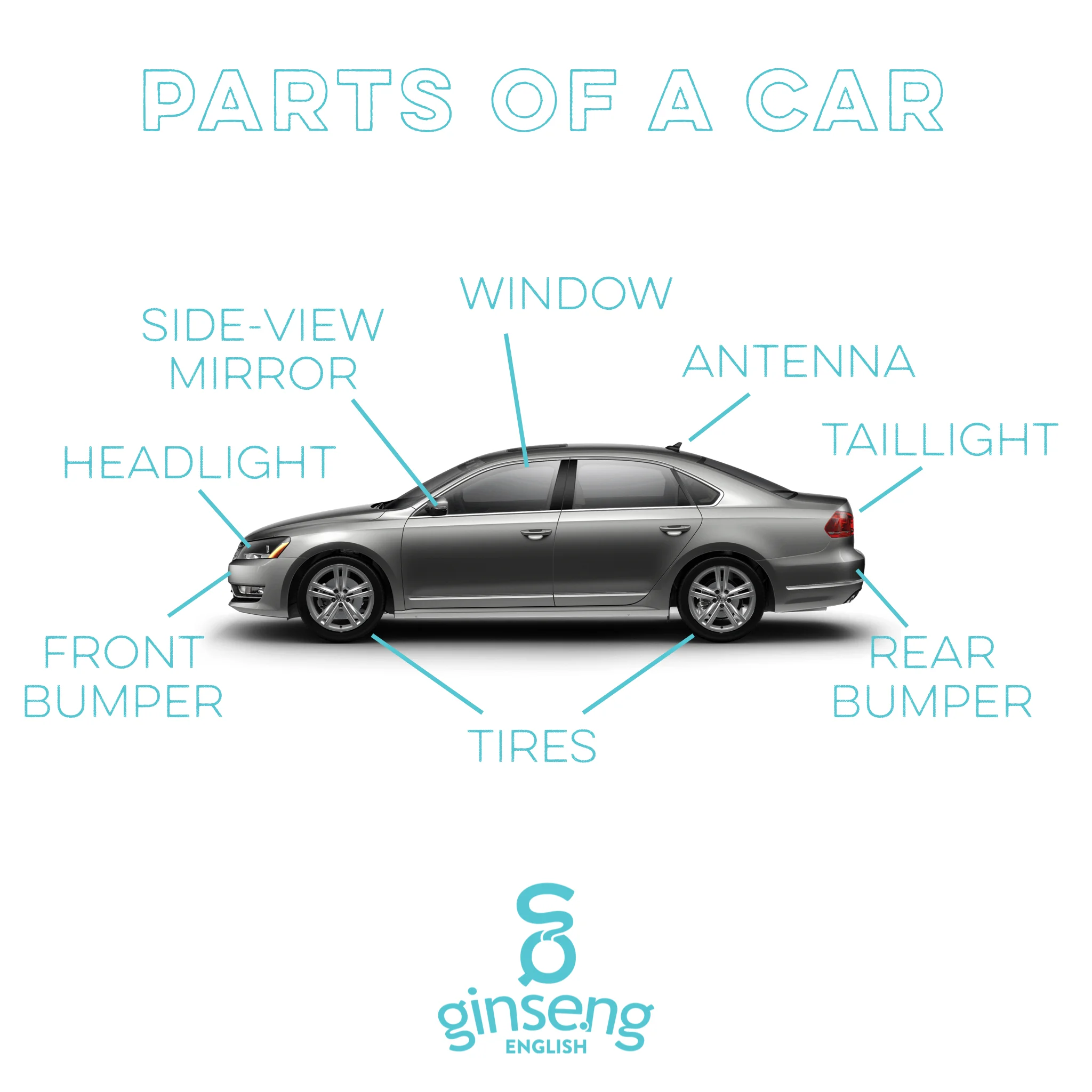
Welcome to the first post in a new series on basic vocabulary from the Ginseng English Blog: Parts of a... Today, let's look at some useful vocabulary for the outside of a car!
On a car there are four tires, two front tires and two rear tires. Front and rear are useful words when we talk about cars. A car has two bumpers to protect you in an accident: a front bumper and a rear bumper. Above the bumpers are lights. There are headlights at the front of the car, and taillights at the rear of the car. On each side of the car is a side-view mirror, to help you see behind you. Inside the car is a rear-view mirror, too.
What other car vocabulary do you know? What do you want to know? Comment below!
More free online English posts
English for Halloween Costumes
Halloween Costume Trends
I recently came across this great infographic over at the W5 blog, called Spooktacular Halloween Costumes (notice that spooktacular is just a fun portmanteau of spooky and spectacular—more on portmanteaus in this blog post).
This seems like a great opportunity to talk about how we talk about costumes in English, which can be a little tricky. If you're talking to an American friend about an upcoming Halloween party, she might ask you:
What are you going as?
What am I going as? Going as?
It may sound like a strange question, but your friend is asking you what your costume will be, or what you will be pretending to be for halloween. Another way to say this is:
What are you dressing up as?
You could answer with:
- I'm going as a ghost.
- I'm going as a dog.
- I'm going as Wonder Woman.
- I'm going as Jon Snow from Game of Thrones.
Notice that if you are going as something generic (not a single, specific character), we use an indefinite article—a ghost, a cat, an elephant—but for specific characters, we don't need an article.
One more thing: if you're a character from a movie or TV show, it's common to add from [the movie]:
- I'm going as Jon Snow from Game of Thrones.
- She's going as the Mad Hatter from Alice in Wonderland.
- He went as Wolverine from X-Men.
So, what are YOU going as for Halloween!?

This post teaches basic English vocabulary for describing our closest family members. Lots of examples and images!