
Future Perfect Continuous Tense
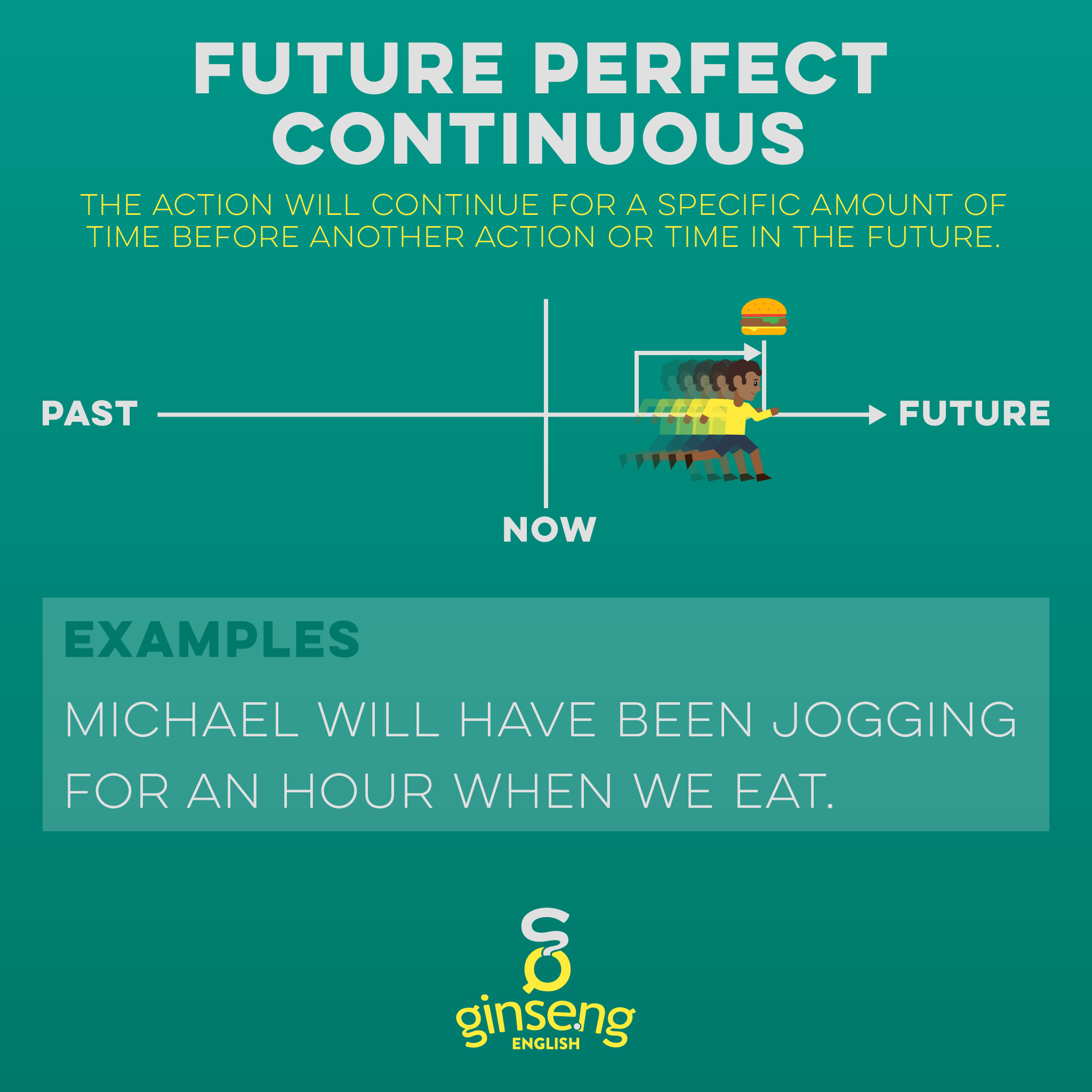
The future perfect continuous is an English verb form used to describe an action that starts in the future and continue up to another time or action in the future. This can be a time or date, or it can be another action. Often a duration is specified for the verb in the future perfect continuous. This verb form alone does not specify if the action will continue after that point.
This is a very rare verb form. Less than .1% of English verbs are in the future perfect continuous. Do not use this verb tense unless you are absolutely certain that it is necessary.
Note that continuous and progressive are just different words for this same thing, so some people call this tense the future perfect progressive.
Keep reading to learn the rules and reasons for using and forming the future perfect continuous, including loads of charts and examples!
Using the Future Perfect Continuous
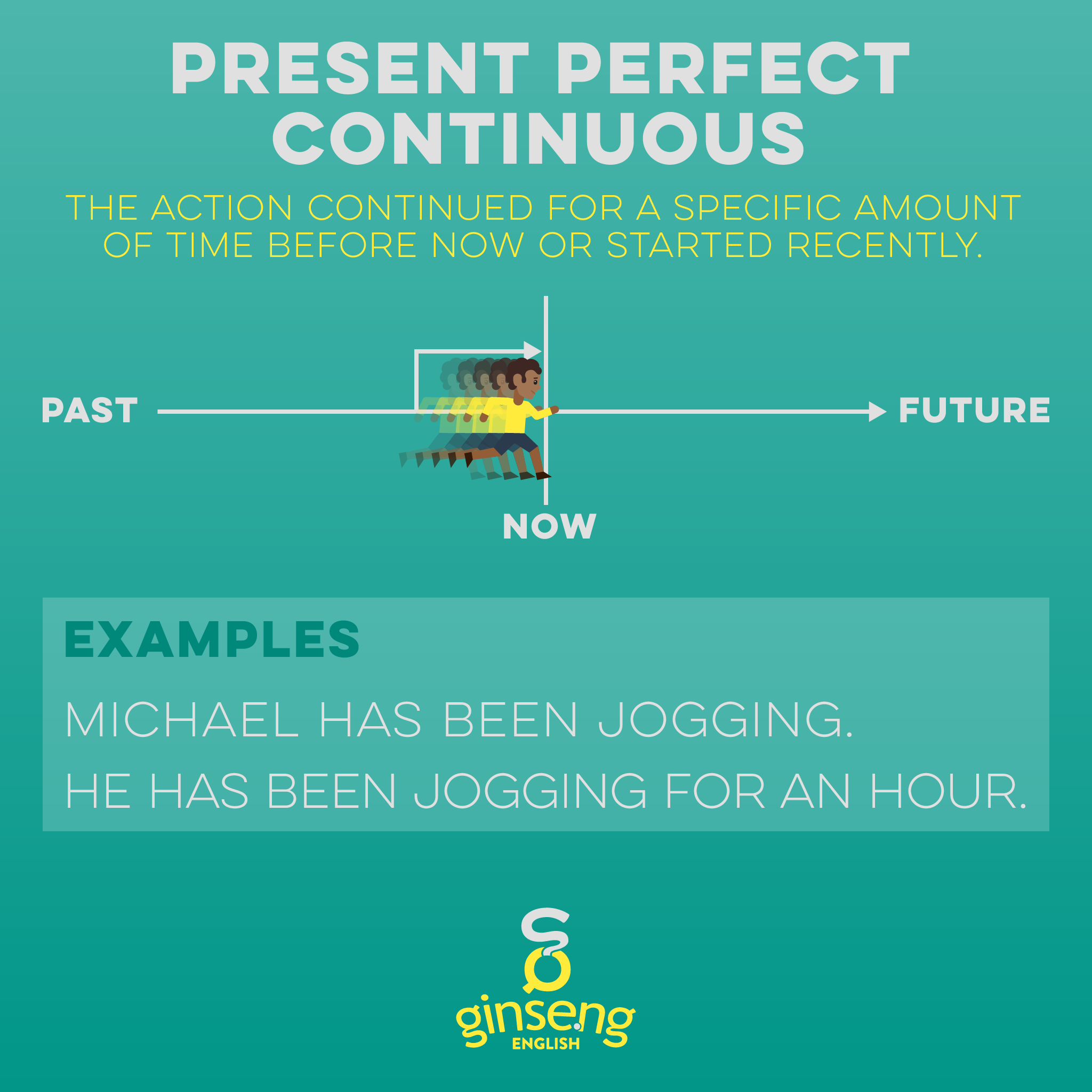
Perfect continuous verbs are used to describe an action that has been in progress before another action or point in time, often with a duration specified. With the future perfect continuous, that time is in the future. This can be a time or date (next summer, Saturday at 5, in 2050) or it can be another action in the future.
Chart for Future Perfect Continuous Tense In English

Here are some example sentences:
By the time I finish my Ph.D., I will have been studying for over 20 years!
Monday is my work anniversary. I'm going to have been working here for a decade!
In these examples, the perfect continuous action (will have been studying, going to have been working) is presented with a duration (over 20 years, a decade) and another action (I finish) or point in time in the future (Monday).
Form
Formula with Will
To form the future perfect continuous, we use the future perfect form of the helping verb be—will have been or going to have been—and the continuous form of the main verb. No matter what the subject is, the verb form is
subject + will have been + VERBing
Conjugation
Here are conjugation tables showing the verb work in the future perfect continuous with will.
| Singular | Plural | |||
|---|---|---|---|---|
| 1st person | I | will have been working. | we | will have been working. |
| 2nd person | you | will have been working. | you | will have been working. |
| 3rd person | he | will have been working. | they | will have been working. |
| she | will have been working. | |||
| it | will have been working. | |||
Formula with Going to
Because forming the future tenses with going to is more complex and wordy, we almost never form the future perfect continuous with going to. In the rare situation that we might use it, the form is
subject + am/is/are + going to have been + VERBing
Conjugation
Here is a conjugation table:
| Singular | Plural | |||
|---|---|---|---|---|
| 1st person | I | am going to have been working. | we | are going to have been working. |
| 2nd person | you | are going to have been working. | you | are going to have been working. |
| 3rd person | he | is going to have been working. | they | are going to have been working. |
| she | is going to have been working. | |||
| it | is going to have been working. | |||
Other Forms
Questions
In the future perfect continuous, you have more than one helping verb. To make a question, move the subject after the first helping verb, will, but before the second helping verb, have. Again, please keep in mind that these forms are extremely rare, and these examples sound very unnatural in English; we share them only to help students understand the patterns of the language.
At what point will you have been acting for 20 years?
When will they have been playing this game for too long?
Negative Sentences
You can form a negative by inserting not between the first helping verb will and the second helping verb have. For example:
In January, we will not have been living in California for 20 years.
But notice that the negative form is ambiguous. It is unclear which part of the sentence we are negating. Are we living someplace other than California? Has it just not been 20 years yet? This is a good reason to avoid making negative sentences in the future perfect continuous.
The Passive Voice
If for some reason you need to make a passive sentence in the future perfect continuous, use be in the future perfect continuous (will have been being) and then the perfect form of the main verb. As you can see in the following example, this is awkward and confusing
Next year the house will have been being renovated for 5 years.
We do not recommend making future perfect continuous passive sentences.
CHECK OUT THESE OTHER FREE GRAMMAR RESOURCES:
Most Common English Verb Tenses
English Verb Form Frequency
We spend a lot of time in English class studying all the different verb tenses. I can't tell you how many times my students have asked me, "How often do we really use the future perfect progressive?" My answer is usually that it is very rare, but it's meaningful, and it can be helpful to understanding how the past perfect progressive works as well. But that really is a good question:
How often do we use each verb tense in English?
This is an important question because there are 12 different verb tenses in English, and you want to study strategically, learning the most valuable ones!
Let's start by saying that there is no one answer. As you may know, the English we use for speaking is different from the English we use in writing. There are many different situations to be speaking or writing in, and in each of those situations we would see different verb frequencies. Even from person to person, our individual speaking style might lead one person to use, for example, the present tense more often than another person. We can, however, observe some useful patterns.
The 5 Most Commonly used English Verb Tenses
If you are looking for a quick answer, here it is:
| # | Tense | Frequency |
|---|---|---|
| 1 | Simple Present | 57.51% |
| 2 | Simple Past | 19.7% |
| 3 | Simple Future | 8.5% |
| 4 | Present Perfect | 6.0% |
| 5 | Present Continuous | 5.1% |
Some quick insights from the top 5:
The simple present accounts for more than half of the verbs used in English speech
The 5 most commonly used verb tenses total up to over 95% of usage
The simple tenses are the top three verb tenses
For a more in-depth analysis, read on!
The Source Material
For this post, we looked at an interesting research study by Krámský (1969). We have also updated this article to include findings from Alzuhairy (2016). Krámský took several different samples of three different styles (or registers) of English—novels, plays, and specialized (academic and technical) texts. He analyzed 20,000-word samples from each text, counting each form of each verb, and sharing all his data.
The results are complex, and grouped in ways that might not be too helpful, but I have tried to regroup them and show them in charts that are more useful for language teachers and learners.
Before we look at some of those patterns, I want to include a caveat, or warning. When compared to all the language in the world, Krámský's sample is actually very, very small. Ideally, we would get this information from a larger base of language called a corpus, like the Corpus of Contemporary American English. Unfortunately, information of this kind is currently difficult (if not impossible) to get from most corpora. Still, the general proportions and patterns that Krámský found should be fairly accurate. The one other warning is that the texts Krámský used as samples of spoken (or colloquial) English are actually plays, written to sound like spoken English. It is very possible that examples of actual spoken English would be different from the language found in the plays.
Ok, now let's get to the fun stuff!
Verb Tense Frequency
First, I've broken each text type down by verb tense: past, present, and future:

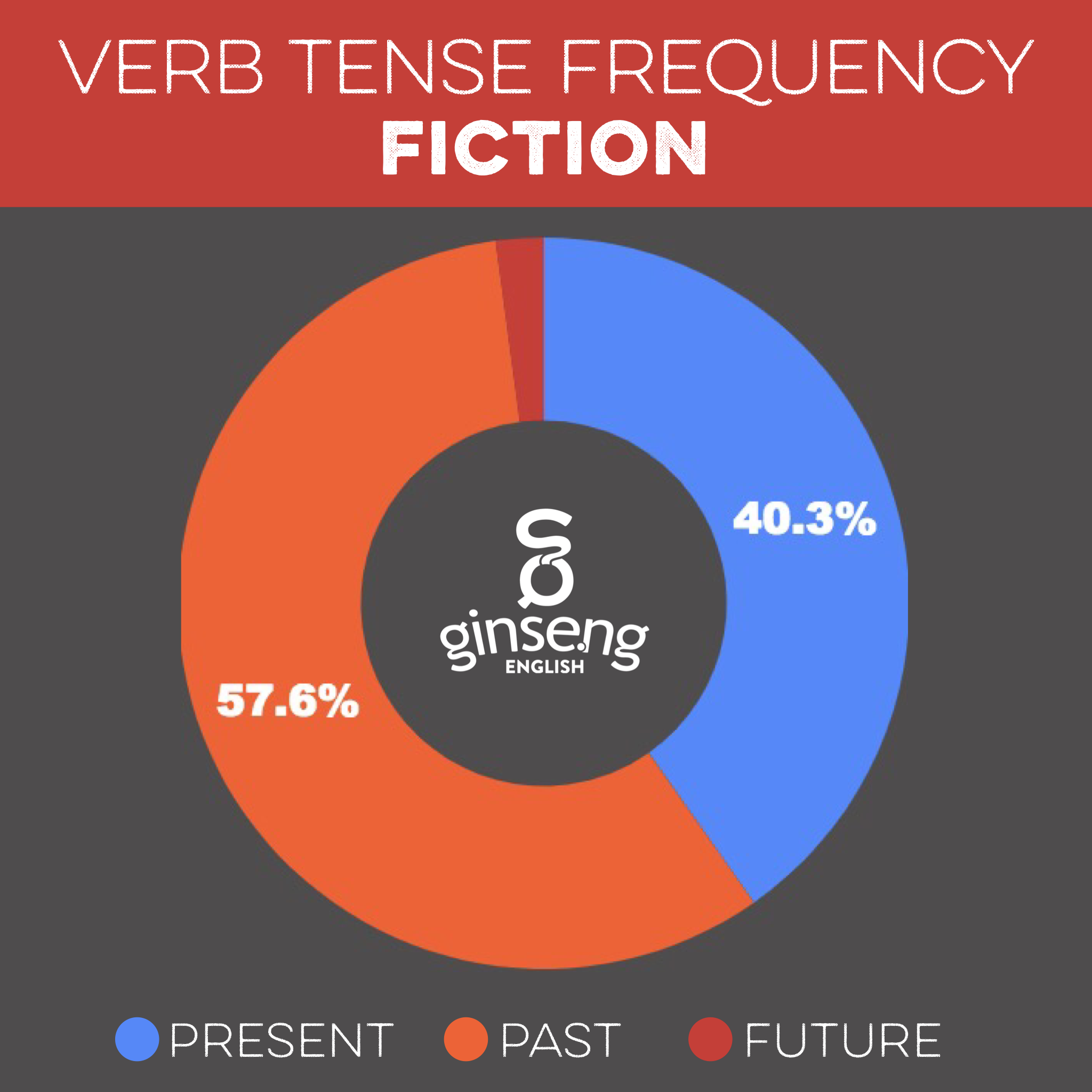

As you can see, there are some big differences between different text types. Spoken English is mostly in the present tense (68.9%), but fiction is mostly past tense (57.6%). Specialized texts overwhelmingly use the present tense (87.1%).
This makes a lot of sense. In fiction, we generally tell stories that take place before: first this happened, then that happened, then that happened. When we speak, though, we talk a lot more about what we think and feel and like, what we do, who people are, our experiences and all of these things are expressed in the present tense. In specialized texts, we are often writing about things that are generally true, and here again, we use the present tense a lot.
The future tense is less used in all text types: 9% in speech, 2% in fiction, and 4% in specialized texts.
This table breaks down each tense by frequency in all three text types:
| Tense | Speech | Frequency | Specialized |
|---|---|---|---|
| Present | 68.9% | 40.3% | 87.1% |
| Past | 22.4% | 57.6%% | 8.7% |
| Future | 8.7% | 2.1% | 4.3% |
Verb Aspect Frequency
The tenses are easy enough—past, present, future—but the really tricky thing about learning English verbs is the four aspects: simple, progressive, perfect, and perfect progressive. Thankfully, there isn't as much difference between the different styles of English when it comes to aspect. Take a look:

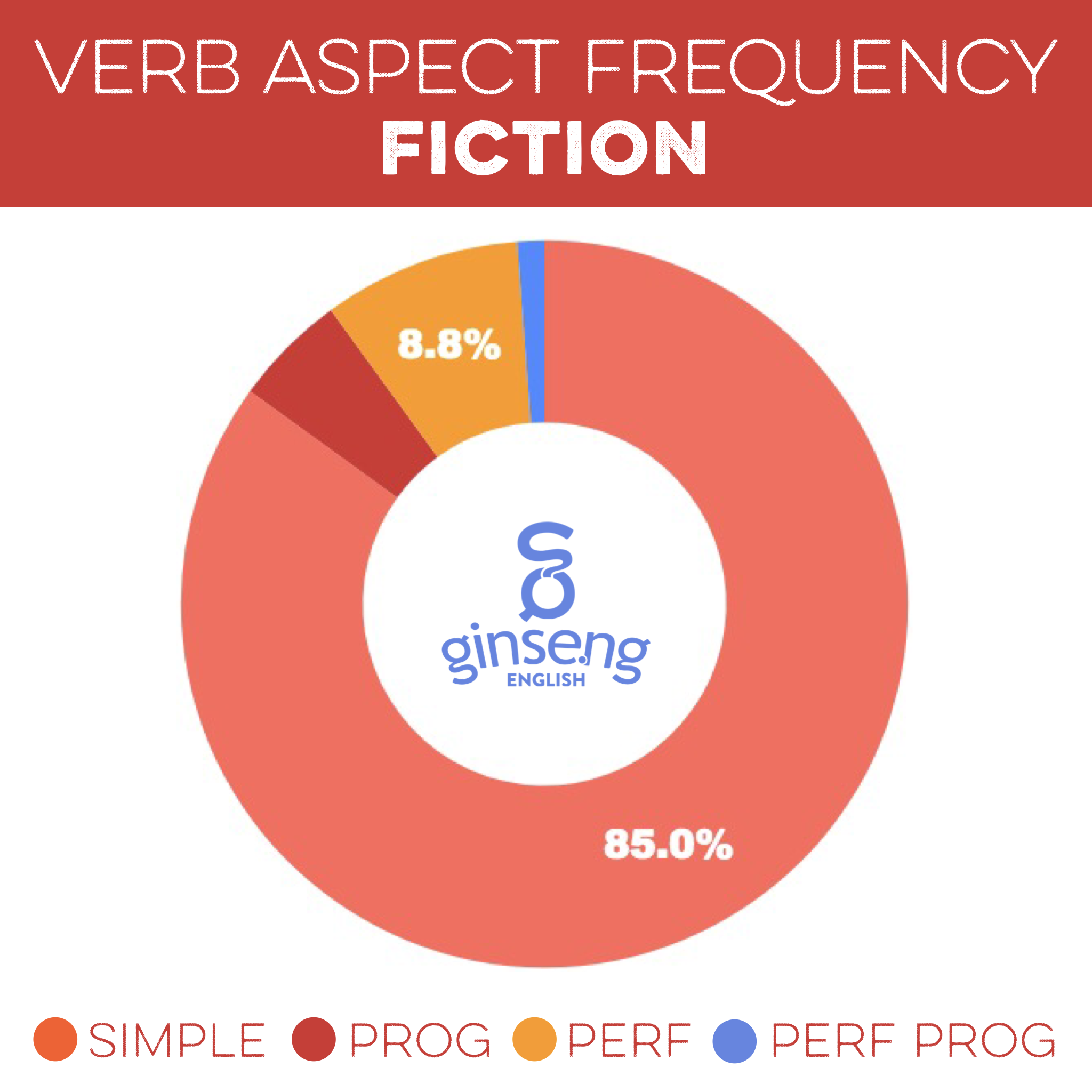
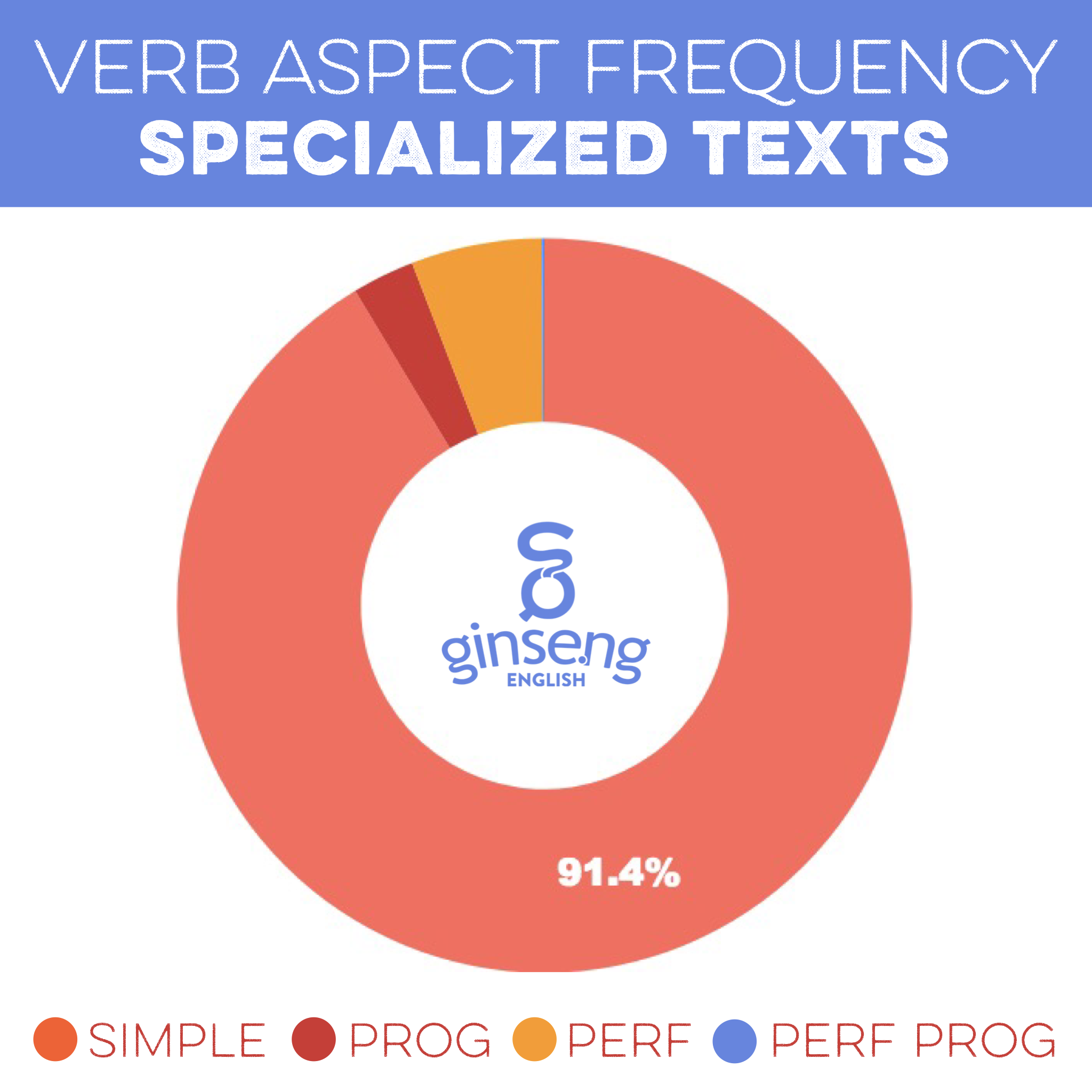
The charts look generally the same. In every style of English, the simple aspect—simple present, simple past, and simple future—makes up over 85% of verbs that we use. The lesser-used aspects all fall in the same order: after simple, it's perfect, then progressive, then perfect progressive gets a tiny little sliver of use. Biber and Reppen (2002) confirm this pattern, observing that the simple aspect is “more than 20 times as common as progressive in conversation.” (p. 204, cited in Alzuhairy (2016).
Alzuhairy (2016) studied academic texts in particular. The same general pattern applies, but simple present only accounts for about 50% of verbs in Alzuhairy’s findings.
Most Used Tenses and Aspects
5 verb forms make up 96% of all verbs in spoken English.
I think this may be one of the most useful insights from Krámský's work for teachers and students. Although there are 12 tense/aspect combinations in English, 5 of these cover around 96% of spoken English.
Notice that the simple present alone accounts for 57% of verbs. Next is the simple past (19.7%), then simple future (8.5%), followed by present perfect (6.0%) and then present progressive (5.1%). If you want to know which verb tenses to learn first, these five will definitely give you the most bang for your buck!
The remaining 7 tense/aspect combinations are each under 1.5% of spoken English verbs. Of course, it is valuable to learn all the combinations, but if you want to prioritize the most useful verb tenses, this should be helpful.
Active and Passive Voice
The passive voice is another of those constructions that challenges students and leads to the question, how useful is this? Well, again, Krámský's work gives us some idea how useful they are. Here is a breakdown of active and passive constructions in the three registers:
The vast majority of verbs in English are in the active voice.
It is not surprising that the vast majority of verbs are active. The most important takeaways that I see are these: 97.5% of verbs in spoken English are active, but the passive voice is much more common in specialized and academic texts, in which only 82.2% of sentences are active.
Complete Table of Most Used Verb Tenses in English
| # | Tense | Frequency |
|---|---|---|
| 1 | Simple Present | 57.51% |
| 2 | Simple Past | 19.7% |
| 3 | Simple Future | 8.5% |
| 4 | Present Perfect | 6.0% |
| 5 | Present Continuous | 5.1% |
| 6 | Past Continuous | 1.4% |
| 7 | Past Perfect | 1.2% |
| 8 | Present Perfect Continuous | 0.7% |
| 9 | Future Perfect | 0.2% |
| 10 | Future Continuous | >0.1% |
| 11 | Past Perfect Continuous | >0.1% |
| 12 | Future Perfect Continuous | >0.1% |
More free grammar resources:

Contractions with Two Meanings
Lots of contractions!
Contractions are two words put together in a shorter form. We use lots of contractions in English: isn't (is not) doesn't (does not), didn't (did not), can't (cannot), won't (will not). I'm (I am), you're (you are), we're (we are). There are tons of them!
Confusing contractions
Apostrophe -s
But let's (let us!) talk about some tricky contractions. Contractions with apostrophe -s ('s) and apostrophe -d ('d) are difficult because they have two meanings. Think about it: what does he's mean? Look at these two sentences:
He's studying English.
He's visited England.
In the first sentence, he's means he is. In the second sentence, he's means he has. When we see 's it can mean either has or is.
Apostrophe -d
I'd been working for hours.
I'd like a glass of champagne.
Sensory Verbs in English
Verbs related to the five senses can be really difficult in English. This post covers all five senses, including active and passive sensory verbs, complete with charts and examples!
We know the world through our eyes, our ears, our fingers, our noses, and our mouths. Sensory verbs (or sense verbs) are the verbs we use to talk about our five senses in English.
With our eyes, we see.
With out ears, we hear.
With our fingers, we feel.
With our noses, we smell.
And with our mouths, we taste.
These are the five basic sensory verbs in English. But we use slightly different sensory verbs depending on the situation.
Using Sensory Verbs in English
Passive/Unintentional
There are three basic ways that we can use sensory verbs in English.
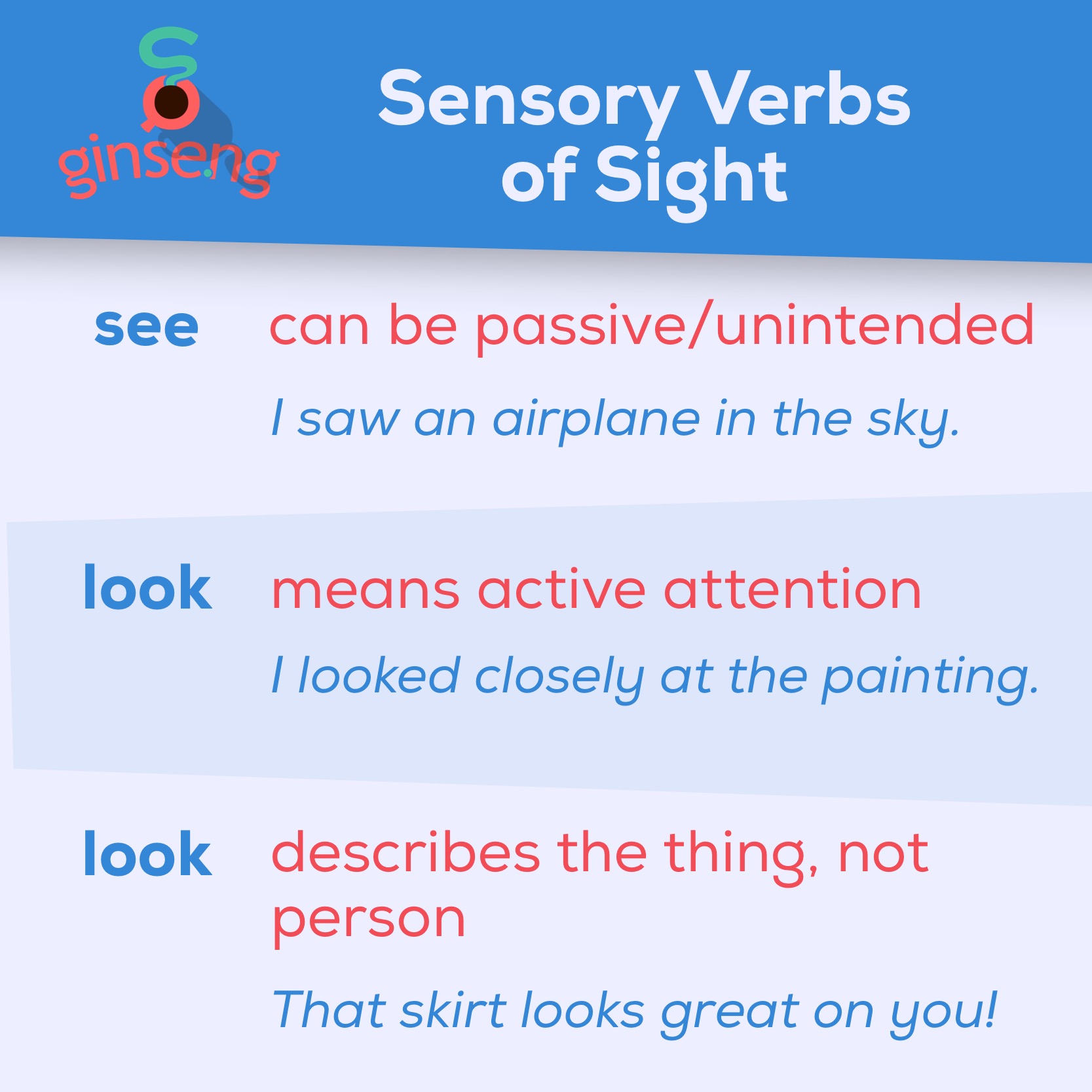
The first is for when we unintentionally sense something. For instance, I am sitting in my room and I hear a truck outside. I'm not trying to hear the truck. I am just sitting here, and the sound reaches my ears. Hear is the way we describe the passive sense of hearing. Here are some more examples of passive, unintentional sensory verbs:
I see a rainbow!
The dog hears someone at the door.
I can feel the floor vibrating!
Do you smell something cooking?
I think I taste cinnamon in this bread.
Active/Intentional
The second way we talk about sensory verbs is when we actively, intentionally use our senses. For example, my soup comes, and I am excited to try it. I put my nose close to the bowl and I smell the soup. Then I take my spoon and I taste my soup. I am actively trying to pay attention to the sensation. These are sometimes called dynamic sensory verbs. Here are examples of the five sensory verbs we use for intentionally using our senses:
She looked out of the window.
Shh! I am listening to a lector for my homework!
Here, taste this before it gets cold.
She smelled the milk to see if it was okay to drink.
He touched the grass, and it was wet.
Stative Sensory Verbs
The final type of sensory verb is a bit different. The first two types describe what people do. with their senses. But the third type of sensory verb talks about the things that we sense, the cause of what we are feeling. I can listen to music, and the music sounds good to me. I can touch the ice, and the ice feels cold to me. These are called stative sensory verbs, because they describe the state of the thing. Here are five more examples:
She was wearing her new dress. She looked beautiful.
What is that music? It sounds terrible.
Wow, this sauce tastes incredible!
Ew, that trash smells awful.
This blanket feels so soft!
Notice that in each of the examples above, the thing is the subject, not a person.
Adjectives and Stative Sensory Verbs
Another thing to notice about stative sensory verbs is that we use adjectives with them. Other verbs often have adverbs after them (adverbs describe verbs). But with stative verbs, we use adjectives. Adjectives describe nouns, and the stative verb is connecting the noun to the adjective that describes it.
Look again at the examples in the last section. We say It sounds terrible, not It sounds terribly. We say It tastes good, not It tastes well.


Future Perfect Tense
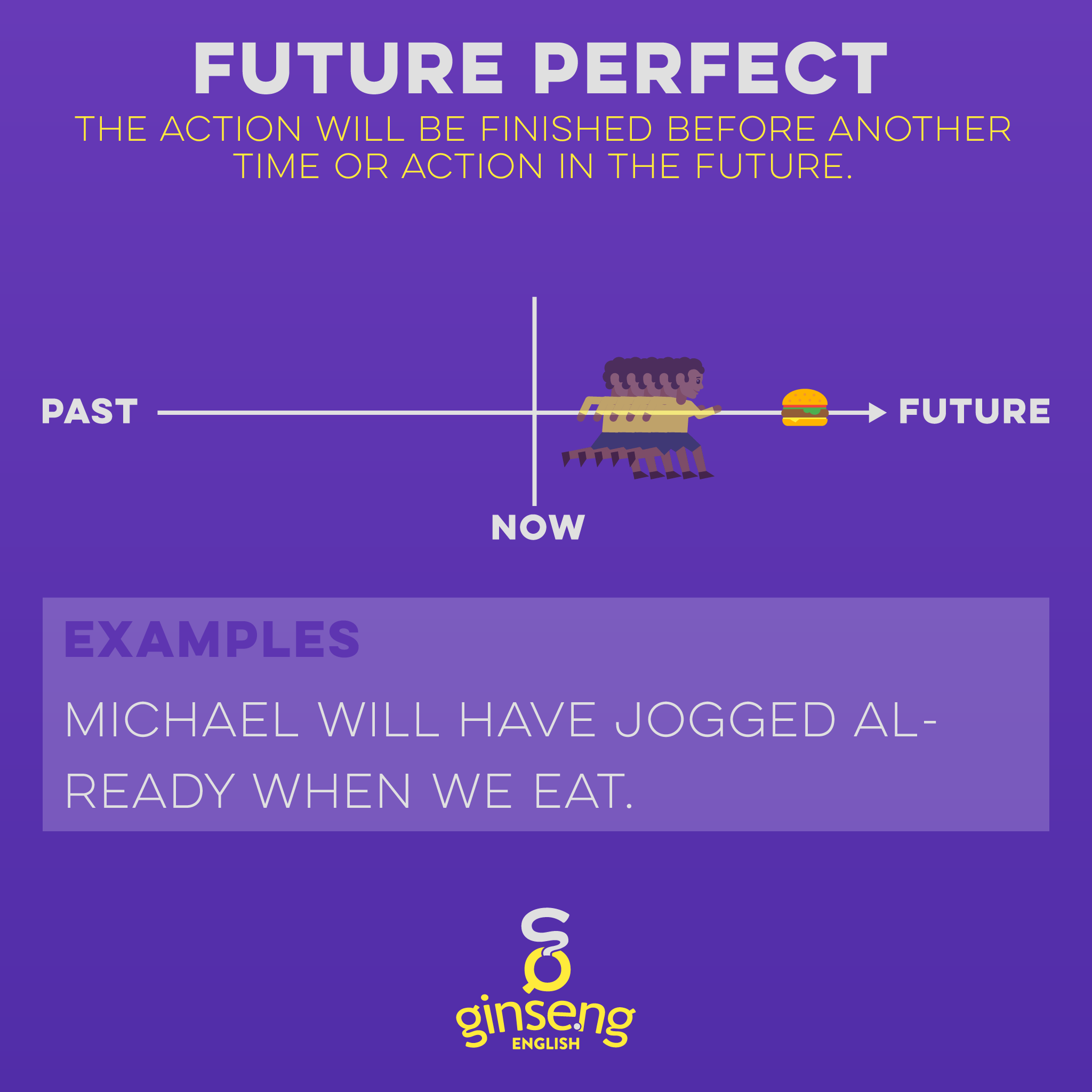
The future perfect is an English verb form used to describe actions that will be complete at a particular moment in the future. This can be a time or date, or it can be another action.
This is not a common verb form. Less than .1% of English verbs are in the future continuous.
Keep reading to learn the rules and reasons for using and forming the future continuous, including loads of charts and examples!
Using the Future Perfect
Perfect verb tenses are used to describe an action that is complete before another action or point in time. With the future perfect, that time is in the future. This can be a time or date (next weekend, tomorrow at 5, on November 3rd) or it can be another action in the future.
Chart for Future Perfect Tense In English

Here are some example sentences:
The skyscraper isn't completely built yet, but when I go in June, they will have finished it.
You can come over at 8. We will have eaten dinner by then.
In these examples, the perfect action (will have finished, will have eaten ) will be complete before the other specific action (when I go in June) or time (at 8).
Forming the Future Perfect
Formula with Will
To form the future perfect, we use the future form of the helping verb have—will have—and the perfect form of the main verb. No matter what the subject is, the verb form is:
subject + will have + perfect VERB
Conjugation
That means the conjugation chart is really easy!
| Singular | Plural | |||
|---|---|---|---|---|
| 1st person | I | will have worked. | we | will have worked. |
| 2nd person | you | will have worked. | you | will have worked. |
| 3rd person | he | will have worked. | they | will have worked. |
| she | will have worked. | |||
| it | will have worked. | |||
Formula with Going to
Because forming the future tenses with be going to is more complex and wordy, we almost never form the future perfect with be going to. In the rare situation that we might use it, the formula is:
subject + am/is/are + going to have + perfect VERB
Conjugation
Here is a conjugation table for the verb work with going to.
| Singular | Plural | |||
|---|---|---|---|---|
| 1st person | I | am going to have worked. | we | are going to have worked. |
| 2nd person | you | are going to have worked. | you | are going to have worked. |
| 3rd person | he | is going to have worked. | they | are going to have worked. |
| she | is going to have worked. | |||
| it | is going to have worked. | |||
Other Forms
Questions
In the future perfect, you have more than one helping verb. To make a question, move the subject after the first helping verb, will, but before the second helping verb, have.
Will you have eaten by 8?
Will they have finished the construction by the end of the year?
Will she have completed her degree by that time?
What will they have accomplished with this senseless war?
When will they have made a decision?
Negative Sentences
To form a negative, insert not between the first helping verb will and the second helping verb have. Here are some examples.
I will not have eaten by 8.
They will not have finished the construction by the end of the year.
She will not have completed her degree yet.
The Passive Voice
Making a passive sentence in the future perfect is extremely complex and extremely rare. We do not recommend making future perfect passive sentences. If for some reason you do need to make a passive sentence in the future perfect, use be in the future perfect (will have been) and then the perfect form of the main verb.
The package will have been delivered by Friday afternoon.
All the food will have been eaten by the time we get there.
CHECK OUT THESE OTHER FREE GRAMMAR RESOURCES:
How Many Verb Tenses Are There?
Sixteen verb tenses in English? Twelve verb tenses? Three verb tenses? Only two verb tenses? This article will explain the various answers you may find to the question, How many verb tenses are there in the English language.
The English verb tense system can be really intimidating for learners. The different verb tenses and aspects really are tricky, but it can be difficult even to get an answer to a simple question: How many verb tenses are there in English?
Below we will discuss the various answers to this questions that you might find to this question and a brief explanation of each.
2 Verb Tenses in English
Occasionally you might hear someone say “technically, there are only two verb tenses in English.” This is not a very helpful answer if you are learning English, but let’s talk about what they mean when they say this.
When someone says that there are only 2 tenses in English, they are referring to morphological tense, that is, tense that can be expressed in a single word, by adding a suffix. In this case, the verb tenses are the present tense and the past tense. Because we talk about the future in English using will or going to—that is, we use helping verbs, rather than changes to the form of the main verb—the way we express the future in English does not meet the definition of morphological tense.
For some linguists, this is a valuable distinction. For English learners, it is not helpful.
3 Verb Tenses
Many English teachers will answer that there are 3 verb tenses. In this case, we are thinking of the three time frames in which an action can take place. By this definition, the three verb tenses are:
Past Tense
Present Tense
Future Tense
If you are talking about tenses in particular (not aspects) then the most useful answer for English learners is that there are three verb tenses.
12 Verb Forms
The answer that we think is most helpful for English learners is that there are 12 verb forms. More precisely, these are not 12 verb tenses but 12 combinations that can be produced by combining the 3 verb tenses and the 4 verb aspects.
16 Verb Tenses

One other answer that you will see sometimes is that there are 16 tenses. This response includes the 12 tense/aspect combinations mentioned above, as well as the 4 future-in-the-past constructions:
Future in the Past
Future Continuous in the Past
Future Perfect in the Past
Future Perfect Continuous in the Past
These are not generally treated as verb tenses in English, although they are tenses in other languages.
24 Verb Tenses
If you find a website that claims there are 24 verb tenses in English, this is wrong. They are probably confusing verb tenses with grammatical voice. You can transform each of the 12 verb forms into both passive and active voice, but grammatical voice is importantly difference from tense.
Passive Voice
What is the passive voice?
The passive voice is a way of expressing yourself in English (some people say passive form or passive tense, but the correct term is voice).
Active vs. Passive Voice
There are two voices in English grammar: active and passive. Voice is different from tense. There are 12 verb tenses in English, and any of these can be either active or passive (though some of these combinations almost never occur in actual usage).
Grammatical voice is a way of showing the relationship between action expressed a verb and the subject of that verb. When the subject does the action, the active voice is generally used. When the subject receives or undergoes the action, the passive voice is generally used.
The vast majority of the time, we use the active voice: over 95% of verbs in speech and fiction are active, and over 80% in academic and specialized texts.
This article explains the grammar of the passive voice in English, with lots of examples in each verb tense and aspect.
Why Do We Use the Passive Voice in English?
There are many different reasons that we use the passive voice. Again, the overall effect of using the passive voice is to focus on the person or thing that receives the action (the receiver or target), rather than the person or thing that does the action (the agent). But there are many reasons we might want to do this.
Because the receiver is the topic:
Because the receiver is more important to the situation than the agent:
Because the agent is obvious:
Because you want to be vague or avoid mentioning the agent:
Because there is no known agent:
To create a more formal or academic style:
Forming the Passive Voice
When you want to transform a sentence from active form to the passive form: there are two main things to pay attention to.
First, we move the direct object to the subject position, before the verb. Simple. You can say that the object gets promoted to the role of subject, and the subject can be demoted to a prepositional phrase (including this is optional).
The second change is trickier: We also need to change the form of the verb. We need to put the main verb in the past participle. Be becomes been. Do or did becomes done. Go or went becomes gone. Cook becomes cooked. In a passive sentence, the main verb is always in the past participle.
Then we need to insert a be verb in whatever tense we are using before the main verb. If the sentence is in the simple past, use be in the simple past: was. If the sentence is in the simple future, use be in the simple future: will be. If the sentence is in the present perfect, use be in the present perfect: has been. If the sentence is in the present perfect, use be in the present perfect: is being.
The formula for a verb in the passive voice is [conjugated be verb] + [main verb in past participle].
The following section contains examples of every verb tense transformed into the passive voice.
The Get Passive
An alternate way to form the passive uses get as an auxiliary instead of be. With certain verbs, the get passive is very common. These include: get married, get hired, get fired, get picked up, get dropped off, get chosen, get arrested, get accepted.
In some situations, the get passive feels less formal than the be passive.
In some verb tenses, the auxiliary be is used to make the action continuous. When these tenses are made passive we still need to add another auxiliary. This means placing been and being together, which sounds awkward. For example the active sentence Trainees have been observing them. becomes the passive They have been being observed by trainees. Using the get passive can make sentences like this sound better: They have been getting observed by trainees.
Examples of Passive Voice for Each Verb Tense
Below you will find examples of every verb tense in the English passive voice. Some of these are so rare that we never use them. These are noted.
Simple Present
Simple Past
Simple Future
Present Continuous
Past Continuous
Future Continuous
Present Perfect
Past Perfect
Future Perfect
*This form is very unusual and awkward.
Present Perfect Continuous
Past Perfect Continuous
Future Perfect Continuous
Intransitive Verbs and the Passive
Remember, when we transform an active sentence into the passive, we are taking the direct object and moving it to the subject position. This means we must have a direct object to transform a sentence into the passive voice.
Transitive verbs have direct objects. Intransitive verbs do not have direct objects. This means that intransitive verbs cannot be transformed into the passive voice.
Imperative Mood and the Passive
How do you say “Shut the door.” in the passive? Learners try to quiz each other with questions like this.
The simplest answer is that you cannot put an imperative sentence in the passive voice in modern English because the passive voice requires an explicit subject and the imperative leaves out the subject.
Some people suggest that Let the door be shut. Is the passive form of Shut the door. This is a close workaround since it is an imperative sentence, and the verb shut is now passive. It is not, however, a direct transformation of the original sentence into the passive, because it introduces an entirely new verb: the causative let.
When Should You Use the Passive Voice?
This is a tricky question. Many inexperienced writers will overuse the passive voice to sound more formal or academic. This has led to the bad advice that you should “avoid the passive voice.”
There is no real answer except that you should use the passive voice when there is a reason to use it. Don’t just use it to sound smart. Good writing is always about making choices. Pay attention to how and when good writers choose to use it, and try to do the same!
3 Types of -ing Verb
Ready for some challenging academic grammar?
English grammar can be difficult because sometimes the same word works differently in different situations. This is true for -ing verbs, which can do three different things.
Let's look at the 3 types:

Three types of -ing verb
CONTINUOUS VERBS
The man is walking.
This is the most basic one: a present continuous verb. The subject in the sentence is "man" and "is walking" tells us what he is doing right now. If you see an -ing verb after a be verb (am, is, are, was, were), it is probably a continuous verb.
Another name for continuous verbs is progressive verbs. Continuous and progressive mean the same thing.
PARTICIPIAL ADJECTIVES
The walking man lives with my friend Paul.
The man walking across the street lives with my friend Paul.
In both of these sentences, walking works like an adjective, not a verb. Walking describes the man, and the verb in the sentence is lives. When an -ing verb describes a noun, we call it a participial adjective. Participial adjectives can come before or after the noun, but it is more common to put them after the noun.
Read a little more about participial adjectives here.
GERUNDS
The man likes walking.
In this sentence, we have a subject: the man. We have a verb: likes . What is the -ing verb here? It's the thing that the man likes. What does he like? Walking. Walking is the object of like. What are some other things you can like? Sports, travel, English. All nouns. Object of verbs are nouns, so walking is acting as a noun here. That's what a gerund is: an -ing verb that works like a noun.
More free English resources
Pronouns in English
What is a Pronoun?
Pronouns are one of the 9 parts of speech in English grammar. A pronoun is a word that takes the place of a noun. Pronouns are important in English. They are some of the first words we learn: I, you, he, she, it. There are different kinds of pronouns for different situations: subject pronouns, object pronouns, possessive pronouns, and reflexive pronouns. Instead of Sara, we can say she. Instead of those guys, we can say them. Instead of the sun, we can say it.
Why do we use pronouns?
One reason that we use pronouns is to avoid repetition. Think about this example:
Look at this beautiful table. The table is gorgeous. The table has a red top and the table's legs are steel. I really want to buy the table.
The table, the table, the table, the table—aaaaaaah. We try to avoid this kind of repetition in English. Instead of table, table, table, table, we usually say table once. After that first time, we use a pronoun, like it. This next example is more typical of how we speak in English:
Look at this beautiful table. It is gorgeous. It has a red top and its legs are steel. I really want to buy it.
Simpler and cleaner! That's why we use pronouns.
So a pronoun can take the place of a noun. But there are also some important differences between how we use nouns and pronouns. For instance, we don’t usually use a determiner before a pronoun: we say the table, but we never say the it. We say my friend, but we don’t say my him. We also don’t usually use adjectives before pronouns. We can say the red car, but it would be very strange to say the red it.
Now let's look at the five different kinds of personal pronouns:
English Personal Pronouns
In English, we use different pronouns to show grammatical person, gender, and singular/plural distinctions.
For example, if I am talking about myself, we call this the first person. If I are talking about myself alone, this is singular (only one person). Singular first person pronouns include I, me, mine, etc.
If I am talking about a group of people that includes me, this is the first person plural (more than one person). Plural first person pronouns include we, us, ours, etc.
English Pronoun Chart
Second person pronouns are used to talk about the person you are speaking to. These include you, yours, yourself, etc. You can be both singular and plural in English.
Third person pronouns are used to talk about people who are not either the speaker or the listener. They include the third person singular pronouns (like he, she, it) and third person singular pronouns (like they, them, etc.).
For inanimate objects—things that are not people—we use it, its, and itself.
They/Them Pronouns
When we use third person pronouns, we often distinguish between genders. For example, she, her, and hers are often used to talk about women, and he, him, and his are often used to talk about men. They, them, and their can be used as gender-neutral pronouns. We can use these either because we don't want or need to specify a gender, or because someone goes by non-gendered or nonbinary pronouns.
SUBJECT PRONOUNS
The first pronouns we teach are usually subject pronouns. The subject is often the noun right before the verb. Almost every sentence has a subject. Generally, the subject of the sentence is the person or thing that does the verb or makes the verb happen.
The tiger sleeps a lot.
In the example above, the verb is sleeps, and the subject is tiger. Who sleeps? The tiger does. The subject usually tells us who or what does the action. We have a special set of pronouns that we use to be the subject of a sentence. The table below lists the most common subject pronouns.
| Singular | Plural | |
|---|---|---|
| 1st person | I | we |
| 2nd person | you | you |
| 3rd person | she | they |
| he | ||
| it |
We don’t say Me like candy or Him has a cat. We say I like candy and He has a cat. Me and him are the wrong type of pronouns. We use subject pronouns. Here are some more examples:
I like movies.
Do you like movies?
Invite Clara. She likes movies.
He likes movies, too!
We like watching movies on weekends.
Before a verb, to express who or what does the action in a sentence, use a subject pronoun.
OBJECT PRONOUNS
Almost all verbs have a subject, and some also have an object. The object of a verb is the thing that receives an action. For example, you wouldn't just say, I want, right? You need to want something. We say I want coffee or I want a cheeseburger. Coffee and cheeseburger are objects. They receive the verb, want.
I want a hamburger.
I want a job.
I want a girlfriend.
Hamburger, job, and girlfriend are objects. Notice that objects generally come after the verb in the sentence. We use object pronouns to represent objects in sentences. This table lists the most common object pronouns:
| Singular | Plural | |
|---|---|---|
| 1st person | me | us |
| 2nd person | you | you |
| 3rd person | her | they |
| him | ||
| it |
Here are some examples of sentences using object pronouns:
That hamburger looks delicious. I want it.
Who is that girl? I think I know her.
You can have these books if you want them.
Can I help you?
My teacher hates me!
In all the examples above, the pronouns are the objects of a verb. We use the same set of object pronouns as the objects of prepositions, as you can see in these examples:
My grandmother gave that to me.
I've been getting weird texts from her.
We've heard so much about you!
After a verb or a preposition, you generally want to use an object pronoun.
POSSESSIVE PRONOUNS
To possess something is to own or have that thing. If I have a car, we can say that car is my possession. We can say, That car is mine. Mine is a pronoun in this sentence. It represents the car, the thing that I possess. Mine is a possessive pronoun. Here is a chart with the most common possessive pronouns:
| Singular | Plural | |
|---|---|---|
| 1st person | mine | ours |
| 2nd person | yours | yours |
| 3rd person | hers | theirs |
| his | ||
| its |
Here are some example sentences with possessive pronouns:
That car is hers.
This is my drink. That one is yours.
All the coats are in a big messy pile. I can't find mine!
As you can see, possessive pronouns can be used to talk about things that belong to specific people.
POSSESSIVE DETERMINERS
Possessive determiners (also called possessive adjectives) are not actually pronouns, but it's a good idea to learn them at the same time, because they are very similar to possessive pronouns. The difference is that possessive determiners can not replace nouns; they come before nouns to tell us whose they are. If someone asks, Whose iPad is this? you could answer with a possessive pronoun: It's mine. But you could also use a possessive determiner:
That's my iPad.
With a possessive determiner, it is important to include a noun after. Just saying That is my. would by wrong. Here is a list of the most common possessive determiners.
| Singular | Plural | |
|---|---|---|
| 1st person | my | our |
| 2nd person | your | your |
| 3rd person | her | their |
| his | ||
| its |
And here are some examples of possessive determiners in sentences:
Sorry, I have to take this call. It's my son.
Cheryl is at her English class.
We lost our baseball game.
Please take off your shoes.
Can you believe they lost their homework again?
REFLEXIVE PRONOUNS
So we have talked about subjects and objects, right? Subjects are the people or things that do the action in the verb, and objects are the people or things that receive the action. Sometimes, those are the same person, right? For example, if I cut my finger, I hurt someone. The someone I hurt is me (ouch!). But in English we don't say I hurt me. We have special pronouns for the object in this situation, and they are called reflexive pronouns.
Here is a table of the most common reflexive pronouns in English:
| Singular | Plural | |
|---|---|---|
| 1st person | myself | ourselves |
| 2nd person | yourself | yourselves |
| 3rd person | herself | themselves |
| himself | ||
| itself |
And here are some examples of reflexive pronouns used in sentences:
Clara taught herself English.
Don't play with that knife. You will hurt yourself.
The kids are entertaining themselves in the yeard.
Oh, nothing. I'm just talking to myself.
After a couple of days, the problem fixed itself.
Complete English Pronoun Chart
Here is a complete table of all the pronouns discussed in this post. There are still some other types of pronouns, however. Demonstrative pronouns and relative pronouns, for example, are usually studied separately.
| Subject | Object | Possessive Pronoun |
Possessive Determiner |
Reflexive | |||
|---|---|---|---|---|---|---|---|
| Singular | 1st Person | I | me | mine | my | myself | |
| 2nd person | you | you | yours | your | yourself | ||
| 3rd person | Feminine | she | her | hers | her | herself | |
| Masculine | he | him | his | his | himself | ||
| Neutral | they | them | theirs | their | themself | ||
| Inanimate | it | it | its | its | itself | ||
| Plural | 1st Person | we | us | ours | our | ourselves | |
| 2nd Person | you | you | yours | your | yourselves | ||
| 3rd Person | they | them | theirs | their | themselves | ||
| Impersonal | one | one | one's | one's | oneself | ||
Pronombres en Inglés
Pronomes pessoais em inglês
الضمائر في الانجليزية
Parts of Speech in English
Parts of Speech in English
Every word in a language can be categorized by its part of speech. Parts of speech (also known as word classes) tell us what a word does, along with how it functions and makes meaning. We can also group parts of speech into lexical words, which carry a lot of meaning, and function words (or grammar words), which help us make sentences and show the relationship between things.
Overview of English Parts of Speech
How Many Parts of Speech are There?
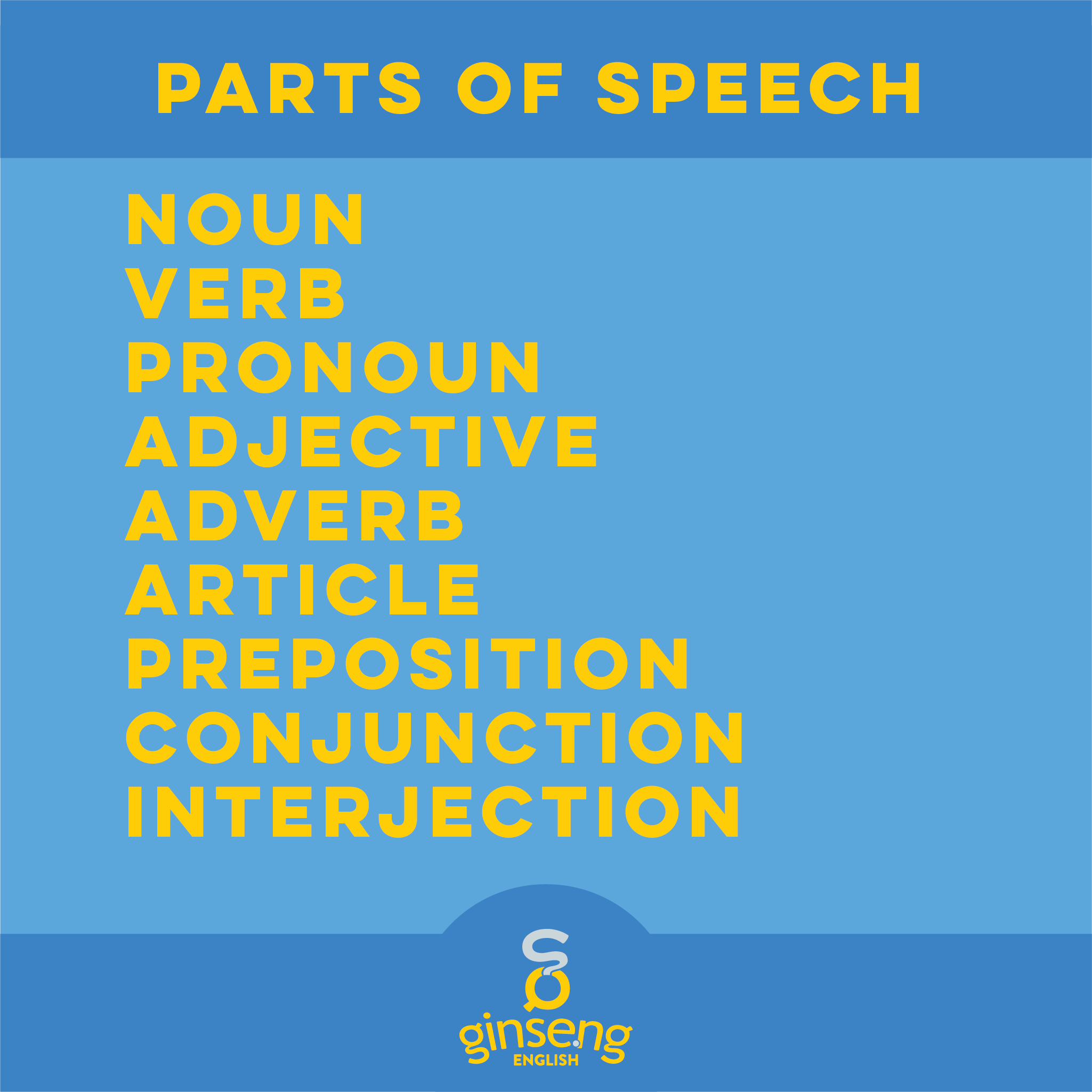
There are a total of 9 different parts of speech in English: nouns, pronouns, verbs, adverbs, adjectives, prepositions, conjunctions, interjections, and articles (or determiners). Read on for a brief explanation of each!
If an article tells you that there are only 8, they are often missing articles or determiners, which are a really important one, especially for language learners.
Why Learn about Parts of Speech?
If you’re looking for the parts of speech in English grammar, you’ve come to the right place! If you’re trying to learn English online by yourself, understanding the parts of speech is a good place to start. They can help you to understand the structure of the language to guide your studying. If you are looking for an in-depth guide to English grammar, our complete English grammar guide might be more helpful.
Frequency of Different Parts of Speech
At Ginseng English, we believe in taking a research-informed, strategic approach to learning English. So understanding the general frequency of the different parts of speech is helpful. Take a look at the following table showing the proportion of the different parts of speech in conversational English and academic prose. (Note that the percentages are approximate and may not total 100% because the original categorization was slightly different from ours. This is only to give a general sense of the proportions.
| Conversation | Academic | ||
|---|---|---|---|
| Lexical | Nouns | 15% | 30% |
| Verbs | 12.5% | 10% | |
| Adjectives | 2.5% | 10% | |
| Adverbs | 5% | 3% | |
| Function | Pronouns | 16.5% | 4% |
| Prepositions | 5.5% | 15% | |
| Determiners | 4.5% | 10% | |
| Conjunctions | 4.5% | 5% |
Source: Biber, et. al., (1999). Longman Grammar of Spoken and Written English.
Nouns
Lots of teachers say a noun is a person, place, or thing! You should also add ideas to that list. Proper nouns in English start with a capital letter, but other nouns do not.
Here are some examples of nouns:
This is my father.
We are from Ecuador.
I have two dogs.
On this holiday we celebrate our independence.
Nouns in English can be singular or plural. to form a regular plural, we simply add -s or -es to the end of a noun. Irregular plurals do not follow this rule.
Here is a complete article on Nouns in English.
Pronouns
Pronouns are used to stand in place for a noun, because in English we don’t like to repeat nouns again and again. The noun that a pronoun refers back to is called its antecedent. Examples of common pronouns in English are he, she, it, him, her, mine, this, that, myself. Pronouns in English change form to show, for example, whether they are singular or plural, subjects or objects, male or female or neither.
Here are examples of some basic pronouns:
Can I have that?
We are with her.
I think I need something to eat.
Here is a complete article on pronouns in English.
Verbs
Verbs are words we use to talk about actions, states, and occurrences (things that happen). Many people would say that nouns and verbs are the most important and useful parts of speech in any language.
The main verb in a sentence has a subject, generally a noun or pronoun referring to the person or thing that the sentence is about. For example, in the sentence Maria walks, the verb is walks and the subject is Maria. Verbs can change form to ‘agree with’ their subject.
Here are some examples of verbs:
They cook every night
We went to the store.
This will help the people.
Notice in that last example that a verb can be more than one word. This is called a compound verb. There are two types of verb: main verbs and helping verbs (also called auxiliary verbs).
Adjectives
Adjectives are words that describe, or modify, nouns. They generally (but not always) come before nouns. In the following phrases, the adjectives are in bold:
a big party some terrible news the best pizza an interesting idea a really strong leader
For more information, check out our list of the most common adjectives in English.
Adverbs
Like adjectives, adverbs are describing words. But while adjectives describe only nouns, adverbs can describe verbs, adjectives, other adverbs, or entire sentences.
Because adverbs are so versatile, it is hard to say much that applies to all adverbs generally. They can appear at different places in the sentence: at the beginning, before a verb, before an adjective, after a verb, or at the end of a sentence.
walk slowly speak clearly immediately fell run fast
Many adverbs end in -ly, and many adjectives can be transformed into adverbs by adding the suffix -ly: slow becomes slowly, eventual becomes eventually, stupid becomes stupidly, etc.
One of the most basic types of adverbs are adverbs of frequency. Click through to read more about those.
Articles
The articles in English are a, an (indefinite articles) and the (definite article). Articles can be really tricky, but the basic idea is that we use indefinite articles when we are introducing a new noun to our listeners or not referring to a specific object. On the other hand, we use definite articles to refer to a specific object that our listeners already know about.
Note: You may find articles out there claiming that articles are a type of adjective. This is simply incorrect. At one time (about 300 years ago) some people thought this, but this is not a current view.
Note: Some grammars treat articles as a subcategory of determiners. This is a valid view. Determiners include possessive determiners such as my and your, as well as demonstrative determiners such as this, that, these, and those.
Prepositions
Prepositions are, to put it simply, words that are placed before (pre-position) nouns or pronouns to connect them to other parts of speech in a sentence. There are different types of preposition that give different types of information: prepositions of time, prepositions of place, prepositions of direction.
Conjunctions
Conjunctions are words that connect. They can connect, for example, a list of nouns in a series. But most of the time, when we are talking about conjunctions, we are talking about connecting one clause to another clause in the same sentence. There are two types of conjunctions: coordinating conjunctions and subordinating conjunctions.
Coordinating Conjunctions
Coordinating conjunctions connect two clauses of equal importance into what we call a compound sentence. There are not many coordinating conjunctions. You can remember them with the acronym FANBOYS: for, and, nor, but, or, yet, so.
Subordinating Conjunctions
When we connect clauses using subordinating conjunctions, we are giving one clause more importance than the other. The less important clause is called a subordinate clause. Two or more clauses combined with subordinating conjunctions are called a complex sentence. Some common subordinating conjunctions are because, although, before, since, when, while, and if.
Interjections
Interjections are funny words: ouch, wow, hmm, oops, well, geez.. They are sort of the black sheep of English grammar. They are not connected to the other words in a sentence (they are inter-jected, put in between, the other words). Generally they add emotion to a sentence. Here are some examples of interjections:
Wow, I'm so tired.
Ouch! I cut my finger.
Oh, you moved to Manhattan
Past Perfect Continuous Tense
The present perfect continuous is an important verb form for talking about recent events and their durations. Read about the rules for using the present perfect continuous tense, how we form it, and tons of example sentences!
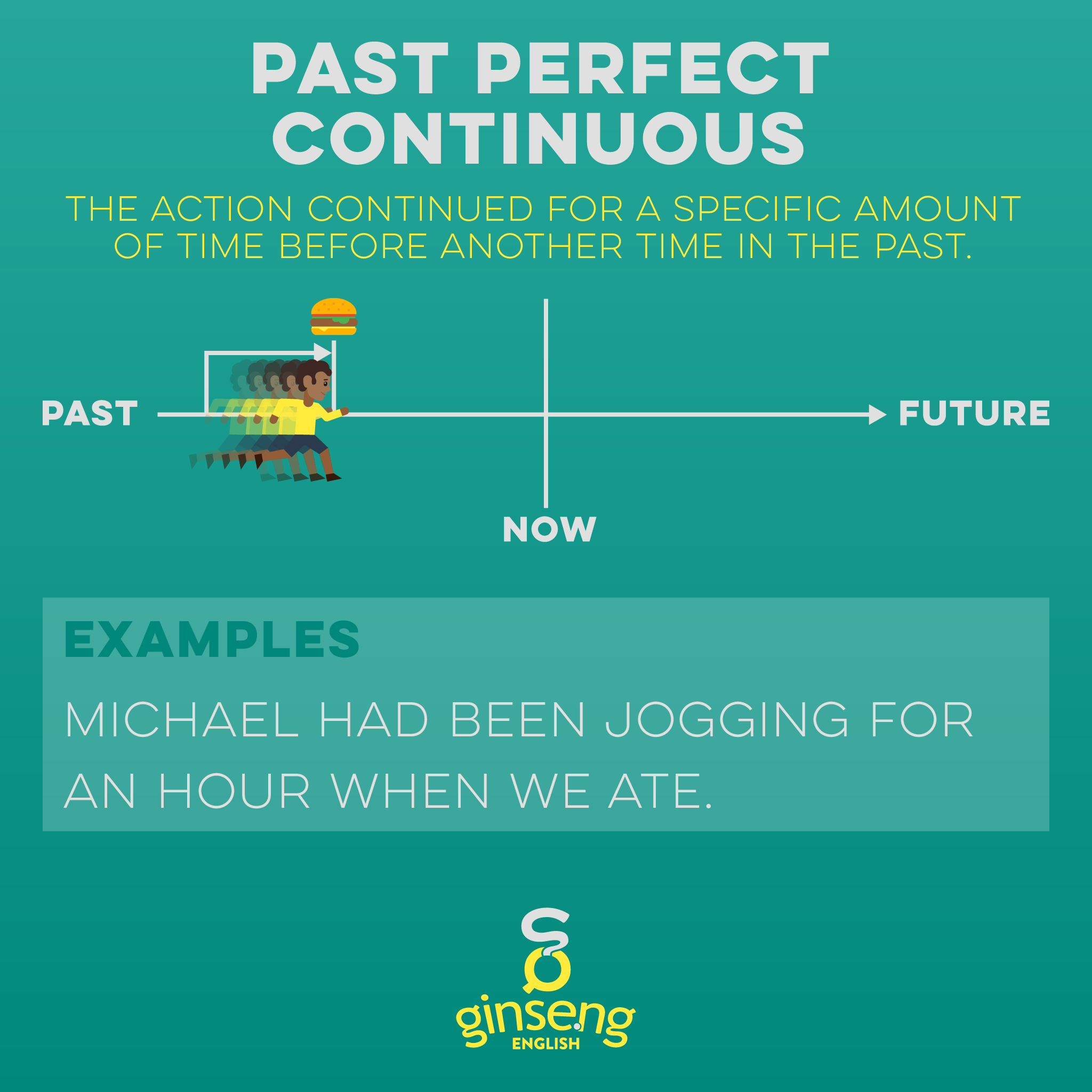
The past perfect progressive shows that an action started in the past and continued up to another time or action, also in the past. It does not specify if the action continues after that point. This is a very uncommon verb form: less than .1% of verbs in spoken English are in this form.
Continue reading to learn how to form the past perfect continuous and when to use it, including loads of examples and charts!
Just to be clear, continuous and progressive are just different names for this same thing. In some countries, one word is more common, but continuous is more common around the world, so we use that!
Chart for Past Perfect Continuous Tense in English

Using the Past Perfect Continuous Tense in English
The past perfect continuous is really difficult. Lots of websites will claim to explain this tense in just a quick article, and this just isn’t possible (sorry!). We use this verb form in a few different situations, and it can have different meanings depending on the situation. Here are some examples:
We were wet because it had been raining for hours.
I knew the city well at that point because I had been living there for a few years..
When I met your mom I was in pretty good shape because I had been working construction
Note that these correspond pretty closely with the different ways that we use the present perfect continuous form:
Recently Completed Actions
Actions Still Happening (with for/since)
New Routines and Habits
The past perfect continuous is basically the same, except shifted into the past time frame.
It is worth mentioning that, in many situations the past perfect and past perfect continuous are interchangeable.
Here are a few more examples:
That had been a difficult month. She had been working long hours.
I’d been going to the gym a lot back then.
We’d been cooking at home more at that point.
Forming the Past Perfect continuous
Formula
Forming the past perfect continuous isn’t difficult. You will always use the same formula:
had + been + VERBing
You could also think of it as simple steps, too:
First, use had (this is the past part)
Then use been (this is the perfect part)
Then use your main verb with -ing (this is the continuous part)
Conjugation
Here is the verb work conjugated into the past perfect continuous.
| Singular | Plural | |||
|---|---|---|---|---|
| 1st person | I | had been working. | we | had been working. |
| 2nd person | you | had been working. | you | had been working. |
| 3rd person | he | had been working. | they | had been working. |
| she | had been working. | |||
| it | had been working. | |||
Notice that we can see both the perfect and the continuous aspect in this form. Had been is the perfect aspect. Been verb-ing is continuous aspect.
Other Forms of the past Perfect continuous
Negative Sentences
You always have two helping verbs in the past perfect continuous: had and been. To make a negative, simply make it had not been.
I had not been practicing for very long.
I had not been living in Boston for years, and I missed it.
I had not been studying, so I was doing poorly in school.
Because the past perfect continuous uses so many words, we often use contractions with not to make it a little shorter:
I hadn't been practicing for very long.
I hadn't been living in Boston for years, and I missed it.
I hadn't been studying, so I was doing poorly in school.
Questions
To make a question, put had before the subject:
Why did they break up? Had he been cheating?
How long had the car been running for when it finally died?
Why had you been studying Chinese if you were planning to move to France?
Passive Voice
Making passive sentences with rarer and more complicated verb forms like the past perfect continuous is extremely uncommon and almost always a bad idea. We really recommend that you rephrase a sentence to avoid creating such an awkward sentence.
They had been being observed a lot at work.
Hopefully you can see how awkward this sentence is. If you really need to make a passive sentence in this form, you should use the get passive to avoid the awkward combination of been and being.
Put get in the past perfect continuous (had been getting) and then the perfect form of the main verb.
We had been getting observed a lot at work lately.
I'd been getting kicked off the internet every 5 minutes.
check out these other free grammar resources:

Future Continuous Tense
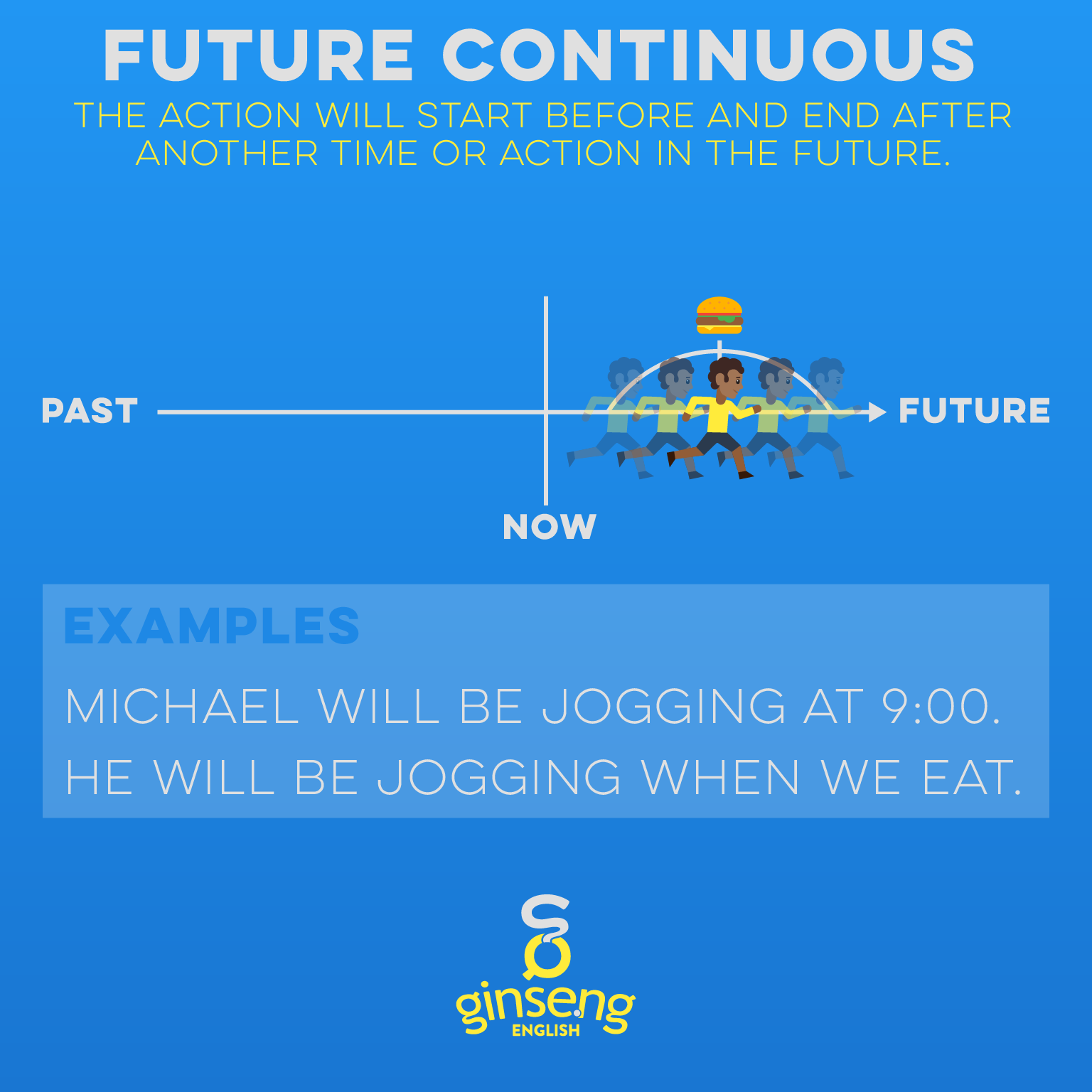
The future continuous (also called the future progressive) is an English verb form used to describe actions that will be in progress at a particular moment in the future. This can be a time or date, or it can be another action.
This is not a common verb form. Less than .1% of English verbs are in the future continuous.
Keep reading to learn the rules and reasons for using and forming the future continuous, including loads of charts and examples!
It is important to realize that continuous and progressive are different names for the same thing. In some places, progressive is more common, but continuous is a more common term overall.
USing the Future continuous
When we see a continuous verb, it tells us that something is in progress at a particular time. With the future continuous, that time is in the future. This can be a time or date (next weekend, tomorrow at 5, on November 3rd) or it can be another action in the future.
Chart for Future Continuous Tense In English

Here are some example sentences:
Don’t call her at 8. She will be flying to Denver then.
I will probably be running when you come home.
Try to be quiet when you come home tonight. Everyone will be sleeping.
In these examples, the continuous action (will be flying, will be running) will start before the other specific action (come home) or time (at 8), and continued after that action or time.
We can also use the future continuous to show that a future action will continue over a period of time.
I’m going to be studying all next week.
We will be traveling for most of 2019.
Forming the Future continuous
There are two options for forming the future continuous: will or going to.
Formula With Will
To form the future continuous with will, use will be and the continuous form of the verb, with -ing.
subject + will be + VERBing
Conjugation with Will
Here is a complete conjugation table:
| Singular | Plural | |||
|---|---|---|---|---|
| 1st person | I | will be working. | we | will be working. |
| 2nd person | you | will be working. | you | will be working. |
| 3rd person | he | will be working. | they | will be working. |
| she | will be working. | |||
| it | will be working. | |||
Formula With Going To
To form the future continuous with going to, you need to use the correct present form of the verb to be (am/is/are). Then use going to be. Then use the -ing form of the verb.
subject + am/is/are + going to be + VERBing
Conjugation with Going to
Here is the going to conjugation table:
| Singular | Plural | |||
|---|---|---|---|---|
| 1st person | I | am going to be working. | we | are going to be working. |
| 2nd person | you | are going to be working. | you | are going to be working. |
| 3rd person | he | is going to be working. | they | are going to be working. |
| she | is going to be working. | |||
| it | is going to be working. | |||
Other Forms
Questions
In the future continuous, you have more than one helping verb. To make a question, move the subject after the first helping verb (be or will).
Will you be eating out tonight?
When will you be arriving in Philadelphia?
Are you going to be sleeping when I get home?
What are you going to be reading next semester?
Negative Sentences
To form a negative, insert not after the first helping verb (be or will).
I will not be eating out tonight.
She will not be running.
We are not going to be reading Nabokov.
I am not going to be sleeping when you get home.
The Passive Voice
Making a passive sentence in the future progressive is extremely complex and extremely rare. In the conventional passive, putting be in the future progressive results in the unnatural combination of be and being: …will be being… or …going to be being…
For this reason, we recommend using the get passive in the future progressive. Put get in the future progressive (is going to be getting, are going to be getting, will be getting) and then the perfect form of the main verb.
We are going to be getting picked up by my mom.
If we miss another payment, we’ll be getting kicked out!
CHECK OUT THESE OTHER FREE GRAMMAR RESOURCES:
Present Perfect Continuous Tense
The present perfect continuous is an important verb form for talking about recent events and their durations. Read about the rules for using the present perfect continuous tense, how we form it, and tons of example sentences!
The present perfect continuous (also called the present perfect progressive) is a verb form that we use to describe an action that started in the past and either recently finished or is still continuing. Although only about .7% of verbs in speech are in the past perfect, this verb tense can be very useful in certain situations.
Continue reading to learn how to form the present perfect continuous and when to use it, including tons of examples and charts!
Just to avoid confusion, continuous and progressive are just different names for this same thing. In some countries, one term is more common than the other, but continuous is more common overall, so we use that term.
Chart for Present Perfect Continuous in English

Using the Present Perfect Continuous Tense in English
The present perfect continuous is a little bit tricky. If you find a website that claims to explain it in just a few sentences, you should be suspicious. We use this tense in a number of different situations, and it can have different meanings in those different situations. We can look at three common ways that the present perfect progressive is used:
to describe new routines,
to describe recently completed actions, and
for actions that are still continuing.
New Routines and Habits
In general, we use the simple present to talk about routines and habits: If I go jogging every day or a couple of times a week, I can simply say, I jog, right?
But what if this is a new habit? Maybe I have gone jogging every day for the past two weeks, so it is a routine, but it might feel funny to just say I jog. I am a jogger. In situations like this, where we want to demonstrate that a habit or routine is somewhat new, the present perfect continuous is the form that we want to use.
I have been jogging.
Here are a few more examples:
This has been a difficult month. She has been working long hours.
I’ve been going to the gym lately.
We’ve been cooking at home more recently
Recently Completed Actions
We also use the present perfect continuous to talk about actions that have just recently ended, especially when there is still evidence of that action. For example, after you paint, you may still have paint on your hands. To explain this, you would use the present perfect progressive:
Sorry, my hands are dirty. I've just been painting.
Take a look at these other examples:
The house is a mess because we've just been redecorating.
Sorry, I'm all sweaty. I've been exercising.
Why are you two crying? Have you been fighting?
Notice that in each of these examples, there is sensory evidence (the mess, sweating, crying) of the recently completed actions (painting, exercising, fighting). This is almost always the case when using the present perfect continuous in this way.
Actions Still Happening with For and Since
This is probably the most common way that this verb form is used. This is very important: When we see the present perfect continuous with for or since, the action started at a specific time in the past and is still happening. Here are some examples:
Michele has been living in Boston since June.
Juana's been writing her thesis for 6 months.
In the first example, Michele still lives in Boston. In the second example, Juana still works at Apple. Again, when you see for or since with this verb tense, the action or situation described by the main verb is still continuing. See Signal Words, below, for more information about how we use for and since.
Here are more examples with for and since:
Cara's been working at FedEx for 3 years now.
I've been thinking about changing jobs for a long time.
We've been developing a new strategic plan since late last year.
You have been traveling back and forth to California since you got married, right?
Forming the Present Perfect continuous
Formula
Forming the present perfect continuous isn’t difficult. You will always use the same formula:
have/has + been + VERBing
You could also think of it as simple steps, too:
First, choose either have (if the subject is plural or the pronouns I, you, we, or they) or has (if the subject is a singular noun, he, she, or it).
Then use been.
Then use your main verb with -ing.
Conjugation
Here is the verb work conjugated into the present perfect continuous.
| Singular | Plural | |||
|---|---|---|---|---|
| 1st person | I | have been working. | we | have been working. |
| 2nd person | you | have been working. | you | have been working. |
| 3rd person | he | has been working. | they | have been working. |
| she | has been working. | |||
| it | has been working. | |||
Notice that we can see both the perfect and the continuous aspect in this form. Have been is the perfect aspect. Been verb-ing is continuous aspect.
Other Forms of the Present Perfect continuous
Negative Sentences
You always have two helping verbs in the present perfect continuous: have/has and been. To make a negative, simply put not in between them!
She has not been living here for a long time.
I have not been reading much recently.
They have not been working late.
Because the present perfect continuous uses so many words, we often use contractions with not to make it a little shorter:
She hasn't been living here for a long time.
I haven't been reading much recently.
Questions
To make a question, simply put has/have before the subject.
Has she been living here for a long time?
Have you been working out lately? You look great!
What have you been reading?
When have you been going to bed lately?
Passive Voice
Making passive sentences with more complex verb forms like the present perfect continuous is extremely uncommon and almost always awkward in English. We really recommend that you rephrase a sentence to avoid creating such an awkward sentence.
We have been being observed a lot at work.
See the awkwardness in the sentence above? If you really need to make a passive sentence in this verb form, we often use the get passive to avoid the unnatural combination of been being.
Put get in the present perfect progressive (has been getting, have been getting) and then the perfect form of the main verb.
We have been getting observed a lot at work lately.
I've been getting kicked off the internet every 5 minutes.
Signal Words
Recently or Lately
When we are talking about new routines and habits, it’s common to use the word recently or lately, which both have the same meaning in this sense. There is some flexibility in where we can put these words in a sentence, but the beginning or end of the clause is a safe bet.
Take a look at these examples:
Lately, I've been thinking a lot about Aunt Maude.
We've been having second thoughts about moving recently.
Just
We can use the adverb just to emphasize that an action was completed in the immediate past, right before now. Because the present perfect continuous can talk about actions that stopped right before now, it is common to use just with it. Have a look at these examples:
Don't mind these ridiculous old clothes. I've just been gardening.
Hey Paul! I can't believe you're here. We've just been talking about you!
For
We already said, the most important signal words with the present perfect progressive are for and since. They are important because they change the meaning. Whenever you see for and since with this verb form, you know the action is still true.
When we use for, we specify the duration of the action. This could be the number of minutes or weeks or years. It could also be a more general phrase like a really long time or a little while.
People have been living on this land for thousands of years.
It's been raining for hours
I've been studying English for half my life!
Since
While for is used with a duration, since is used to specify the point in time when the action began. That could be a time or date. It can also be another event described with a clause, like since I was a child.
People have been living on this land since about 800 B.C.E.
It's been raining since noon.
I've been studying English since I was a child.
check out these other free grammar resources:
Past Perfect Tense
The past perfect is an important verb form for describing events in the past. Read about the rules for using the past perfect tense, how we form it, and tons of example sentences!
The past perfect is a verb form that we use to talk about an action that is complete before another action or event in the past.
It isn't one of the most common verb tenses in English (only about 1.2% of verbs in speech are in the past perfect), but it can be very important for narrating events in the past.
Chart for Past Perfect Tense in English
Using the Past Perfect Tense in English

Perfect verb forms are generally used to show that an action or situation is complete before another action or a point in time. In the past perfect, that one action happened before another action in the past. For this reason, we sometimes say the past perfect is “the past of the past.”
Here's an example:
Carla had already eaten when we arrived at her house.
There are two actions here: eating and arriving. Eat is in the past perfect, and arrive is in the simple past, so we know that the eating was completed first. When you have two verbs in a sentence, one in the simple past and one in the past perfect, the past perfect action finished before the simple past action.
The examples below illustrate the rules for how we generally use the past perfect tense.
Examples of the Past Perfect tense
First let's look at how we often use the past perfect in a sentence with other past tense verbs:
I had just left my house when it started to rain.
Notice that we have two clauses and two verbs. Started is in the simple past: it started and finished in the past. Left is in the past perfect (had left) which means that the action (leaving) was complete before the other action (starting to rain).
Sometimes there are two verbs in the same sentence, like in the example above, but not always. Look at this conversation:
Te: Hey, I called you last night, but you didn’t answer!
Banh: Oh, I went to bed pretty early last night. What time did you call?
Te: I think it was around 9.
Banh: Yeah, I had already fallen asleep.
In this example, the verb in the past perfect is had fallen asleep. We know that past perfect means this action was complete before another action or point in time in the past. In this case, we have both an action (Te called) and a time (around 9).
Forming the Past Perfect
Formula
Forming the past perfect is easy. We use had (the past form of the helping verb have) and the perfect form of the main verb.
subject + had + perfect VERB
Conjugation
This table shows the complete conjugation of the verb work in the past perfect.
| Singular | Plural | |||
|---|---|---|---|---|
| 1st person | I | had worked. | we | had worked. |
| 2nd person | you | had worked. | you | had worked. |
| 3rd person | he | had worked. | they | had worked. |
| she | had worked. | |||
| it | had worked. | |||
Other Forms of the Past Perfect
Negative Sentences
The helping verb in the past perfect is always had.To make a negative, put not after the helping verb had.
I had not studied French before I went to Morocco.
They had not seen each other for years.
I hadn’t eaten all night so I was starving.
Questions
To make a question, put had before the subject.
Had they dated long before they got married?
Had you expected the promotion?
Why had she bought so many extra tickets?
How long had you lived in San Francisco by then?
Passive Voice
To make a passive sentence in the past perfect, use be in the past perfect (had been) and then the perfect form of the main verb.
By 1945, the war had been won.
I had been fired, so I felt really depressed.
In the morning we learned that Kiki had been found by the neighbors.
Signal Words
The past perfect is often used with time words such as before, until, previously, etc. One word that is very common (and sometimes confusing!) with the past perfect is by.
We can use by with a specific time to show the completion of the action before that time.
By 1:00, everyone had left the party.
In this example, all the people left before 1:00.
The time isn't always a number, as these examples illustrate:
By dawn the rain had stopped.
By the end of the semester, she had completed all her prerequisites.
By then, I had figured out the solution.
By the time has a similar meaning, but it is used with a clause describing another action, rather than a time.
By the time I got home, everyone had gone to bed.
It had gotten dark by the time we finished eating.
Check out these other free grammar resources:
Past Continuous Tense
The past continuous is an important and challenging verb form in English. It is used to describe actions that were in progress at a specific point in the past. Read about the rules for using the past continuous tense and how we form it, with charts and over 25 example sentences!
The past continuous (also called the past progressive) is an English verb form used to describe actions that were in progress at a particular moment in the past.
About 1.5% of verbs we use when speaking English are in the past continuous tense. If you are looking for more common verb tenses, start with the simple present, simple future, or present continuous.
Keep reading to learn the rules and reasons for using and forming the past continuous, including loads of charts and examples!
Note that past continuous and progressive are just different names for the same form. In some countries, progressive is more common, but continuous is more common overall.
USING THE Past CONTINUOUS TENSE IN ENGLISH
Continuous verbs show that an action is in progress at a specific time. With the past progressive, that specific time is in the past. This can be a time or date in the past (last night, yesterday at 5, on September 1st) or it can be another action in the past (called, got home).
Chart for Past Continuous Tense In English

Take a look at some example sentences:
I was eating dinner when the phone rang.
At 10:00 last night, we were watching TV.
This time last year we were driving to California.
In these examples, the progressive action (was eating, were watching) started before the other specific action (phone rang) or time (at 10:00), and continued after that action or time.
We can also use the past progressive to show that a past action continued or repeated over a period of time in the past
In college I was always sleeping too late.
All last week I was working.
In the first sentence, always with the past continuous shows a repeated action in the past. In the second sentence, the past continuous emphasizes that the action spanned the entire time period (last week). In both of these situations, the simple past is also acceptable.
More EXAMPLES OF THE past CONTINUOUS
Here are a bunch of examples of the past continuous to help you get a better idea of how we use this verb form:
In December I was preparing for the TOEFL.
Something was happening outside.
Everything was changing then.
The next day people were talking about the election.
Forming the past Continuous
Formula
To form the past continuous, we use the past form of the helping verb be and the continuous form of the verb, with -ing.
subject + was/were + VERBing
Conjugation
The table below shows the full conjugation for the verb work in the past continuous form:
| Singular | Plural | |||
|---|---|---|---|---|
| 1st person | I | was working. | we | were working. |
| 2nd person | you | were working. | you | were working. |
| 3rd person | he | was working. | they | were working. |
| she | was working. | |||
| it | was working. | |||
Note that when adding -ing to C-V-C words, you must double the last consonant and when adding -ing to silent E words, you must drop the silent E.
Other Forms of the past Continuous
Questions
In the past continuous, you have a helping verb, either was or were. To make a question, move the helping verb to before the subject.
Were you wearing a tie?
Was she having a party?
What were they doing?
Who was she yelling at?
Negative Sentences
To form a negative in the past continuous, put not between the helping verb and the main verb.
I was not wearing a tie.
We were not having a party.
The Passive Voice
To make a passive sentence, put be in the past continuous (was being, were being) and then use the perfect form of the main verb.
A party was being planned.
The trash was being collected.
The winners were being selected.
Signal Words
When
The most common signal word with the past continuous is when. We use when to connect a second clause with the other action in the simple past to show that the simple past action interrupts the past continuous action.
I was eating dinner when he called.
He called when I was eating dinner.
Notice that when is flexible. It can be used at the beginning of the simple past clause or the past continuous clause. We can also start the sentence with a when clause if we put a comma in the middle:
When he called, I was eating dinner.
When I was eating dinner, he called
While
We can also use while with the past continuous. The meaning is basically the same, but the way we can use it is more limited. While can only come at the start of the past continuous clause, not the simple past clause.
He called while I was eating dinner.
I was eating dinner while he called.
While I was eating dinner, he called.
While he called, I was eating dinner.
