
Most Common English Verb Tenses
English Verb Form Frequency
We spend a lot of time in English class studying all the different verb tenses. I can't tell you how many times my students have asked me, "How often do we really use the future perfect progressive?" My answer is usually that it is very rare, but it's meaningful, and it can be helpful to understanding how the past perfect progressive works as well. But that really is a good question:
How often do we use each verb tense in English?
This is an important question because there are 12 different verb tenses in English, and you want to study strategically, learning the most valuable ones!
Let's start by saying that there is no one answer. As you may know, the English we use for speaking is different from the English we use in writing. There are many different situations to be speaking or writing in, and in each of those situations we would see different verb frequencies. Even from person to person, our individual speaking style might lead one person to use, for example, the present tense more often than another person. We can, however, observe some useful patterns.
The 5 Most Commonly used English Verb Tenses
If you are looking for a quick answer, here it is:
| # | Tense | Frequency |
|---|---|---|
| 1 | Simple Present | 57.51% |
| 2 | Simple Past | 19.7% |
| 3 | Simple Future | 8.5% |
| 4 | Present Perfect | 6.0% |
| 5 | Present Continuous | 5.1% |
Some quick insights from the top 5:
The simple present accounts for more than half of the verbs used in English speech
The 5 most commonly used verb tenses total up to over 95% of usage
The simple tenses are the top three verb tenses
For a more in-depth analysis, read on!
The Source Material
For this post, we looked at an interesting research study by Krámský (1969). We have also updated this article to include findings from Alzuhairy (2016). Krámský took several different samples of three different styles (or registers) of English—novels, plays, and specialized (academic and technical) texts. He analyzed 20,000-word samples from each text, counting each form of each verb, and sharing all his data.
The results are complex, and grouped in ways that might not be too helpful, but I have tried to regroup them and show them in charts that are more useful for language teachers and learners.
Before we look at some of those patterns, I want to include a caveat, or warning. When compared to all the language in the world, Krámský's sample is actually very, very small. Ideally, we would get this information from a larger base of language called a corpus, like the Corpus of Contemporary American English. Unfortunately, information of this kind is currently difficult (if not impossible) to get from most corpora. Still, the general proportions and patterns that Krámský found should be fairly accurate. The one other warning is that the texts Krámský used as samples of spoken (or colloquial) English are actually plays, written to sound like spoken English. It is very possible that examples of actual spoken English would be different from the language found in the plays.
Ok, now let's get to the fun stuff!
Verb Tense Frequency
First, I've broken each text type down by verb tense: past, present, and future:

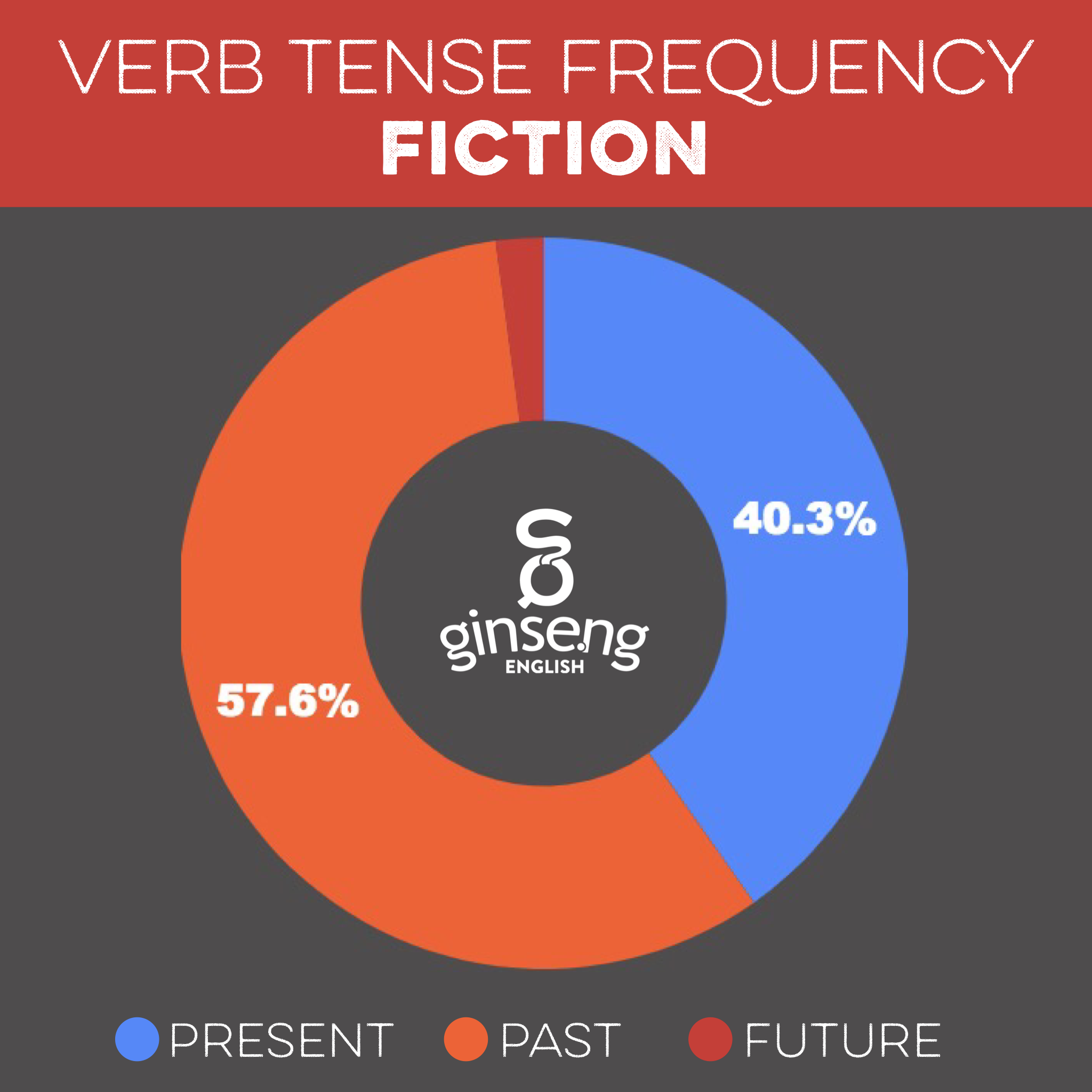

As you can see, there are some big differences between different text types. Spoken English is mostly in the present tense (68.9%), but fiction is mostly past tense (57.6%). Specialized texts overwhelmingly use the present tense (87.1%).
This makes a lot of sense. In fiction, we generally tell stories that take place before: first this happened, then that happened, then that happened. When we speak, though, we talk a lot more about what we think and feel and like, what we do, who people are, our experiences and all of these things are expressed in the present tense. In specialized texts, we are often writing about things that are generally true, and here again, we use the present tense a lot.
The future tense is less used in all text types: 9% in speech, 2% in fiction, and 4% in specialized texts.
This table breaks down each tense by frequency in all three text types:
| Tense | Speech | Frequency | Specialized |
|---|---|---|---|
| Present | 68.9% | 40.3% | 87.1% |
| Past | 22.4% | 57.6%% | 8.7% |
| Future | 8.7% | 2.1% | 4.3% |
Verb Aspect Frequency
The tenses are easy enough—past, present, future—but the really tricky thing about learning English verbs is the four aspects: simple, progressive, perfect, and perfect progressive. Thankfully, there isn't as much difference between the different styles of English when it comes to aspect. Take a look:

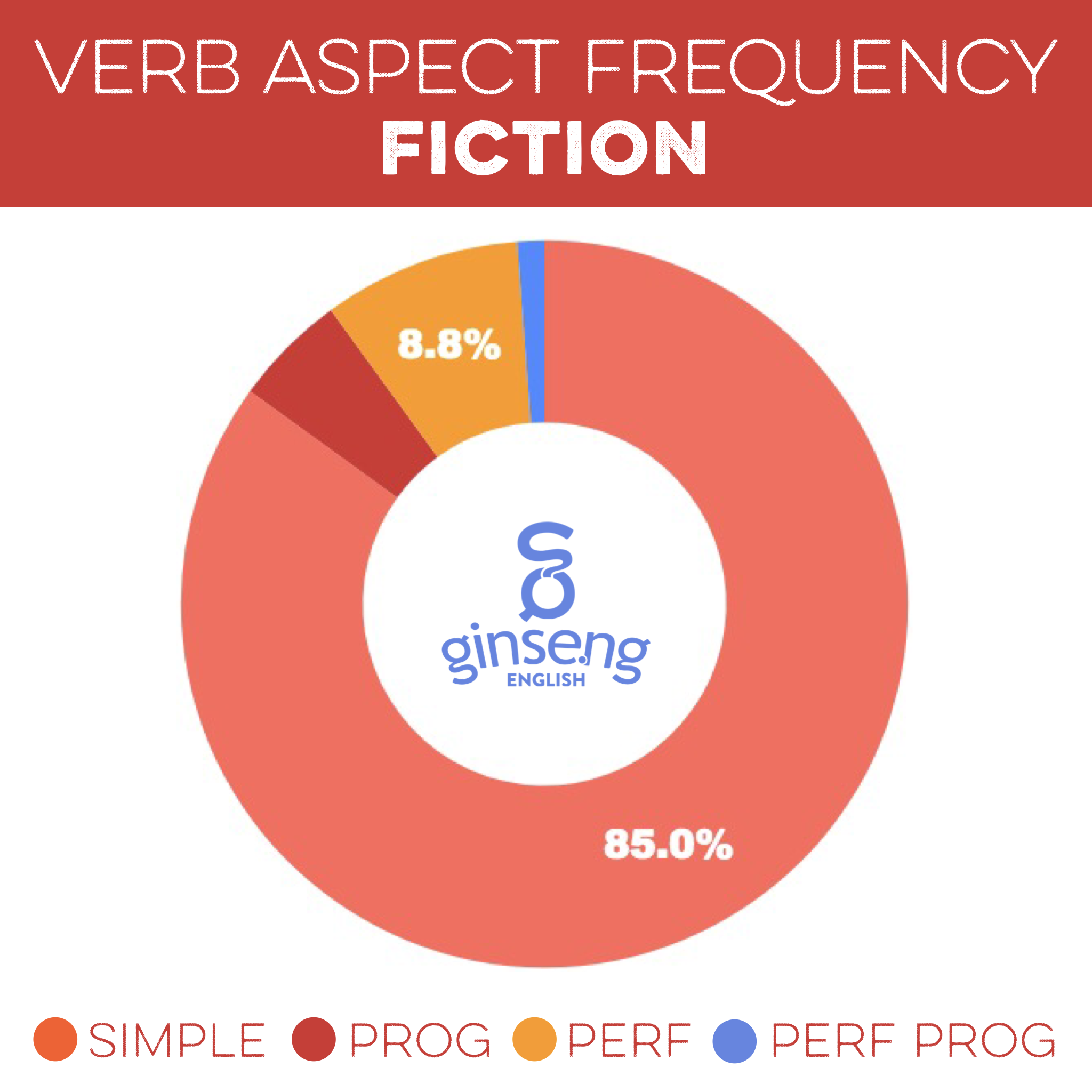
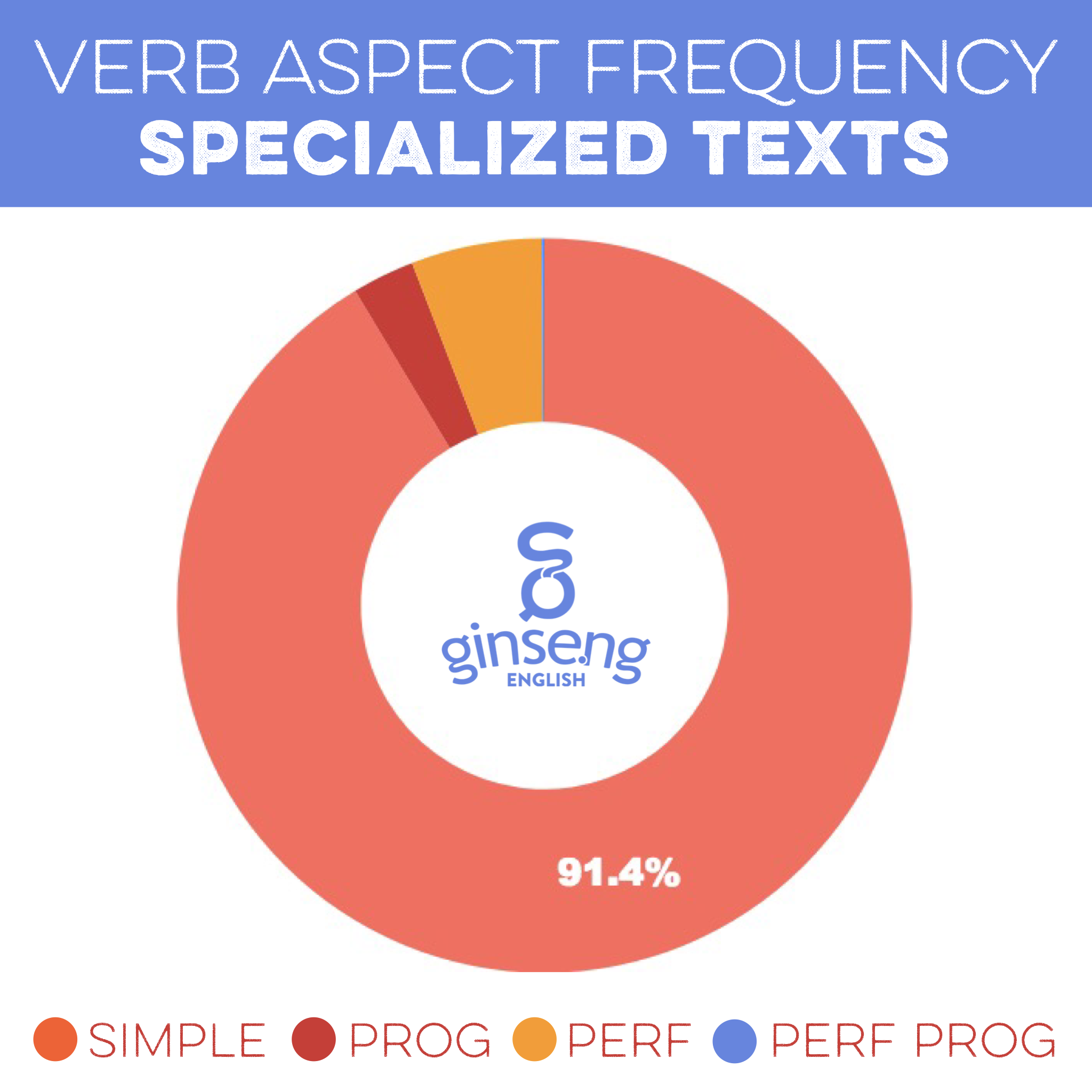
The charts look generally the same. In every style of English, the simple aspect—simple present, simple past, and simple future—makes up over 85% of verbs that we use. The lesser-used aspects all fall in the same order: after simple, it's perfect, then progressive, then perfect progressive gets a tiny little sliver of use. Biber and Reppen (2002) confirm this pattern, observing that the simple aspect is “more than 20 times as common as progressive in conversation.” (p. 204, cited in Alzuhairy (2016).
Alzuhairy (2016) studied academic texts in particular. The same general pattern applies, but simple present only accounts for about 50% of verbs in Alzuhairy’s findings.
Most Used Tenses and Aspects
5 verb forms make up 96% of all verbs in spoken English.
I think this may be one of the most useful insights from Krámský's work for teachers and students. Although there are 12 tense/aspect combinations in English, 5 of these cover around 96% of spoken English.
Notice that the simple present alone accounts for 57% of verbs. Next is the simple past (19.7%), then simple future (8.5%), followed by present perfect (6.0%) and then present progressive (5.1%). If you want to know which verb tenses to learn first, these five will definitely give you the most bang for your buck!
The remaining 7 tense/aspect combinations are each under 1.5% of spoken English verbs. Of course, it is valuable to learn all the combinations, but if you want to prioritize the most useful verb tenses, this should be helpful.
Active and Passive Voice
The passive voice is another of those constructions that challenges students and leads to the question, how useful is this? Well, again, Krámský's work gives us some idea how useful they are. Here is a breakdown of active and passive constructions in the three registers:
The vast majority of verbs in English are in the active voice.
It is not surprising that the vast majority of verbs are active. The most important takeaways that I see are these: 97.5% of verbs in spoken English are active, but the passive voice is much more common in specialized and academic texts, in which only 82.2% of sentences are active.
Complete Table of Most Used Verb Tenses in English
| # | Tense | Frequency |
|---|---|---|
| 1 | Simple Present | 57.51% |
| 2 | Simple Past | 19.7% |
| 3 | Simple Future | 8.5% |
| 4 | Present Perfect | 6.0% |
| 5 | Present Continuous | 5.1% |
| 6 | Past Continuous | 1.4% |
| 7 | Past Perfect | 1.2% |
| 8 | Present Perfect Continuous | 0.7% |
| 9 | Future Perfect | 0.2% |
| 10 | Future Continuous | >0.1% |
| 11 | Past Perfect Continuous | >0.1% |
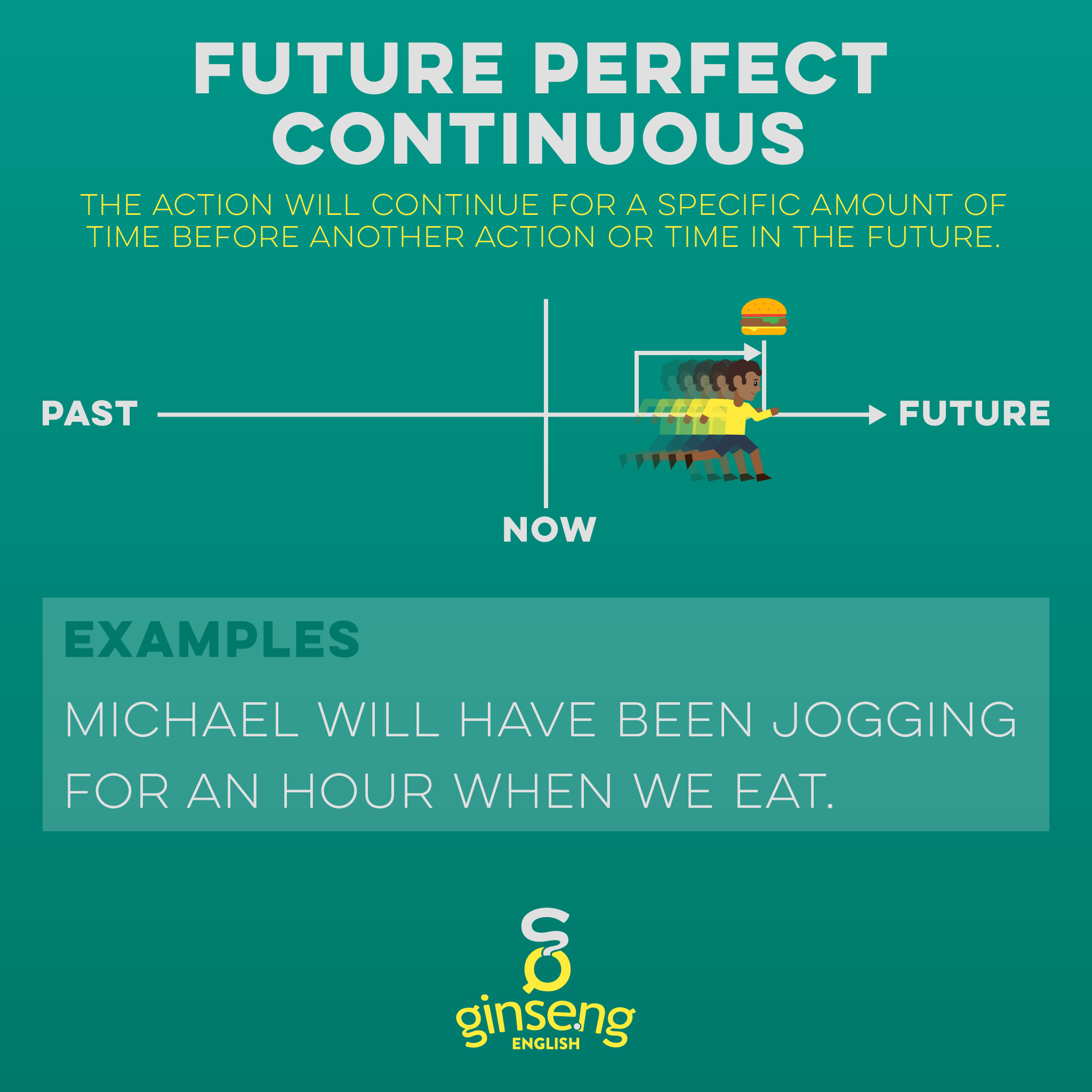
| 12 | Future Perfect Continuous | >0.1% |
More free grammar resources:

Passive Voice
What is the passive voice?
The passive voice is a way of expressing yourself in English (some people say passive form or passive tense, but the correct term is voice).
Active vs. Passive Voice
There are two voices in English grammar: active and passive. Voice is different from tense. There are 12 verb tenses in English, and any of these can be either active or passive (though some of these combinations almost never occur in actual usage).
Grammatical voice is a way of showing the relationship between action expressed a verb and the subject of that verb. When the subject does the action, the active voice is generally used. When the subject receives or undergoes the action, the passive voice is generally used.
The vast majority of the time, we use the active voice: over 95% of verbs in speech and fiction are active, and over 80% in academic and specialized texts.
This article explains the grammar of the passive voice in English, with lots of examples in each verb tense and aspect.
Why Do We Use the Passive Voice in English?
There are many different reasons that we use the passive voice. Again, the overall effect of using the passive voice is to focus on the person or thing that receives the action (the receiver or target), rather than the person or thing that does the action (the agent). But there are many reasons we might want to do this.
Because the receiver is the topic:
Because the receiver is more important to the situation than the agent:
Because the agent is obvious:
Because you want to be vague or avoid mentioning the agent:
Because there is no known agent:
To create a more formal or academic style:
Forming the Passive Voice
When you want to transform a sentence from active form to the passive form: there are two main things to pay attention to.
First, we move the direct object to the subject position, before the verb. Simple. You can say that the object gets promoted to the role of subject, and the subject can be demoted to a prepositional phrase (including this is optional).
The second change is trickier: We also need to change the form of the verb. We need to put the main verb in the past participle. Be becomes been. Do or did becomes done. Go or went becomes gone. Cook becomes cooked. In a passive sentence, the main verb is always in the past participle.
Then we need to insert a be verb in whatever tense we are using before the main verb. If the sentence is in the simple past, use be in the simple past: was. If the sentence is in the simple future, use be in the simple future: will be. If the sentence is in the present perfect, use be in the present perfect: has been. If the sentence is in the present perfect, use be in the present perfect: is being.
The formula for a verb in the passive voice is [conjugated be verb] + [main verb in past participle].
The following section contains examples of every verb tense transformed into the passive voice.
The Get Passive
An alternate way to form the passive uses get as an auxiliary instead of be. With certain verbs, the get passive is very common. These include: get married, get hired, get fired, get picked up, get dropped off, get chosen, get arrested, get accepted.
In some situations, the get passive feels less formal than the be passive.
In some verb tenses, the auxiliary be is used to make the action continuous. When these tenses are made passive we still need to add another auxiliary. This means placing been and being together, which sounds awkward. For example the active sentence Trainees have been observing them. becomes the passive They have been being observed by trainees. Using the get passive can make sentences like this sound better: They have been getting observed by trainees.
Examples of Passive Voice for Each Verb Tense
Below you will find examples of every verb tense in the English passive voice. Some of these are so rare that we never use them. These are noted.
Simple Present
Simple Past
Simple Future
Present Continuous
Past Continuous
Future Continuous
Present Perfect
Past Perfect
Future Perfect
*This form is very unusual and awkward.
Present Perfect Continuous
Past Perfect Continuous
Future Perfect Continuous
Intransitive Verbs and the Passive
Remember, when we transform an active sentence into the passive, we are taking the direct object and moving it to the subject position. This means we must have a direct object to transform a sentence into the passive voice.
Transitive verbs have direct objects. Intransitive verbs do not have direct objects. This means that intransitive verbs cannot be transformed into the passive voice.
Imperative Mood and the Passive
How do you say “Shut the door.” in the passive? Learners try to quiz each other with questions like this.
The simplest answer is that you cannot put an imperative sentence in the passive voice in modern English because the passive voice requires an explicit subject and the imperative leaves out the subject.
Some people suggest that Let the door be shut. Is the passive form of Shut the door. This is a close workaround since it is an imperative sentence, and the verb shut is now passive. It is not, however, a direct transformation of the original sentence into the passive, because it introduces an entirely new verb: the causative let.
When Should You Use the Passive Voice?
This is a tricky question. Many inexperienced writers will overuse the passive voice to sound more formal or academic. This has led to the bad advice that you should “avoid the passive voice.”
There is no real answer except that you should use the passive voice when there is a reason to use it. Don’t just use it to sound smart. Good writing is always about making choices. Pay attention to how and when good writers choose to use it, and try to do the same!
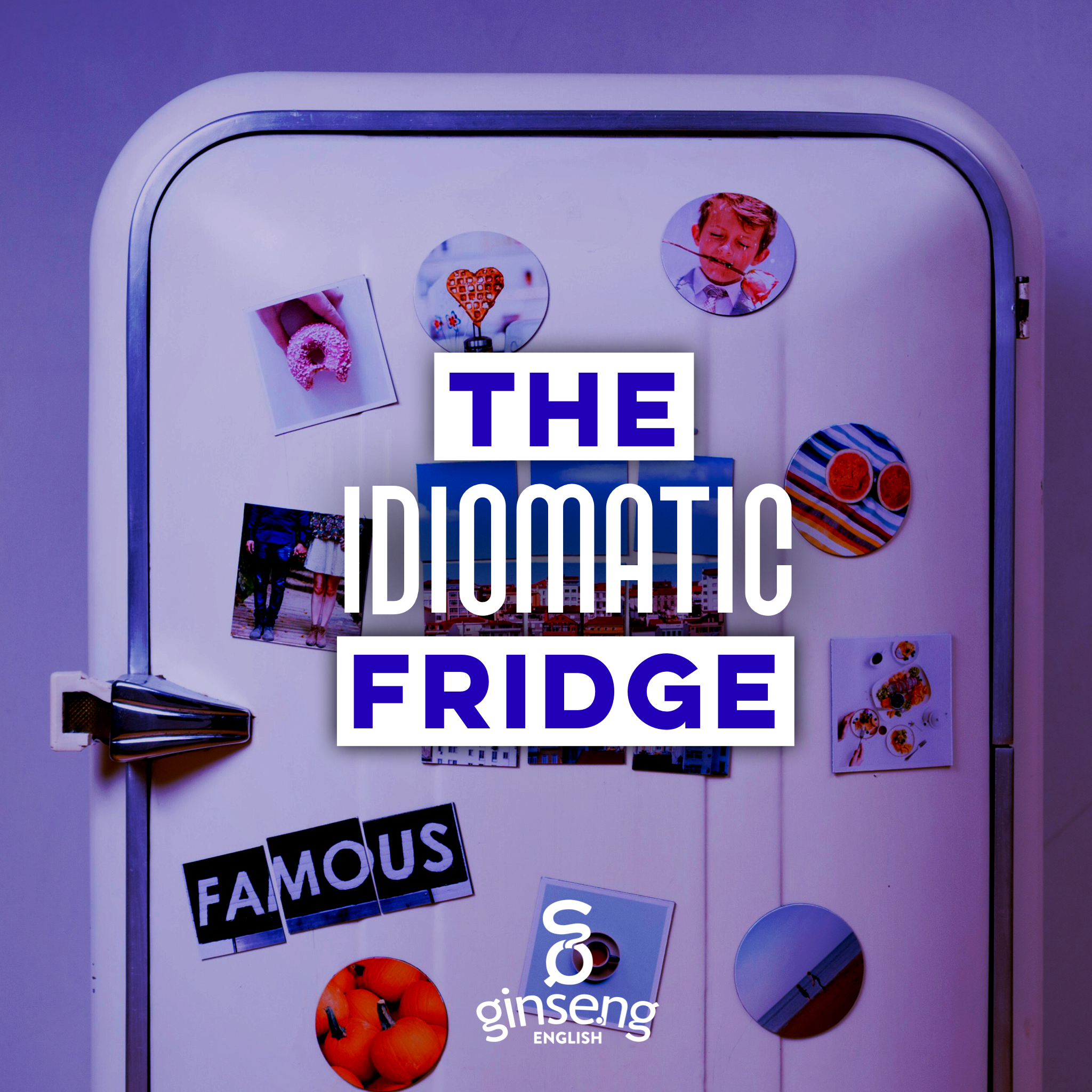
The Idiomatic Fridge
English Idiom - The Idiomatic Fridge
We came across this fantastic cartoon by John Atkinson, from his site Wrong Hands, and thought it would be the perfect topic for a vocabulary lesson. It’s called The Idiomatic Fridge because all of the “foods” in here are actually idioms in English!
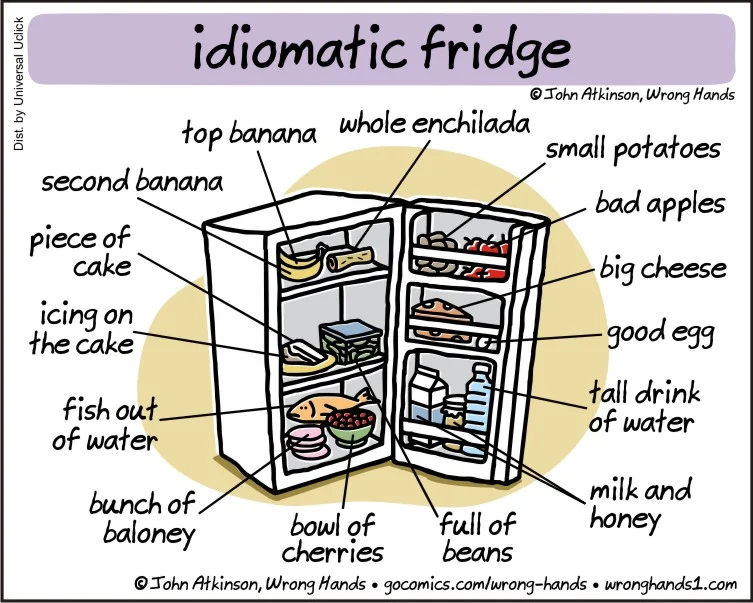
Before we get started, take a look! Do you know any of these?
fish out of water
icing on the cake
piece of cake
top banana
second banana
tall drink of water
milk and honey
full of beans
bowl of cherries
bunch of baloney
whole enchilada
small potatoes
bad apples
good egg
big cheese
Definitions and Example Sentences
top banana 🍌
The idiom top banana is used to describe the best or most popular person in a show, group or organization.
Of all the comedians in the world, Robin Williams was the top banana. Would you agree?
second banana 🍌🍌
Going hand in hand with top banana is second banana which means the second best or most popular person in a show group or organization.
President Obama was top banana, but he would be nowhere without his second banana, Vice President, Joe Biden.
whole enchilada 🌮
The whole enchilada is a funny way of explaining that something is complete and comes all packaged together.
When considering vacation packages, I decided to go for the whole enchilada and get a deal that included the room, transportation to the airport, and unlimited food and alcohol. I didn’t regret it, I had an amazing trip!
small potatoes 🥔
If something is small, insignificant, or cheap, we might say that it’s just small potatoes.
The price we pay for health insurance is small potatoes compared to what we would pay for medicine without it.
bad apples 🍎
If a bad apple is stored in a container with good apples, it will typically cause the other apples to rot faster. Someone who is very negative can make people around them very negative as well, so we call a negative or badly behaved person a bad apple or a rotten apple.
Joey always complained about his homework in class, and then I started noticing my other students didn’t want to do their work either. I think he’s a bad apple!
good egg 🥚
A good egg is pretty much the opposite of a bad apple. If you someone is just all around (like an egg!) a nice, helpful, and responsible person, he or she is considered a good egg.
When I broke my leg, my neighbor mowed my lawn and made me dinner without me even asking! What a good egg!
big cheese 🧀
If someone is very important and successful, we might call them the big cheese, or a big shot.
After Alex got promoted, he thought it was the big cheese around the office, but he quieted down once he realized he still wasn’t such a big shot...
tall drink of water 🚰
This isn’t an expression that we use very often anymore, but it’s still a funny one! If someone is very beautiful, handsome, and overall just very attractive, you could say that they are a tall drink of water. Imagine drinking a tall glass of water on a hot day. This is how some people feel when seeing someone very attractive!
Even after all these years of marriage, when my wife comes into the room I still think she’s a tall drink of water!
milk and honey 🥛 🍯
This term is used to explain a land that has plenty of everything that you could possibly need to survive, and is therefore considered a perfect place to live.
When I moved to Florida, it had everything I could want, beaches, friendly people, and good food! I thought it was the land of milk and honey until I realized that I missed snow!
full of beans 🥫
If you have a ton of energy, are very happy, and can't sit still you’re full of beans.
On this beautiful summer day, we were full of beans and couldn't wait to go play outside!
bowl of cherries 🍒
When something is very nice, and everything is going perfectly in your day, or your life, we might say that it’s like a bowl of cherries.
Today I found $100 on the sidewalk! Life is a bowl of cherries!
However, this expression is actually used more often in a sarcastic or ironic way, meaning exactly the opposite of perfect.
My car broke down, and I was late for work so I lost my job. Life is a bowl of cherries, huh?
bunch of baloney 😡
If someone is telling you lies, or a fake story, we call this a bunch of baloney.
The car salesman promised me a good price on a car, but when I went to actually buy it, it was much more expensive than he originally said. What a bunch of baloney!!
fish out of water 🎣
A fish out of water is very uncomfortable, doesn’t know what to do and usually can’t survive. When someone is in a situation that they are unfamiliar with, or very uncomfortable with, we call them a fish out of water.
When Lexi visited China for the first time, she felt like a fish out of water because she didn't know anyone, couldn't speak Chinese, and had no idea where to find her hotel.
icing on the cake 🎂
This is another idiom that can be used positively or sarcastically. The icing on the cake is the colorful, sugary cream that goes on the top of the cake. It is the last thing done to make the cake look perfect.
We use this positively to talk about the final thing that made a situation just perfect:
The dinner was already amazing, but the waiter gave us a free bottle of wine, which was really the icing on the cake.
We also use it negatively, sarcastically, or ironically when a situation seems like it can’t get any worse, but then it does:
It rained on my wedding day, my mom couldn’t come because her flight was delayed, and the caterer canceled but the icing on the cake was that my husband got food poisoning! It’s ok though, the honeymoon was amazing!
piece of cake 🍰
Something that is very easily accomplished or achieved is known as a piece of cake.
I got the job! I had the right qualifications and had great answers prepared for their questions, so the interview was a piece of cake.
Other free English resources:


Idiomatic Fridge

Check out this blog post to learn what "going hand in hand" means!
British Bad Words
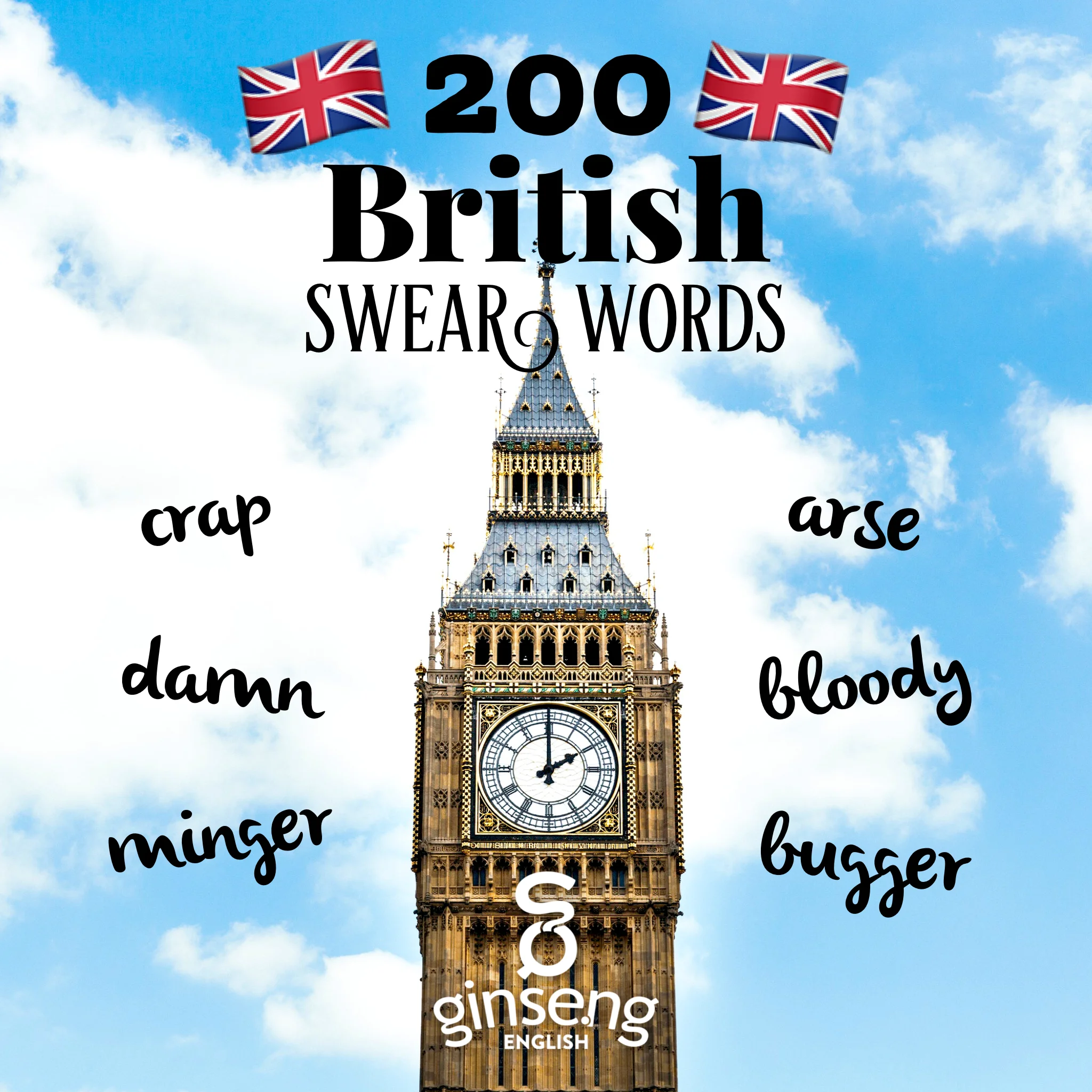
One of the most interesting and difficult things about learning a new language is learning which words are bad, and how bad they are. If you learn English, for example, we have the words crap and shit. Both have the same meaning, but shit is a much stronger word. Your mom might tell you not to say shit, but most people don't mind crap.
A recent article at British newspaper The Indepedent describes a survey that was done by the British government's Ofcom (of + com = office of communications). This office decides what language is okay to say on TV. In the UK some language and content is acceptable after 9:00, when most kids are not watching, but not okay before that.
In the survey, they asked 200 people to rank bad words. Different rankings were mild (not bad, okay for kids), medium (maybe okay on TV before 9:00pm), strong (mostly okay on TV after 9:00pm), strongest (never okay before 9:00, generally okay after).
Here's the full list (sorry Mom! 🙊)
If you like this, check out these other great English posts!



Anatomy of an Email - Greeting
The punctuation you use at the end of an email greeting is important!
If you found this Ginseng English tip helpful, please share with #ginsenglish and follow @ginsenglish on Twitter, Instagram, and Facebook! Also, consider signing up for our online English courses!

Portmanteau Words
A portmanteau word is a words that is made by combining two other words.
Portmanteau is a French word (pronounced /pɔːtˈmantəʊ/ in English) for a big suitcase that can hold many things. Because these words "hold" more than one other word inside them they were called portmanteaus by Lewis Carroll, the writer of Through the Looking Glass, who enjoyed using them in his writing).
English Portmanteau Words
Have you ever felt so hungry that it made you angry? We call that feeling hangry in English! Ever wondered if someone was your friend or enemy? Frenemies! What's an icon that expresses an emotion? An emoticon!
What is a Portmanteau?
First, let's define portmanteau. A portmanteau word is a words that is made by combining two other words.
Portmanteau is a French word (pronounced /pɔːtˈmantəʊ/ in English) for a big suitcase that can hold many things. Because these words "hold" more than one other word inside them they were called portmanteaus by Lewis Carroll, the writer of Through the Looking Glass, who enjoyed using them in his writing).
Although the French plural of the word is portmanteaux, in English we can just say portmanteaus
How we form portmanteaus
Usually, it's the first half of one word added to the second half off another word. For example, a TV show that has both drama and comedy is sometimes called a dramedy. If you want to chill and relax with your friends, you can say, We're just chillaxing. When they first made hotels that where you could park your motorcar, they called them motels.
One of our favorites is brunch, which is breakfast + lunch. What could be better?
Not all portmanteaus are formed in the same way, though. For example, you have probably heard the word sitcom used to describe shows like Friends and How I Met Your Mother, right? Well, sitcom comes from the phrase situational comedy.
Surprising Portmanteaus
Oxford Dictionaries points out that there are some common words that you may not realize are portmanteaus:
moped = motor + pedal
modem = modulator + demodulator
motel = motor + hotel
dumbfound = dumb + confound
bash = bang + smash
hassle = haggle + tussle
web + seminar = webinar
brother + romance = bromance
friend + enemy = frenemy
hungry + angry = hangry
Examples of Common Portmanteaus in English
Here's a longer list of portmanteau examples. After each word in the list are the two words that form it and its definition.
| # | Word | Part A | Part B | Definition |
|---|---|---|---|---|
| 1 | hangry | hungry | angry | so hungry you are angry |
| 2 | motel | motor | hotel | a hotel for people driving |
| 3 | podcast | iPod | broadcast | a radio show for iPods or smartphones |
| 4 | spork | spoon | fork | a spoon with tines on the end |
| 5 | brainiac | brain | maniac | someone very smart |
| 6 | emoticon | emotion | icon | an icon that expresses an emotion |
| 7 | snark | snide | remark | sarcasm, especially online |
| 8 | dramedy | drama | comedy | a show with both serious and funny parts |
| 9 | sitcom | situational | comedy | a tv show based on funny situations |
| 10 | frankenfood | Frankenstein | food | genetically modified food |
| 11 | Bollywood | Bombay | Hollywood | the Indian movie industry |
| 12 | bromance | brother | romance | a close friendship between men |
| 13 | crunk | crazy | drunk | really drunk and crazy |
| 14 | edutainment | education | entertainment | educational entertainment |
| 15 | mansplaining | man | explaining | when men explains to women rudely | 16 | sexture | sexy | texture | a sexy, messy hairstyle |
Can you add any to this list?
Using Portmanteaus
It's important to know that some portmanteaus, like chillax, are just for fun and extremely casual. We'd rarely use them in places like school or work. Others are not necessarily casual, but not used very commonly, such as dramedy. And then some have become everyday words, like motel and brunch.
In the media, it's common to combine the names of celebrities who are dating to refer to them as a couple. The first was Brangelina (Brad Pitt and Angelina Jolie), and others have followed: Kimye (Kim Kardashian + Kanye West), Billary (Bill + Hillary Clinton).