Contractions with Two Meanings
Lots of contractions!
Contractions are two words put together in a shorter form. We use lots of contractions in English: isn't (is not) doesn't (does not), didn't (did not), can't (cannot), won't (will not). I'm (I am), you're (you are), we're (we are). There are tons of them!
Confusing contractions
Apostrophe -s
But let's (let us!) talk about some tricky contractions. Contractions with apostrophe -s ('s) and apostrophe -d ('d) are difficult because they have two meanings. Think about it: what does he's mean? Look at these two sentences:
He's studying English.
He's visited England.
In the first sentence, he's means he is. In the second sentence, he's means he has. When we see 's it can mean either has or is.
Apostrophe -d
I'd been working for hours.
I'd like a glass of champagne.

Give, Take, Borrow, and Lend
Give, take, borrow, and lend are all extremely useful verbs in English, but the grammar can be confusing. This post teaches all four words with examples and illustrations!
Give, take, borrow, and lend are all extremely useful verbs in English. This post teaches all four words with examples and illustrations!
Give and Take
The meaning is simple. I have something, and I want you to have it so I put it in your hand. I give it to you. You take it from me.
But the grammar is a little more difficult. Look at the sentences in the picture:
In the first sentence, Juana is giving Jim some aspirin. The word give is tricky because can have two objects, a person and a thing. The objects here are Jim and some aspirin. The thing that you give, aspirin, is called the direct object. The person who you give it to, the one who receives the action, is called the indirect object, is Jim.
We can put the indirect object just after the verb or at the end of the sentence, using to. Look at the two sentences:
Juana is giving Jim some aspirin.
Juana is giving some aspirin to Jim.
Take is much simpler. It doesn't really have an indirect object, but you can use the preposition from to indicate the person who is giving, like this:
Jim is taking some aspirin from Juana.
Borrow and Lend
Let's start with borrow. Borrow is like take, but when you borrow something, you give it back later. I can borrow your pencil now, and give it back to you when I am finished. There are two common ways to use borrow. The first works just like take:
Carlo is taking a pen from Kate.
Carlo is borrowing a pen from Kate.
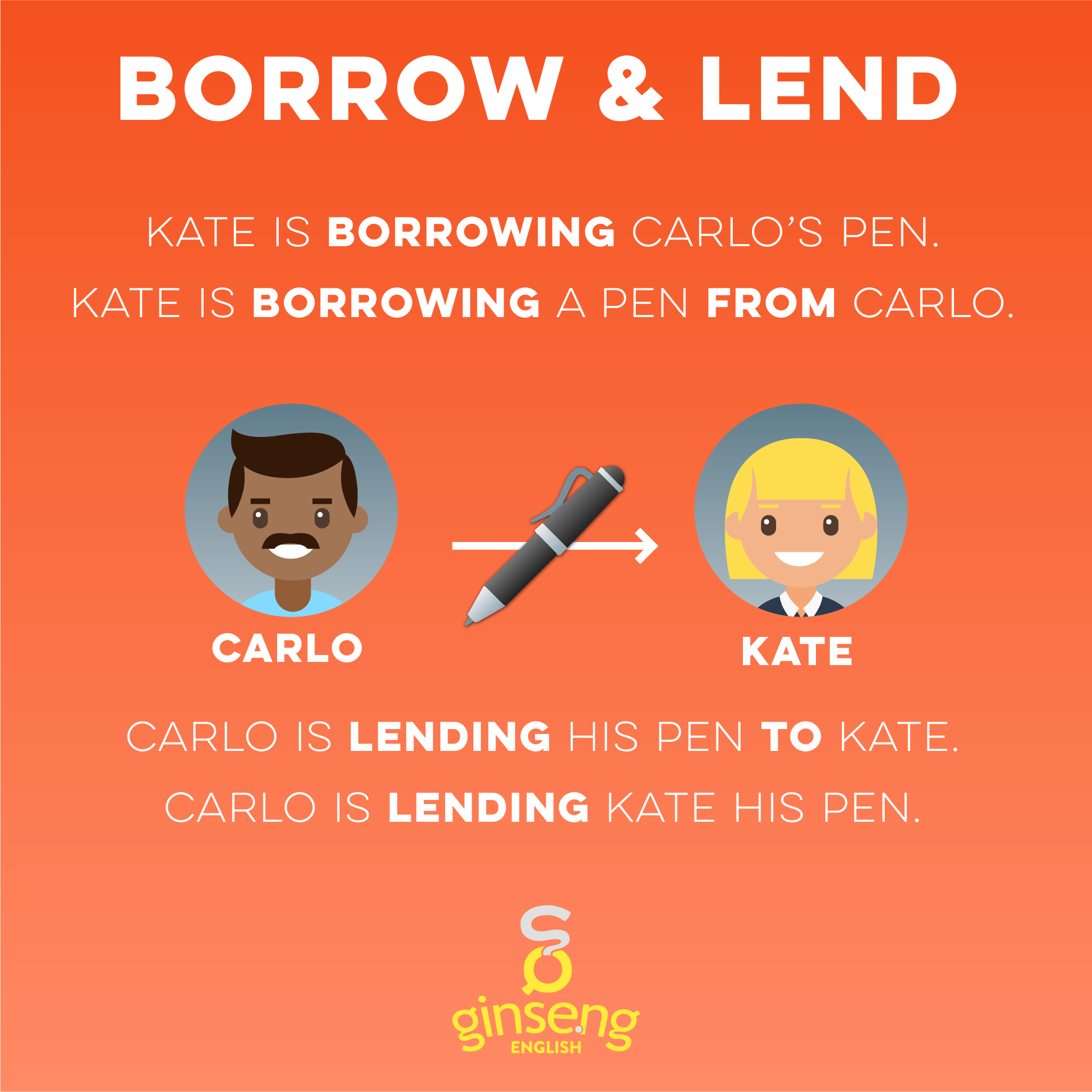
Notice the preposition from. A person borrows a thing from another person. Another way to use from is with the possessive form. The pen belongs to Kate. It is Kate's pen. So we can also simply say:
Carlo is borrowing Kate's pen.
Many people make mistakes with borrow. Many people say Please borrow me a pen. But we can not say borrow a person! The word here is lend. Similarly, lend is like give , but when you lend something, you take it back later. I can lend you my car now, and you can give it back to me tomorrow.
Carlo is giving Kate his pen.
Carlo is lending Kate his pen.
We can also move the indirect object (Kate) to the end of the sentence with both lend and give :
Carlo is giving his pen to Kate.
Carlo is lending his pen to Kate.
What you can say
In daily life, the useful sentences you may want to use are these:
May I borrow your __?
Could you lend me a __?
Can you borrow me a pen.
check out these other free grammar resources:

The Most Common English Adjectives
If you want to quickly expand your English vocabulary, adjectives are a great place to start! Adjectives are a really important part of speech. An adjective is a word used to describe a noun.
It is a good idea to focus on the most common ones in the language. Below are lists of the 50 most common words in both American and British English.
| No. | Adjective |
|---|---|
| 1 | OTHER |
| 2 | NEW |
| 3 | GOOD |
| 4 | AMERICAN |
| 5 | GREAT |
| 6 | BIG |
| 7 | HIGH |
| 8 | OLD |
| 9 | DIFFERENT |
| 10 | NATIONAL |
| 11 | SMALL |
| 12 | LITTLE |
| 13 | BLACK |
| 14 | IMPORTANT |
| 15 | POLITICAL |
| 16 | SOCIAL |
| 17 | LONG |
| 18 | YOUNG |
| 19 | RIGHT |
| 20 | BEST |
| 21 | REAL |
| 22 | WHITE |
| 23 | PUBLIC |
| 24 | SURE |
| 25 | ONLY |
| 26 | LARGE |
| 27 | ABLE |
| 28 | HUMAN |
| 29 | LOCAL |
| 30 | EARLY |
| 31 | BAD |
| 32 | BETTER |
| 33 | ECONOMIC |
| 34 | FREE |
| 35 | POSSIBLE |
| 36 | WHOLE |
| 37 | MAJOR |
| 38 | MILITARY |
| 39 | FEDERAL |
| 40 | INTERNATIONAL |
| 41 | TRUE |
| 42 | FULL |
| 43 | HARD |
| 44 | SPECIAL |
| 45 | RECENT |
| 46 | RED |
| 47 | OPEN |
| 48 | PERSONAL |
| 49 | GENERAL |
| 50 | CLEAR |
| No. | Adjective |
|---|---|
| 1 | OTHER |
| 2 | NEW |
| 3 | GOOD |
| 4 | OLD |
| 5 | DIFFERENT |
| 6 | LOCAL |
| 7 | GREAT |
| 8 | SMALL |
| 9 | SOCIAL |
| 10 | IMPORTANT |
| 11 | NATIONAL |
| 12 | HIGH |
| 13 | BRITISH |
| 14 | POSSIBLE |
| 15 | LARGE |
| 16 | RIGHT |
| 17 | LONG |
| 18 | LITTLE |
| 19 | YOUNG |
| 20 | POLITICAL |
| 21 | ABLE |
| 22 | GENERAL |
| 23 | ONLY |
| 24 | PUBLIC |
| 25 | AVAILABLE |
| 26 | FULL |
| 27 | EARLY |
| 28 | BEST |
| 29 | BIG |
| 30 | MAIN |
| 31 | MAJOR |
| 32 | ECONOMIC |
| 33 | SURE |
| 34 | REAL |
| 35 | LIKELY |
| 36 | BLACK |
| 37 | PARTICULAR |
| 38 | INTERNATIONAL |
| 39 | SPECIAL |
| 40 | DIFFICULT |
| 41 | CERTAIN |
| 42 | CLEAR |
| 43 | WHOLE |
| 44 | FURTHER |
| 45 | WHITE |
| 46 | OPEN |
| 47 | EUROPEAN |
| 48 | FREE |
| 49 | CENTRAL |
| 50 | SIMILAR |
Most of the most common adjectives are the same in the US and the UK (78% of the top 50 and 92% of the top 25 words appear in both lists). Notice that American is the 4th most common adjective in American English and British is the 13th most common adjective in British English. We shouldn't read too much into these simple lists, but it is interesting to note that military, federal, and personal all appear in the American list. Do you notice any other patterns?
That's all for now! Start studying!
If you're looking for something similar, check out the most common verbs in English.
Sources: The primary sources for compiling this article were the Corpus of Contemporary American English (COCA) and the British National Corpus.
more free english tips
Parts of a Laptop
English Vocabulary - Parts of a Laptop
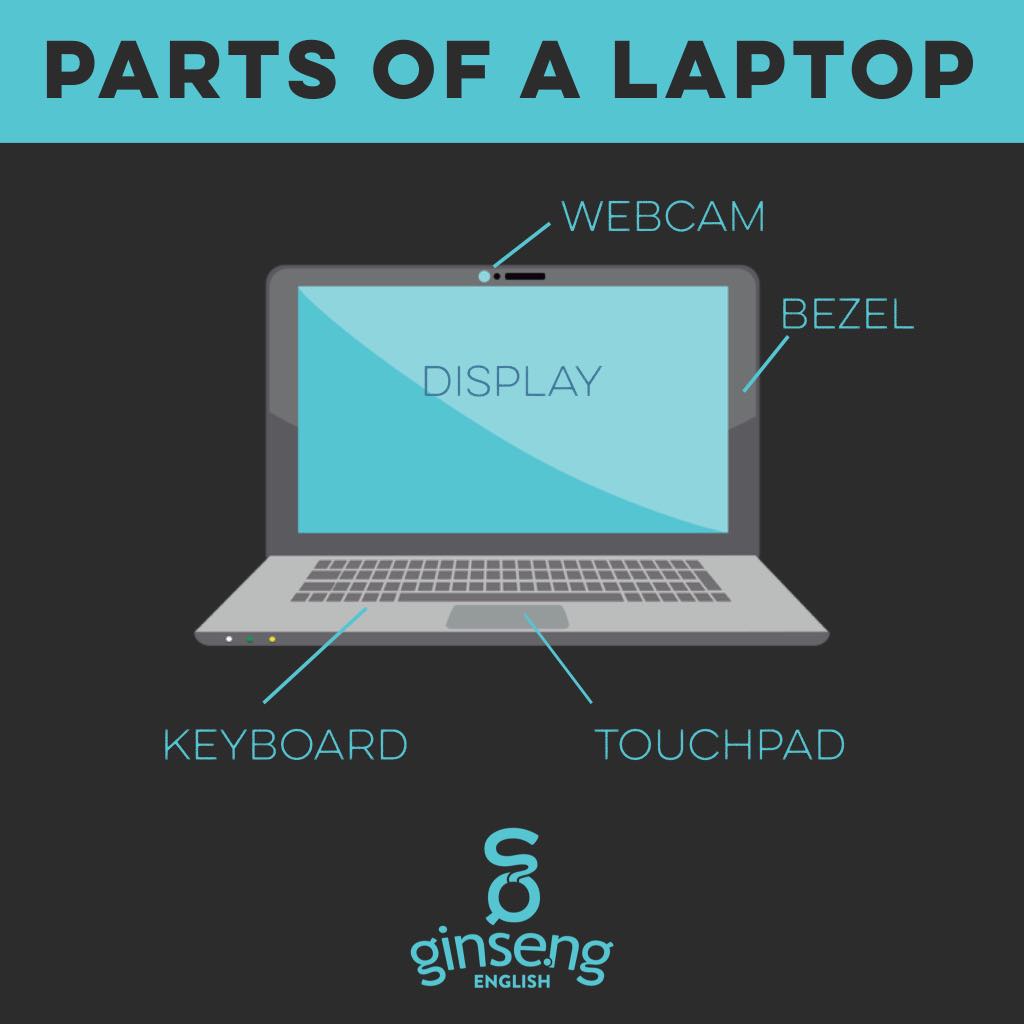
Today lets learn English words to talk about parts of a laptop. As you may know, a laptop is a computer you can close like a book and take with you. Larger computers that you cannot take with you are called desktops, because they sit on top of a desk. A laptop sits on top of your lap (your lap is the upper part of your legs, which is horizontal when you sit!
The part of the laptop that you look at is called the display. Display is also a verb: your computer displays pictures, videos, and websites. Some people call this a screen, too. Screen is a more general word—your TV has a screen, there is a screen at the movies—but display is better for computers. On most laptops, there is an area around the display that doesn't show pictures, like a frame. We call this the bezel. In the middle of the bezel, above the display, you probably have a webcam: a camera that you can use on the web.
The part of the laptop with the letters is called the keyboard. A board is a flat surface, and this board is covered with buttons called keys; that's why we say keyboard! In front of the keyboard is a touchpad, which you can touch to move your cursor (the arrow on your computer screen).
On the sides of the laptop (not shown in this picture) you may have many different ports to plug in your power cord, headphones, or a USB cord.
More free English resources


Parts of a Laptop Computer
Parts of a Car
Basic English Vocabulary - Parts of a Car
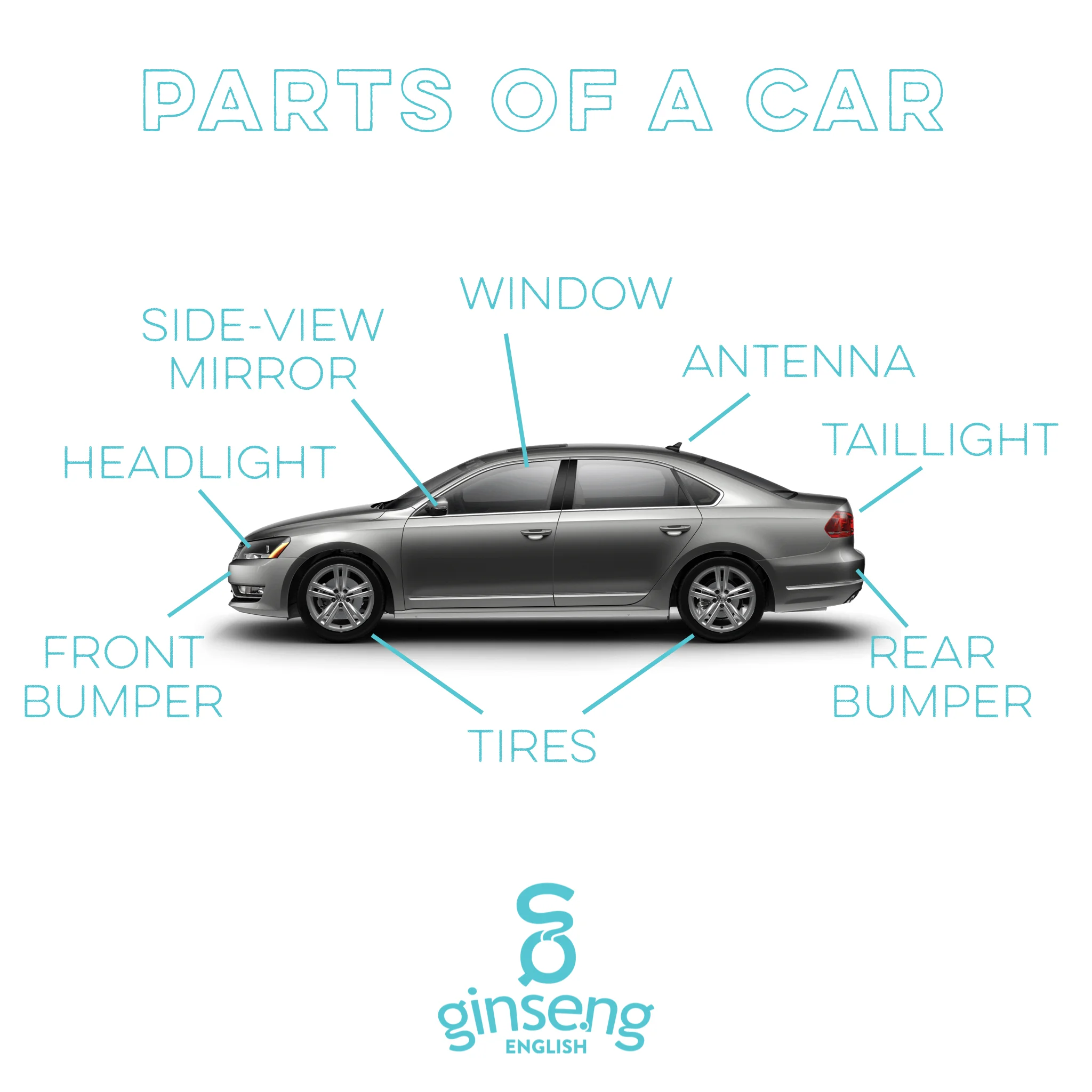
Welcome to the first post in a new series on basic vocabulary from the Ginseng English Blog: Parts of a... Today, let's look at some useful vocabulary for the outside of a car!
On a car there are four tires, two front tires and two rear tires. Front and rear are useful words when we talk about cars. A car has two bumpers to protect you in an accident: a front bumper and a rear bumper. Above the bumpers are lights. There are headlights at the front of the car, and taillights at the rear of the car. On each side of the car is a side-view mirror, to help you see behind you. Inside the car is a rear-view mirror, too.
What other car vocabulary do you know? What do you want to know? Comment below!
More free online English posts
Review of Participles
Remember:
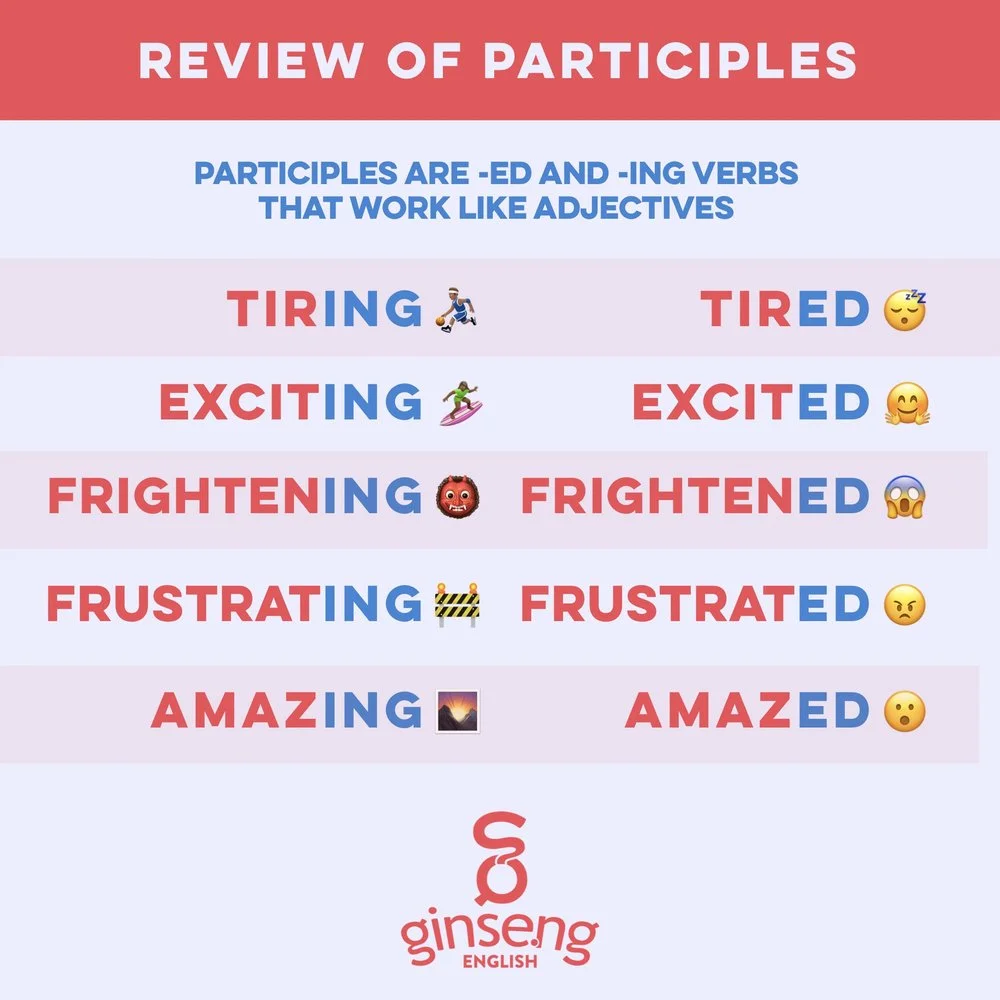
Participles (or participial adjectives) are verbs with -ED and -ING endings that can work like adjectives, describing people and things.
-ED participles (past participles) usually describe how we feel, as in, "I feel exhausted."
-ING participles (present participles) usually describe things that make us feel that way, as in, "That hike was exhausting."
If you found this Ginseng English tip helpful, please share with #ginsenglish and follow @ginsenglish on Twitter, Instagram, and Facebook! Also, consider signing up for our online English courses!

Portmanteau Words
A portmanteau word is a words that is made by combining two other words.
Portmanteau is a French word (pronounced /pɔːtˈmantəʊ/ in English) for a big suitcase that can hold many things. Because these words "hold" more than one other word inside them they were called portmanteaus by Lewis Carroll, the writer of Through the Looking Glass, who enjoyed using them in his writing).
English Portmanteau Words
Have you ever felt so hungry that it made you angry? We call that feeling hangry in English! Ever wondered if someone was your friend or enemy? Frenemies! What's an icon that expresses an emotion? An emoticon!
What is a Portmanteau?
First, let's define portmanteau. A portmanteau word is a words that is made by combining two other words.
Portmanteau is a French word (pronounced /pɔːtˈmantəʊ/ in English) for a big suitcase that can hold many things. Because these words "hold" more than one other word inside them they were called portmanteaus by Lewis Carroll, the writer of Through the Looking Glass, who enjoyed using them in his writing).
Although the French plural of the word is portmanteaux, in English we can just say portmanteaus
How we form portmanteaus
Usually, it's the first half of one word added to the second half off another word. For example, a TV show that has both drama and comedy is sometimes called a dramedy. If you want to chill and relax with your friends, you can say, We're just chillaxing. When they first made hotels that where you could park your motorcar, they called them motels.
One of our favorites is brunch, which is breakfast + lunch. What could be better?
Not all portmanteaus are formed in the same way, though. For example, you have probably heard the word sitcom used to describe shows like Friends and How I Met Your Mother, right? Well, sitcom comes from the phrase situational comedy.
Surprising Portmanteaus
Oxford Dictionaries points out that there are some common words that you may not realize are portmanteaus:
moped = motor + pedal
modem = modulator + demodulator
motel = motor + hotel
dumbfound = dumb + confound
bash = bang + smash
hassle = haggle + tussle
web + seminar = webinar
brother + romance = bromance
friend + enemy = frenemy
hungry + angry = hangry
Examples of Common Portmanteaus in English
Here's a longer list of portmanteau examples. After each word in the list are the two words that form it and its definition.
| # | Word | Part A | Part B | Definition |
|---|---|---|---|---|
| 1 | hangry | hungry | angry | so hungry you are angry |
| 2 | motel | motor | hotel | a hotel for people driving |
| 3 | podcast | iPod | broadcast | a radio show for iPods or smartphones |
| 4 | spork | spoon | fork | a spoon with tines on the end |
| 5 | brainiac | brain | maniac | someone very smart |
| 6 | emoticon | emotion | icon | an icon that expresses an emotion |
| 7 | snark | snide | remark | sarcasm, especially online |
| 8 | dramedy | drama | comedy | a show with both serious and funny parts |
| 9 | sitcom | situational | comedy | a tv show based on funny situations |
| 10 | frankenfood | Frankenstein | food | genetically modified food |
| 11 | Bollywood | Bombay | Hollywood | the Indian movie industry |
| 12 | bromance | brother | romance | a close friendship between men |
| 13 | crunk | crazy | drunk | really drunk and crazy |
| 14 | edutainment | education | entertainment | educational entertainment |
| 15 | mansplaining | man | explaining | when men explains to women rudely | 16 | sexture | sexy | texture | a sexy, messy hairstyle |
Can you add any to this list?
Using Portmanteaus
It's important to know that some portmanteaus, like chillax, are just for fun and extremely casual. We'd rarely use them in places like school or work. Others are not necessarily casual, but not used very commonly, such as dramedy. And then some have become everyday words, like motel and brunch.
In the media, it's common to combine the names of celebrities who are dating to refer to them as a couple. The first was Brangelina (Brad Pitt and Angelina Jolie), and others have followed: Kimye (Kim Kardashian + Kanye West), Billary (Bill + Hillary Clinton).