
Sensory Verbs in English
Verbs related to the five senses can be really difficult in English. This post covers all five senses, including active and passive sensory verbs, complete with charts and examples!
We know the world through our eyes, our ears, our fingers, our noses, and our mouths. Sensory verbs (or sense verbs) are the verbs we use to talk about our five senses in English.
With our eyes, we see.
With out ears, we hear.
With our fingers, we feel.
With our noses, we smell.
And with our mouths, we taste.
These are the five basic sensory verbs in English. But we use slightly different sensory verbs depending on the situation.
Using Sensory Verbs in English
Passive/Unintentional
There are three basic ways that we can use sensory verbs in English.
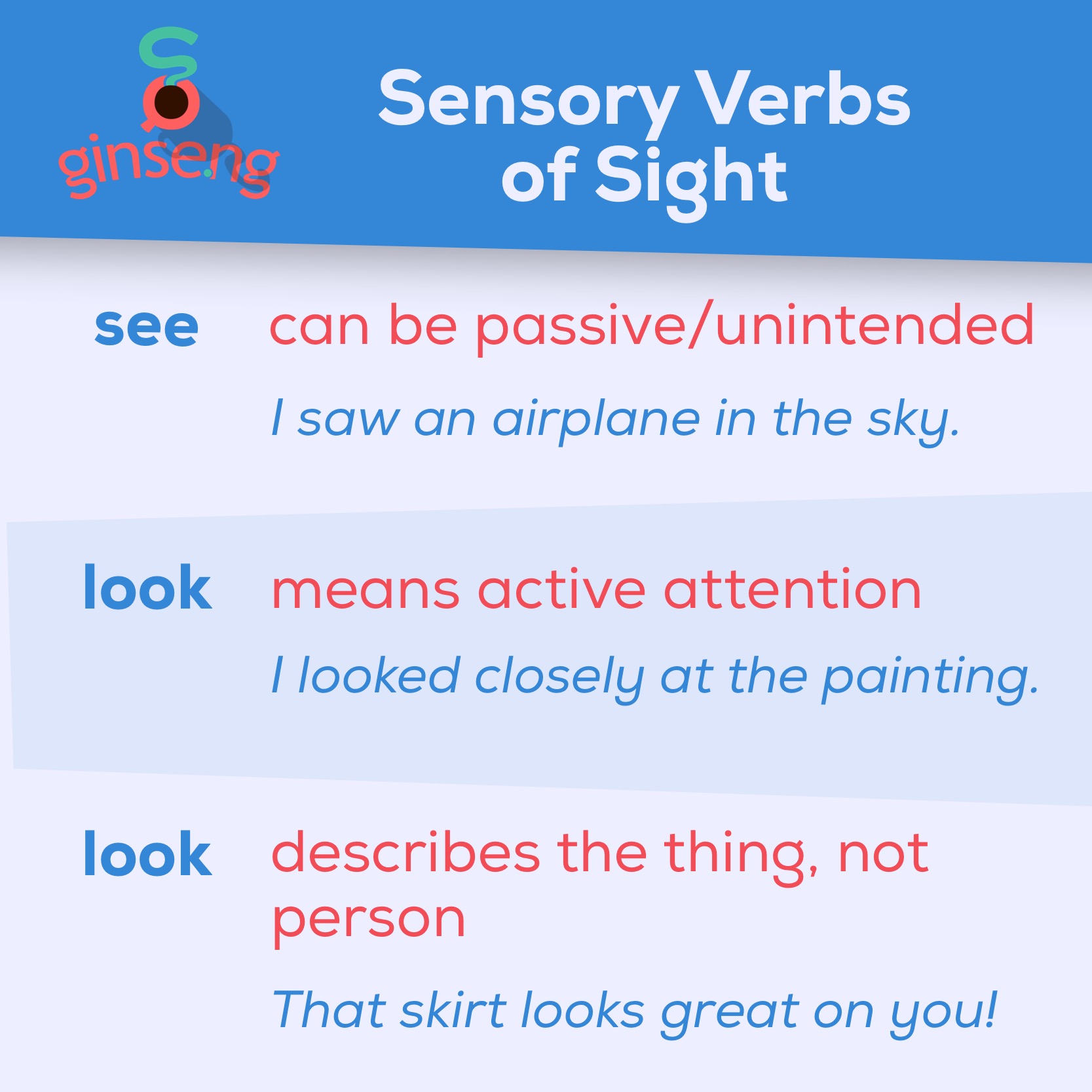
The first is for when we unintentionally sense something. For instance, I am sitting in my room and I hear a truck outside. I'm not trying to hear the truck. I am just sitting here, and the sound reaches my ears. Hear is the way we describe the passive sense of hearing. Here are some more examples of passive, unintentional sensory verbs:
I see a rainbow!
The dog hears someone at the door.
I can feel the floor vibrating!
Do you smell something cooking?
I think I taste cinnamon in this bread.
Active/Intentional
The second way we talk about sensory verbs is when we actively, intentionally use our senses. For example, my soup comes, and I am excited to try it. I put my nose close to the bowl and I smell the soup. Then I take my spoon and I taste my soup. I am actively trying to pay attention to the sensation. These are sometimes called dynamic sensory verbs. Here are examples of the five sensory verbs we use for intentionally using our senses:
She looked out of the window.
Shh! I am listening to a lector for my homework!
Here, taste this before it gets cold.
She smelled the milk to see if it was okay to drink.
He touched the grass, and it was wet.
Stative Sensory Verbs
The final type of sensory verb is a bit different. The first two types describe what people do. with their senses. But the third type of sensory verb talks about the things that we sense, the cause of what we are feeling. I can listen to music, and the music sounds good to me. I can touch the ice, and the ice feels cold to me. These are called stative sensory verbs, because they describe the state of the thing. Here are five more examples:
She was wearing her new dress. She looked beautiful.
What is that music? It sounds terrible.
Wow, this sauce tastes incredible!
Ew, that trash smells awful.
This blanket feels so soft!
Notice that in each of the examples above, the thing is the subject, not a person.
Adjectives and Stative Sensory Verbs
Another thing to notice about stative sensory verbs is that we use adjectives with them. Other verbs often have adverbs after them (adverbs describe verbs). But with stative verbs, we use adjectives. Adjectives describe nouns, and the stative verb is connecting the noun to the adjective that describes it.
Look again at the examples in the last section. We say It sounds terrible, not It sounds terribly. We say It tastes good, not It tastes well.


POTUS, FLOTUS, and SCOTUS
You may have seen some strange acronyms floating around on the internet. If you are curious what POTUS, FLOTUS, SCOTUS, SGOTUS, FGOTUS, or even SCROTUS means, this is what you’re looking for!
POTUS, FLOTUS, and SCOTUS
If you spend any time on Twitter, you may have heard some funny words that all look the same: POTUS, FLOTUS, and SCOTUS.
What do these strange words mean? Well, they are all acronyms. Acronyms are abbreviations, in which each of the letters represents a word. The -OTUS in these three words stands for of the United States.
POTUS
POTUS means president of the United States. This abbreviation originated in telegrams, to save time. This is the most common -OTUS acronym. POTUS is pronounced /ˈpōdəs/. The abbreviation is even used as the president’s official Twitter handle: @POTUS.
Sometimes we will use VPOTUS, meaning Vice President of the United States, in writing. This is somewhat rare, though, because it is difficult to pronounce in English.
SCOTUS
SCOTUS is Supreme Court of the United States (the most important court in the US). SCOTUS is pronounced /ˈskōdəs/.
FLOTUS and SLOTUS
When the president has a wife, she is referred to as the First Lady. FLOTUS stands for first lady of the United States. FLOTUS is pronounced /ˈflōdəs/.
President Joe Biden’s wife, Dr. Jill Biden, is a professor of English. This has earned her the fun nickname Professor FLOTUS.
Although the term is much less common, the vice president’s wife is sometimes called the second lady, so the acronym SLOTUS can be used for second lady of the United States.
FGOTUS and SGOTUS
For many years the president and vice president were heterosexual men, so our terms are very heteronormative. Today, we have a female vice president and have had at least one serious presidential contenders who is a gay man. This means that we may be seeing some new -OTUS terms arising!
Gentleman is the typical counterpart to lady in English, so the terms
FGOTUS, meaning first gentleman of the United States, will be used for the president’s husband. SGOTUS, meaning second gentleman of the United States, can be used for the vice president’s husband.
History of POTUS and SCOTUS
English has many acronyms like this. Many of them began in the military. SCOTUS and POTUS were first used in the late 19th century, in telegrams. FLOTUS didn't come into the language until almost a hundred years later. VPOTUS has been used here and there to refer to the vice president, but because it isn't exactly easy to pronounce, it hasn't caught on.
SCROTUS
As you may know, Donald Trump was a very unpopular POTUS, and this has led to many jokes about him. In 2017, a Twitter user came up with a new -OTUS word for Trump: SCROTUS. This joke works for two reasons: first, it stands for so-called ruler of the United States, and Trump really doesn't like when people suggest that he is an illegitimate president. But the much funnier part of this joke is that it sounds like the word scrotum. You can click here to find out what that one means; this is a family website!
Other -OTUS Words
COTUS has been used to mean constitution of the United States.
FDOTUS (and DOTUS) been used jokingly to refer to the president’s dog, first dog of the United States.
more free english resources


Pronouns in English
What is a Pronoun?
Pronouns are one of the 9 parts of speech in English grammar. A pronoun is a word that takes the place of a noun. Pronouns are important in English. They are some of the first words we learn: I, you, he, she, it. There are different kinds of pronouns for different situations: subject pronouns, object pronouns, possessive pronouns, and reflexive pronouns. Instead of Sara, we can say she. Instead of those guys, we can say them. Instead of the sun, we can say it.
Why do we use pronouns?
One reason that we use pronouns is to avoid repetition. Think about this example:
Look at this beautiful table. The table is gorgeous. The table has a red top and the table's legs are steel. I really want to buy the table.
The table, the table, the table, the table—aaaaaaah. We try to avoid this kind of repetition in English. Instead of table, table, table, table, we usually say table once. After that first time, we use a pronoun, like it. This next example is more typical of how we speak in English:
Look at this beautiful table. It is gorgeous. It has a red top and its legs are steel. I really want to buy it.
Simpler and cleaner! That's why we use pronouns.
So a pronoun can take the place of a noun. But there are also some important differences between how we use nouns and pronouns. For instance, we don’t usually use a determiner before a pronoun: we say the table, but we never say the it. We say my friend, but we don’t say my him. We also don’t usually use adjectives before pronouns. We can say the red car, but it would be very strange to say the red it.
Now let's look at the five different kinds of personal pronouns:
English Personal Pronouns
In English, we use different pronouns to show grammatical person, gender, and singular/plural distinctions.
For example, if I am talking about myself, we call this the first person. If I are talking about myself alone, this is singular (only one person). Singular first person pronouns include I, me, mine, etc.
If I am talking about a group of people that includes me, this is the first person plural (more than one person). Plural first person pronouns include we, us, ours, etc.
English Pronoun Chart
Second person pronouns are used to talk about the person you are speaking to. These include you, yours, yourself, etc. You can be both singular and plural in English.
Third person pronouns are used to talk about people who are not either the speaker or the listener. They include the third person singular pronouns (like he, she, it) and third person singular pronouns (like they, them, etc.).
For inanimate objects—things that are not people—we use it, its, and itself.
They/Them Pronouns
When we use third person pronouns, we often distinguish between genders. For example, she, her, and hers are often used to talk about women, and he, him, and his are often used to talk about men. They, them, and their can be used as gender-neutral pronouns. We can use these either because we don't want or need to specify a gender, or because someone goes by non-gendered or nonbinary pronouns.
SUBJECT PRONOUNS
The first pronouns we teach are usually subject pronouns. The subject is often the noun right before the verb. Almost every sentence has a subject. Generally, the subject of the sentence is the person or thing that does the verb or makes the verb happen.
The tiger sleeps a lot.
In the example above, the verb is sleeps, and the subject is tiger. Who sleeps? The tiger does. The subject usually tells us who or what does the action. We have a special set of pronouns that we use to be the subject of a sentence. The table below lists the most common subject pronouns.
| Singular | Plural | |
|---|---|---|
| 1st person | I | we |
| 2nd person | you | you |
| 3rd person | she | they |
| he | ||
| it |
We don’t say Me like candy or Him has a cat. We say I like candy and He has a cat. Me and him are the wrong type of pronouns. We use subject pronouns. Here are some more examples:
I like movies.
Do you like movies?
Invite Clara. She likes movies.
He likes movies, too!
We like watching movies on weekends.
Before a verb, to express who or what does the action in a sentence, use a subject pronoun.
OBJECT PRONOUNS
Almost all verbs have a subject, and some also have an object. The object of a verb is the thing that receives an action. For example, you wouldn't just say, I want, right? You need to want something. We say I want coffee or I want a cheeseburger. Coffee and cheeseburger are objects. They receive the verb, want.
I want a hamburger.
I want a job.
I want a girlfriend.
Hamburger, job, and girlfriend are objects. Notice that objects generally come after the verb in the sentence. We use object pronouns to represent objects in sentences. This table lists the most common object pronouns:
| Singular | Plural | |
|---|---|---|
| 1st person | me | us |
| 2nd person | you | you |
| 3rd person | her | they |
| him | ||
| it |
Here are some examples of sentences using object pronouns:
That hamburger looks delicious. I want it.
Who is that girl? I think I know her.
You can have these books if you want them.
Can I help you?
My teacher hates me!
In all the examples above, the pronouns are the objects of a verb. We use the same set of object pronouns as the objects of prepositions, as you can see in these examples:
My grandmother gave that to me.
I've been getting weird texts from her.
We've heard so much about you!
After a verb or a preposition, you generally want to use an object pronoun.
POSSESSIVE PRONOUNS
To possess something is to own or have that thing. If I have a car, we can say that car is my possession. We can say, That car is mine. Mine is a pronoun in this sentence. It represents the car, the thing that I possess. Mine is a possessive pronoun. Here is a chart with the most common possessive pronouns:
| Singular | Plural | |
|---|---|---|
| 1st person | mine | ours |
| 2nd person | yours | yours |
| 3rd person | hers | theirs |
| his | ||
| its |
Here are some example sentences with possessive pronouns:
That car is hers.
This is my drink. That one is yours.
All the coats are in a big messy pile. I can't find mine!
As you can see, possessive pronouns can be used to talk about things that belong to specific people.
POSSESSIVE DETERMINERS
Possessive determiners (also called possessive adjectives) are not actually pronouns, but it's a good idea to learn them at the same time, because they are very similar to possessive pronouns. The difference is that possessive determiners can not replace nouns; they come before nouns to tell us whose they are. If someone asks, Whose iPad is this? you could answer with a possessive pronoun: It's mine. But you could also use a possessive determiner:
That's my iPad.
With a possessive determiner, it is important to include a noun after. Just saying That is my. would by wrong. Here is a list of the most common possessive determiners.
| Singular | Plural | |
|---|---|---|
| 1st person | my | our |
| 2nd person | your | your |
| 3rd person | her | their |
| his | ||
| its |
And here are some examples of possessive determiners in sentences:
Sorry, I have to take this call. It's my son.
Cheryl is at her English class.
We lost our baseball game.
Please take off your shoes.
Can you believe they lost their homework again?
REFLEXIVE PRONOUNS
So we have talked about subjects and objects, right? Subjects are the people or things that do the action in the verb, and objects are the people or things that receive the action. Sometimes, those are the same person, right? For example, if I cut my finger, I hurt someone. The someone I hurt is me (ouch!). But in English we don't say I hurt me. We have special pronouns for the object in this situation, and they are called reflexive pronouns.
Here is a table of the most common reflexive pronouns in English:
| Singular | Plural | |
|---|---|---|
| 1st person | myself | ourselves |
| 2nd person | yourself | yourselves |
| 3rd person | herself | themselves |
| himself | ||
| itself |
And here are some examples of reflexive pronouns used in sentences:
Clara taught herself English.
Don't play with that knife. You will hurt yourself.
The kids are entertaining themselves in the yeard.
Oh, nothing. I'm just talking to myself.
After a couple of days, the problem fixed itself.
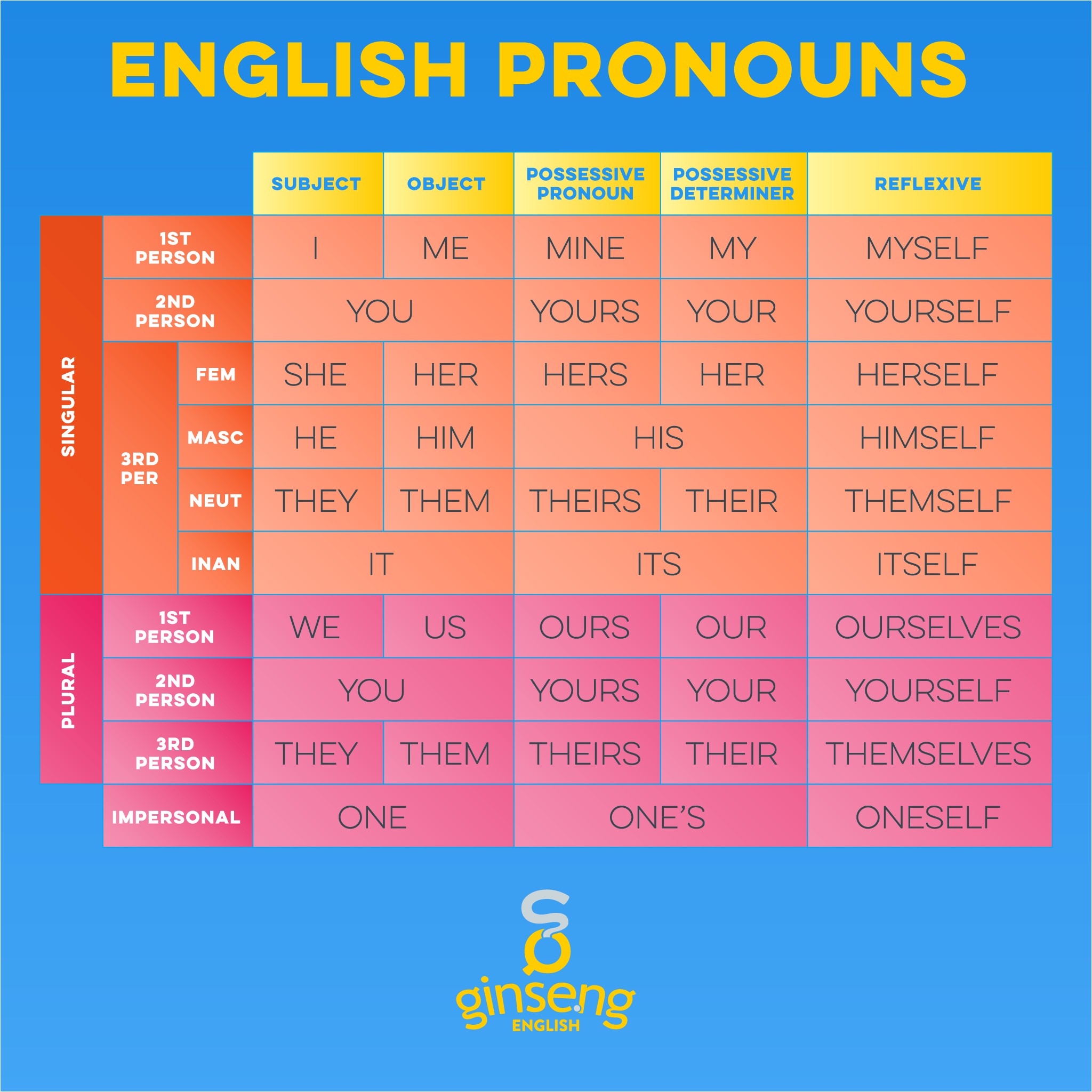
Complete English Pronoun Chart
Here is a complete table of all the pronouns discussed in this post. There are still some other types of pronouns, however. Demonstrative pronouns and relative pronouns, for example, are usually studied separately.
| Subject | Object | Possessive Pronoun |
Possessive Determiner |
Reflexive | |||
|---|---|---|---|---|---|---|---|
| Singular | 1st Person | I | me | mine | my | myself | |
| 2nd person | you | you | yours | your | yourself | ||
| 3rd person | Feminine | she | her | hers | her | herself | |
| Masculine | he | him | his | his | himself | ||
| Neutral | they | them | theirs | their | themself | ||
| Inanimate | it | it | its | its | itself | ||
| Plural | 1st Person | we | us | ours | our | ourselves | |
| 2nd Person | you | you | yours | your | yourselves | ||
| 3rd Person | they | them | theirs | their | themselves | ||
| Impersonal | one | one | one's | one's | oneself | ||
Pronombres en Inglés
Pronomes pessoais em inglês
الضمائر في الانجليزية
Idioms About Winter
We have to make decisions every day, but sometimes it’s so hard to just make up your mind! If you’re on the fence about a big decision, then these idioms might help your thought process! (Or at least help you procrastinate making a difficult decision😂)
English Idioms about Winter
Over here in America, we’re in the heart of winter time! For many people, that means we are hibernating, just like bears, and not leaving our house! While we’re inside keeping warm, here are some fun idioms about winter!
Tip of the Iceberg
Our first winter idiom is tip of the iceberg. This phrase is usually spoken in a negative way to refer to a problem that is much bigger than it initially seems.
We say this because when an iceberg sticks out of the water, you only see a small part of it, and have no idea how big it really is underneath.

The e captain of the Titanic certainly experienced more than just the tip of the iceberg!
Examples
The cut on my leg is only the tip of the iceberg. The doctor is worried that I may have broken a bone.
The flooding is bad, but that is just the tip of the iceberg. Wait until the hurricane starts!
I thought paying rent was expensive, but I realized that was just the tip of the iceberg when I saw how much my heating and internet bills are!
Under the Weather
If you are feeling under the weather, it means that you are feeling unwell, and maybe a little sick.
This one is easy to remember because you can imagine how unpleasant it feels to be under a cloud of rain or stuck in the middle of a snowstorm!
Another idiom to talk about feeling ill is to say that you’re sick as a dog! 🤧
Lilly called out sick from work today because she was feeling under the weather.
Jared was skiing all weekend in a snow storm, so it came as no surpsie when he was feeling under the weather when he got home!
Kathleen was really hoping she would feel good enough to go to the concert, but even after a lot of rest and chicken soup, shse was still feeling under the weather and had to stay home.
Cold Shoulder
If someone is intentionally being rude, mean, or unfriendly, you can say that they are giving you the cold shoulder.
It is rumored by Phrases.org that this expression began in the early 1800’s. When a family would have a welcomed visitor, they would serve them a nice hot meal, but when they had an unwelcome visitor, they would serve them a cold shoulder of meat. 🍖❄️
Ian hoped that him and his ex-girlfriend could be friends, but whenever he tried to talk to her, she gave him the cold shoulder.
My roommate came home late last night and was loud and woke me up, so the next morning I gave her the cold shoulder. Once she apologized and made me coffee, I forgave her.
Christine's co-worker gave her the cold shoulder after she realized that Christine hadn't invited her to her wedding.
When Hell Freezes Over
This next expression is very informal and even a little offensive, so be careful who you say it to!
If something is guaranteed to never happen, you can say that it’ll happen when hell freezes over. This is a sarcastic comment, because obviously, hell is not going to freeze over!
Examples
I'll apologize to him when hell freezes over!
You can expect a pay raise... when hell freezes over!
Gabriel's mom promised to buy him a car when hell freezes over!
Break the Ice
Here’s another great idiom related to winter. To do something funny in a tense situation can be called breaking the ice. For example, if you are in a new English class, your teacher might start out with some fun games known as icebreakers to help students get to know each other better and become more comfortable in the class.
When the elevator broke, I was stuck in it for 2 hours with a stranger, so I made some jokes to help break the ice.
It's hard to break the ice on a first date, but I find that telling a funny story helps!
A friendly smile and little wave can be a simple way to break the ice at a new job.
on thin ice
This idiom is on thin ice. We use this one to talk about a situation where someone is doing something that is very risky and could be dangerous if something goes wrong.
This idiom is great to visualize because you can easily imagine what it’s like to actually walk on thin ice knowing that it could break at any time, and you could fall into freezing water!
We also might say someone is treading, or skating, on thin ice. ⛸⛸
Examples
I wanted to ask my mom for money to go to the movies, but I was already walking on thin ice after coming home too late last night, so I decided against it.
Jo-Anne was late to work three times this week, so when she left for her luch break, her boss told her that she's skating on thin ice and she better come back on time.
The company was in a lot of financial trouble and was treading on thin ice with the government.
Take a Chill Pill
This next one is a funny expression, but it needs to be said with a smile so that you don’t offend someone! If someone is very worried or anxious about a situation, you can tell them to take a chill pill, which is another way of telling them to relax.
If something is chilled, it is cold, but we also use this word to talk about relaxing, or calming down. A pill is a type of medication, so taking a chill pill is another way of saying “chill out, dude!” 💊 💊

Ross certainly could use a chill pill in this scene!
I know you're excited to see if you wont a lottery, but you have to take a chill pill and relax until the winners are announced!
Can you please take a chill pill and slow down? Driving quickly is only making us both more nervous!
Jill still has 6 months until her wedding. She really needs to take a chill pill about wedding dress shopping because she's driving her bridesmaids crazy!
Snowball Effect
A snowball effect is another great visual! Something that has a snowball effect starts out small, but as time goes on, it gets bigger and bigger.
Imagine a snowball rolling down a mountain and getting bigger and bigger. Before you know it, it’s an avalanche!
Something that has a snowball effect can be either a good or bad thing, depending on what it is. Check out the examples below to find out how!

Watch out!! Avalanche!!
Andrew ignored his credit card debt for so long that it has snowballed into a major problem.
The new movie wasn't well known until social media started talking about it, which had a snowball effect, and it became very popular!
As more and more women become members of congress, it creates a snowball effect and opens doors for more women to get involved in the government.
Other free English resources:


Study Off the Beaten Track in the US
When considering where to study English in the US, the first places that come to most international student’s minds are New York City, Boston, Los Angeles, and maybe Chicago, but there is so much more to America! Take a look at these brief descriptions of weird and wacky American cities and see if any of them might be your cup of tea.
Study Off the Beaten Track in the US
When considering where to study abroad in the US, the first places that come to most international student’s minds are New York City, Boston, Los Angeles, and maybe Chicago, but there is so much more to America! Some prefer to go off the beaten track, or travel to an unusual place less popular and well known. Take a look at these brief descriptions of weird and wacky American cities and see if any of them might be your cup of tea.
Portland, Maine
Freshest seafood of your life!
The first of three cities situated in beautiful New England, the historic northeastern part of the U.S., Portland is nestled along Maine’s rocky coastline. This up-and-coming city is developing a reputation for its great food, beer, and arts scenes. Duck Fat is probably the most famous restaurant here, so much so that Bostonians make the two-hour drive north from Boston without a second thought.
With several schools to choose from, such as Maine College of Art, University of Southern Maine, and University of New England you have quite a selection. If you love rustic New England, delicious seafood and local beer but don’t mind long, cozy winters, Portland, Maine is worth a try!
Providence, Rhode Island
WaterFire!
An industrial city with a whole lot of culture and character, including farmers’ markets, the nearby Newport Folk and Jazz Festivals, beaches, WaterFire events along the Woonasquatucket river, Providence is a small city with a lot to offer. Their food culture revolves around seafood, so come and try a Stuffie (a clam stuffed with sweet meat or some of their incredible Portuguese food.
Providence has a number of excellent schools, including the top-ranked Brown University, Rhode Island School of Design (RISD), Johnson & Wales and University of Rhode Island (URI) not too far away.
If you want a taste of New England, but Boston seems too clichéd, check out Providence!
Bozeman, montana
Nothing like the Rocky Mountains
Montana is known as Big Sky Country: wide open spaces of cornfields and mountains, where the crystal blue sky over head feels immense, like you’re seeing it in HD for the first time. In Montana, your back yards are Glacier and Yellowstone, two of America’s most famous national parks, with all variety of wildlife—bears, bison, moose, elk, deer. Situated in the heart of it all, Bozeman is a one-of-a-kind college town.
Bozeman has that safe, small town feeling, where everyone knows everyone. Surrounded by mountains, the possibilities in Bozeman feel endless. Whether you want to try rock climbing, rafting, fly fishing, or cross country skiing, there’s something for everyone here. Montana State University was recently named one of the best colleges for outdoor adventures, so much so that adventurous professors from around the world at taking jobs here.
There is a sense of the Wild West, you’ll see locals working the fields, horses and cows grazing, and endless abandoned coal mining towns. However, cozy bars are still the center of social life, especially during the cold winters when local bands play at your favorite brewery next to an open wood fire.
Bozeman is a small town, but there are great opportunities for international students such as INTERLINK, Montana State University’s Intensive English Program. If you’re looking for some peace and quiet, want to spend time hiking with fellow outdoorsy people and then finish your day with some local craft beer, consider Bozeman
AUSTIN, TEXAS
Typical scene in Austin
Austin may be technically in Texas—home of George Bush, George W. Bush, and all things oversized—but don’t expect to see too many cowboys or horses within the city limits. Austin’s slogan is “Keep Austin Weird” for a reason: this city is truly a unique place, and feels unlike any other part of Texas.
If you’re a meat eater, you can’t possibly miss Austin, famous for some of the best barbecue in the country. And with its proximity to Mexico, the Mexican food is out of this world. Vegetarian or even vegan? Don’t worry, there’s plenty here for you too, including BBQ tofu “ribs”!
Rainey Street, a row of historic houses converted into bars and restaurants, is a unique spot you can hang out in what used to be someone's living room, while eating some of the best tacos of your life and listening to a lively bluegrass band. Austin’s Bangers Sausage House sums up the vibe perfectly by saying it’s “Not too rowdy, not too laid back, just a good old fashioned good time.”
The University of Texas at Austin, Texas State University as well as the massive Austin Community College are all within a stone’s throw of this beautiful city. If you want an all-American experience with a touch of that weird wild west twang, Austin should be on your list!.
burlington, vermont

Free ice cream!? Sign us up!
Nestled in the mountains of Vermont, but only a few miles from Canada, Burlington is known for some of the best fall foliage in the country, as well as beautiful hiking and skiing spots. This town is quintessential New England, with a hint of weird, in the best way possible. Uncommercialized to the extent that billboards were outlawed in the 70’s, Burlington is a hippy mecca, where all wacky walks of life come together to celebrate music, good beer, and nature.
Burlington is a small town, but the students from the Champlain College and University of Vermont make up a large part of the population, so there is always something going on! However, if that doesn’t quite do it for you, take 20 mile drive across the border to New York and check out the scene at SUNY College of Plattsburg.
If you’re not sold on this town yet, let us direct your attention to the free ice cream will: Burlington is the home of Ben and Jerry’s ice cream, whose factory you can visit for free samples!
Denver, Colorado
Nothing like the Mile High City!
Surprisingly flat but within an hour’s drive of some of the biggest mountains in the US, Denver, Colorado is an adventure-seeker’s paradise. Whether your sport is rock climbing, fishing, mountain biking, hiking, or drinking Denver has you covered. As one of the quickest growing cities in the country, with a population with an average age of 34, it’s impossible to miss a weekend camping trip with all the new friends you’ll make here.
Not only are schools like University of Colorado and College America Denver options, but you have Boulder, a fun little hippy town, right down the street with a bunch of great community colleges to choose from.
If you love to hang out in a great city Monday through Friday, but take a break and dive into the wilderness over the weekend, Denver is the perfect fit for you.
Portland, Oregon
This famous sign will guide you home
No, that’s not a typo: there are two Portlands in the U.S.—actually, there are over 30—but two of them are well-known and cool enough to make our list of weird places to study. The Portland in Oregon is a quirky city in the Pacific Northwest, just a short drive from two other awesome cities: Seattle and Vancouver, Canada. Portland is known for hipster craft beer joints like McMenamins, retro arcade games, lush local hikes along the coast, and, well, rain—lots and lots of rain.
In case the Portland Japanese Garden, street art and graffiti, interactive movie theaters, and the International Rose Test Garden don’t keep you busy enough, you can spend an entire afternoon at Powell’s City of Books, the largest independent bookstore in the world.
Portland is home to Concordia University Portland, Pacific Northwest College of Art, and Portland State University, to name just a few. If you’re looking for a weird place to study, watch a few episodes of Portlandia to see if you can handle the weird!
Savannah, georgia
The trees and architecture of Savannah will blow your mind.
In the heart of America’s south, not far from the massive metropolitan hub of Atlanta, sits Savannah, Georgia. Walking down the streets of Savannah, between picturesque homes, beneath dangling tangles of Spanish moss, you can easily picture horses and carriages rolling over the same cobblestone roads. Sample a variety of southern cuisines: buckets of shuck-your-own oysters, shrimp and grits, or southern fried chicken.
Southern hospitality and confederacy run deep in this part of the country, so there is history everywhere you turn. Are you a Tom Hanks Fan? If so, you can take a stroll through the square where he waited for his bus in Forrest Gump and compared life to a box of chocolates!
With an artsy school like Savannah School of Art and Design, a techy one like Savannah Technical College, and Savannah State University, there’s something for every kind of student here.
If you don’t mind shucking yourself, talking to the locals about the weather (spoiler alert: It’s hot), and regular reminders of America’s dark past, Savannah is a beautiful spot to spend a semester!
New Orleans, Louisiana
Jazz on every street corner
You may have heard Creedence Clearwater Revival sing about being “Born on the Bayou.” Well, New Orleans sits right on the Bayou, a very wet area in the south of Louisiana. NOLA, as many affectionately call it, was once a French territory, so a visit here can feel like taking a step back through European history. Throw in that southern influence, green trees canopied over streets flowing with jazz music and a rich history, and NOLA feels truly magical.
With the party scene on Bourbon St, you may find it hard to get to class, but if you do, there are many great colleges such as Tulane and Loyola University of New Orleans right nearby. After class, take a stroll through the numerous art galleries, take a break to do some homework in the abundant parks, and end your day by hopping on a ferry or street car home!
NOLA is also one of the few places in America where you can drink in the streets, so grab an old-fashioned and go for a stroll along the river! If you love jazz, seafood and ghost stories and have the kind of hair that can handle the humidity, New Orleans might be the perfect fit for you.
Nashville, tennessee
These boots were made for walkin’…
We use the idiom the calm before the storm to describe the very calm, quiet, or peaceful time before a big argument breaks out, a big change happens, somethSet in central Tennessee, Nashville is the place for you if country music is your thing. Indeed, simply the name Nashville is often used to represent the country music industry. A short walk down Music Row, and you’ll see why: neon lights, cowboy hats, and live music pouring out into the streets at all hours of the day and night.
Some of our other suggestions are known for there beer, and you can certainly find a great craft brew at ---, but Tennessee is bourbon country, so order a shot of Jack Daniel’s with that beer. You'll need it to cool off your tongue when you try Nashville’s signature dish, hot chicken.
There are a handful of universities in and around Nashville, most with music and performing arts programs, like Vanderbilt and Tennessee State
Whether your musical taste is more Johnny Cash and Dolly Parton, Jack White and Kings of Leon, or Taylor Swift and Miley Cyrus, you can start your music career where these icons did right in Nashville.
Seattle, Washington

There are lots of great things about Seattle, but its library is certainly top of the list.
If you glance at a map, it’s hard to believe that just south of Canada, surrounded by National parks, this little clump of islands and peninsulas actually makes up one of America’s most iconic cities, Seattle. Home to Starbucks, Pike Place Market, and the freshest oysters you can find, this is another foodie’s paradise. Constant farmers markets, street fairs, art shows, and concerts means there’s always something going on. Despite being known for constant rain, the temperature is comfortable year round, and living here means you can skip out on the snowy winters! So up your dosage of Vitamin D supplements, buy a reliable poncho, and get ready for some of the lushest forests in the country.
Seattle isn’t quite as hilly as San Francisco, but it sure is close. If you can climb up the steep streets, you’ll find many schools to choose from, such as Seattle University, Bellevue College, and Cornish College of the Arts.
If the allure of being within just a couple hours drive to the ocean, deserts, and mountains can outweigh the “light” Seattle rain, you might just find your home in this green paradise.
Berkeley, California

That view, though…
There’s no going wrong, no matter where you visit in California, because well, it’s California! However, nestled right on the San Francisco Bay with a breathtaking view of the Golden Gate Bridge, a perfect Mediterranean climate, and Napa wineries only an hour away, Berkeley is a no brainer.
Berkeley is known for being super diverse, educated and liberal, so it’s no surprise that it’s home to the esteemed University of California at Berkeley, as well as California College of the Arts, and Berkeley City College. UC Berkeley is California’s first college, where the free speech movement originated, and where hippies are speculated to have sprouted from, so this area is rich with culture. Post graduation, this city also offers a ton of great opportunities for start ups and techies given it’s close proximity to Silicon Valley. On the other hand, if you want to take a break from academia for a weekend, there are endless mountains to climb, beaches to sunbathe on, and slopes to ski.
As the nation's first city to impose a soda tax, Berkeley is a health-conscious town, to say the least. If you love to be surrounded by open-minded people, bike lanes in every street streets, and weekly farmers markets, you might have found your new home.
minneapolis, minnesota
No, Minneapolis isn’t the newest virus going around. It’s one of the biggest cities in Minnesota, just south of Canada! You’re in lake territory now: Minnesota is known for having 10,000 lakes, and Minneapolis is home to more than 22 of them.

Brrrrr!!
Minneapolis is infamous for some of the harshest winters in the US, but don’t worry, they found a solution in one of the longest continuous skyway system in the world! Spanning over 18 kilometers, this climate-controlled walkway connects schools, banks, restaurants, and malls so there’s never a need to brave the snow if you don’t want to! In fact, Minnesotans make the most of their winter by embracing the quieter pace of life and ice skating on one of those 22 lakes, cross country skiing, and of course, sledding!
Close to it’s Twin City, St. Paul is a quick drive away, as is Ontario, Canada! There are plenty of liberal arts colleges to choose from, such as the University of Minnesota, Walden University and Minneapolis college.
If you look great in winter attire, and love clean air, the friendliest of mid western folks and a great quality of life, you may want to consider Minneapolis!
Philadelphia, Pennsylvania

Geno’s vs. Pat’s cheesesteaks? You choose!
Philadelphia is an undervisited city among tourists, known as “The Birthplace of the United States.” Both the Declaration of Independence and U.S. Constitution were written here, and the city served as the capital of the U.S. from 1790 to 1800
Don’t get us wrong, Philly is no bore! Take a run up the famous Rocky steps, then follow your nose to tasty Reading Terminal Market to scarf down a Philly cheesesteaks, and end your night on South Street for an offbeat punk vibe with tons of shopping, bars and pizza places.
A quick train ride to both New York City, and Washington, D.C., complete with a bustling city life Philadelphia, or more affectionately known as “The City of Brotherly Love,” is just an overall great city. If you’re a sports fan, you can certainly find your niche among Eagles and Phillies fans. If you prefer to hang out in a local park, check out a rowing race, or just have a quiet coffee, Philly has it all. Of course, there are also many great places to study such as Temple and Drexel University, as well as the Ivy League University of Pennsylvania.
.This not too south, but not too north, location makes all four of the seasons bearable. However, if the humidity gets to you, but you can take a dip in the ocean at the “Jersey Shore,” just a quick drive away! If this sounds like your speed, check out Philadelphia!
Read more about studying English in Philadelphia
Other free English resources:



Immediate Family
This post teaches basic English vocabulary for describing our closest family members. Lots of examples and images!
English Vocabulary - Immediate Family
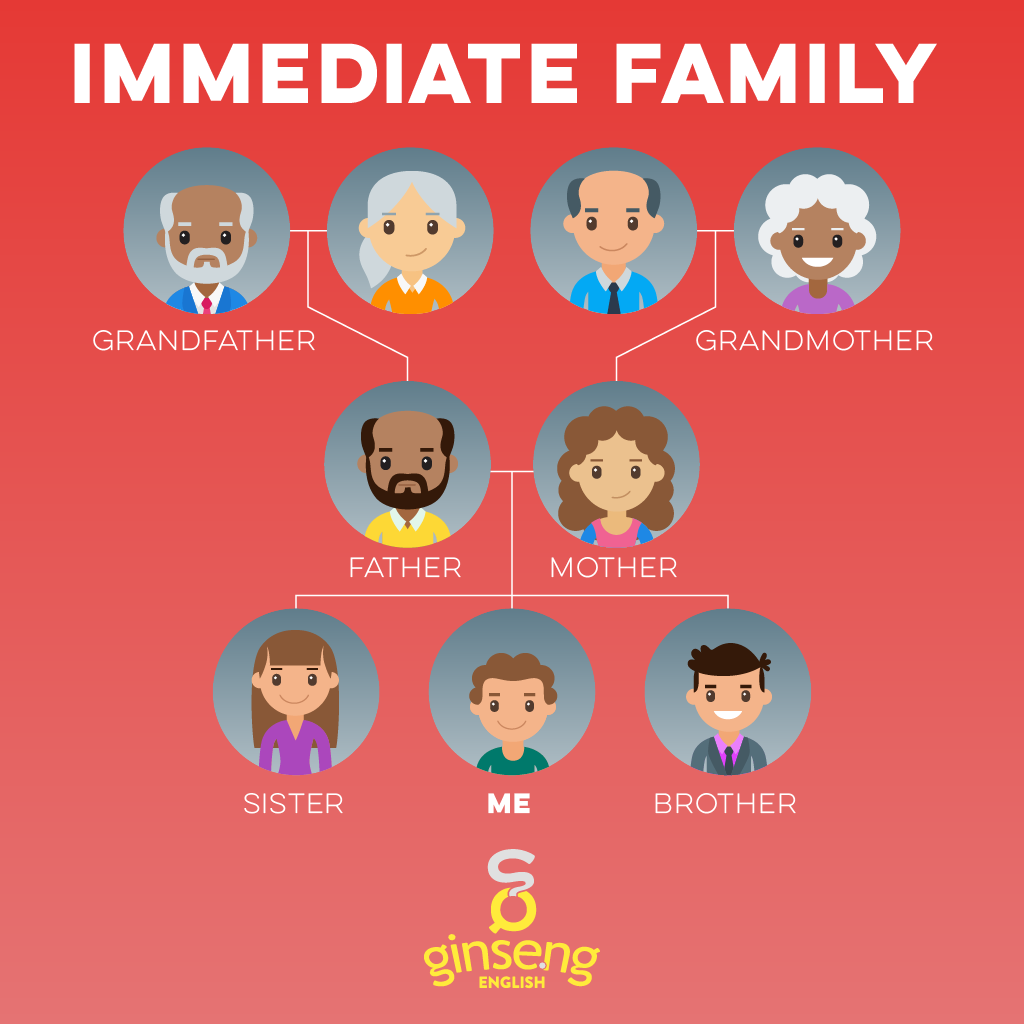
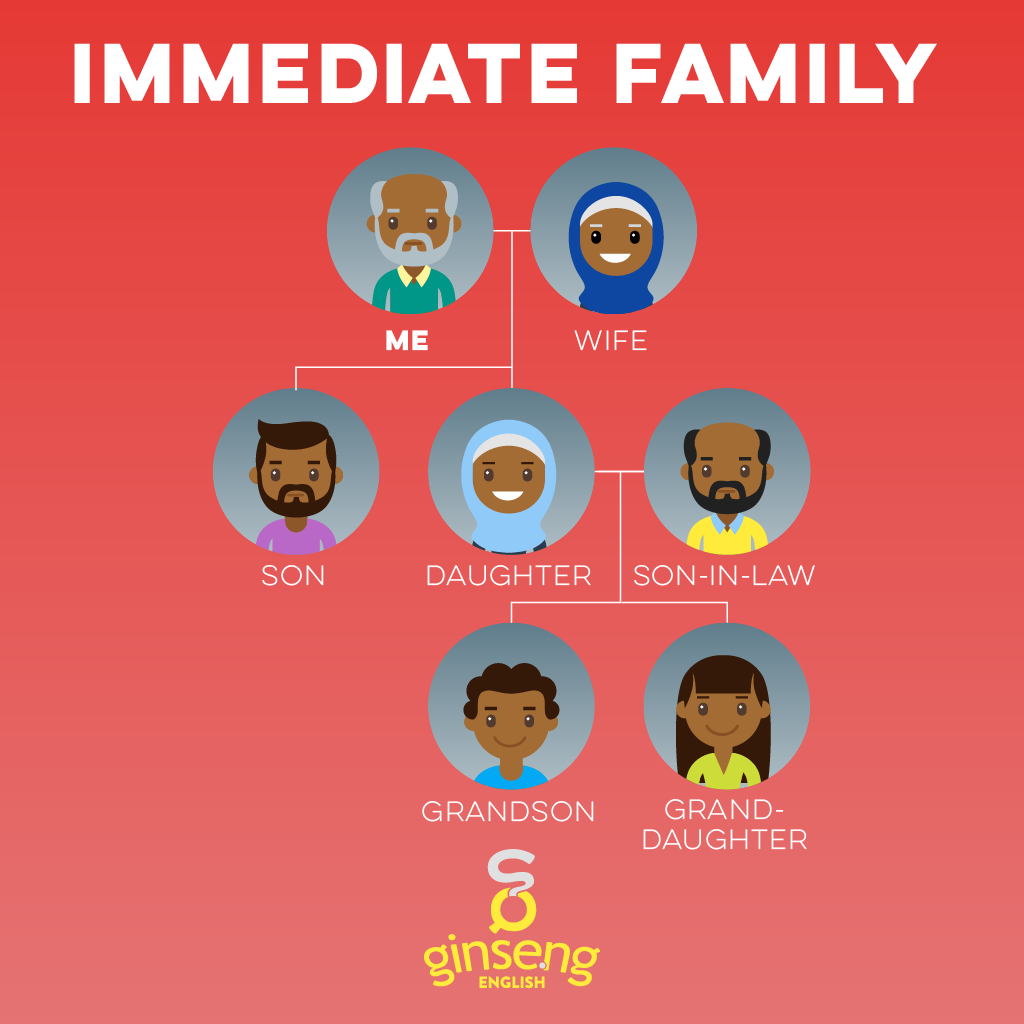
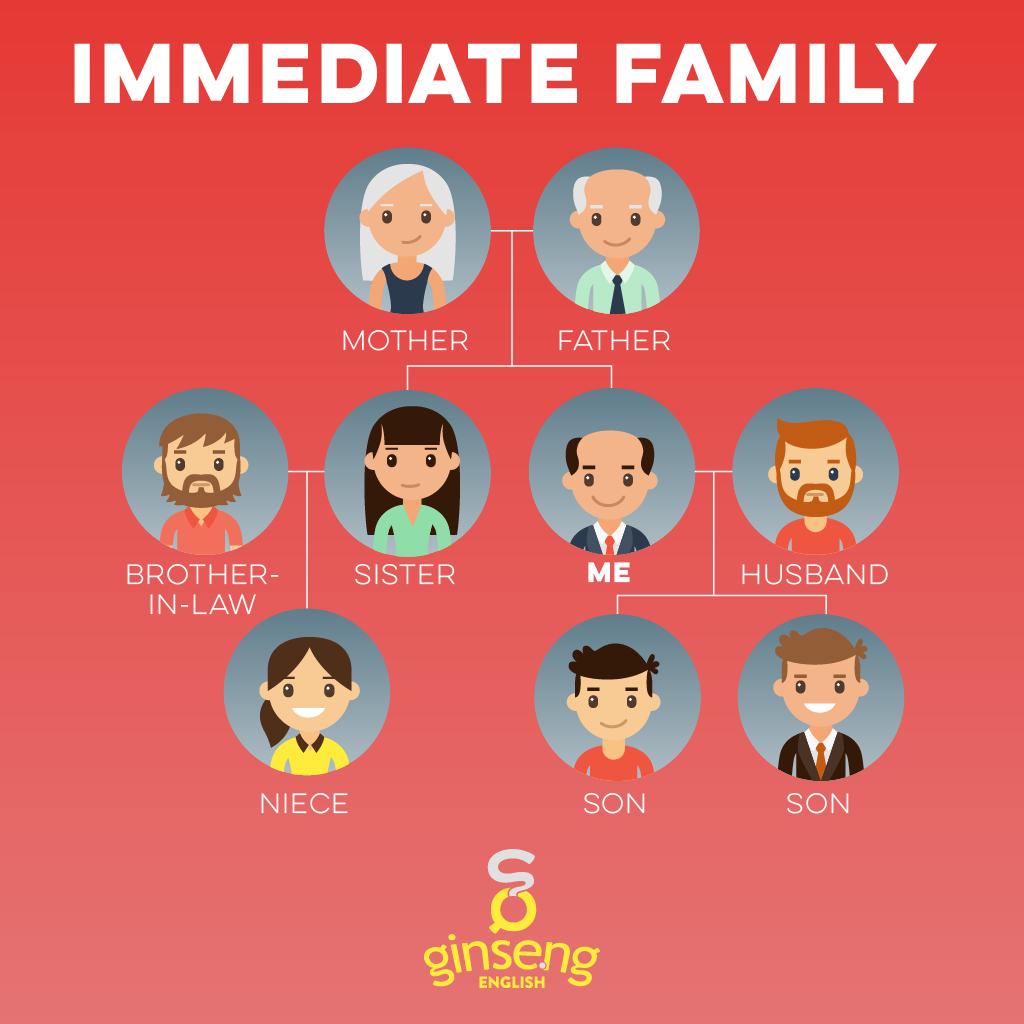
One of the most important topics in any language is family. This post will discuss vocabulary we use to talk about your immediate family. Immediate means very close in this situation. In a future post, we will talk about your bigger extended family.
Parents
First, let’s talk about parents. Parents are the people who take care of us when we are babies. A parent who is a man is called your father. A parent who is a woman is called a mother. Some families have a mother and a father. Some families only have one father or one mother. And some families have two mothers or two fathers.
A more familiar word for father is dad. Children might say daddy. A more familiar word for mother is mom. Children sometimes say mommy.
Grandparents
Your parents’ parents are called your grandparents. Your father’s mother or your mother’s mother is called your grandmother. Your father’s father or your mother’s father is called your grandfather.
Most people have two parents and four grandparents.
Siblings
If your parents have more than one child, then you have siblings! A male sibling is called your brother. A female sibling is called your sister. If you have no siblings, then you are an only child.
In English, we cannot use the word brothers to talk about siblings of both sexes. We say siblings or brothers and sisters. You can ask someone these questions:
Do you have any brothers and sisters?
How many brothers and sisters do you have?
Do you have any siblings?
How many siblings do you have?
You can answer like this:
I have 2 brothers and 2 sisters.
I have 4 siblings.
Notice that we generally use the simple present when talking about family members.
Spouses and Partners
If you get married or live with a boyfriend or girlfriend, this person can be part of your immediate family, too.
If you are married to a woman, this person is called your wife. If you are married to a man, this person is called your husband. If you don’t want to mention gender, you can say spouse or partner:
All the employees and their partners are invited to joing us for dinner.
My wife is pregnant. We’re having twins.
If you are not married, but are dating someone, you can use the word boyfriend for a man, or girlfriend for a woman. It is okay to use these words when you are an adult, but some people think that the words boy and girl in them sound immature, so they prefer partner.
If you need a general word that includes husbands, wives, boyfriends, and girlfriends, then partner or significant other is the best word to use.
More Free English Vocabulary Resources


Idioms About Making Decisions
We have to make decisions every day, but sometimes it’s so hard to just make up your mind! If you’re on the fence about a big decision, then these idioms might help your thought process! (Or at least help you procrastinate making a difficult decision😂)
English Idioms about Making Decisions
We have to make decisions every day, but sometimes it’s so hard to just make up your mind! If you’re on the fence about a big decision, then these idioms might help your thought process! (Or at least help you procrastinate making a difficult decision😂)
Read on to learn what making up your mind and being on the fence mean, as well as many other fun idioms!
Make Up Your Mind
Today’s first idiom is make up your mind. This phrase means make a choice or decision. Sometimes when making a big decision, people spend a lot of time trying to decide which is best, but when we finally decide, we call this making up your mind.
Examples
Maddie was on the fence about what college to go to, but, after visiting both campuses, it was easy for her to make up her mind because the food was much better at one.
My mind is made up, I'm going to learn English, so that I can go to Australia and nothing can stop me!
When the waitress asked me if I wanted french toast or pancakes, I couldn't decide but when I noticed how good the pancakces smelled, it was easy for me to make up my mind!
On the Fence
If you are on the fence, it means that you are undecided between two options and can't make up your mind to decide which way to go. We use the prepositions about or between after this phrase.
I want to get a new phone but I'm on the fence about changing from an iPhone to an Android.
Julia wanted to go to the beach but also wanted to ski on her vacation, so she was on the fence between a trip to Mexico or Switzerland.
Andrew found things that he liked about both presidential candidates, so he was on the fence about who he wanted to vote for.
One one step at a time
To go one step at a time means to think carefully, and go slowly without being careless or rushed.
The hike was very difficult and slippery so we had to go one step at a time to avoid falling.
I loved the first house I saw, but buying a house is such a huge decision that I decided to take it one step at a time and look at other houses too.
Jody really likes her boyfriend, but they are going to take their relationship slowly and go one step at a time so that they can get to know each other better before getting married.
At end of day
You may hear people saying at the end of the day in the news or on the radio, and wondered what it means. You can use this expression when you have considered all of the facts and a ready to make a big decision. Some people will also say it before presenting the final and biggest fact of a situation, or as a way to summarize the final decision. Other ways of saying at the end of the day are "ultimately," "when all was said and done," "in conclusion," "to sum it up," or "all things considered."
Examples
Of course I'll listen to all the sales pitches, but at the end of the day, it's about which company can save us the most money.
Everyone was fighting over the office space with the most windows, but they knew that at the end of the day, the boss would get the best office.
Molly's mom told her that she didn't have to do her homework, but at the end of the day it was Molly who would get the bad grades, not her mom.
No strings attached
No strings attached is an informal phrase that is used to show that an offer or opportunity has no restrictions or hidden fine print, and nothing is required or expected in return.
Ginseng English is offering a free demo English class. We promise, there are no strings attached!
Henry's life was very busy, so when he met a cute woman at a coffee shop, he told her that he wasn't looking for a serious relationship, just something fun with no strings attached.
The gym near my house was offering one month for free. They told me that if I didn't like it, I could cancel easily, no strings attached!
Light at end of tunnel
This Ginseng English idiom is the light at the end of the tunnel. We use it to talk about the end of a long, difficult period of time. The phrase contains a great visual metaphor: the tunnel represents the difficult time, and the light at the end is the sign that it will end soon.
Examples
It's been a terrible year, but there's a light at the end of the tunnel: I'm going on vacation in December!
This is a long week, but it's Wednesday and you can almost see the light at the end of the tunnel.
In the second year of her master's program, Jane finally started to see the light at the end of the tunnel.
LOW HANGING FRUIT
We sometimes say low hanging fruit to describe the tasks or jobs that are the easiest to finish first, don't require a lot of hard work, but make a big difference.
The reason we describe the easiest jobs as low hanging fruit is because the fruit that is hanging lowest on a tree is always the easiest to pick! Once you take care of the low hang fruit, you can work to pick the fruit that is higher from the ground.
When trying to sell their new product, the company called customers who had already bought from them first. They seemed like low hanging fruit.
I needed to save some money, so when I looked at my budget, I decided to cut out the low hanging fruit first, and stop getting so many drinks with friends!
The website needed a lot of improvements, but we had to take it one step at a time so we started with the low hanging fruit, such as changing the color scheme and fixing the homepage.
This article about healthcare is good, but it seems like the writer chose to write only about the low hanging fruit issues, and not the more complex ones that really need to be talked about.
like watching paint dry
Hopefully reading this blog post wasn’t like watching paint dry! Paint dries slowly and with no excitement, so if something is realllllllly boring, we can say that thing is like watching paint dry:
Oh my god, that movie was so boring. It was like watching paint dry.
Ugh, I hate golf. It's like watching paint dry.
How can anyone enjoy studying!? I'd rather watch paint dry!
Other free English resources:
English Idioms about Competition
They say some friendly competition never hurt anyone. In fact, sometimes, people even thrive on a little competition! If you’re one of these people, these idioms about competition might come in handy…
English Idioms about competition
They say some friendly competition never hurt anyone. In fact, sometimes, people even thrive on a little competition! If you’re one of these people, these idioms about competition might come in handy…
Read on, or should we say, game on?!
see eye to eye
Today's first Ginseng English idiom is "see eye to eye." Do you have any friends, coworkers, or family members who you really understand and agree with? In English, you can express this with the idiom see eye to eye. It's also very common in the negative. Check out the examples below!
Examples
My wife and I are a great match, we really see eye to eye.
Jerry and his boss see eye to eye so they work well together.
My parents and I don't see eye to eye about a lot of things, so we fight a lot.
The relationship didn't work because we didn't see eye to eye on some important issues.
No Pain No Gain
This idiom comes from some people's belief that you must suffer to succeed, that nothing good comes without hard work. Do you agree with this theory?
Training for a marathon was the hardest thing I ever did, but as they say, no pain, no gain! Crossing the finish line made all the pain and suffering worth it!
Max's parents told him, no pain, no gain, and made him study English every day. It was hard but when he realized he could speak English with his American friends, he was very happy!
Julie's goal was to be able to do 50 push-ups, Every day her arms hurt so much, but she knew that this was the only way to achieve her goal and she told herself, no pain, no gain!
Ball in your court
The ball is in your court is a simple one. It actually comes from tennis, though it could apply to several different sports. We say the ball is in your court to tell someone that it is their turn to take action, that it is their responsibility to take the next step.
I sent them an two emails last week, so now the ball's in their court.
Well, I apologized and she said nothing, so now the ball is in her court.
They made me a job offer. I'm still thinking about it. I guess the ball is in my court to make a counter-offer.
Toot Your Own Horn
Tooting your own horn is another way to say brag or boast.
A horn is a type of musical instrument that includes trumpets, trombones, and French horns. Horn is also the word for the loud noise your car can make to avoid an accident. The sound that a horn makes is toot. When you toot the horn of a car, it draws attention to your car 📢 🎺. Therefore, if someone toots their own horn, they are making noise to draw attention to themselves.
This is an funny phrase that people use when they know they are about to brag about a personal achievement or skill, but don't want to sound too annoying or conceited while doing so.

Examples
I normally wouldn't brag about my cooking because I'm not very good at it, but I'm going to toot my own horn because this cake I just made is so delicious!
Not to toot my own horn, but I did really well in the interview today and, fingers crossed, I think I'll get the job! 🤞🏼
Jack didn't want to toot his own horn but his boss wasn't in the meeting to see how well his presentation went. Jack knew how hard he worked and that he deserved recognition for it, so he wrote his boss an e-mail to tell her about it. His boss was glad to hear it and was very proud of Jack!
Steal Someone’s Thunder
This next idiom is to steal [someone's] thunder. We use this phrase when one person does something that takes (the stealing) positive attention (the thunder) away from someone who should be getting that positive attention. For example, if it's Alexa's birthday, she should get lots of attention. If Jade announces that she is pregnant at Alexa's birthday, and steals that attention, she steals Alexa's thunder.
Jade really stole Alexa's thunder when she announced that she's pregnant at Alexa's birthday party.
I really wanted to tell everyone about my engagement, but I didn't want to steal Joe's thunder.
My whole childhood, my older sister was always stealing my thunder.
In the Same Boat
Despite our theme of competition today, the idiom, all in the same boat, can sometimes mean the opposite We use this idiom to mean that we are all in the same situation, or sharing the same problem together. In this situation, working together and teamwork is the best option because if the boat sinks, you're all going down together!
Examples
Our boss asked us to work on an extra project. None of us wanted to work over the weekend, and since we were all in the same boat, we decided to stay late and finish the project!
When my cousin asked to borrow $10, I refused because we're in the same boat and I don't have any money either!
Vera and Peter both didn't understand the math class, so since they were in the same boat, they went together to ask the teacher for extra help.
Singing a different tune
To sing a different tune is to change your opinion or attitude about something.
Andy was careless and spent all his retirement money at age 40. I bet once he's 70 and has no retirement fund, he'll be singing a different tune!
Brian claimed that he was the one that broke up with Rebecca, but when she tells her side of the story, she sings a different tune.
Alice wanted a big family, but when she realized how expensive children are, she starting singing a different tune.
Pardon my french
Today's idiom is pardon my French. We say "Pardon my French" as a funny way to apologize for cursing or using profanity. It is also common to say excuse my French.
Back in the 1800s, the phrase was used when you actually used a French word or phrase in your speaking. You might say, "The film had a certain, je ne sais quoi." Then you'd say "Pardon my French," because it was a little rude to speak French in front of people who might not understand. Eventually French developed some negative connotations in English—sorry French speakers!—and the phrase came to be used with swear words.
Shit, I hit my head—Oops, pardon my French!
When John accidentally said a bad word, his wife told him, "John, don't curse in front of the children!" He replied, "Oh, I'm sorry, pardon my French!"
Excuse my French, but this movie sucks!

A famous example of pardon my French from Ferris Bueller's Day Off.
A Dime a Dozen
This last idiom is a dime a dozen, which means very common.
As you may know, a dozen means 12. We use this word frequently to talk about buying things:
a dozen eggs:🥚🥚🥚🥚🥚🥚🥚🥚🥚🥚🥚🥚
a dozen donuts: 🍩🍩🍩🍩🍩🍩🍩🍩🍩🍩🍩🍩
a dozen roses: 🌹🌹🌹🌹🌹🌹🌹🌹🌹🌹🌹🌹

And a dime is a coin worth $0.10 in America.
So, if something costs a dime for a dozen, it's really cheap, so it must be really common. This is a metaphor, though, so it isn't literal.
Beach towels are a dime a dozen in Florida.
Many people think old baseball cards are valuable, but they're a dime a dozen.
Cell phones used to be for rich people only, but now they're a dime a dozen.
Other free English resources:
Black and White Idioms
Today we bring you a variety of English idioms featuring black and white images to help you visualize the meanings, along with sample sentences and definitions!
English Idioms in Black and White
Who doesn’t love some beautiful black and white pictures? Today we bring you a variety of English idioms featuring black and white images to help you visualize the meanings, along with sample sentences and definitions!
Read on for idioms in black and white!!
Show Some Spine
This first Ginseng English idiom is show some spine. Your spine is your backbone, the strong middle bones that support your body. When you tell some one to show some spine or show some backbone, you are telling them to be brave or morally strong. If someone has no backbone or is spineless, it means they are a coward.
Examples
Your boss won't take advantage of you if you just show some spine and stand up to her.
Don't be intimidated by him. He's just a bully. Show some spine!
I always thought of Karen as timid, but she really showed some spine in that meeting.
Go Hand in Hand
When two things go hand in hand, they are very closely connected and always come together. You cannot separate them. For example, we can say that food and health go hand in hand. They are completely connected.
When two people hold each other's hands, we say that they are hand in hand. To help you remember, you can picture health and good food walking hand in hand down the street together!
Homework may be annoying, but it goes hand in hand with learning any new skill!
I can't eat cookies without milk, they just always go hand in hand for me!
Honesty goes hand in hand with friendship.
Rest Assured
We use rest assured when we are confident that you don't need to lose sleep over something because it will work out and be ok. It's another way of saying, "You don't have to worry."
Rest assured, I finally see the bus coming up the street now!
You can rest assured, the airlines will refund you for the flight that they cancelled.
I could rest assured when I was finally home in my own bed and didn't have to worry about bed bugs anymore!
Gray Area
We use the term gray area to talk about a situation where things don't fit easily into categories or where the rules are not clear. Things are easy when they are black and white, but much more complicated when there is a lot of gray area. Examples below!
Examples
It seems like there is a lot of gray area in the university's policy on coworkers dating.
A good novel doesn't just tell you what to think about a character, if they are good or bad. The gray area is the most interesting part!
The law was designed before the internet existed, so there is still a lot of legal gray area surrounding it.
A Wrench in the system
This idiom is a wrench in the system. A wrench is a tool. Usually we think of tools as helpful things, good for building or fixing things, but a wrench in the system is actually a negative phrase. Imagine you have a big, complex machine with lots of gears and moving parts. Then imagine someone puts a wrench in the middle of those moving parts. This will cause big problems for your system, right? That's what we mean when we say a wrench in the system: it's a problem that causes a big complicated plan or system to break or fail.
We had our whole vacation planned out, but when we got food poisoning, it really put a wrench in the system.
If the new client won't agree to this contract, it will really throw a wrench in the system.
When they lost a major funder, it threw a wrench in the system for the new startup.
Come out of shell
The next idiom is come out of your shell. Lots of animals, like snails and turtles, have hard shells that they can hide in if they are scared or in danger. We can use this as a metaphor for people's personalities. If you come out of your shell, it means you open up and become more social and less shy.
Examples
Paula seems quiet at first but once you get to know her, she really comes out of her shell.
Lots of kids are shy around age 4 or 5, but most come out of their shells as they get a little older.
When Kim has a few drinks, he really comes out of his shell and doesn't stop talking!
Birds eye view
How does the world look to a bird flying high above the earth? Probably similar to your perspective if you are in a tall building or an airplane. This is what we mean when we say you have a bird's-eye view.
Punctuation Note
Notice that we put a hyphen (-) in bird's-eye. This is because, together the words bird's and eye are working like an adjective describing view. Whenever you have two words together working as an adjective to describe a noun, you should connect them with a hyphen.
I was nervous for my first hot-air balloon ride, but I really loved the bird's-eye view.
Drone cameras make it easy for anyone to get great pictures from a bird's eye view.
The bird's-eye view from the 25th floor was nice, but the elevator up was so slow.
Homesick
Homesick is the emotional feeling you might get when you're far away from your home, friends and family and you miss them very much. Homesickness can make you feel very sad and depressed, but will usually go away after you make more friends and become more adjusted and comfortable in a new place.
I was really excited when I first got to Spain, but after a week the homesickness really kicked in and I had to call my Mom daily.
It's funny, even after living in a new city for 2 years, sometimes I feel homesick for my childhood town. Eating my favorite food from home helps!
Alex thought he would feel homesick while traveling in Asia, but he was so busy having fun that he didn't even think about home!
Shoot the Moon
Shoot the moon or shoot for the moon! The meaning of this idiom is to try something really ambitious or challenging, to have very big goals. It's impossible to actually shoot the moon, but some people say "If you shoot for the moon and miss, you will land among the stars." This means, if you have very high goals and you don't achieve them, you may still achieve something else great. Common synonyms for shoot the moon are go for broke and aim high.
Examples
When my aunt plays cards, she really shoots the moon and bets a lot.
BThey already offered you the job. When they ask what kind of salary you want, you may as well shoot the moon and ask for more than you expect.
When I was a kid, my parents always taught me to dream big and shoot the moon.
Calm before storm
We use the idiom the calm before the storm to describe the very calm, quiet, or peaceful time before a big argument breaks out, a big change happens, something difficult occurs, or quite literally, before a storm comes!
It's nice to have all my teaching work finished before the students arrive so that I can really enjoy the calm before the storm.
My parents seem happy now, but this is just the calm before the storm. Wait until my mom finds out that my dad bought a new car without talking to her first!
Before the tornado hits, there is a great peacefulness that comes over the town. This is literally the calm before the storm.
Other free English resources:
Fall Idioms
The time has come for Americans to kiss summer goodbye and welcome fall (also known as autumn). Here are some idioms about the fall season!
English Idioms about Fall
The time has come for Americans to kiss summer goodbye and welcome fall (also known as autumn). For most people, especially those living in the north or northeast part of the country, fall means cool evenings, pumpkin spice lattes, apple and pumpkin picking, but above all, beautiful fall foliage! Foliage is what we call it when the leaves on the trees change from green to beautiful shades of orange and red. A popular American hobby is to visit states such as Michigan, Vermont or Maine to “peep” (or view) the foliage!
Read on for idioms that relate to fall!
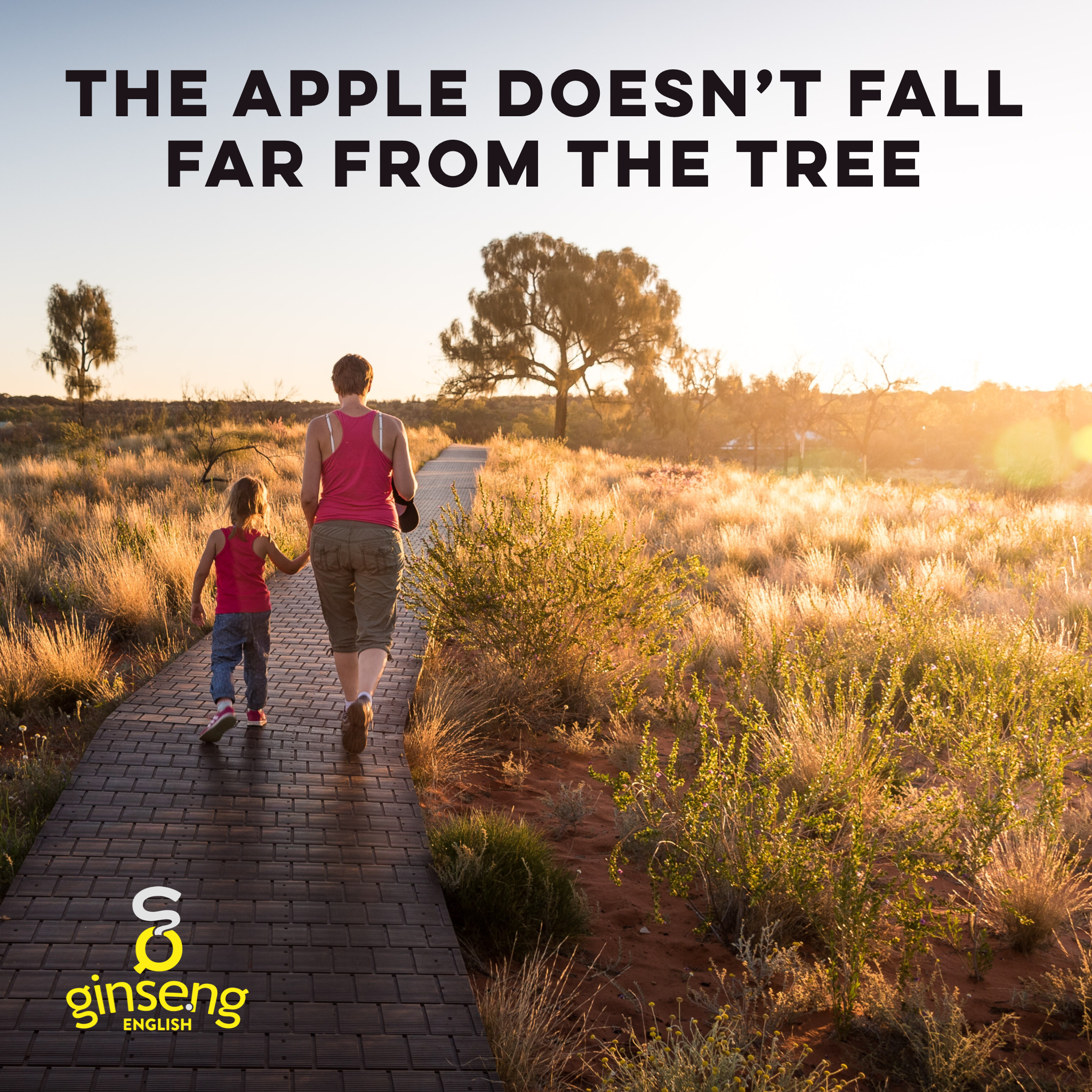
The apple doesn’t fall far from the tree
If a child has very similar traits or characteristics to their parents, we say that the apple doesn’t fall far from the tree. The apple represents the child, and the tree is a symbol for their parents.
Other common expressions with the same meaning are a chip off the old block, or like father, like son.
Examples
Even at a young age, Brandon's son is great at soccer, and seems to have inhereted his father's athetlic abilities. The apple doesn't fall far from the tree, I guess!
Just look at all that curly hair. It's just like your mothers! The apple doesn't fall far from the tree!
I've tried to change my ways, but I'm as stubborn as my mom. I think what they say is true, the apple doesn't fall far from the tree.
Turn over a new leaf
When someone decides to make a big life change, and start acting in a better way, you can say that they are turning over a new leaf.
Examples
Smoking is a bad habit that Jeff had been trying to break for years. He finally decided to turn over a new leaf and stop smoking for good when his wife became pregnant!
My boss and I could never agree on anything but we finally had a big discussion and developed a plan to work better together. I am hopeful that we are both turning over new leaves!
Last year, Casey got in trouble constantly at school for missing classes and not doing her homework. This year, though, she seems to really have turned over a new leaf! and hasn't had any problems!
Apple of MY eye
The apple of my eye is an expression that we use to describe someone or something that we love, or are especially proud of.
Mom would never admit it, but out of my five siblings, I'm truly the apple of her eye.
As a math teacher, Mrs. Temple isn't supposed to choose a favorite student, but Kat is so bright and eager when the rest of the class is half asleep, that she is the apple of Mrs. Temple's eye.
My dog finished his obedience classes, and came in first place! I know he's just a dog, but he's the apple of my eye!
squirrel away
If you secretly save something to use in the future, we can say that you squirrel it away.

Squirrel squirreling away a peanut! 🐿🥜
We use this expression because squirrels are known for hiding nuts and other food to eat during the winter!
Examples
Julia loves Halloween candy so much that she wanted to make it last as long as possible, so she squirreled away some of her favorite candy bars to eat the next month.
It's hard for me to save money, but I really wanted to buy a new computer, so I forced myself to squirrel some money away and eventually I could afford my computer!
Jill's roommate was always eating her food without her permsission, so she squirreled away her favorite food in the back of the refrigerator.
Go out on a limb
To go out on a limb means to take a risk, and put yourself in a vulnerable situation. This is another one of those great visual idioms, because you can imagine the risk someone is taking of falling of they go far out on a limb, or branch, of a tree.

This panda went out on a limb but it didn’t end very well…
Examples
I really went out on a limb when I recommended Andrea for a job at my company, so when she missed a week of work, it made me look very bad!
Brenda decided to go out on a limb and ask Anthony on a date. She was so relieved when he said yes!
Alexa went out on a limb and proposed a new idea at work. Her team knew that she had the facts to back up her proposal, so luckily, they supported her.
Other free English resources:

Watch Your Mouth: Hidden Brain Podcast
Podcasts are not only a great way to enjoy a car ride with friends, make a task like cleaning the kitchen more bearable, and help pass a long bus ride. They are also a great way to learn English!
Watch Your Mouth: Hidden Brain Podcast
Podcasts are not only a great way to enjoy a car ride with friends, make a task like cleaning the kitchen more bearable, and help pass a long bus ride. They are also a great way to learn English!
There are hundreds of great podcasts out there, but when we heard Hidden Brain’s podcast, Watch Your Mouth, we had to share it! This podcast is about whether the structure of languages we speak can change how we see the world, and “how the constantly evolving nature of languages can give us different ways of understanding ourselves as well as the world we live in.” The transcript of this episode is great read too!
A favorite quote from this podcast is, “If you're bilingual or you're learning a new language, you get what Jennifer experienced - the joy of discovering a phrase that helps you perfectly encapsulate a feeling or an experience. The phrase brings an entire world with it - its context, its flavor, its culture. Today, we explore the many facets of this idea. Languages are not just tools to describe the world. They are ways of seeing the world.”
We hope that you enjoy this interesting podcast! If you’re looking for more podcasts suggestions to help you learn English, FluentU has a great list to get you started.
Other FREE English Resources



Summer Idioms
In America, summer officially ends on September 22nd, though in many places it starts to feel like fall much earlier than that! To make sure we enjoy summer for as long as possible, here are some fun summer idioms!
English Idioms about Summer
In America, summer officially ends on September 22nd, though in many places it starts to feel like fall much earlier than that! To make sure we enjoy summer for as long as possible, here are some fun summer idioms!
Ray of sunshine
A ray of sunshine is something or someone that makes people feel very happy, cheerful or optimistic.
Alternatively, this can be used ironically or sarcastically to describe someone who is always miserable or pessimistic, and therefore, is exactly the opposite of a ray of sunshine. 😂
Examples
Monday mornings are tough, but when our boss brings us a box of donuts and coffee, it's like a ray of sunshine in the office!
Alice's mother been sick but when Alice takes her puppy to visit her, it brightens her mom's whole day, just like a ray of sunshine!
Brian were very excited about their new apartment until his roommate, Jill, complained about the messy backyard. He said, "Jill, well aren't you just a ray of sunshine?! We can clean it up, don't worry!"
Indian Summer
An Indian summer is period of unseasonably warm weather that sometimes happens in the fall, especially after a cold period. It is usually a nice surprise, because people might not be quite ready for summer to be over yet!
This expression is also used to describe a time late in someone's life that is surprisingly happy, peaceful, or joyful.
Examples
Audrey and her friends were so happy when there was suddenly an Indian summer in October that they all rushed to the beach for one last day in the sun!
After my father passwed away, we were worried that my mother would be lonely, but to our surprise, in her 70's, she met a very nice man and enjoyed quite the Indian summer late into her old age!
A Day at the Beach
A day at the beach is used as a metaphor to mean something that is very enjoyable, pleasant or easy.
You might also hear people say it was no day at the beach, meaning exactly the opposite: a difficult and unpleasant task or experience.
We thought that moving to a new house would be very difficult, but we hired a great moving company, and it turned out that the move was really a day at the beach!
I had to waste my Saturday renewing my drivers license. Between the long lines, the expensive fees, and the crowded waiting room, it was no day at the beach!
Like a Cat on a Hot Tin Roof
This is one of those great visual idioms. A tin roof is made out of material that can get very hot because tin attracts the sun. So, just imagine a cat on a hot tin roof dancing around with his paws burning and you might be able to guess the meaning of this one!
Someone is who acting like cat on a hot tin roof is very nervous, anxious, and overall in an very worrisome state of mind.
Cat on a Hot Tin Roof is also a 1958 American movie starring Elizabeth Taylor and Paul Newman, based on the play of the same name.

Paul Newman and Elizabeth Taylor in Cat on a Hot Tin Roof
Examples
Kevin didn’t do his homework, so when the teacher called on him to answer a question, he was like a cat on a hot tin roof.
While nervously waiting for the doctor to give her the results of her medical tests, Charlotte paced back and forth across the room like a cat on a hot tin roof
Sink or Swim
Our last one is sink or swim. If you dive into the water, there are literally only two choices: to sink or swim.
Therefore, this idiom means that if you are put in a difficult position and given no help, so it's completely up to you if you fail (sink) or succeed (swim).
Examples
I started a new job but my boss was out sick all week, so I was left to sink or swim!
Sandra didn't speak English very well, but it was her lifelong her dream to see New York City, so she bought a plane ticket anyway and decided it was sink or swim!
After 4 years of college, students graduate and need to find a job on their own. It's time to sink or swim in the real world !
Other free English resources:


Battle Idioms
Today’s idiom posts are all about dogs! Check out this post for several example sentences, definitions. and images to help you remember these idioms!
English Idioms with Battle
From the Battle of Hastings to the battle over the Oxford comma or how many vowels there are, the English language has had its fair share of fighting. We also have lots of different idioms featuring the word battle! Take a look at some below!
A Losing Battle
Our first idiom is fighting a losing battle which means trying to do something that will eventually fail. According to Dictionary.com, this expression actually refers to "unsuccessful battles or games, and has been used figuratively since the early 1600s."
Examples
I have tried and tried to lose weight but with my health problems, it seems like I'm fighting a losing battle.
When her basement flooded, Beth tried to scoop the water out with buckets but it was coming in so quickly that she was fighting a losing battle.
You'd be fighting a losing battle if you try to run against the mayor in the next election. Everyone loves him so much already, there's no way you would win.
Uphill Battle
Unlike fighting a losing battle (above), fighting an uphill battle is difficult, but not impossible! An uphill battle is a task that is challenging from the very beginning, and continues to be hard the entire time.
This idiom is a very visual one. You can imagine the feeling that you get when you are walking up a very steep hill. It's incredibly difficult the entire way up, but there is an end in sight, and you know you can do it!
Notice sometimes we also say uphill struggle or uphill fight.
Examples
My favorite soccer team has many injured players this season. It'll be an uphill battle for them to win the championships!
Math has always been an uphill struggle for Lesley because it's her hardest subject. However, with the help of a math tutor, and a lot of studying, she managed to get an A!
In the 1950's, America ran an anti-litter campaign to get Americans to stop throwing their trash on the ground. It was an uphill battle, but now, 70 years later, you will rarely see trash on the ground. You could say it was a success!
Choose your Battles
This one is more than just an idiom, some might say it's a way of life! If you choose your battles or pick your battles wisely, it means that you are purposely deciding which fights to have, and which ones are not worth your time.
We normally say this when we think a certain "battle" is not worth fighting.
Sandy: It drives me crazy when Paul emails me from right across the hall.
Claire: I don't know, you just talked to him about typing too loud. You've got to pick your battles.
Parents learn how to choose their battles wisely when raising young children. For example, if you have to choose between making your child clean up their mess or eat a healthy dinner, sometimes you might just settle for the healthy meal.
It annoyed me when my girlfriend didn't help clean up after I made dinner, but I decided to choose my battles wisely!
A Running Battle
A running battle is another good one! A prolonged fight or debate between two or more people that may never be resolved can be called a running battle.
The word “running” in this situation means ongoing, or open. For example, sometimes a restaurant may allow their customers to keep a running bill, meaning they can order as much food as they want and pay later.
Examples
My brother and I have a running battle about who is better. He might be taller, but I’m sure that I’m smarter!
The police are fighting a running battle against crime.
The two neighbors have had a running battle for the past five years over whose responsibility it is to cut the grass between their houses.
Half the Battle
The last one for today is half the battle. We use this expression to say that one component is a major part of achieving something bigger, so that by achieving that one component, you have already finished the most difficult part. In this expression, the battle refers to the end achievement or goal!
A common version on this expression is knowing is half the battle, which is similar to saying "knowledge is power." This means that once you are aware of something you can then act on it!
Examples
Showing up to school is half the battle! Now if I can just stay awake for class...
Julie had no idea that her son had been falling asleep in class. Knowing is half the battle, so now she can make sure he gets to bed early!
Learning how to walk around a new city is just half the battle. Once you learn the train system, you'll be a pro!
Winning my new dog's trust is half the battle. After that, I can finally start teaching him tricks!
Other free English resources:
Dog Idioms
Today’s idiom posts are all about dogs! Check out this post for several example sentences, definitions. and images to help you remember these idioms!
English Idioms About Dogs
There are tons and tons of idioms in the English language about dogs, but here are 5 of our favorites!
The Dog Days of Summer
Happy Summer! In honor of the start of summer, we want to talk about the idiom dog days of summer. The expression the dog days of summer is used to describe the hottest days of summertime.
Examples
During the dog days of summer, you can either find me at the beach, or inside my air conditioned house! It's way too hot to do anything else.
It is recommended that you drink a lot of water and stay cool during the dog days of summer to aoid heatstroke.
Once the dog days of summer hit, many people take s vacation to the mountains where it is cooler.
Barking Up the Wrong Tree
We use the expression barking up the wrong tree if someone is making a wrong choice, pursuing the wrong thing, or making a false assumption about someone.
You might have seen dogs chasing animals, such as squirrels or rabbits. The squirrels often run up one tree to escape, and then jump to another tree once it's high enough. The dog might not notice this, and continue barking up the wrong tree without realizing that his prey has moved to a different tree!
Examples
Nicholas asked me to help him cheat on the test. I told him, no way, you're barking up the wrong tree! I'm an honest student and I don't want to get kicked out of school.
I accused my dog of destroying the couch, but I realized I was barking up the wrong tree when I saw pieces of the couch pillows in my cats hair!
Rick had been flirting with Jodi all night, but realized he was barking up the wrong tree because she actually had a crush on his best friend.
Can’t Teach an Old Dog New Tricks
Have you ever heard the idiom, you can’t teach an old dog new tricks? We use this to describe someone who is not open to change or improvement. This kind of person usually doesn’t want to learn a better way to do something and is very stubborn, so we are comparing them to an "old dog" who doesn't want to learn "new tricks"! 🐶
In contrast, some people say "you're never too old to learn!" Which expression do you agree the most with?
Examples
Mr. Gonzalez had been taking attendance on paper for 30 years and he refused to start using a computer. Like they say, you can’t teach an old dog new tricks.
We tried to teach our grandmother how to use her iPhone, but it was nearly impossible! I guess you really can’t teach an old dog new tricks.
Let Sleeping Dogs Lie
Let sleeping dogs lie, which means that you should not bring up old fights or conflicts. Instead, it is best to just forget them and let them be. This is especially common if an argument has been dropped, but not resolved. Letting sleeping dogs lie is a way of keeping the peace and avoiding conflict.
Examples
My sister was wearing the shirt that I know she stole from me, but we were having a peaceful family dinner so I decided to just let sleeping dogs lie and not bring it up.
Hannah got her test back and noticed that the teacher made a mistake on her grade. She was getting an A in the class anyway, so she decided to let sleeping dogs lie and not bother asking the teacher to correct it.
Alex knew that him and his girlfriend would never come to an agreement about whose turn it was to do the dishes, so he thought it was best to let sleeping dogs lie and just do them himself.
Sick as a Dog
Today's idiom is sick as a dog. This expression actually dates back to the 1700s when there weren't many veterinarians to help sick dogs, so it was common for dogs to be very sick. Now, if someone is very, very ill, we say that they are "sick as a dog." 🐶😷
Examples
Rebecca ate a bad hamburger and got food poisoning. Her boss said to her, "Rebecca, you look as sick as a dog, you need to go home right now!"
Jennifer was very tired while traveling in Costa Rica. She thought she was just homesick, but realized she was running a fever. She finally admitted that she was sick as a dog and went to the hospital. 🤒
I don't know what was in that seafood dinner, but afterwards, everyone in my family was sick as a dog!
Other free English resources:
Cat Idioms
English has tons of idioms about animals. Have a look at these idioms about cats. Check out this post for several example sentences, definitions. and images to help you remember these idioms!
English Idioms About Cats
There are tons of fun idioms about cats in English, but here are five of our favorites!
Curiosity Killed the Cat
The first cat idiom that we will talk about today is curiosity killed the cat. This is a funny way to warn someone that if you are too curious, you might end up getting hurt, or in trouble. Too many questions, or too much curiosity can lead to dangerous situations.
We use this idiom because we often we joke that cats have nine lives and can live forever. However, they actually get hurt quite often for doing things they aren't supposed to, such as getting stuck up in trees, or falling off tall shelves. Therefore, sometimes being too curious can actually kill a cat!
Examples
Andrew was very curious about the abandonded building and wanted to sneak in to explore. His friend told him that it's very dangerous, and he shouldn't go because it's not safe. After all, he said, curiosity killed the cat!
Alexis kept asking her friends about what her boyfriend is planning for her birthday. They knew he was throwing a big surprise party and would be heartbroken if she found out, so they told her to stop asking so many questions, curiosity killed the cat!
I was very curious to hear about why my coworker get fired, but my boss warned me that curiosity killed the cat and that it was none of my business.
Scaredy-Cat
Do you have a friend who is always scared? You could call them a scaredy-cat, but they probably wouldn't appreciate it very much! 😹 Someone who is overly nervous, or always frightened is known as a scaredy-cat. You can also call this type of person a fraidy-cat
This expression alludes to the skittishness and anxious behavior of cats.
Examples
Don't be such a scaredy-cat, just give spicy food a chance!
At the amusement park everyone except for Sandra went on the biggest roller coaster. We made fun of Sandra for being a fraidy-cat, but she's so afraid of heights that she couldn't help herself.
Michael was not feeling well, and needed to go to the doctor, but he's a scaredy-cat and is afraid of needles, so he stayed home and just got sicker!
Let The Cat out of the Bag
Have you ever accidentally told a secret, or shared something you shouldn't? If you have, you let the cat out of the bag. We use this phrase to say that you let a secret 'escape'. Someone who constantly lets the cat out of the bag could be called a blabbermouth or a gossip.
Examples
Christine told us not to tell anyone that she is pregnant, but I accidentally mentioned it to a friend and let the cat out of the bag. I felt awful!
Lynn told me that she was quitting her job. I didn't realize this was a secret, and I let the cat out of the bag by telling her coworker. Luckily, her boss wasn't mad!
My fiancé and I weren't ready to tell our parents we were engaged, but when I forgot to take off my engagement ring, the cat was out of the bag💍
CatNap
The next idiom is catnap. If someone takes a very short nap, you can say that they took a catnap. We use this expression because cats are known for sleeping for short periods of time throughout the day.
Catnaps are great because even though they are very quick, you can usually get a good boost of energy from them!
Examples
I have a half hour before my next meeting and I'm exhausted! I guess I'll try to squeeze in a quick catnap!
Wow, I only slept for 10 minutes, but I feel so refreshed! What a great catnap!
Jolene had a long drive ahead of her, so she took a catnap so she could stay awake.
Cat Got Your Tongue
To close out this post, we will talk about the idiom cats got your tongue. We use this idiom when someone has nothing to say, or when they are unusually quiet.
This may be an easy one to remember, because it's quite visual! If the cat has your tongue, you are literally unable able to speak! 👅 😸
Examples
I had a big speech prepared, but when I got up on stage, I froze! Cat got my tongue!
Why are you so quiet? Cat got your tongue?
Lilly was very opinionated but today she didn't have much to say. I wondered if the cat got her tongue!
You may have seen some strange acronyms floating around on the internet. If you are curious what POTUS, FLOTUS, SCOTUS, SGOTUS, FGOTUS, or even SCROTUS means, this is what you’re looking for!