
Nouns
Nouns and verbs are probably the two most important parts of speech in English. The core of every sentence is a noun (or pronoun) and a verb.
What is a noun?
We generally learn that a noun names a person, place, thing, or idea. In a sentence, a noun can be a subject or object.
Some nouns can be singular (talking about one thing), and others can be plural (talking about more than one thing). Other nouns are not countable.
Nouns for People
Here are examples of a noun naming a person:
John Lennon
Queen Elizabeth
Sarah
Jeff
my girlfriend
parents
the winner
an American
Notice that in English some nouns for people’s names and titles, start with a capital letter. These are called proper nouns. Notice that some other nouns require words like an, a, and the before them. These are called articles.
Nouns for Places
Other nouns name places. Many of these are proper nouns, too, particularly names of countries, cities, states, mountains, bodies of water:
America
Zimbabwe
New York City
Delhi
Mecca
The Himalayas
Lake Michigan
Niagara Falls
But other nouns for places are common nouns and do not need a capital letter:
my house
the kitchen
a park
Nouns for Things
Nouns can also be things, physical objects, stuff.
rice
my car
his foot
the chair
shirts
Some things are also proper nouns, if the are famous and unique:
The Hope Diamond
The Mona Lisa
War and Peace
Ginseng English
Nouns for Ideas
Finally, nouns often name ideas, abstract concepts. These are like things, but they are not physical, you cannot touch or see them.
democracy
hope
happiness
hunger
English
Countable and Uncountable Nouns
Nouns are either countable or uncountable (some people call these count nouns and noncount nouns). It is a good idea to learn if a new noun is countable or uncountable, because this will help you use correct grammar (such as indefinite articles).
Countable Nouns
Countable nouns can be counted with a number. Countable nouns are either singular or plural. Here are some examples:
ten birds
two friends
one house
Uncountable Nouns
Uncountable nouns can’t be counted. These include abstract nouns, fluids, and things like sand and rice, which are so small that we don’t count them. Here are some examples:
energy
water
rice
juice
democracy
sugar
Singular and Plural forms of Nouns
In English we change the form of a countable noun to show if we are talking about just one thing (singular) or many things (plural). For most nouns, the plural form simply adds -s to the end of the word. For example, we say a car or one car, but we say two cars, three cars, many cars.

Nouns in English
3 Types of -ing Verb
Ready for some challenging academic grammar?
English grammar can be difficult because sometimes the same word works differently in different situations. This is true for -ing verbs, which can do three different things.
Let's look at the 3 types:

Three types of -ing verb
CONTINUOUS VERBS
The man is walking.
This is the most basic one: a present continuous verb. The subject in the sentence is "man" and "is walking" tells us what he is doing right now. If you see an -ing verb after a be verb (am, is, are, was, were), it is probably a continuous verb.
Another name for continuous verbs is progressive verbs. Continuous and progressive mean the same thing.
PARTICIPIAL ADJECTIVES
The walking man lives with my friend Paul.
The man walking across the street lives with my friend Paul.
In both of these sentences, walking works like an adjective, not a verb. Walking describes the man, and the verb in the sentence is lives. When an -ing verb describes a noun, we call it a participial adjective. Participial adjectives can come before or after the noun, but it is more common to put them after the noun.
Read a little more about participial adjectives here.
GERUNDS
The man likes walking.
In this sentence, we have a subject: the man. We have a verb: likes . What is the -ing verb here? It's the thing that the man likes. What does he like? Walking. Walking is the object of like. What are some other things you can like? Sports, travel, English. All nouns. Object of verbs are nouns, so walking is acting as a noun here. That's what a gerund is: an -ing verb that works like a noun.
More free English resources


Pronouns in English
What is a Pronoun?
Pronouns are one of the 9 parts of speech in English grammar. A pronoun is a word that takes the place of a noun. Pronouns are important in English. They are some of the first words we learn: I, you, he, she, it. There are different kinds of pronouns for different situations: subject pronouns, object pronouns, possessive pronouns, and reflexive pronouns. Instead of Sara, we can say she. Instead of those guys, we can say them. Instead of the sun, we can say it.
Why do we use pronouns?
One reason that we use pronouns is to avoid repetition. Think about this example:
Look at this beautiful table. The table is gorgeous. The table has a red top and the table's legs are steel. I really want to buy the table.
The table, the table, the table, the table—aaaaaaah. We try to avoid this kind of repetition in English. Instead of table, table, table, table, we usually say table once. After that first time, we use a pronoun, like it. This next example is more typical of how we speak in English:
Look at this beautiful table. It is gorgeous. It has a red top and its legs are steel. I really want to buy it.
Simpler and cleaner! That's why we use pronouns.
So a pronoun can take the place of a noun. But there are also some important differences between how we use nouns and pronouns. For instance, we don’t usually use a determiner before a pronoun: we say the table, but we never say the it. We say my friend, but we don’t say my him. We also don’t usually use adjectives before pronouns. We can say the red car, but it would be very strange to say the red it.
Now let's look at the five different kinds of personal pronouns:
English Personal Pronouns
In English, we use different pronouns to show grammatical person, gender, and singular/plural distinctions.
For example, if I am talking about myself, we call this the first person. If I are talking about myself alone, this is singular (only one person). Singular first person pronouns include I, me, mine, etc.
If I am talking about a group of people that includes me, this is the first person plural (more than one person). Plural first person pronouns include we, us, ours, etc.
English Pronoun Chart
Second person pronouns are used to talk about the person you are speaking to. These include you, yours, yourself, etc. You can be both singular and plural in English.
Third person pronouns are used to talk about people who are not either the speaker or the listener. They include the third person singular pronouns (like he, she, it) and third person singular pronouns (like they, them, etc.).
For inanimate objects—things that are not people—we use it, its, and itself.
They/Them Pronouns
When we use third person pronouns, we often distinguish between genders. For example, she, her, and hers are often used to talk about women, and he, him, and his are often used to talk about men. They, them, and their can be used as gender-neutral pronouns. We can use these either because we don't want or need to specify a gender, or because someone goes by non-gendered or nonbinary pronouns.
SUBJECT PRONOUNS
The first pronouns we teach are usually subject pronouns. The subject is often the noun right before the verb. Almost every sentence has a subject. Generally, the subject of the sentence is the person or thing that does the verb or makes the verb happen.
The tiger sleeps a lot.
In the example above, the verb is sleeps, and the subject is tiger. Who sleeps? The tiger does. The subject usually tells us who or what does the action. We have a special set of pronouns that we use to be the subject of a sentence. The table below lists the most common subject pronouns.
| Singular | Plural | |
|---|---|---|
| 1st person | I | we |
| 2nd person | you | you |
| 3rd person | she | they |
| he | ||
| it |
We don’t say Me like candy or Him has a cat. We say I like candy and He has a cat. Me and him are the wrong type of pronouns. We use subject pronouns. Here are some more examples:
I like movies.
Do you like movies?
Invite Clara. She likes movies.
He likes movies, too!
We like watching movies on weekends.
Before a verb, to express who or what does the action in a sentence, use a subject pronoun.
OBJECT PRONOUNS
Almost all verbs have a subject, and some also have an object. The object of a verb is the thing that receives an action. For example, you wouldn't just say, I want, right? You need to want something. We say I want coffee or I want a cheeseburger. Coffee and cheeseburger are objects. They receive the verb, want.
I want a hamburger.
I want a job.
I want a girlfriend.
Hamburger, job, and girlfriend are objects. Notice that objects generally come after the verb in the sentence. We use object pronouns to represent objects in sentences. This table lists the most common object pronouns:
| Singular | Plural | |
|---|---|---|
| 1st person | me | us |
| 2nd person | you | you |
| 3rd person | her | they |
| him | ||
| it |
Here are some examples of sentences using object pronouns:
That hamburger looks delicious. I want it.
Who is that girl? I think I know her.
You can have these books if you want them.
Can I help you?
My teacher hates me!
In all the examples above, the pronouns are the objects of a verb. We use the same set of object pronouns as the objects of prepositions, as you can see in these examples:
My grandmother gave that to me.
I've been getting weird texts from her.
We've heard so much about you!
After a verb or a preposition, you generally want to use an object pronoun.
POSSESSIVE PRONOUNS
To possess something is to own or have that thing. If I have a car, we can say that car is my possession. We can say, That car is mine. Mine is a pronoun in this sentence. It represents the car, the thing that I possess. Mine is a possessive pronoun. Here is a chart with the most common possessive pronouns:
| Singular | Plural | |
|---|---|---|
| 1st person | mine | ours |
| 2nd person | yours | yours |
| 3rd person | hers | theirs |
| his | ||
| its |
Here are some example sentences with possessive pronouns:
That car is hers.
This is my drink. That one is yours.
All the coats are in a big messy pile. I can't find mine!
As you can see, possessive pronouns can be used to talk about things that belong to specific people.
POSSESSIVE DETERMINERS
Possessive determiners (also called possessive adjectives) are not actually pronouns, but it's a good idea to learn them at the same time, because they are very similar to possessive pronouns. The difference is that possessive determiners can not replace nouns; they come before nouns to tell us whose they are. If someone asks, Whose iPad is this? you could answer with a possessive pronoun: It's mine. But you could also use a possessive determiner:
That's my iPad.
With a possessive determiner, it is important to include a noun after. Just saying That is my. would by wrong. Here is a list of the most common possessive determiners.
| Singular | Plural | |
|---|---|---|
| 1st person | my | our |
| 2nd person | your | your |
| 3rd person | her | their |
| his | ||
| its |
And here are some examples of possessive determiners in sentences:
Sorry, I have to take this call. It's my son.
Cheryl is at her English class.
We lost our baseball game.
Please take off your shoes.
Can you believe they lost their homework again?
REFLEXIVE PRONOUNS
So we have talked about subjects and objects, right? Subjects are the people or things that do the action in the verb, and objects are the people or things that receive the action. Sometimes, those are the same person, right? For example, if I cut my finger, I hurt someone. The someone I hurt is me (ouch!). But in English we don't say I hurt me. We have special pronouns for the object in this situation, and they are called reflexive pronouns.
Here is a table of the most common reflexive pronouns in English:
| Singular | Plural | |
|---|---|---|
| 1st person | myself | ourselves |
| 2nd person | yourself | yourselves |
| 3rd person | herself | themselves |
| himself | ||
| itself |
And here are some examples of reflexive pronouns used in sentences:
Clara taught herself English.
Don't play with that knife. You will hurt yourself.
The kids are entertaining themselves in the yeard.
Oh, nothing. I'm just talking to myself.
After a couple of days, the problem fixed itself.
Complete English Pronoun Chart
Here is a complete table of all the pronouns discussed in this post. There are still some other types of pronouns, however. Demonstrative pronouns and relative pronouns, for example, are usually studied separately.
| Subject | Object | Possessive Pronoun |
Possessive Determiner |
Reflexive | |||
|---|---|---|---|---|---|---|---|
| Singular | 1st Person | I | me | mine | my | myself | |
| 2nd person | you | you | yours | your | yourself | ||
| 3rd person | Feminine | she | her | hers | her | herself | |
| Masculine | he | him | his | his | himself | ||
| Neutral | they | them | theirs | their | themself | ||
| Inanimate | it | it | its | its | itself | ||
| Plural | 1st Person | we | us | ours | our | ourselves | |
| 2nd Person | you | you | yours | your | yourselves | ||
| 3rd Person | they | them | theirs | their | themselves | ||
| Impersonal | one | one | one's | one's | oneself | ||
Pronombres en Inglés
Pronomes pessoais em inglês
الضمائر في الانجليزية
Parts of Speech in English
Parts of Speech in English
Every word in a language can be categorized by its part of speech. Parts of speech (also known as word classes) tell us what a word does, along with how it functions and makes meaning. We can also group parts of speech into lexical words, which carry a lot of meaning, and function words (or grammar words), which help us make sentences and show the relationship between things.
Overview of English Parts of Speech
How Many Parts of Speech are There?
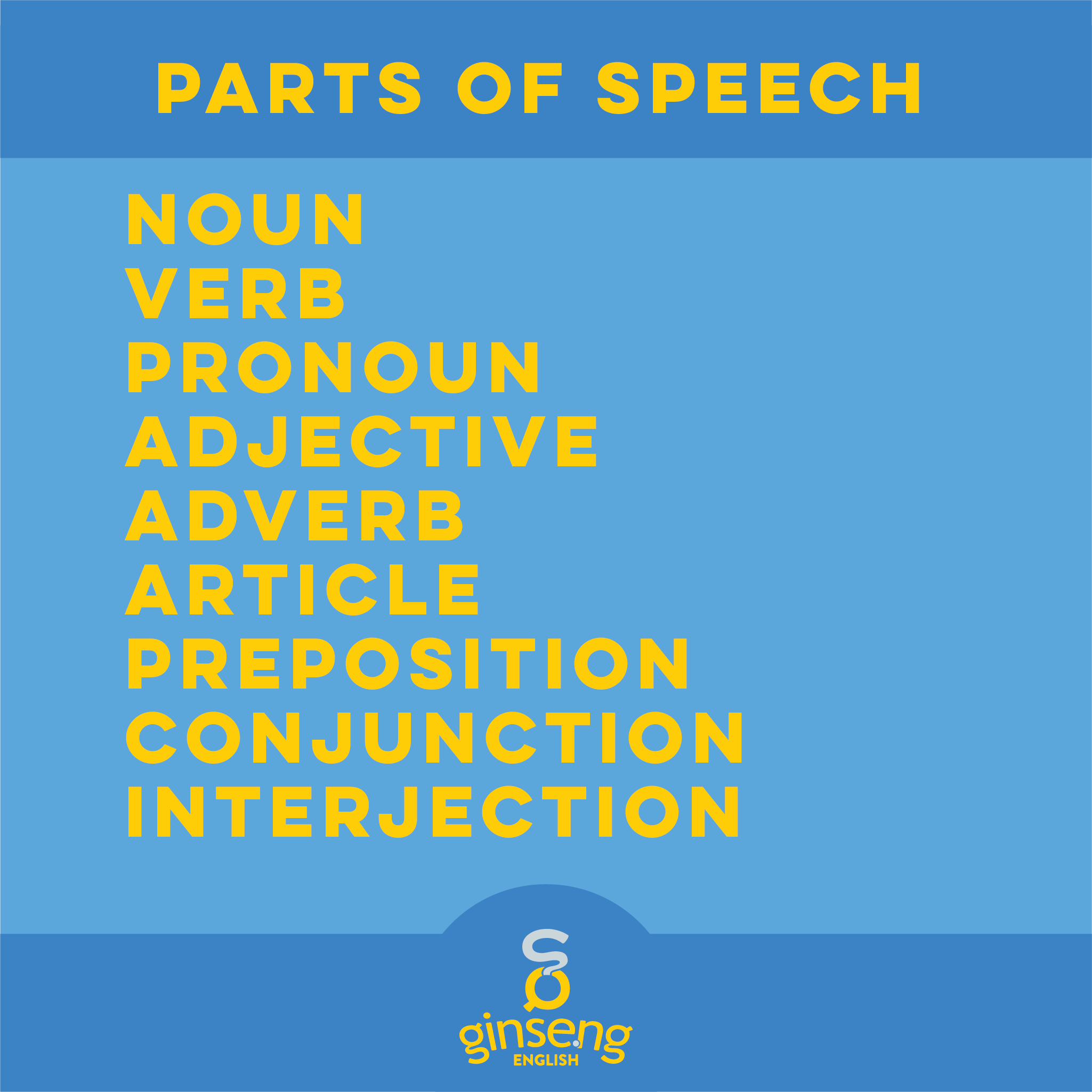
There are a total of 9 different parts of speech in English: nouns, pronouns, verbs, adverbs, adjectives, prepositions, conjunctions, interjections, and articles (or determiners). Read on for a brief explanation of each!
If an article tells you that there are only 8, they are often missing articles or determiners, which are a really important one, especially for language learners.
Why Learn about Parts of Speech?
If you’re looking for the parts of speech in English grammar, you’ve come to the right place! If you’re trying to learn English online by yourself, understanding the parts of speech is a good place to start. They can help you to understand the structure of the language to guide your studying. If you are looking for an in-depth guide to English grammar, our complete English grammar guide might be more helpful.
Frequency of Different Parts of Speech
At Ginseng English, we believe in taking a research-informed, strategic approach to learning English. So understanding the general frequency of the different parts of speech is helpful. Take a look at the following table showing the proportion of the different parts of speech in conversational English and academic prose. (Note that the percentages are approximate and may not total 100% because the original categorization was slightly different from ours. This is only to give a general sense of the proportions.
| Conversation | Academic | ||
|---|---|---|---|
| Lexical | Nouns | 15% | 30% |
| Verbs | 12.5% | 10% | |
| Adjectives | 2.5% | 10% | |
| Adverbs | 5% | 3% | |
| Function | Pronouns | 16.5% | 4% |
| Prepositions | 5.5% | 15% | |
| Determiners | 4.5% | 10% | |
| Conjunctions | 4.5% | 5% |
Source: Biber, et. al., (1999). Longman Grammar of Spoken and Written English.
Nouns
Lots of teachers say a noun is a person, place, or thing! You should also add ideas to that list. Proper nouns in English start with a capital letter, but other nouns do not.
Here are some examples of nouns:
This is my father.
We are from Ecuador.
I have two dogs.
On this holiday we celebrate our independence.
Nouns in English can be singular or plural. to form a regular plural, we simply add -s or -es to the end of a noun. Irregular plurals do not follow this rule.
Here is a complete article on Nouns in English.
Pronouns
Pronouns are used to stand in place for a noun, because in English we don’t like to repeat nouns again and again. The noun that a pronoun refers back to is called its antecedent. Examples of common pronouns in English are he, she, it, him, her, mine, this, that, myself. Pronouns in English change form to show, for example, whether they are singular or plural, subjects or objects, male or female or neither.
Here are examples of some basic pronouns:
Can I have that?
We are with her.
I think I need something to eat.
Here is a complete article on pronouns in English.
Verbs
Verbs are words we use to talk about actions, states, and occurrences (things that happen). Many people would say that nouns and verbs are the most important and useful parts of speech in any language.
The main verb in a sentence has a subject, generally a noun or pronoun referring to the person or thing that the sentence is about. For example, in the sentence Maria walks, the verb is walks and the subject is Maria. Verbs can change form to ‘agree with’ their subject.
Here are some examples of verbs:
They cook every night
We went to the store.
This will help the people.
Notice in that last example that a verb can be more than one word. This is called a compound verb. There are two types of verb: main verbs and helping verbs (also called auxiliary verbs).
Adjectives
Adjectives are words that describe, or modify, nouns. They generally (but not always) come before nouns. In the following phrases, the adjectives are in bold:
a big party some terrible news the best pizza an interesting idea a really strong leader
For more information, check out our list of the most common adjectives in English.
Adverbs
Like adjectives, adverbs are describing words. But while adjectives describe only nouns, adverbs can describe verbs, adjectives, other adverbs, or entire sentences.
Because adverbs are so versatile, it is hard to say much that applies to all adverbs generally. They can appear at different places in the sentence: at the beginning, before a verb, before an adjective, after a verb, or at the end of a sentence.
walk slowly speak clearly immediately fell run fast
Many adverbs end in -ly, and many adjectives can be transformed into adverbs by adding the suffix -ly: slow becomes slowly, eventual becomes eventually, stupid becomes stupidly, etc.
One of the most basic types of adverbs are adverbs of frequency. Click through to read more about those.
Articles
The articles in English are a, an (indefinite articles) and the (definite article). Articles can be really tricky, but the basic idea is that we use indefinite articles when we are introducing a new noun to our listeners or not referring to a specific object. On the other hand, we use definite articles to refer to a specific object that our listeners already know about.
Note: You may find articles out there claiming that articles are a type of adjective. This is simply incorrect. At one time (about 300 years ago) some people thought this, but this is not a current view.
Note: Some grammars treat articles as a subcategory of determiners. This is a valid view. Determiners include possessive determiners such as my and your, as well as demonstrative determiners such as this, that, these, and those.
Prepositions
Prepositions are, to put it simply, words that are placed before (pre-position) nouns or pronouns to connect them to other parts of speech in a sentence. There are different types of preposition that give different types of information: prepositions of time, prepositions of place, prepositions of direction.
Conjunctions
Conjunctions are words that connect. They can connect, for example, a list of nouns in a series. But most of the time, when we are talking about conjunctions, we are talking about connecting one clause to another clause in the same sentence. There are two types of conjunctions: coordinating conjunctions and subordinating conjunctions.
Coordinating Conjunctions
Coordinating conjunctions connect two clauses of equal importance into what we call a compound sentence. There are not many coordinating conjunctions. You can remember them with the acronym FANBOYS: for, and, nor, but, or, yet, so.
Subordinating Conjunctions
When we connect clauses using subordinating conjunctions, we are giving one clause more importance than the other. The less important clause is called a subordinate clause. Two or more clauses combined with subordinating conjunctions are called a complex sentence. Some common subordinating conjunctions are because, although, before, since, when, while, and if.
Interjections
Interjections are funny words: ouch, wow, hmm, oops, well, geez.. They are sort of the black sheep of English grammar. They are not connected to the other words in a sentence (they are inter-jected, put in between, the other words). Generally they add emotion to a sentence. Here are some examples of interjections:
Wow, I'm so tired.
Ouch! I cut my finger.
Oh, you moved to Manhattan
For and Since in English
For and since are two English prepositions that we can use to talk about time in English. They are similar, but we use them a little differently (Be careful! For and since have other meanings as well).
Which verb tenses do we use with for and since
We can use these words with many different verb tenses, especially these ones:
Many learners try to use for and since with the simple present, but this is usually an error:
I am living in Medellin since 2011
I study English for 3 hours
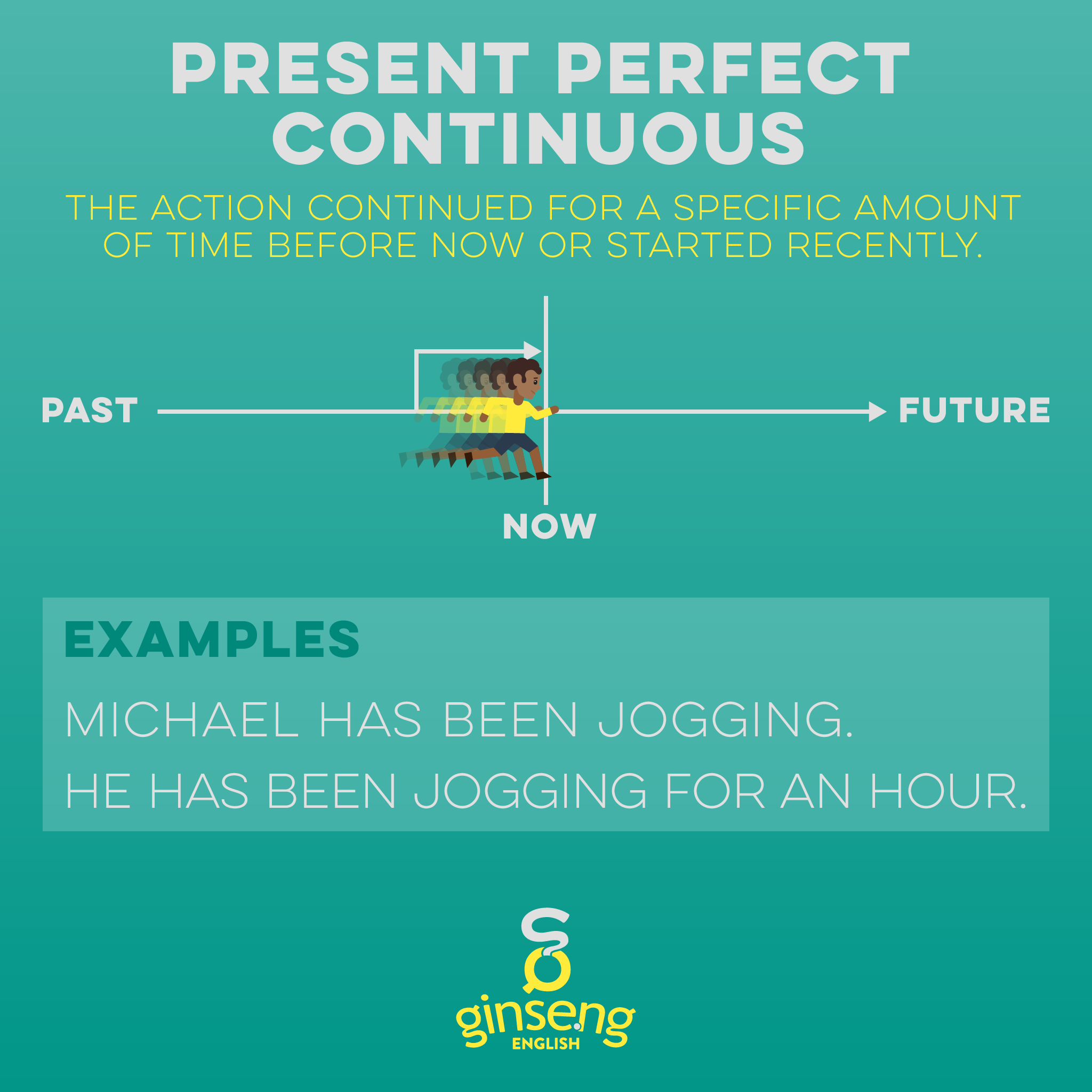
There are some exceptions, but generally you want to use the present perfect or present perfect continuous in to describe an action or situation that started in the past and is still true:
I have lived in Medellin since 2011
I have been studying English for 3 hours
The Difference Between For and Since
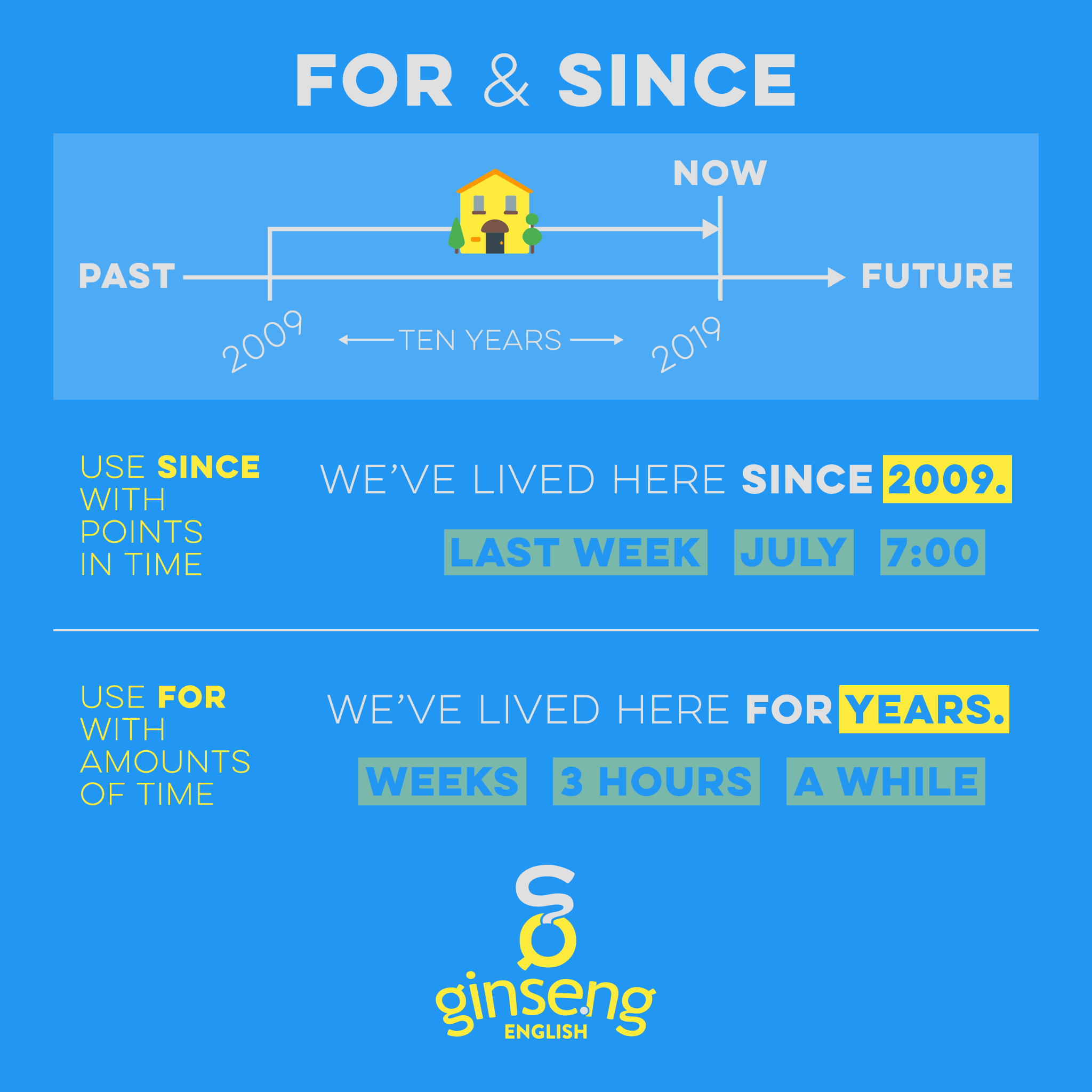
Here is the important difference between for and since: We use for with an amount of time, but we use since with a point in time.
Using For
We use for to express an amount of time (we could also call this a period or time or a duration). Here are some examples of for with amounts of time:
for two years
for 3 hours
for a week
for a long time
for a little while
for centuries
for ages
for as long as I can remember
Using Since
We use since with a point in time, the time when an action or situation began.
since last week
since Monday
since December 11
since September
since 1984
since Thanksgiving
since last fall
since I was born
Ago
Ago is a useful word for changing most durations into points in time. That is, two years is a duration and we use it with for. But if we add ago, two years ago is a point in time, and we can say since two years ago. Here are some examples with ago:
since five years ago
since 3 hours ago
since a week ago
Note that using since with ago is a little informal, and better for speaking than formal writing.
Past Perfect Continuous Tense
The present perfect continuous is an important verb form for talking about recent events and their durations. Read about the rules for using the present perfect continuous tense, how we form it, and tons of example sentences!
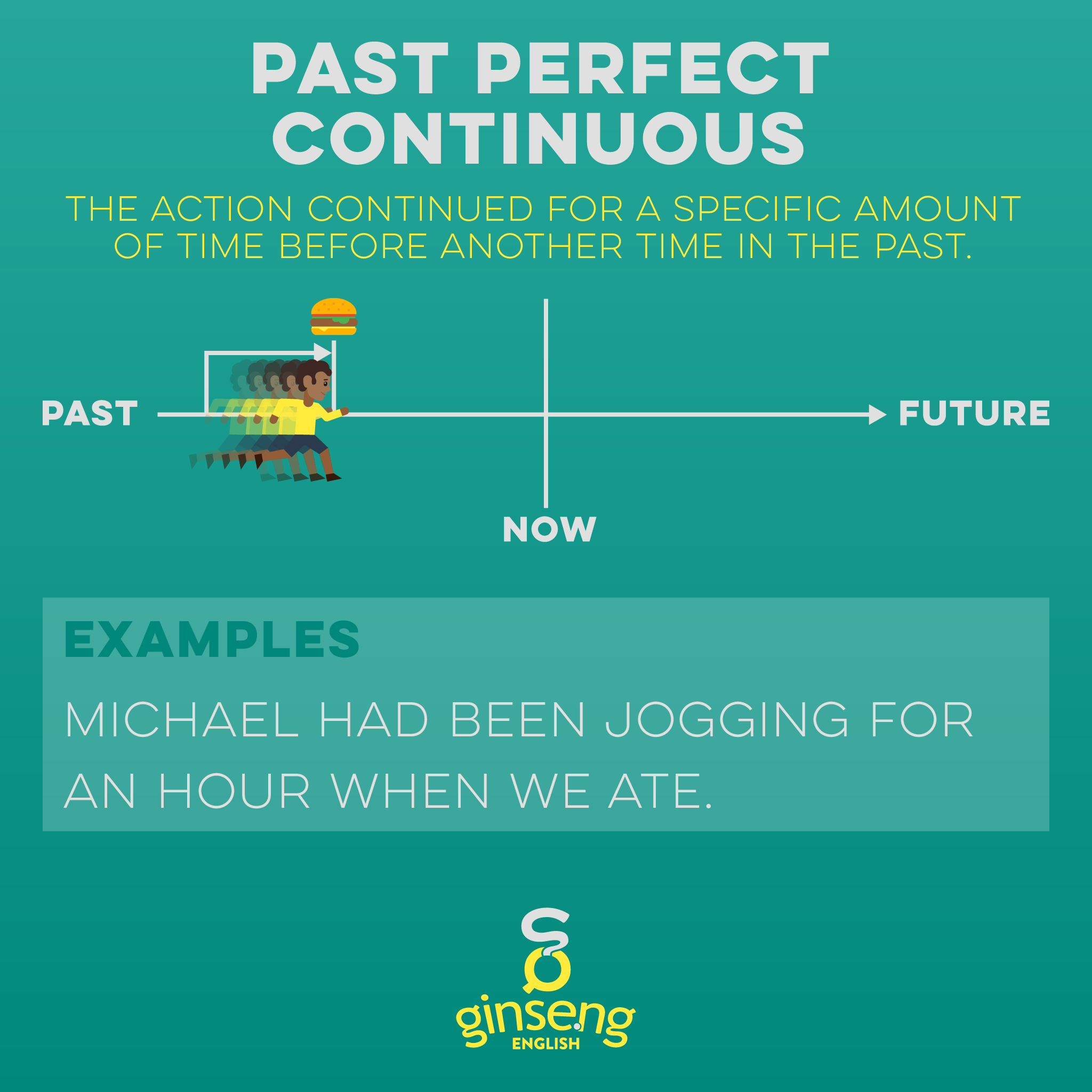
The past perfect progressive shows that an action started in the past and continued up to another time or action, also in the past. It does not specify if the action continues after that point. This is a very uncommon verb form: less than .1% of verbs in spoken English are in this form.
Continue reading to learn how to form the past perfect continuous and when to use it, including loads of examples and charts!
Just to be clear, continuous and progressive are just different names for this same thing. In some countries, one word is more common, but continuous is more common around the world, so we use that!
Chart for Past Perfect Continuous Tense in English

Using the Past Perfect Continuous Tense in English
The past perfect continuous is really difficult. Lots of websites will claim to explain this tense in just a quick article, and this just isn’t possible (sorry!). We use this verb form in a few different situations, and it can have different meanings depending on the situation. Here are some examples:
We were wet because it had been raining for hours.
I knew the city well at that point because I had been living there for a few years..
When I met your mom I was in pretty good shape because I had been working construction
Note that these correspond pretty closely with the different ways that we use the present perfect continuous form:
Recently Completed Actions
Actions Still Happening (with for/since)
New Routines and Habits
The past perfect continuous is basically the same, except shifted into the past time frame.
It is worth mentioning that, in many situations the past perfect and past perfect continuous are interchangeable.
Here are a few more examples:
That had been a difficult month. She had been working long hours.
I’d been going to the gym a lot back then.
We’d been cooking at home more at that point.
Forming the Past Perfect continuous
Formula
Forming the past perfect continuous isn’t difficult. You will always use the same formula:
had + been + VERBing
You could also think of it as simple steps, too:
First, use had (this is the past part)
Then use been (this is the perfect part)
Then use your main verb with -ing (this is the continuous part)
Conjugation
Here is the verb work conjugated into the past perfect continuous.
| Singular | Plural | |||
|---|---|---|---|---|
| 1st person | I | had been working. | we | had been working. |
| 2nd person | you | had been working. | you | had been working. |
| 3rd person | he | had been working. | they | had been working. |
| she | had been working. | |||
| it | had been working. | |||
Notice that we can see both the perfect and the continuous aspect in this form. Had been is the perfect aspect. Been verb-ing is continuous aspect.
Other Forms of the past Perfect continuous
Negative Sentences
You always have two helping verbs in the past perfect continuous: had and been. To make a negative, simply make it had not been.
I had not been practicing for very long.
I had not been living in Boston for years, and I missed it.
I had not been studying, so I was doing poorly in school.
Because the past perfect continuous uses so many words, we often use contractions with not to make it a little shorter:
I hadn't been practicing for very long.
I hadn't been living in Boston for years, and I missed it.
I hadn't been studying, so I was doing poorly in school.
Questions
To make a question, put had before the subject:
Why did they break up? Had he been cheating?
How long had the car been running for when it finally died?
Why had you been studying Chinese if you were planning to move to France?
Passive Voice
Making passive sentences with rarer and more complicated verb forms like the past perfect continuous is extremely uncommon and almost always a bad idea. We really recommend that you rephrase a sentence to avoid creating such an awkward sentence.
They had been being observed a lot at work.
Hopefully you can see how awkward this sentence is. If you really need to make a passive sentence in this form, you should use the get passive to avoid the awkward combination of been and being.
Put get in the past perfect continuous (had been getting) and then the perfect form of the main verb.
We had been getting observed a lot at work lately.
I'd been getting kicked off the internet every 5 minutes.
check out these other free grammar resources:

Idioms About Winter
We have to make decisions every day, but sometimes it’s so hard to just make up your mind! If you’re on the fence about a big decision, then these idioms might help your thought process! (Or at least help you procrastinate making a difficult decision😂)
English Idioms about Winter
Over here in America, we’re in the heart of winter time! For many people, that means we are hibernating, just like bears, and not leaving our house! While we’re inside keeping warm, here are some fun idioms about winter!
Tip of the Iceberg
Our first winter idiom is tip of the iceberg. This phrase is usually spoken in a negative way to refer to a problem that is much bigger than it initially seems.
We say this because when an iceberg sticks out of the water, you only see a small part of it, and have no idea how big it really is underneath.

The e captain of the Titanic certainly experienced more than just the tip of the iceberg!
Examples
The cut on my leg is only the tip of the iceberg. The doctor is worried that I may have broken a bone.
The flooding is bad, but that is just the tip of the iceberg. Wait until the hurricane starts!
I thought paying rent was expensive, but I realized that was just the tip of the iceberg when I saw how much my heating and internet bills are!
Under the Weather
If you are feeling under the weather, it means that you are feeling unwell, and maybe a little sick.
This one is easy to remember because you can imagine how unpleasant it feels to be under a cloud of rain or stuck in the middle of a snowstorm!
Another idiom to talk about feeling ill is to say that you’re sick as a dog! 🤧
Lilly called out sick from work today because she was feeling under the weather.
Jared was skiing all weekend in a snow storm, so it came as no surpsie when he was feeling under the weather when he got home!
Kathleen was really hoping she would feel good enough to go to the concert, but even after a lot of rest and chicken soup, shse was still feeling under the weather and had to stay home.
Cold Shoulder
If someone is intentionally being rude, mean, or unfriendly, you can say that they are giving you the cold shoulder.
It is rumored by Phrases.org that this expression began in the early 1800’s. When a family would have a welcomed visitor, they would serve them a nice hot meal, but when they had an unwelcome visitor, they would serve them a cold shoulder of meat. 🍖❄️
Ian hoped that him and his ex-girlfriend could be friends, but whenever he tried to talk to her, she gave him the cold shoulder.
My roommate came home late last night and was loud and woke me up, so the next morning I gave her the cold shoulder. Once she apologized and made me coffee, I forgave her.
Christine's co-worker gave her the cold shoulder after she realized that Christine hadn't invited her to her wedding.
When Hell Freezes Over
This next expression is very informal and even a little offensive, so be careful who you say it to!
If something is guaranteed to never happen, you can say that it’ll happen when hell freezes over. This is a sarcastic comment, because obviously, hell is not going to freeze over!
Examples
I'll apologize to him when hell freezes over!
You can expect a pay raise... when hell freezes over!
Gabriel's mom promised to buy him a car when hell freezes over!
Break the Ice
Here’s another great idiom related to winter. To do something funny in a tense situation can be called breaking the ice. For example, if you are in a new English class, your teacher might start out with some fun games known as icebreakers to help students get to know each other better and become more comfortable in the class.
When the elevator broke, I was stuck in it for 2 hours with a stranger, so I made some jokes to help break the ice.
It's hard to break the ice on a first date, but I find that telling a funny story helps!
A friendly smile and little wave can be a simple way to break the ice at a new job.
on thin ice
This idiom is on thin ice. We use this one to talk about a situation where someone is doing something that is very risky and could be dangerous if something goes wrong.
This idiom is great to visualize because you can easily imagine what it’s like to actually walk on thin ice knowing that it could break at any time, and you could fall into freezing water!
We also might say someone is treading, or skating, on thin ice. ⛸⛸
Examples
I wanted to ask my mom for money to go to the movies, but I was already walking on thin ice after coming home too late last night, so I decided against it.
Jo-Anne was late to work three times this week, so when she left for her luch break, her boss told her that she's skating on thin ice and she better come back on time.
The company was in a lot of financial trouble and was treading on thin ice with the government.
Take a Chill Pill
This next one is a funny expression, but it needs to be said with a smile so that you don’t offend someone! If someone is very worried or anxious about a situation, you can tell them to take a chill pill, which is another way of telling them to relax.
If something is chilled, it is cold, but we also use this word to talk about relaxing, or calming down. A pill is a type of medication, so taking a chill pill is another way of saying “chill out, dude!” 💊 💊

Ross certainly could use a chill pill in this scene!
I know you're excited to see if you wont a lottery, but you have to take a chill pill and relax until the winners are announced!
Can you please take a chill pill and slow down? Driving quickly is only making us both more nervous!
Jill still has 6 months until her wedding. She really needs to take a chill pill about wedding dress shopping because she's driving her bridesmaids crazy!
Snowball Effect
A snowball effect is another great visual! Something that has a snowball effect starts out small, but as time goes on, it gets bigger and bigger.
Imagine a snowball rolling down a mountain and getting bigger and bigger. Before you know it, it’s an avalanche!
Something that has a snowball effect can be either a good or bad thing, depending on what it is. Check out the examples below to find out how!

Watch out!! Avalanche!!
Andrew ignored his credit card debt for so long that it has snowballed into a major problem.
The new movie wasn't well known until social media started talking about it, which had a snowball effect, and it became very popular!
As more and more women become members of congress, it creates a snowball effect and opens doors for more women to get involved in the government.
Other free English resources:


Top 10 English Learning Blog Posts of 2018
2018 is drawing to a close, so it's the perfect opportunity to review the year's best blog post to help you learn English for free!
As 2018 draws to a close, let’s review the year's best blog posts from the Ginseng English blog! Tell us in the comments what you want to see in 2019!

1. SILENT E WORDS
In 2017 we began our posts on words with silent letters—almost every letter is silent sometimes!—almost but one of the most popular and useful came this year. Silent E words are a super useful pattern to learn, and will help with both your spelling and pronunciation!

2. STUDY OFF THE BEATEN TRACK IN THE US
So many people are choosing where to study abroad in the U.S. but have only considered Boston, New York, and California! These are great cities, but America has a whole bunch of weirder, more interesting options that you should consider if you’re going to study English abroad!

3. NICKNAMES FOR AMERICA
This quick post on different names for the United States has been surprisingly popular! We just threw it together to celebrate Independence Day in the U.S., and we have gotten a whole lot of hits since! How many names does your country have?

4. CONTRACTIONS IN ENGLISH
Contractions are challenging because some are acceptable in some situations but not in others. In this post, we break down when you can use both standard and nonstandard contractions, and how to form them!

5. PRONOUNS IN ENGLISH
The English pronoun system is notoriously tricky, with different sets of pronouns for subjects, objects, possessives, etc. We developed this post and pronoun charts in various languages to help teachers and students sort out this important grammar point!

6. IMMEDIATE FAMILY
This post is a great place to start for some basic vocabulary. It covers the words we use to describe the most important people in our lives: our family! Watch for a follow-up post in 2019 on extended family!

7. ADVERBS OF FREQUENCY
Students have been asking for a while now for a post on this useful grammar point, and now we’ve finally got one! Take a look to learn what all these different adverbs mean, which verb tense to use with them, and where to put them in your sentence!

8. TOP 27 TWITTER ACCOUNTS TO LEARN ENGLISH
Alright, so the Top 10 Twitter Accounts to Learn English was on our list of the best English blog posts of 2017, but we made a huge update to that list in 2018, so we had to include it again!

9. SIMPLE PRESENT TENSE
This year Ginseng started releasing detailed guides to each and every English verb tense, and the first in the series (and the most common verb tense in English) is on the simple present tense. If you only learn one English verb form, this is the one!

10. C-V-C WORDS
This post is the perfect complement to the post on silent E words (in fact, it’s better to start with this one!). This pattern is a surefire way to know how to pronounce those tricky vowels in tons of short words in English!

More free English resources:
Study Off the Beaten Track in the US
When considering where to study English in the US, the first places that come to most international student’s minds are New York City, Boston, Los Angeles, and maybe Chicago, but there is so much more to America! Take a look at these brief descriptions of weird and wacky American cities and see if any of them might be your cup of tea.
Study Off the Beaten Track in the US
When considering where to study abroad in the US, the first places that come to most international student’s minds are New York City, Boston, Los Angeles, and maybe Chicago, but there is so much more to America! Some prefer to go off the beaten track, or travel to an unusual place less popular and well known. Take a look at these brief descriptions of weird and wacky American cities and see if any of them might be your cup of tea.
Portland, Maine

Freshest seafood of your life!
The first of three cities situated in beautiful New England, the historic northeastern part of the U.S., Portland is nestled along Maine’s rocky coastline. This up-and-coming city is developing a reputation for its great food, beer, and arts scenes. Duck Fat is probably the most famous restaurant here, so much so that Bostonians make the two-hour drive north from Boston without a second thought.
With several schools to choose from, such as Maine College of Art, University of Southern Maine, and University of New England you have quite a selection. If you love rustic New England, delicious seafood and local beer but don’t mind long, cozy winters, Portland, Maine is worth a try!
Providence, Rhode Island
WaterFire!
An industrial city with a whole lot of culture and character, including farmers’ markets, the nearby Newport Folk and Jazz Festivals, beaches, WaterFire events along the Woonasquatucket river, Providence is a small city with a lot to offer. Their food culture revolves around seafood, so come and try a Stuffie (a clam stuffed with sweet meat or some of their incredible Portuguese food.
Providence has a number of excellent schools, including the top-ranked Brown University, Rhode Island School of Design (RISD), Johnson & Wales and University of Rhode Island (URI) not too far away.
If you want a taste of New England, but Boston seems too clichéd, check out Providence!
Bozeman, montana
Nothing like the Rocky Mountains
Montana is known as Big Sky Country: wide open spaces of cornfields and mountains, where the crystal blue sky over head feels immense, like you’re seeing it in HD for the first time. In Montana, your back yards are Glacier and Yellowstone, two of America’s most famous national parks, with all variety of wildlife—bears, bison, moose, elk, deer. Situated in the heart of it all, Bozeman is a one-of-a-kind college town.
Bozeman has that safe, small town feeling, where everyone knows everyone. Surrounded by mountains, the possibilities in Bozeman feel endless. Whether you want to try rock climbing, rafting, fly fishing, or cross country skiing, there’s something for everyone here. Montana State University was recently named one of the best colleges for outdoor adventures, so much so that adventurous professors from around the world at taking jobs here.
There is a sense of the Wild West, you’ll see locals working the fields, horses and cows grazing, and endless abandoned coal mining towns. However, cozy bars are still the center of social life, especially during the cold winters when local bands play at your favorite brewery next to an open wood fire.
Bozeman is a small town, but there are great opportunities for international students such as INTERLINK, Montana State University’s Intensive English Program. If you’re looking for some peace and quiet, want to spend time hiking with fellow outdoorsy people and then finish your day with some local craft beer, consider Bozeman
AUSTIN, TEXAS
Typical scene in Austin
Austin may be technically in Texas—home of George Bush, George W. Bush, and all things oversized—but don’t expect to see too many cowboys or horses within the city limits. Austin’s slogan is “Keep Austin Weird” for a reason: this city is truly a unique place, and feels unlike any other part of Texas.
If you’re a meat eater, you can’t possibly miss Austin, famous for some of the best barbecue in the country. And with its proximity to Mexico, the Mexican food is out of this world. Vegetarian or even vegan? Don’t worry, there’s plenty here for you too, including BBQ tofu “ribs”!
Rainey Street, a row of historic houses converted into bars and restaurants, is a unique spot you can hang out in what used to be someone's living room, while eating some of the best tacos of your life and listening to a lively bluegrass band. Austin’s Bangers Sausage House sums up the vibe perfectly by saying it’s “Not too rowdy, not too laid back, just a good old fashioned good time.”
The University of Texas at Austin, Texas State University as well as the massive Austin Community College are all within a stone’s throw of this beautiful city. If you want an all-American experience with a touch of that weird wild west twang, Austin should be on your list!.
burlington, vermont

Free ice cream!? Sign us up!
Nestled in the mountains of Vermont, but only a few miles from Canada, Burlington is known for some of the best fall foliage in the country, as well as beautiful hiking and skiing spots. This town is quintessential New England, with a hint of weird, in the best way possible. Uncommercialized to the extent that billboards were outlawed in the 70’s, Burlington is a hippy mecca, where all wacky walks of life come together to celebrate music, good beer, and nature.
Burlington is a small town, but the students from the Champlain College and University of Vermont make up a large part of the population, so there is always something going on! However, if that doesn’t quite do it for you, take 20 mile drive across the border to New York and check out the scene at SUNY College of Plattsburg.
If you’re not sold on this town yet, let us direct your attention to the free ice cream will: Burlington is the home of Ben and Jerry’s ice cream, whose factory you can visit for free samples!
Denver, Colorado
Nothing like the Mile High City!
Surprisingly flat but within an hour’s drive of some of the biggest mountains in the US, Denver, Colorado is an adventure-seeker’s paradise. Whether your sport is rock climbing, fishing, mountain biking, hiking, or drinking Denver has you covered. As one of the quickest growing cities in the country, with a population with an average age of 34, it’s impossible to miss a weekend camping trip with all the new friends you’ll make here.
Not only are schools like University of Colorado and College America Denver options, but you have Boulder, a fun little hippy town, right down the street with a bunch of great community colleges to choose from.
If you love to hang out in a great city Monday through Friday, but take a break and dive into the wilderness over the weekend, Denver is the perfect fit for you.
Portland, Oregon
This famous sign will guide you home
No, that’s not a typo: there are two Portlands in the U.S.—actually, there are over 30—but two of them are well-known and cool enough to make our list of weird places to study. The Portland in Oregon is a quirky city in the Pacific Northwest, just a short drive from two other awesome cities: Seattle and Vancouver, Canada. Portland is known for hipster craft beer joints like McMenamins, retro arcade games, lush local hikes along the coast, and, well, rain—lots and lots of rain.
In case the Portland Japanese Garden, street art and graffiti, interactive movie theaters, and the International Rose Test Garden don’t keep you busy enough, you can spend an entire afternoon at Powell’s City of Books, the largest independent bookstore in the world.
Portland is home to Concordia University Portland, Pacific Northwest College of Art, and Portland State University, to name just a few. If you’re looking for a weird place to study, watch a few episodes of Portlandia to see if you can handle the weird!
Savannah, georgia
The trees and architecture of Savannah will blow your mind.
In the heart of America’s south, not far from the massive metropolitan hub of Atlanta, sits Savannah, Georgia. Walking down the streets of Savannah, between picturesque homes, beneath dangling tangles of Spanish moss, you can easily picture horses and carriages rolling over the same cobblestone roads. Sample a variety of southern cuisines: buckets of shuck-your-own oysters, shrimp and grits, or southern fried chicken.
Southern hospitality and confederacy run deep in this part of the country, so there is history everywhere you turn. Are you a Tom Hanks Fan? If so, you can take a stroll through the square where he waited for his bus in Forrest Gump and compared life to a box of chocolates!
With an artsy school like Savannah School of Art and Design, a techy one like Savannah Technical College, and Savannah State University, there’s something for every kind of student here.
If you don’t mind shucking yourself, talking to the locals about the weather (spoiler alert: It’s hot), and regular reminders of America’s dark past, Savannah is a beautiful spot to spend a semester!
New Orleans, Louisiana
Jazz on every street corner
You may have heard Creedence Clearwater Revival sing about being “Born on the Bayou.” Well, New Orleans sits right on the Bayou, a very wet area in the south of Louisiana. NOLA, as many affectionately call it, was once a French territory, so a visit here can feel like taking a step back through European history. Throw in that southern influence, green trees canopied over streets flowing with jazz music and a rich history, and NOLA feels truly magical.
With the party scene on Bourbon St, you may find it hard to get to class, but if you do, there are many great colleges such as Tulane and Loyola University of New Orleans right nearby. After class, take a stroll through the numerous art galleries, take a break to do some homework in the abundant parks, and end your day by hopping on a ferry or street car home!
NOLA is also one of the few places in America where you can drink in the streets, so grab an old-fashioned and go for a stroll along the river! If you love jazz, seafood and ghost stories and have the kind of hair that can handle the humidity, New Orleans might be the perfect fit for you.
Nashville, tennessee
These boots were made for walkin’…
We use the idiom the calm before the storm to describe the very calm, quiet, or peaceful time before a big argument breaks out, a big change happens, somethSet in central Tennessee, Nashville is the place for you if country music is your thing. Indeed, simply the name Nashville is often used to represent the country music industry. A short walk down Music Row, and you’ll see why: neon lights, cowboy hats, and live music pouring out into the streets at all hours of the day and night.
Some of our other suggestions are known for there beer, and you can certainly find a great craft brew at ---, but Tennessee is bourbon country, so order a shot of Jack Daniel’s with that beer. You'll need it to cool off your tongue when you try Nashville’s signature dish, hot chicken.
There are a handful of universities in and around Nashville, most with music and performing arts programs, like Vanderbilt and Tennessee State
Whether your musical taste is more Johnny Cash and Dolly Parton, Jack White and Kings of Leon, or Taylor Swift and Miley Cyrus, you can start your music career where these icons did right in Nashville.
Seattle, Washington

There are lots of great things about Seattle, but its library is certainly top of the list.
If you glance at a map, it’s hard to believe that just south of Canada, surrounded by National parks, this little clump of islands and peninsulas actually makes up one of America’s most iconic cities, Seattle. Home to Starbucks, Pike Place Market, and the freshest oysters you can find, this is another foodie’s paradise. Constant farmers markets, street fairs, art shows, and concerts means there’s always something going on. Despite being known for constant rain, the temperature is comfortable year round, and living here means you can skip out on the snowy winters! So up your dosage of Vitamin D supplements, buy a reliable poncho, and get ready for some of the lushest forests in the country.
Seattle isn’t quite as hilly as San Francisco, but it sure is close. If you can climb up the steep streets, you’ll find many schools to choose from, such as Seattle University, Bellevue College, and Cornish College of the Arts.
If the allure of being within just a couple hours drive to the ocean, deserts, and mountains can outweigh the “light” Seattle rain, you might just find your home in this green paradise.
Berkeley, California

That view, though…
There’s no going wrong, no matter where you visit in California, because well, it’s California! However, nestled right on the San Francisco Bay with a breathtaking view of the Golden Gate Bridge, a perfect Mediterranean climate, and Napa wineries only an hour away, Berkeley is a no brainer.
Berkeley is known for being super diverse, educated and liberal, so it’s no surprise that it’s home to the esteemed University of California at Berkeley, as well as California College of the Arts, and Berkeley City College. UC Berkeley is California’s first college, where the free speech movement originated, and where hippies are speculated to have sprouted from, so this area is rich with culture. Post graduation, this city also offers a ton of great opportunities for start ups and techies given it’s close proximity to Silicon Valley. On the other hand, if you want to take a break from academia for a weekend, there are endless mountains to climb, beaches to sunbathe on, and slopes to ski.
As the nation's first city to impose a soda tax, Berkeley is a health-conscious town, to say the least. If you love to be surrounded by open-minded people, bike lanes in every street streets, and weekly farmers markets, you might have found your new home.
minneapolis, minnesota
No, Minneapolis isn’t the newest virus going around. It’s one of the biggest cities in Minnesota, just south of Canada! You’re in lake territory now: Minnesota is known for having 10,000 lakes, and Minneapolis is home to more than 22 of them.

Brrrrr!!
Minneapolis is infamous for some of the harshest winters in the US, but don’t worry, they found a solution in one of the longest continuous skyway system in the world! Spanning over 18 kilometers, this climate-controlled walkway connects schools, banks, restaurants, and malls so there’s never a need to brave the snow if you don’t want to! In fact, Minnesotans make the most of their winter by embracing the quieter pace of life and ice skating on one of those 22 lakes, cross country skiing, and of course, sledding!
Close to it’s Twin City, St. Paul is a quick drive away, as is Ontario, Canada! There are plenty of liberal arts colleges to choose from, such as the University of Minnesota, Walden University and Minneapolis college.
If you look great in winter attire, and love clean air, the friendliest of mid western folks and a great quality of life, you may want to consider Minneapolis!
Philadelphia, Pennsylvania

Geno’s vs. Pat’s cheesesteaks? You choose!
Philadelphia is an undervisited city among tourists, known as “The Birthplace of the United States.” Both the Declaration of Independence and U.S. Constitution were written here, and the city served as the capital of the U.S. from 1790 to 1800
Don’t get us wrong, Philly is no bore! Take a run up the famous Rocky steps, then follow your nose to tasty Reading Terminal Market to scarf down a Philly cheesesteaks, and end your night on South Street for an offbeat punk vibe with tons of shopping, bars and pizza places.
A quick train ride to both New York City, and Washington, D.C., complete with a bustling city life Philadelphia, or more affectionately known as “The City of Brotherly Love,” is just an overall great city. If you’re a sports fan, you can certainly find your niche among Eagles and Phillies fans. If you prefer to hang out in a local park, check out a rowing race, or just have a quiet coffee, Philly has it all. Of course, there are also many great places to study such as Temple and Drexel University, as well as the Ivy League University of Pennsylvania.
.This not too south, but not too north, location makes all four of the seasons bearable. However, if the humidity gets to you, but you can take a dip in the ocean at the “Jersey Shore,” just a quick drive away! If this sounds like your speed, check out Philadelphia!
Read more about studying English in Philadelphia
Other free English resources:



Future Continuous Tense
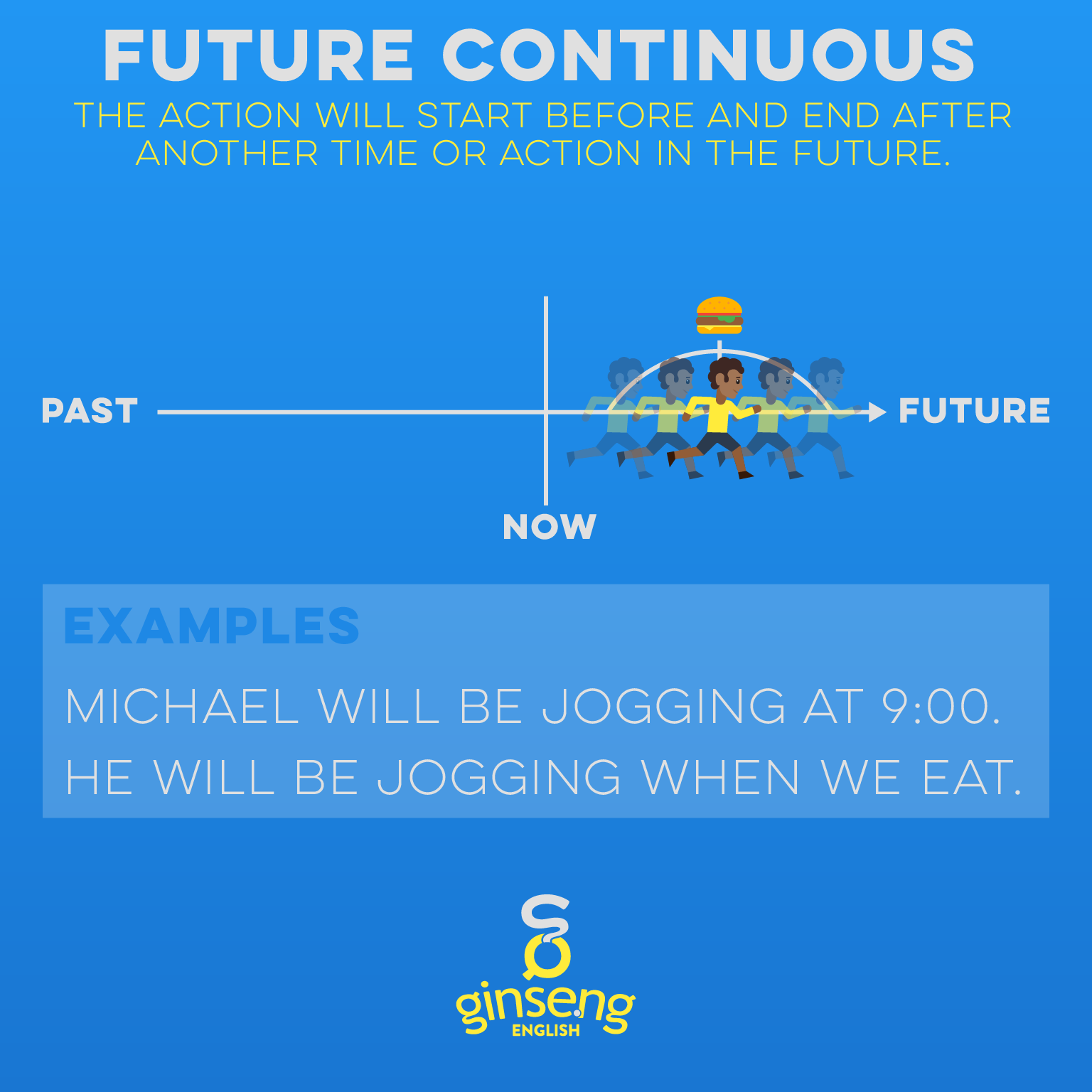
The future continuous (also called the future progressive) is an English verb form used to describe actions that will be in progress at a particular moment in the future. This can be a time or date, or it can be another action.
This is not a common verb form. Less than .1% of English verbs are in the future continuous.
Keep reading to learn the rules and reasons for using and forming the future continuous, including loads of charts and examples!
It is important to realize that continuous and progressive are different names for the same thing. In some places, progressive is more common, but continuous is a more common term overall.
USing the Future continuous
When we see a continuous verb, it tells us that something is in progress at a particular time. With the future continuous, that time is in the future. This can be a time or date (next weekend, tomorrow at 5, on November 3rd) or it can be another action in the future.
Chart for Future Continuous Tense In English

Here are some example sentences:
Don’t call her at 8. She will be flying to Denver then.
I will probably be running when you come home.
Try to be quiet when you come home tonight. Everyone will be sleeping.
In these examples, the continuous action (will be flying, will be running) will start before the other specific action (come home) or time (at 8), and continued after that action or time.
We can also use the future continuous to show that a future action will continue over a period of time.
I’m going to be studying all next week.
We will be traveling for most of 2019.
Forming the Future continuous
There are two options for forming the future continuous: will or going to.
Formula With Will
To form the future continuous with will, use will be and the continuous form of the verb, with -ing.
subject + will be + VERBing
Conjugation with Will
Here is a complete conjugation table:
| Singular | Plural | |||
|---|---|---|---|---|
| 1st person | I | will be working. | we | will be working. |
| 2nd person | you | will be working. | you | will be working. |
| 3rd person | he | will be working. | they | will be working. |
| she | will be working. | |||
| it | will be working. | |||
Formula With Going To
To form the future continuous with going to, you need to use the correct present form of the verb to be (am/is/are). Then use going to be. Then use the -ing form of the verb.
subject + am/is/are + going to be + VERBing
Conjugation with Going to
Here is the going to conjugation table:
| Singular | Plural | |||
|---|---|---|---|---|
| 1st person | I | am going to be working. | we | are going to be working. |
| 2nd person | you | are going to be working. | you | are going to be working. |
| 3rd person | he | is going to be working. | they | are going to be working. |
| she | is going to be working. | |||
| it | is going to be working. | |||
Other Forms
Questions
In the future continuous, you have more than one helping verb. To make a question, move the subject after the first helping verb (be or will).
Will you be eating out tonight?
When will you be arriving in Philadelphia?
Are you going to be sleeping when I get home?
What are you going to be reading next semester?
Negative Sentences
To form a negative, insert not after the first helping verb (be or will).
I will not be eating out tonight.
She will not be running.
We are not going to be reading Nabokov.
I am not going to be sleeping when you get home.
The Passive Voice
Making a passive sentence in the future progressive is extremely complex and extremely rare. In the conventional passive, putting be in the future progressive results in the unnatural combination of be and being: …will be being… or …going to be being…
For this reason, we recommend using the get passive in the future progressive. Put get in the future progressive (is going to be getting, are going to be getting, will be getting) and then the perfect form of the main verb.
We are going to be getting picked up by my mom.
If we miss another payment, we’ll be getting kicked out!
CHECK OUT THESE OTHER FREE GRAMMAR RESOURCES:
Immediate Family
This post teaches basic English vocabulary for describing our closest family members. Lots of examples and images!
English Vocabulary - Immediate Family
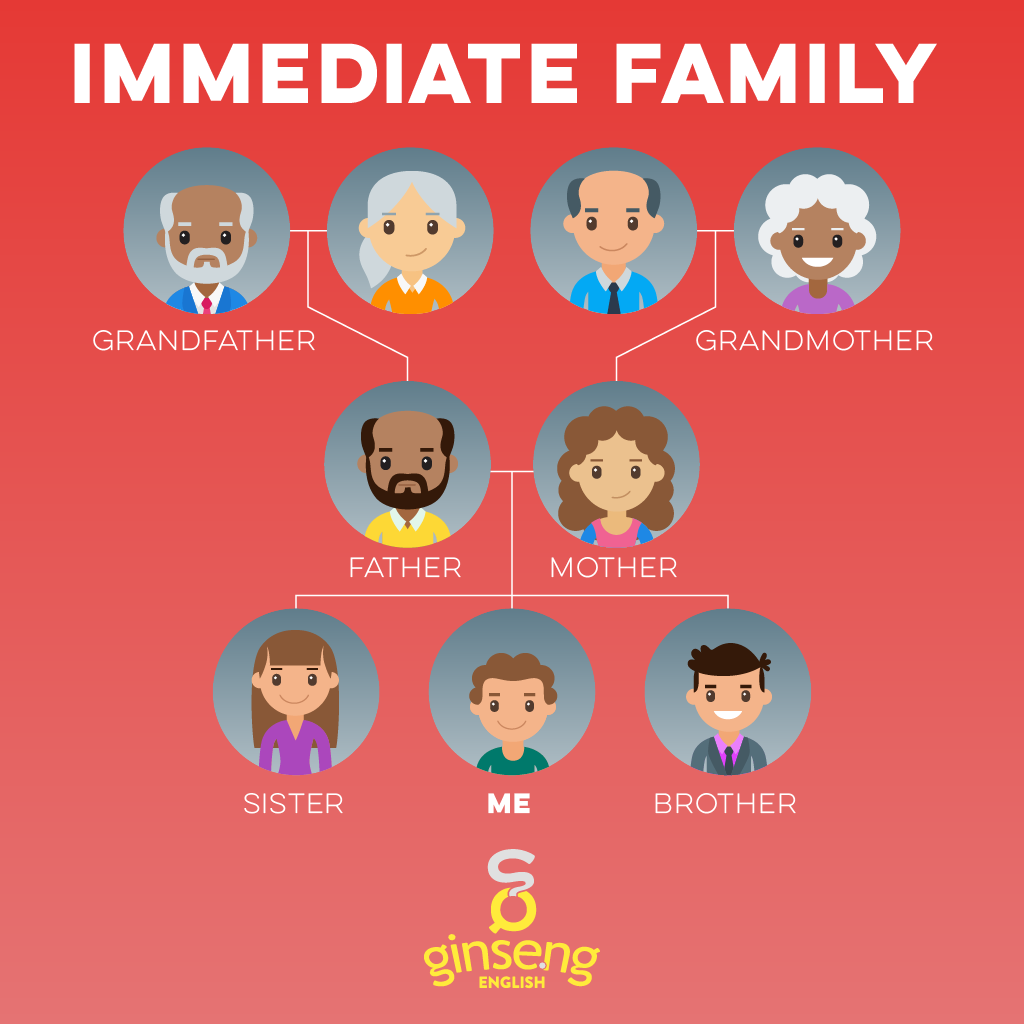
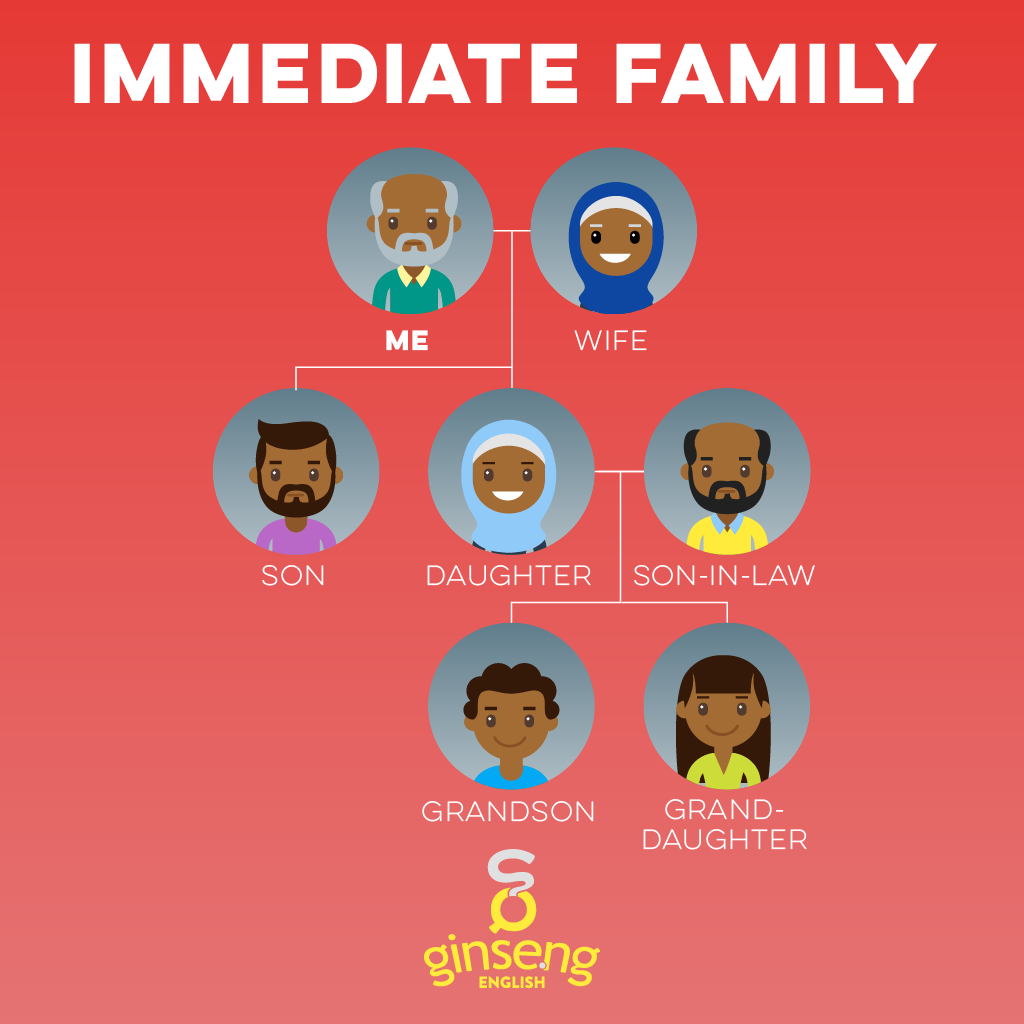
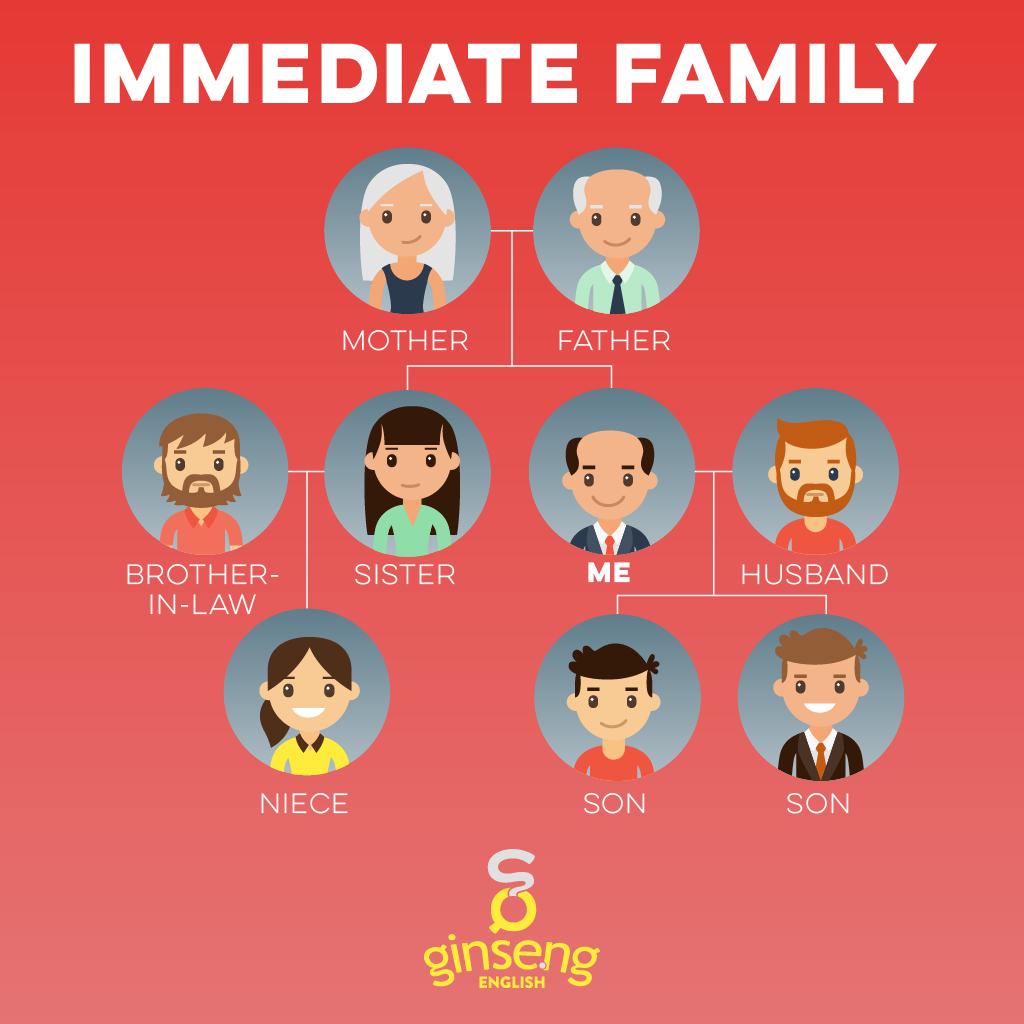
One of the most important topics in any language is family. This post will discuss vocabulary we use to talk about your immediate family. Immediate means very close in this situation. In a future post, we will talk about your bigger extended family.
Parents
First, let’s talk about parents. Parents are the people who take care of us when we are babies. A parent who is a man is called your father. A parent who is a woman is called a mother. Some families have a mother and a father. Some families only have one father or one mother. And some families have two mothers or two fathers.
A more familiar word for father is dad. Children might say daddy. A more familiar word for mother is mom. Children sometimes say mommy.
Grandparents
Your parents’ parents are called your grandparents. Your father’s mother or your mother’s mother is called your grandmother. Your father’s father or your mother’s father is called your grandfather.
Most people have two parents and four grandparents.
Siblings
If your parents have more than one child, then you have siblings! A male sibling is called your brother. A female sibling is called your sister. If you have no siblings, then you are an only child.
In English, we cannot use the word brothers to talk about siblings of both sexes. We say siblings or brothers and sisters. You can ask someone these questions:
Do you have any brothers and sisters?
How many brothers and sisters do you have?
Do you have any siblings?
How many siblings do you have?
You can answer like this:
I have 2 brothers and 2 sisters.
I have 4 siblings.
Notice that we generally use the simple present when talking about family members.
Spouses and Partners
If you get married or live with a boyfriend or girlfriend, this person can be part of your immediate family, too.
If you are married to a woman, this person is called your wife. If you are married to a man, this person is called your husband. If you don’t want to mention gender, you can say spouse or partner:
All the employees and their partners are invited to joing us for dinner.
My wife is pregnant. We’re having twins.
If you are not married, but are dating someone, you can use the word boyfriend for a man, or girlfriend for a woman. It is okay to use these words when you are an adult, but some people think that the words boy and girl in them sound immature, so they prefer partner.
If you need a general word that includes husbands, wives, boyfriends, and girlfriends, then partner or significant other is the best word to use.
More Free English Vocabulary Resources



Idioms About Making Decisions
We have to make decisions every day, but sometimes it’s so hard to just make up your mind! If you’re on the fence about a big decision, then these idioms might help your thought process! (Or at least help you procrastinate making a difficult decision😂)
English Idioms about Making Decisions
We have to make decisions every day, but sometimes it’s so hard to just make up your mind! If you’re on the fence about a big decision, then these idioms might help your thought process! (Or at least help you procrastinate making a difficult decision😂)
Read on to learn what making up your mind and being on the fence mean, as well as many other fun idioms!
Make Up Your Mind
Today’s first idiom is make up your mind. This phrase means make a choice or decision. Sometimes when making a big decision, people spend a lot of time trying to decide which is best, but when we finally decide, we call this making up your mind.
Examples
Maddie was on the fence about what college to go to, but, after visiting both campuses, it was easy for her to make up her mind because the food was much better at one.
My mind is made up, I'm going to learn English, so that I can go to Australia and nothing can stop me!
When the waitress asked me if I wanted french toast or pancakes, I couldn't decide but when I noticed how good the pancakces smelled, it was easy for me to make up my mind!
On the Fence
If you are on the fence, it means that you are undecided between two options and can't make up your mind to decide which way to go. We use the prepositions about or between after this phrase.
I want to get a new phone but I'm on the fence about changing from an iPhone to an Android.
Julia wanted to go to the beach but also wanted to ski on her vacation, so she was on the fence between a trip to Mexico or Switzerland.
Andrew found things that he liked about both presidential candidates, so he was on the fence about who he wanted to vote for.
One one step at a time
To go one step at a time means to think carefully, and go slowly without being careless or rushed.
The hike was very difficult and slippery so we had to go one step at a time to avoid falling.
I loved the first house I saw, but buying a house is such a huge decision that I decided to take it one step at a time and look at other houses too.
Jody really likes her boyfriend, but they are going to take their relationship slowly and go one step at a time so that they can get to know each other better before getting married.
At end of day
You may hear people saying at the end of the day in the news or on the radio, and wondered what it means. You can use this expression when you have considered all of the facts and a ready to make a big decision. Some people will also say it before presenting the final and biggest fact of a situation, or as a way to summarize the final decision. Other ways of saying at the end of the day are "ultimately," "when all was said and done," "in conclusion," "to sum it up," or "all things considered."
Examples
Of course I'll listen to all the sales pitches, but at the end of the day, it's about which company can save us the most money.
Everyone was fighting over the office space with the most windows, but they knew that at the end of the day, the boss would get the best office.
Molly's mom told her that she didn't have to do her homework, but at the end of the day it was Molly who would get the bad grades, not her mom.
No strings attached
No strings attached is an informal phrase that is used to show that an offer or opportunity has no restrictions or hidden fine print, and nothing is required or expected in return.
Ginseng English is offering a free demo English class. We promise, there are no strings attached!
Henry's life was very busy, so when he met a cute woman at a coffee shop, he told her that he wasn't looking for a serious relationship, just something fun with no strings attached.
The gym near my house was offering one month for free. They told me that if I didn't like it, I could cancel easily, no strings attached!
Light at end of tunnel
This Ginseng English idiom is the light at the end of the tunnel. We use it to talk about the end of a long, difficult period of time. The phrase contains a great visual metaphor: the tunnel represents the difficult time, and the light at the end is the sign that it will end soon.
Examples
It's been a terrible year, but there's a light at the end of the tunnel: I'm going on vacation in December!
This is a long week, but it's Wednesday and you can almost see the light at the end of the tunnel.
In the second year of her master's program, Jane finally started to see the light at the end of the tunnel.
LOW HANGING FRUIT
We sometimes say low hanging fruit to describe the tasks or jobs that are the easiest to finish first, don't require a lot of hard work, but make a big difference.
The reason we describe the easiest jobs as low hanging fruit is because the fruit that is hanging lowest on a tree is always the easiest to pick! Once you take care of the low hang fruit, you can work to pick the fruit that is higher from the ground.
When trying to sell their new product, the company called customers who had already bought from them first. They seemed like low hanging fruit.
I needed to save some money, so when I looked at my budget, I decided to cut out the low hanging fruit first, and stop getting so many drinks with friends!
The website needed a lot of improvements, but we had to take it one step at a time so we started with the low hanging fruit, such as changing the color scheme and fixing the homepage.
This article about healthcare is good, but it seems like the writer chose to write only about the low hanging fruit issues, and not the more complex ones that really need to be talked about.
like watching paint dry
Hopefully reading this blog post wasn’t like watching paint dry! Paint dries slowly and with no excitement, so if something is realllllllly boring, we can say that thing is like watching paint dry:
Oh my god, that movie was so boring. It was like watching paint dry.
Ugh, I hate golf. It's like watching paint dry.
How can anyone enjoy studying!? I'd rather watch paint dry!
Other free English resources:
English Idioms about Competition
They say some friendly competition never hurt anyone. In fact, sometimes, people even thrive on a little competition! If you’re one of these people, these idioms about competition might come in handy…
English Idioms about competition
They say some friendly competition never hurt anyone. In fact, sometimes, people even thrive on a little competition! If you’re one of these people, these idioms about competition might come in handy…
Read on, or should we say, game on?!
see eye to eye
Today's first Ginseng English idiom is "see eye to eye." Do you have any friends, coworkers, or family members who you really understand and agree with? In English, you can express this with the idiom see eye to eye. It's also very common in the negative. Check out the examples below!
Examples
My wife and I are a great match, we really see eye to eye.
Jerry and his boss see eye to eye so they work well together.
My parents and I don't see eye to eye about a lot of things, so we fight a lot.
The relationship didn't work because we didn't see eye to eye on some important issues.
No Pain No Gain
This idiom comes from some people's belief that you must suffer to succeed, that nothing good comes without hard work. Do you agree with this theory?
Training for a marathon was the hardest thing I ever did, but as they say, no pain, no gain! Crossing the finish line made all the pain and suffering worth it!
Max's parents told him, no pain, no gain, and made him study English every day. It was hard but when he realized he could speak English with his American friends, he was very happy!
Julie's goal was to be able to do 50 push-ups, Every day her arms hurt so much, but she knew that this was the only way to achieve her goal and she told herself, no pain, no gain!
Ball in your court
The ball is in your court is a simple one. It actually comes from tennis, though it could apply to several different sports. We say the ball is in your court to tell someone that it is their turn to take action, that it is their responsibility to take the next step.
I sent them an two emails last week, so now the ball's in their court.
Well, I apologized and she said nothing, so now the ball is in her court.
They made me a job offer. I'm still thinking about it. I guess the ball is in my court to make a counter-offer.
Toot Your Own Horn
Tooting your own horn is another way to say brag or boast.
A horn is a type of musical instrument that includes trumpets, trombones, and French horns. Horn is also the word for the loud noise your car can make to avoid an accident. The sound that a horn makes is toot. When you toot the horn of a car, it draws attention to your car 📢 🎺. Therefore, if someone toots their own horn, they are making noise to draw attention to themselves.
This is an funny phrase that people use when they know they are about to brag about a personal achievement or skill, but don't want to sound too annoying or conceited while doing so.

Examples
I normally wouldn't brag about my cooking because I'm not very good at it, but I'm going to toot my own horn because this cake I just made is so delicious!
Not to toot my own horn, but I did really well in the interview today and, fingers crossed, I think I'll get the job! 🤞🏼
Jack didn't want to toot his own horn but his boss wasn't in the meeting to see how well his presentation went. Jack knew how hard he worked and that he deserved recognition for it, so he wrote his boss an e-mail to tell her about it. His boss was glad to hear it and was very proud of Jack!
Steal Someone’s Thunder
This next idiom is to steal [someone's] thunder. We use this phrase when one person does something that takes (the stealing) positive attention (the thunder) away from someone who should be getting that positive attention. For example, if it's Alexa's birthday, she should get lots of attention. If Jade announces that she is pregnant at Alexa's birthday, and steals that attention, she steals Alexa's thunder.
Jade really stole Alexa's thunder when she announced that she's pregnant at Alexa's birthday party.
I really wanted to tell everyone about my engagement, but I didn't want to steal Joe's thunder.
My whole childhood, my older sister was always stealing my thunder.
In the Same Boat
Despite our theme of competition today, the idiom, all in the same boat, can sometimes mean the opposite We use this idiom to mean that we are all in the same situation, or sharing the same problem together. In this situation, working together and teamwork is the best option because if the boat sinks, you're all going down together!
Examples
Our boss asked us to work on an extra project. None of us wanted to work over the weekend, and since we were all in the same boat, we decided to stay late and finish the project!
When my cousin asked to borrow $10, I refused because we're in the same boat and I don't have any money either!
Vera and Peter both didn't understand the math class, so since they were in the same boat, they went together to ask the teacher for extra help.
Singing a different tune
To sing a different tune is to change your opinion or attitude about something.
Andy was careless and spent all his retirement money at age 40. I bet once he's 70 and has no retirement fund, he'll be singing a different tune!
Brian claimed that he was the one that broke up with Rebecca, but when she tells her side of the story, she sings a different tune.
Alice wanted a big family, but when she realized how expensive children are, she starting singing a different tune.
Pardon my french
Today's idiom is pardon my French. We say "Pardon my French" as a funny way to apologize for cursing or using profanity. It is also common to say excuse my French.
Back in the 1800s, the phrase was used when you actually used a French word or phrase in your speaking. You might say, "The film had a certain, je ne sais quoi." Then you'd say "Pardon my French," because it was a little rude to speak French in front of people who might not understand. Eventually French developed some negative connotations in English—sorry French speakers!—and the phrase came to be used with swear words.
Shit, I hit my head—Oops, pardon my French!
When John accidentally said a bad word, his wife told him, "John, don't curse in front of the children!" He replied, "Oh, I'm sorry, pardon my French!"
Excuse my French, but this movie sucks!

A famous example of pardon my French from Ferris Bueller's Day Off.
A Dime a Dozen
This last idiom is a dime a dozen, which means very common.
As you may know, a dozen means 12. We use this word frequently to talk about buying things:
a dozen eggs:🥚🥚🥚🥚🥚🥚🥚🥚🥚🥚🥚🥚
a dozen donuts: 🍩🍩🍩🍩🍩🍩🍩🍩🍩🍩🍩🍩
a dozen roses: 🌹🌹🌹🌹🌹🌹🌹🌹🌹🌹🌹🌹

And a dime is a coin worth $0.10 in America.
So, if something costs a dime for a dozen, it's really cheap, so it must be really common. This is a metaphor, though, so it isn't literal.
Beach towels are a dime a dozen in Florida.
Many people think old baseball cards are valuable, but they're a dime a dozen.
Cell phones used to be for rich people only, but now they're a dime a dozen.
Other free English resources:
Black and White Idioms
Today we bring you a variety of English idioms featuring black and white images to help you visualize the meanings, along with sample sentences and definitions!
English Idioms in Black and White
Who doesn’t love some beautiful black and white pictures? Today we bring you a variety of English idioms featuring black and white images to help you visualize the meanings, along with sample sentences and definitions!
Read on for idioms in black and white!!
Show Some Spine
This first Ginseng English idiom is show some spine. Your spine is your backbone, the strong middle bones that support your body. When you tell some one to show some spine or show some backbone, you are telling them to be brave or morally strong. If someone has no backbone or is spineless, it means they are a coward.
Examples
Your boss won't take advantage of you if you just show some spine and stand up to her.
Don't be intimidated by him. He's just a bully. Show some spine!
I always thought of Karen as timid, but she really showed some spine in that meeting.
Go Hand in Hand
When two things go hand in hand, they are very closely connected and always come together. You cannot separate them. For example, we can say that food and health go hand in hand. They are completely connected.
When two people hold each other's hands, we say that they are hand in hand. To help you remember, you can picture health and good food walking hand in hand down the street together!
Homework may be annoying, but it goes hand in hand with learning any new skill!
I can't eat cookies without milk, they just always go hand in hand for me!
Honesty goes hand in hand with friendship.
Rest Assured
We use rest assured when we are confident that you don't need to lose sleep over something because it will work out and be ok. It's another way of saying, "You don't have to worry."
Rest assured, I finally see the bus coming up the street now!
You can rest assured, the airlines will refund you for the flight that they cancelled.
I could rest assured when I was finally home in my own bed and didn't have to worry about bed bugs anymore!
Gray Area
We use the term gray area to talk about a situation where things don't fit easily into categories or where the rules are not clear. Things are easy when they are black and white, but much more complicated when there is a lot of gray area. Examples below!
Examples
It seems like there is a lot of gray area in the university's policy on coworkers dating.
A good novel doesn't just tell you what to think about a character, if they are good or bad. The gray area is the most interesting part!
The law was designed before the internet existed, so there is still a lot of legal gray area surrounding it.
A Wrench in the system
This idiom is a wrench in the system. A wrench is a tool. Usually we think of tools as helpful things, good for building or fixing things, but a wrench in the system is actually a negative phrase. Imagine you have a big, complex machine with lots of gears and moving parts. Then imagine someone puts a wrench in the middle of those moving parts. This will cause big problems for your system, right? That's what we mean when we say a wrench in the system: it's a problem that causes a big complicated plan or system to break or fail.
We had our whole vacation planned out, but when we got food poisoning, it really put a wrench in the system.
If the new client won't agree to this contract, it will really throw a wrench in the system.
When they lost a major funder, it threw a wrench in the system for the new startup.
Come out of shell
The next idiom is come out of your shell. Lots of animals, like snails and turtles, have hard shells that they can hide in if they are scared or in danger. We can use this as a metaphor for people's personalities. If you come out of your shell, it means you open up and become more social and less shy.
Examples
Paula seems quiet at first but once you get to know her, she really comes out of her shell.
Lots of kids are shy around age 4 or 5, but most come out of their shells as they get a little older.
When Kim has a few drinks, he really comes out of his shell and doesn't stop talking!
Birds eye view
How does the world look to a bird flying high above the earth? Probably similar to your perspective if you are in a tall building or an airplane. This is what we mean when we say you have a bird's-eye view.
Punctuation Note
Notice that we put a hyphen (-) in bird's-eye. This is because, together the words bird's and eye are working like an adjective describing view. Whenever you have two words together working as an adjective to describe a noun, you should connect them with a hyphen.
I was nervous for my first hot-air balloon ride, but I really loved the bird's-eye view.
Drone cameras make it easy for anyone to get great pictures from a bird's eye view.
The bird's-eye view from the 25th floor was nice, but the elevator up was so slow.
Homesick
Homesick is the emotional feeling you might get when you're far away from your home, friends and family and you miss them very much. Homesickness can make you feel very sad and depressed, but will usually go away after you make more friends and become more adjusted and comfortable in a new place.
I was really excited when I first got to Spain, but after a week the homesickness really kicked in and I had to call my Mom daily.
It's funny, even after living in a new city for 2 years, sometimes I feel homesick for my childhood town. Eating my favorite food from home helps!
Alex thought he would feel homesick while traveling in Asia, but he was so busy having fun that he didn't even think about home!
Shoot the Moon
Shoot the moon or shoot for the moon! The meaning of this idiom is to try something really ambitious or challenging, to have very big goals. It's impossible to actually shoot the moon, but some people say "If you shoot for the moon and miss, you will land among the stars." This means, if you have very high goals and you don't achieve them, you may still achieve something else great. Common synonyms for shoot the moon are go for broke and aim high.
Examples
When my aunt plays cards, she really shoots the moon and bets a lot.
BThey already offered you the job. When they ask what kind of salary you want, you may as well shoot the moon and ask for more than you expect.
When I was a kid, my parents always taught me to dream big and shoot the moon.
Calm before storm
We use the idiom the calm before the storm to describe the very calm, quiet, or peaceful time before a big argument breaks out, a big change happens, something difficult occurs, or quite literally, before a storm comes!
It's nice to have all my teaching work finished before the students arrive so that I can really enjoy the calm before the storm.
My parents seem happy now, but this is just the calm before the storm. Wait until my mom finds out that my dad bought a new car without talking to her first!
Before the tornado hits, there is a great peacefulness that comes over the town. This is literally the calm before the storm.
Other free English resources:
Simple Present vs Present Continuous
The simple present tense and present continuous tense can be difficult for English learners. This article explains the differences in how we form and use these two tenses.
Two verb forms that are confusing for many students are the simple present and the present continuous (also called the present progressive). Both of these verb forms talk about the current moment, now, the present—that’s why they are both in the present tense. But they talk about very different aspects of the present.
The simple present is used for things that are true in general, or happen repeatedly. Think about this as a big, wide present tense. Birds fly. The sky is blue. I like grapes. I have a dog.
On the other hand, the present continuous is often used for right now, the exact current moment. This is a small present tense. There is a start and an end. It is happening right now but it will stop in the future. I am reading. It is raining. My sisters are talking.
Form
When you are making an affirmative statement, the simple present is just a single word, either the base form of the verb or with a final -s (after the subject pronouns he, she, it, or a singular noun).
I watch TV.
He exercises.
For present continuous, we use the present form of the verb to be (am, is, or are) and then the -ing form of the verb.
I am watching TV.
He is exercising.
Signal Words
The simple present tense is often used with adverbs of frequency: always, never, sometimes, frequently, rarely.
I always brush my teeth.
I never eat bacon.
I go to the beach sometimes.
I exercise frequently.
I rarely watch TV.
The present continuous is often used with adverbs and adverb phrases that emphasize the current moment or that a situation is only temporary, such as right now, at the moment, currently, and for the time being.
I'm sitting in traffic at the moment.
For the time being I am living in Brooklyn but we will move in September.
Right now I'm studying.
I am having dinner at the moment.
Exceptions
Note that some verbs (called non-continuous verbs or stative verbs) describing feelings, senses, states of mind, and states of being are generally used in the simple tenses only, or else have a different meaning when used in the simple vs continuous forms.
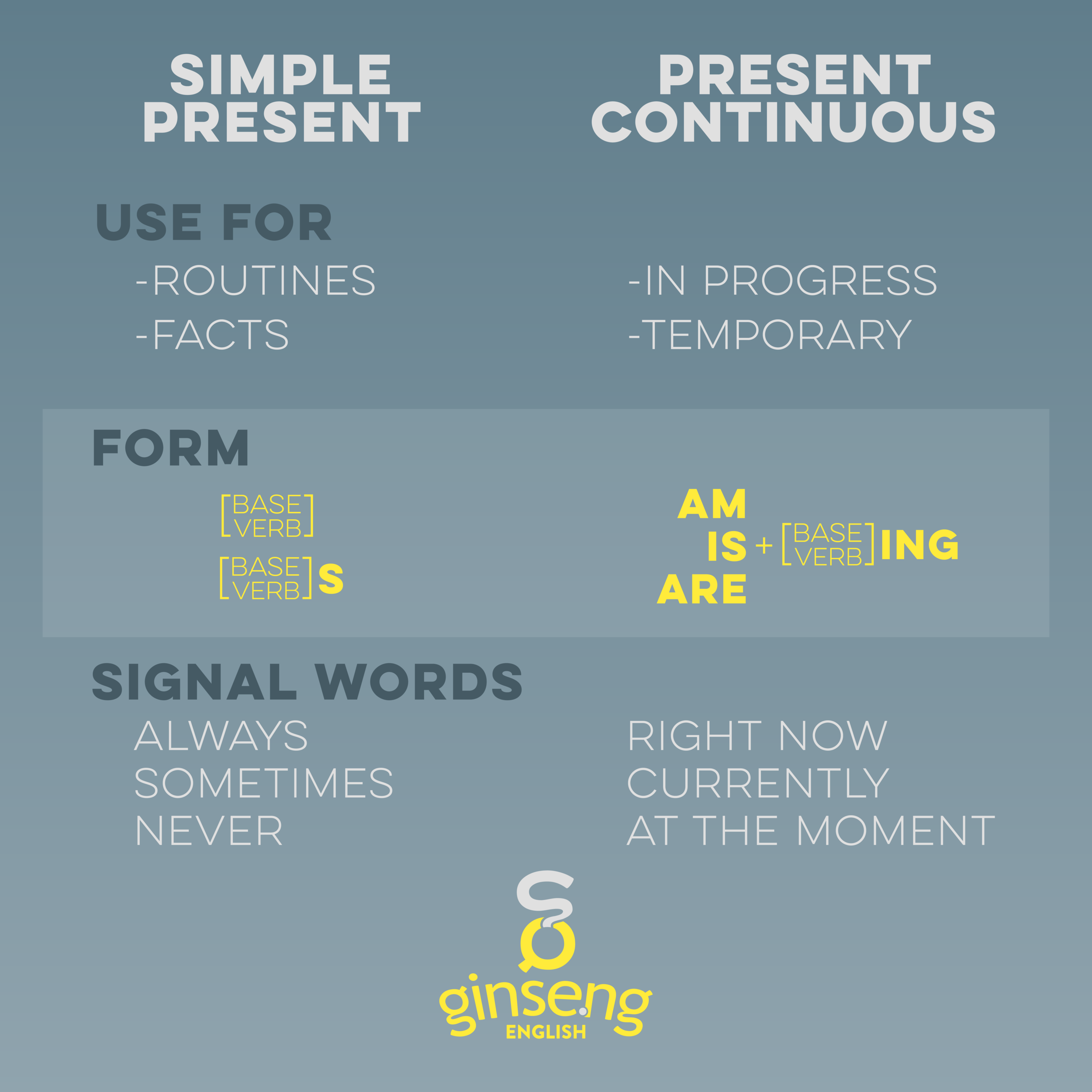
Simple Present and Present Continuous