
Fall Idioms
The time has come for Americans to kiss summer goodbye and welcome fall (also known as autumn). Here are some idioms about the fall season!
English Idioms about Fall
The time has come for Americans to kiss summer goodbye and welcome fall (also known as autumn). For most people, especially those living in the north or northeast part of the country, fall means cool evenings, pumpkin spice lattes, apple and pumpkin picking, but above all, beautiful fall foliage! Foliage is what we call it when the leaves on the trees change from green to beautiful shades of orange and red. A popular American hobby is to visit states such as Michigan, Vermont or Maine to “peep” (or view) the foliage!
Read on for idioms that relate to fall!
The apple doesn’t fall far from the tree
If a child has very similar traits or characteristics to their parents, we say that the apple doesn’t fall far from the tree. The apple represents the child, and the tree is a symbol for their parents.
Other common expressions with the same meaning are a chip off the old block, or like father, like son.
Examples
Even at a young age, Brandon's son is great at soccer, and seems to have inhereted his father's athetlic abilities. The apple doesn't fall far from the tree, I guess!
Just look at all that curly hair. It's just like your mothers! The apple doesn't fall far from the tree!
I've tried to change my ways, but I'm as stubborn as my mom. I think what they say is true, the apple doesn't fall far from the tree.
Turn over a new leaf
When someone decides to make a big life change, and start acting in a better way, you can say that they are turning over a new leaf.
Examples
Smoking is a bad habit that Jeff had been trying to break for years. He finally decided to turn over a new leaf and stop smoking for good when his wife became pregnant!
My boss and I could never agree on anything but we finally had a big discussion and developed a plan to work better together. I am hopeful that we are both turning over new leaves!
Last year, Casey got in trouble constantly at school for missing classes and not doing her homework. This year, though, she seems to really have turned over a new leaf! and hasn't had any problems!
Apple of MY eye
The apple of my eye is an expression that we use to describe someone or something that we love, or are especially proud of.
Mom would never admit it, but out of my five siblings, I'm truly the apple of her eye.
As a math teacher, Mrs. Temple isn't supposed to choose a favorite student, but Kat is so bright and eager when the rest of the class is half asleep, that she is the apple of Mrs. Temple's eye.
My dog finished his obedience classes, and came in first place! I know he's just a dog, but he's the apple of my eye!
squirrel away
If you secretly save something to use in the future, we can say that you squirrel it away.

Squirrel squirreling away a peanut! 🐿🥜
We use this expression because squirrels are known for hiding nuts and other food to eat during the winter!
Examples
Julia loves Halloween candy so much that she wanted to make it last as long as possible, so she squirreled away some of her favorite candy bars to eat the next month.
It's hard for me to save money, but I really wanted to buy a new computer, so I forced myself to squirrel some money away and eventually I could afford my computer!
Jill's roommate was always eating her food without her permsission, so she squirreled away her favorite food in the back of the refrigerator.
Go out on a limb
To go out on a limb means to take a risk, and put yourself in a vulnerable situation. This is another one of those great visual idioms, because you can imagine the risk someone is taking of falling of they go far out on a limb, or branch, of a tree.

This panda went out on a limb but it didn’t end very well…
Examples
I really went out on a limb when I recommended Andrea for a job at my company, so when she missed a week of work, it made me look very bad!
Brenda decided to go out on a limb and ask Anthony on a date. She was so relieved when he said yes!
Alexa went out on a limb and proposed a new idea at work. Her team knew that she had the facts to back up her proposal, so luckily, they supported her.
Other free English resources:



Adverbs of Frequency
What are Adverbs of Frequency?
Adverbs are an important part of speech in English. Just like adjectives describe nouns, adverbs are words that describe verbs. There are of course many different ways we can describe a verb. We can talk about how something happens, why it happens, when it happens. Adverbs of frequency tell us how often—or how frequently—an action happens.
The Most Common Adverbs of Frequency
Some of the most common adverbs of frequency are shown in the image. It is very common for teachers and textbooks to show adverbs of frequency with percentages next to them to explain their meaning; for example: 80% of the time = usually. Be careful. It is important to note that these can only be very rough estimates. It is more useful and accurate to say that usually is more than sometimes but less than always. The exceptions are always, which means 100% of the time, and never, which means 0% of the time.
Rules for using adverbs of frequency
Adverbs of frequency often describe habits, routines, and repeated actions, so they are frequently used with the simple present tense.
It is sometimes difficult to know where to put adverbs of frequency in a sentence. When describing a simple verb tense, with no auxiliary verbs, adverbs of frequency generally come between the subject and the verb. Look at these examples:
We never travel in the fall.
Lydia generally takes the train to work.
They sometimes have wine with dinner.
The exception to this rule is when the main verb in the sentence is to be. If the sentence is a subject + BE + noun or subject + BE + adjective sentence, put the adverb of frequency after be.
Munir is always late.
This is never a good sign.
We are usually the first ones in line.
The adverbs often, sometimes, generally, frequently, usually, and typically can go at the beginning of a sentence, as you can see here:
Generally Lydia takes the train to work.
Sometimes they have wine with dinner.
Usually we are the first ones in line.
Note that no comma is necessary when an adverb of frequency starts a sentence.
It is also possible to put these same adverbs at the end of a sentence, though this is more common in spoken English than in writing:
Lydia takes the train to work generally
They have wine with dinner sometimes
We are the first ones in line usually
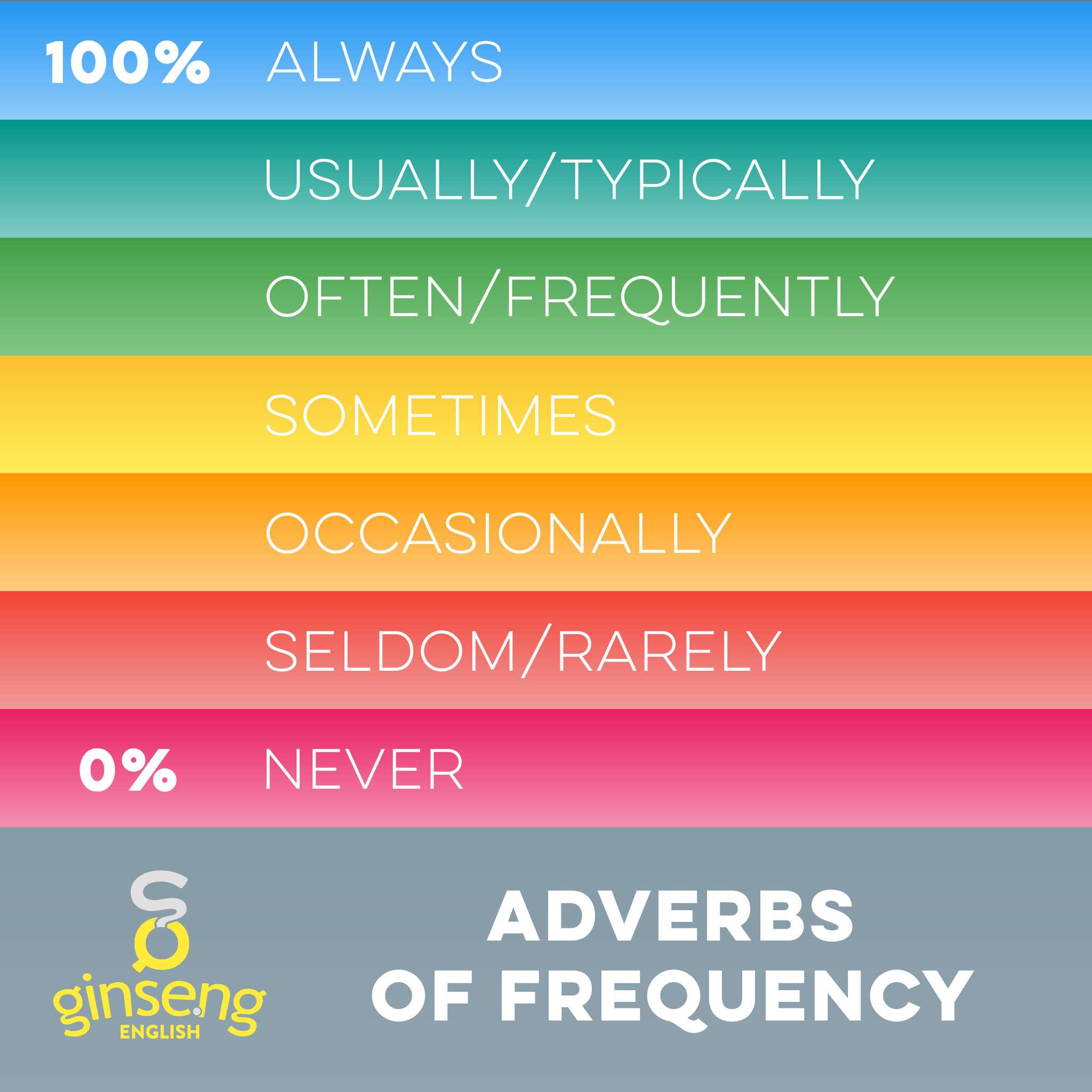
Chart Showing Common Adverbs of Frequency
Present Perfect Continuous Tense
The present perfect continuous is an important verb form for talking about recent events and their durations. Read about the rules for using the present perfect continuous tense, how we form it, and tons of example sentences!
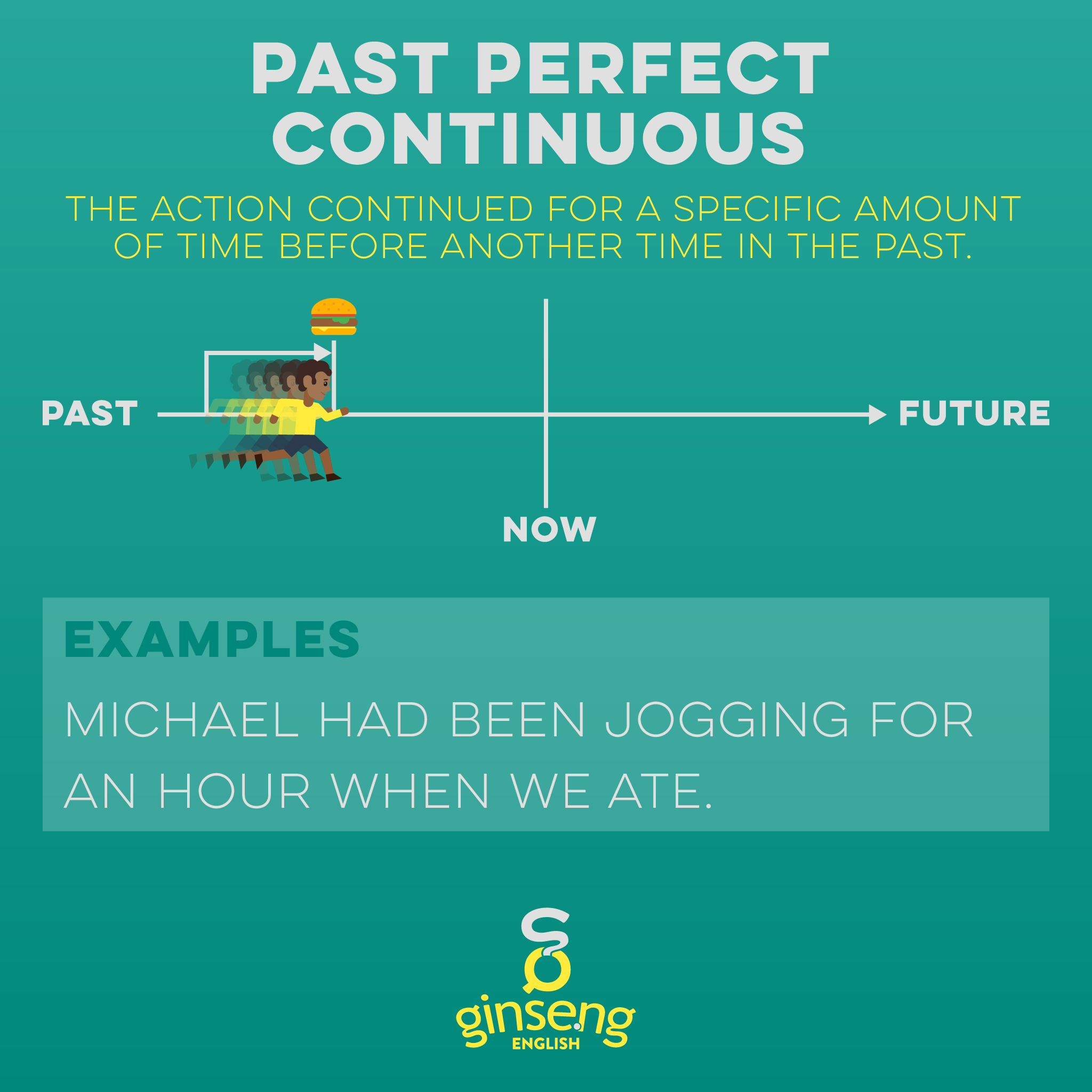
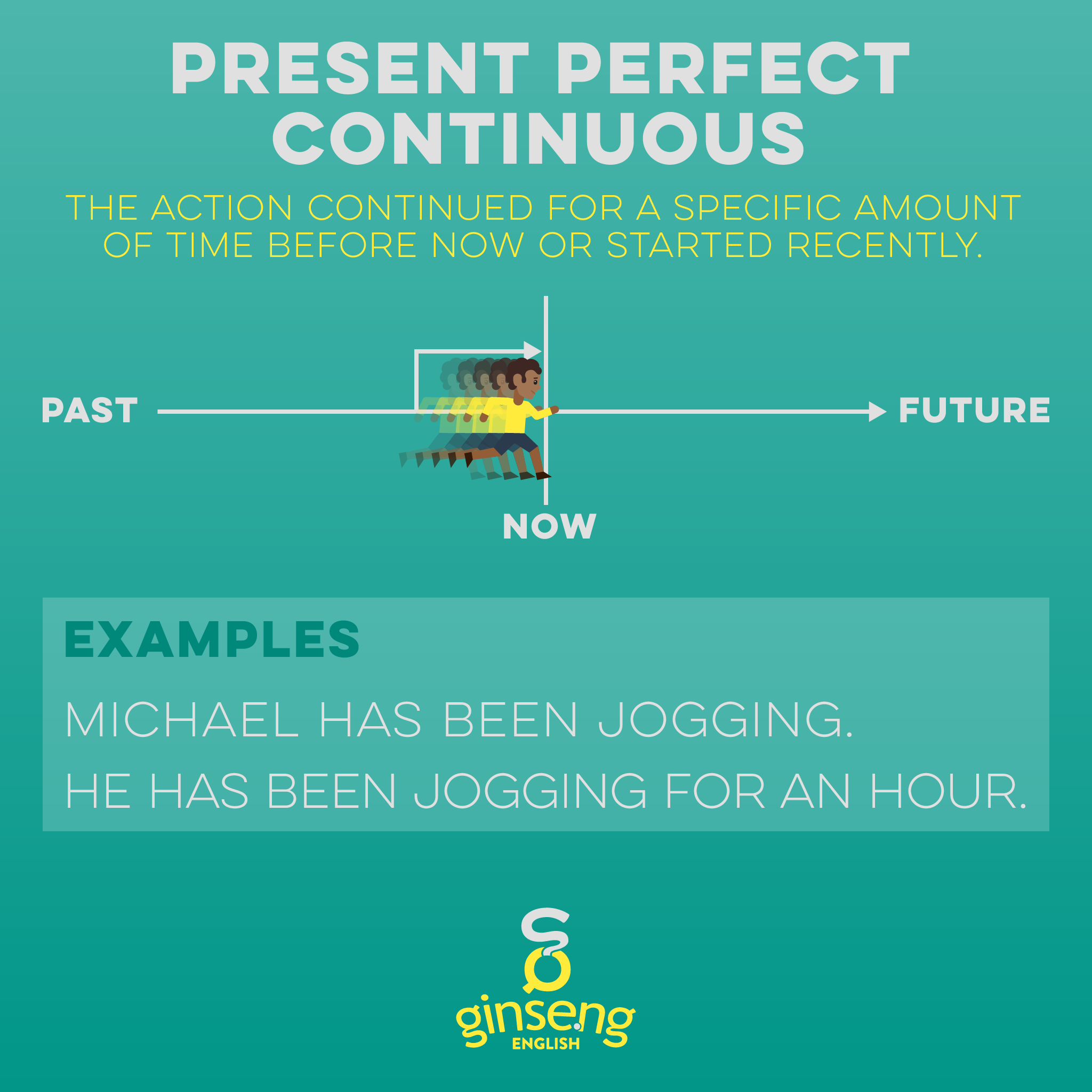
The present perfect continuous (also called the present perfect progressive) is a verb form that we use to describe an action that started in the past and either recently finished or is still continuing. Although only about .7% of verbs in speech are in the past perfect, this verb tense can be very useful in certain situations.
Continue reading to learn how to form the present perfect continuous and when to use it, including tons of examples and charts!
Just to avoid confusion, continuous and progressive are just different names for this same thing. In some countries, one term is more common than the other, but continuous is more common overall, so we use that term.
Chart for Present Perfect Continuous in English

Using the Present Perfect Continuous Tense in English
The present perfect continuous is a little bit tricky. If you find a website that claims to explain it in just a few sentences, you should be suspicious. We use this tense in a number of different situations, and it can have different meanings in those different situations. We can look at three common ways that the present perfect progressive is used:
to describe new routines,
to describe recently completed actions, and
for actions that are still continuing.
New Routines and Habits
In general, we use the simple present to talk about routines and habits: If I go jogging every day or a couple of times a week, I can simply say, I jog, right?
But what if this is a new habit? Maybe I have gone jogging every day for the past two weeks, so it is a routine, but it might feel funny to just say I jog. I am a jogger. In situations like this, where we want to demonstrate that a habit or routine is somewhat new, the present perfect continuous is the form that we want to use.
I have been jogging.
Here are a few more examples:
This has been a difficult month. She has been working long hours.
I’ve been going to the gym lately.
We’ve been cooking at home more recently
Recently Completed Actions
We also use the present perfect continuous to talk about actions that have just recently ended, especially when there is still evidence of that action. For example, after you paint, you may still have paint on your hands. To explain this, you would use the present perfect progressive:
Sorry, my hands are dirty. I've just been painting.
Take a look at these other examples:
The house is a mess because we've just been redecorating.
Sorry, I'm all sweaty. I've been exercising.
Why are you two crying? Have you been fighting?
Notice that in each of these examples, there is sensory evidence (the mess, sweating, crying) of the recently completed actions (painting, exercising, fighting). This is almost always the case when using the present perfect continuous in this way.
Actions Still Happening with For and Since
This is probably the most common way that this verb form is used. This is very important: When we see the present perfect continuous with for or since, the action started at a specific time in the past and is still happening. Here are some examples:
Michele has been living in Boston since June.
Juana's been writing her thesis for 6 months.
In the first example, Michele still lives in Boston. In the second example, Juana still works at Apple. Again, when you see for or since with this verb tense, the action or situation described by the main verb is still continuing. See Signal Words, below, for more information about how we use for and since.
Here are more examples with for and since:
Cara's been working at FedEx for 3 years now.
I've been thinking about changing jobs for a long time.
We've been developing a new strategic plan since late last year.
You have been traveling back and forth to California since you got married, right?
Forming the Present Perfect continuous
Formula
Forming the present perfect continuous isn’t difficult. You will always use the same formula:
have/has + been + VERBing
You could also think of it as simple steps, too:
First, choose either have (if the subject is plural or the pronouns I, you, we, or they) or has (if the subject is a singular noun, he, she, or it).
Then use been.
Then use your main verb with -ing.
Conjugation
Here is the verb work conjugated into the present perfect continuous.
| Singular | Plural | |||
|---|---|---|---|---|
| 1st person | I | have been working. | we | have been working. |
| 2nd person | you | have been working. | you | have been working. |
| 3rd person | he | has been working. | they | have been working. |
| she | has been working. | |||
| it | has been working. | |||
Notice that we can see both the perfect and the continuous aspect in this form. Have been is the perfect aspect. Been verb-ing is continuous aspect.
Other Forms of the Present Perfect continuous
Negative Sentences
You always have two helping verbs in the present perfect continuous: have/has and been. To make a negative, simply put not in between them!
She has not been living here for a long time.
I have not been reading much recently.
They have not been working late.
Because the present perfect continuous uses so many words, we often use contractions with not to make it a little shorter:
She hasn't been living here for a long time.
I haven't been reading much recently.
Questions
To make a question, simply put has/have before the subject.
Has she been living here for a long time?
Have you been working out lately? You look great!
What have you been reading?
When have you been going to bed lately?
Passive Voice
Making passive sentences with more complex verb forms like the present perfect continuous is extremely uncommon and almost always awkward in English. We really recommend that you rephrase a sentence to avoid creating such an awkward sentence.
We have been being observed a lot at work.
See the awkwardness in the sentence above? If you really need to make a passive sentence in this verb form, we often use the get passive to avoid the unnatural combination of been being.
Put get in the present perfect progressive (has been getting, have been getting) and then the perfect form of the main verb.
We have been getting observed a lot at work lately.
I've been getting kicked off the internet every 5 minutes.
Signal Words
Recently or Lately
When we are talking about new routines and habits, it’s common to use the word recently or lately, which both have the same meaning in this sense. There is some flexibility in where we can put these words in a sentence, but the beginning or end of the clause is a safe bet.
Take a look at these examples:
Lately, I've been thinking a lot about Aunt Maude.
We've been having second thoughts about moving recently.
Just
We can use the adverb just to emphasize that an action was completed in the immediate past, right before now. Because the present perfect continuous can talk about actions that stopped right before now, it is common to use just with it. Have a look at these examples:
Don't mind these ridiculous old clothes. I've just been gardening.
Hey Paul! I can't believe you're here. We've just been talking about you!
For
We already said, the most important signal words with the present perfect progressive are for and since. They are important because they change the meaning. Whenever you see for and since with this verb form, you know the action is still true.
When we use for, we specify the duration of the action. This could be the number of minutes or weeks or years. It could also be a more general phrase like a really long time or a little while.
People have been living on this land for thousands of years.
It's been raining for hours
I've been studying English for half my life!
Since
While for is used with a duration, since is used to specify the point in time when the action began. That could be a time or date. It can also be another event described with a clause, like since I was a child.
People have been living on this land since about 800 B.C.E.
It's been raining since noon.
I've been studying English since I was a child.
check out these other free grammar resources:

Watch Your Mouth: Hidden Brain Podcast
Podcasts are not only a great way to enjoy a car ride with friends, make a task like cleaning the kitchen more bearable, and help pass a long bus ride. They are also a great way to learn English!
Watch Your Mouth: Hidden Brain Podcast
Podcasts are not only a great way to enjoy a car ride with friends, make a task like cleaning the kitchen more bearable, and help pass a long bus ride. They are also a great way to learn English!
There are hundreds of great podcasts out there, but when we heard Hidden Brain’s podcast, Watch Your Mouth, we had to share it! This podcast is about whether the structure of languages we speak can change how we see the world, and “how the constantly evolving nature of languages can give us different ways of understanding ourselves as well as the world we live in.” The transcript of this episode is great read too!
A favorite quote from this podcast is, “If you're bilingual or you're learning a new language, you get what Jennifer experienced - the joy of discovering a phrase that helps you perfectly encapsulate a feeling or an experience. The phrase brings an entire world with it - its context, its flavor, its culture. Today, we explore the many facets of this idea. Languages are not just tools to describe the world. They are ways of seeing the world.”
We hope that you enjoy this interesting podcast! If you’re looking for more podcasts suggestions to help you learn English, FluentU has a great list to get you started.
Other FREE English Resources



Top 27 Twitter Accounts to Learn English
Learning English online isn't easy, and your best options are generally actual online classes with real teachers, but Twitter does have some great ESL accounts you can follow to help improve your English in 280 characters! Here's a list of our favorites.
Updated September 2018
Learning English online isn't easy, and your best options are generally actual online classes with real teachers, but Twitter does have some great ESL sites to help you improve your English on the go in 140 280 characters!
Here's a list of our 15 25 27 favorite accounts, updated to include some great newer accounts and remove some inactive ones! You can also follow this list of accounts.
Also make sure to check out the hashtag #LearnEnglish, and if you like what you see on our website, #GinsEnglish is a good one too. 🤓

Best Twitter Accounts to Learn English
Evil English
What makes them so great: sense of humor, useful idioms, funny images
Trash Talking / Talking Trash / Trashing
— Evil English (@RealEvilEnglish) August 30, 2018
= talking bad about or to another person
To learn more ways to use "trashed," go here:
👉https://t.co/aLNuqLtQa2 #English #Twinglish #EngPls #EnglishLessons #EnglishExpressions #英語 #Inglés #الإنجليزية #영어 #อังกฤษ #EvilEnglish
😈 pic.twitter.com/OhqSoSrJSi
Yentelman
What makes them so great: highly entertaining posts with a great sense of humor, always good for a laugh and the perfectly selected GIF
cheesy pickup lines: 15 frases para ligar en inglés https://t.co/5f29gdRgcy
— Yentelman (@YentelmanBlog) August 29, 2018
English 121
What makes them so great: creative emojis, sample dialogues, synonym lists
👦🏻I must learn English.
— English121 (@learnenglish121) April 28, 2017
👦🏼You should study more.
👦🏻I will do it.
MODAL VERB + infinitive
can
could
may
might
must
shall
should
will
would
Idiom Land
What makes them so great: clean design, video clips, useful idioms
"Toss and turn" means "to sleep badly".
— Idiom Land (@idiomland) April 29, 2017
🎓 🇬🇧 🇺🇸 Learning English can be fun! 👍 Visit our website: https://t.co/El5F11iExc #idiom #idioms pic.twitter.com/xXkInQkkEL
Jeffrey Wong
What makes them so great: funky aesthetic, grammar info, kitties
Walkaway
— Jeffrey Wong (@jeffreywckin) April 24, 2017
(=An easy victory.)#LearnEnglish #English #ingles pic.twitter.com/kCo8maB0z4
Funky English
What makes them so great: vocabulary quizzes, slang, Britishisms
Photo Vocabulary - Wind Turbine
— FunkyEnglish.com (@EnglishStudy) April 30, 2017
A wind farm generating renewable energy through the use of a number of...https://t.co/pYFhCU6Qp8#Education pic.twitter.com/qNzYUUHvuH
Vocab Page
What makes them so great: animated posts, clean design, clear layout
Animal homes (Part 2)
— Vocabulary Page (@VocabPage) April 17, 2017
fishbowlhttps://t.co/E52Gvv4qCC pic.twitter.com/2BzD42N1mH
Next Step English
What makes them so great: lots of quizzes, fun imagery, retweets of other great accounts
surly: bad-tempered and rude
— Next Step English (@NextStepEnglish) August 29, 2018
Pronunciation: /ˈsɜːrli/, rhymes with 'curly'
😤 If you want to learn the words that will make you stand out in #English, sign up for my FREE email lessons! https://t.co/ZTh4wMDIb9 😤#LearnEnglish #الإنجليزية #Inglês #Englisch #Engels #Vocabulary pic.twitter.com/XcVXRVmc5f
Keep Smiling English
What makes them so great: beautiful design, grammar charts, daily paper
ENGLISH VERB TENSES#english #tenses #verbs #learnenglish #englishlearning #efl #esl #tefl pic.twitter.com/L4T7dcmWYG
— KSE Academy (@KSmilingEnglish) February 10, 2016
The YUNiversity
What makes them so great: fun videos, lots of variety, volume of content
Raise = elevate; lift
— 𝕋𝕙𝕖 𝕐𝕌ℕ𝕚𝕧𝕖𝕣𝕤𝕚𝕥𝕪 (@The_YUNiversity) August 29, 2018
Raze = completely destroy 💣💥
Before we *razed* the old stadium, Jo *raised* a sign 👷⛔ to warn people to stay away. pic.twitter.com/9gyNg8h9Gy
BBC Learning English
What makes them so great: The best thing about the BBC is that they're the BBC, bringing a great deal of authority and rich content.
🎺 #Jazz up your #English with these #expressions inspired by a beautiful style of music … 🎷
— BBC Learning English (@bbcle) August 29, 2018
More #idioms and phrases here: https://t.co/HWXzebVk3q#learnenglish #bbclearningenglish #vocabulary #vocab #jazz #speakenglish pic.twitter.com/UpLwFbZLls
Ginseng English
What makes them so great: We had to mention ourselves! We take pride in well designed, clear English learning graphics covering all four skills and plenty of vocab and grammar.
"Perfect verb forms are used to show that an action or situation is complete before another action or a point in time. In the past perfect, that one action happened before another action in the past." Check out this blog post for examples!https://t.co/Fp61QXJuVz#LearnEnglish pic.twitter.com/hEiWgN2OpG
— Ginseng English (@ginsenglish) August 26, 2018
ABC Education Learn English
What makes them so great: Lots of ABC's content links to their blog, but there's no denying they're pumping out a ton of fantastic ESL resources.
#LearnEnglish: What happened to migrants to Australia in the 1970s if they could not attend English classes, due to work or family commitments? How did they learn? #ESL pic.twitter.com/RvZUfpBbkF
— Learn English (@learnenglish) August 29, 2018
Woodward English
What makes them so great: Woodward produces a whole lot of great English learning content, but what makes them stand out from our perspective is their detailed, clear grammatical charts.
English Conversation Question 91
— Learn English (@WoodwardEnglish) August 30, 2018
***
Have you ever touched a snake?
If so, where? How did it feel?
***
Let us know in the comments pic.twitter.com/dC1D9yHRqt
ELLA Language
What makes them so great: high-quality, well-designed graphics, regular posts
#English #LearnEnglish #ingles pic.twitter.com/u4Obr2r9ND
— Learn English (@EllaLanguage) March 17, 2017
English Guru
What makes them so great: fun GIFs, clear explanations, conversation prompts
• to play something by ear 👂🏻
— English Guru (@Apoven1) July 18, 2018
1. —> to perform music without reading it 🎼
Example:
He can play the piano by ear.
2. —> to decide a plan flexibly depending on circumstances
*See thread for example. #idioms #phrases #LearnEnglish #Twinglish pic.twitter.com/nLfbdoolzl
English Club
What makes them so great: sense of humor, useful idioms, funny images
Months of the Year https://t.co/UUcRYYxTdc #englishclub pic.twitter.com/6T40GCGCVj
— EnglishClub (@EnglishClub) August 30, 2018
Language Consultants
What makes them so great: eye catching graphics with fun quizzes, as well as engaging blog posts chock full of useful info
Test your #English #language skills with #LanguageConsultants #Milan #SpreadTheEnglish #PleaseShare #owls pic.twitter.com/yjb1wPOKWY
— Language Consultants (@LC_Milano) August 28, 2018
My Business English Coach
What makes them so great: all around useful business English tips, including common workplace idioms and blog posts
HEADS UP! A new head phrase tip: I'm IN over my head doesn't mean the same as 'That WENT over my head' -> means you don't understand something. For example: that sales presentation went over my head, she used way to many technical words I didn't understand! pic.twitter.com/F54FbSwSrZ
— Ashleigh (@mybusinesseng1) May 4, 2018
Alberto Alonso
What makes them so great: charming content and a ton of fun videos, especially his tours of cities that make you feel like you're there!
Simón is _________ the strawberry.
— Alberto Alonso (@imalbertoalonso) August 27, 2018
a. asking
b. staring at
c. looking#English #quiz pic.twitter.com/LrmvvDG1Yn
English Radar
What makes them so great: loaded with grammar, slang, captivating quizzes and vocab lessons, you learn something new everyday with this account
💼 Business idiom
— Learn English (@EnglishRadar) August 29, 2018
🔷 strike while the iron is hot
Check out our 50 business idioms athttps://t.co/Ayjj7viu9A#LearnEnglish #vocabulary #idioms #strikewhiletheironishot pic.twitter.com/E8FGsOTjAe
Interactive English
What makes them so great: in addition to colorful images, these guys aren't afraid to get a little goofy in their videos to demonstrate important English learning points
No way
— EOI Teacher (@Herminio_EOI) August 29, 2018
(Adverb; especially 🇺🇸)
》In no manner
》No chance
▪They no way deserved to lose the game.
▪There is no way Joe can ever do this job.#ESL #inglés #English #TESOL #TEFL #vocabulary #LearnEnglish
EOI Teacher
What makes them so great: straight to the point and easy to read, these posts give you all the information you need to know quickly and clearly
No way
— EOI Teacher (@Herminio_EOI) August 29, 2018
(Adverb; especially 🇺🇸)
》In no manner
》No chance
▪They no way deserved to lose the game.
▪There is no way Joe can ever do this job.#ESL #inglés #English #TESOL #TEFL #vocabulary #LearnEnglish
Clark And Miller
What makes them so great: the recent use of stick figures is not only creative, but helpful in demonstrating the points of their complex blog posts
How many of these negative feeling adjectives do you know? https://t.co/7vEcSgvz8D #esl #efl #learnenglish #englishvocab #adjectives pic.twitter.com/t52Wdlvkxd
— Clark&MillerEnglish (@CandMEnglish) August 18, 2018
Daria Storozhilova
What makes them so great: English learning videos that are not only informative but fun to watch
Speak English naturally!
— Daria Storozhilova (@StordarLearn) August 30, 2018
Collocations and Phrasal Verbs with GO | Learn English Online - YouTube https://t.co/RuagcFsQd9#vocabulary #vocabularylesson #collocations #phrasalverbs #livelesson pic.twitter.com/09pRf4DyYE
College Essay Guy
What makes them so great: While this "Guy" doesn't specifically teach English, his motivational quotes, writing advice and college tips are great for anyone hoping to study abroad or improve their writing!
Volume One of the Counselor Training Program video course series: “How to Write a Personal Statement”:
— College Essay Guy (@CollegeEssayGuy) August 27, 2018
• 25+ Video Modules
• 14+ Sample Essays
Watch or read anytime: https://t.co/pJaVY5fD0h pic.twitter.com/5536ggNP2G
English with Christina
What makes them so great: Real English tips that can be used immediately in everyday life, especially in casual conversation
Shit & sheet, bitch & beach https://t.co/NfZu9ZZuc4 pic.twitter.com/6lRCYeIRuw
— EnglishWithChristina (@Chris_Rebuffet) August 30, 2018
More free english resources




Related Content

Best Instagram Accounts to Learn English
Past Perfect Tense
The past perfect is an important verb form for describing events in the past. Read about the rules for using the past perfect tense, how we form it, and tons of example sentences!
The past perfect is a verb form that we use to talk about an action that is complete before another action or event in the past.
It isn't one of the most common verb tenses in English (only about 1.2% of verbs in speech are in the past perfect), but it can be very important for narrating events in the past.
Chart for Past Perfect Tense in English
Using the Past Perfect Tense in English

Perfect verb forms are generally used to show that an action or situation is complete before another action or a point in time. In the past perfect, that one action happened before another action in the past. For this reason, we sometimes say the past perfect is “the past of the past.”
Here's an example:
Carla had already eaten when we arrived at her house.
There are two actions here: eating and arriving. Eat is in the past perfect, and arrive is in the simple past, so we know that the eating was completed first. When you have two verbs in a sentence, one in the simple past and one in the past perfect, the past perfect action finished before the simple past action.
The examples below illustrate the rules for how we generally use the past perfect tense.
Examples of the Past Perfect tense
First let's look at how we often use the past perfect in a sentence with other past tense verbs:
I had just left my house when it started to rain.
Notice that we have two clauses and two verbs. Started is in the simple past: it started and finished in the past. Left is in the past perfect (had left) which means that the action (leaving) was complete before the other action (starting to rain).
Sometimes there are two verbs in the same sentence, like in the example above, but not always. Look at this conversation:
Te: Hey, I called you last night, but you didn’t answer!
Banh: Oh, I went to bed pretty early last night. What time did you call?
Te: I think it was around 9.
Banh: Yeah, I had already fallen asleep.
In this example, the verb in the past perfect is had fallen asleep. We know that past perfect means this action was complete before another action or point in time in the past. In this case, we have both an action (Te called) and a time (around 9).
Forming the Past Perfect
Formula
Forming the past perfect is easy. We use had (the past form of the helping verb have) and the perfect form of the main verb.
subject + had + perfect VERB
Conjugation
This table shows the complete conjugation of the verb work in the past perfect.
| Singular | Plural | |||
|---|---|---|---|---|
| 1st person | I | had worked. | we | had worked. |
| 2nd person | you | had worked. | you | had worked. |
| 3rd person | he | had worked. | they | had worked. |
| she | had worked. | |||
| it | had worked. | |||
Other Forms of the Past Perfect
Negative Sentences
The helping verb in the past perfect is always had.To make a negative, put not after the helping verb had.
I had not studied French before I went to Morocco.
They had not seen each other for years.
I hadn’t eaten all night so I was starving.
Questions
To make a question, put had before the subject.
Had they dated long before they got married?
Had you expected the promotion?
Why had she bought so many extra tickets?
How long had you lived in San Francisco by then?
Passive Voice
To make a passive sentence in the past perfect, use be in the past perfect (had been) and then the perfect form of the main verb.
By 1945, the war had been won.
I had been fired, so I felt really depressed.
In the morning we learned that Kiki had been found by the neighbors.
Signal Words
The past perfect is often used with time words such as before, until, previously, etc. One word that is very common (and sometimes confusing!) with the past perfect is by.
We can use by with a specific time to show the completion of the action before that time.
By 1:00, everyone had left the party.
In this example, all the people left before 1:00.
The time isn't always a number, as these examples illustrate:
By dawn the rain had stopped.
By the end of the semester, she had completed all her prerequisites.
By then, I had figured out the solution.
By the time has a similar meaning, but it is used with a clause describing another action, rather than a time.
By the time I got home, everyone had gone to bed.
It had gotten dark by the time we finished eating.
Check out these other free grammar resources:

六个出国留学的理由
选择出国留学是一个害怕但令人兴奋的决定!如果你正在考虑到某一个国家留学,让我看看能不能帮助你做决定。我们有成百上千的理由去留学,但下面六个理由是你决定留学之前所需要考虑的。
选择出国留学是一个害怕但令人兴奋的决定!如果你正在考虑到某一个国家留学,让我看看能不能帮助你做决定。我们有成百上千的理由去留学,但下面六个理由是你决定留学之前所需要考虑的。

1. 学习一门新语言
你是怎么猜到我会从这个理由开始呢?😉我假设,如果你正在登陆Ginseng English的博客,那你正在考虑去一个说英语的国家学习。学习英语是个好主意,因为英语是世界上最常用的语言之一,也是旅行时使用的通用语言。
学习英语最好的方法就是去一个说英语的国家生活。就像他们说的,或者下沉或者漂浮!
2. 像当地人一样生活
也许留学最酷的事情是这不是假期,这就是你现在的生活。

像当地人一样生活,像当地人一样吃饭
实际生活在一个新的地方,而不仅仅到新的地方旅游,你可以让自己融入到新的家里,而这是度假生活无法体验到的。尝试所有的咖啡店,直到找到你最喜爱的拿铁。记下你最喜欢的调酒师的名字。找到去学校最快和风景最优美的路线,并享受每天做决定走哪一条路的时光。在你意识到这一点之前,你会走在大街上,意识到你不再像一个游客了——你觉得自己像个本地人。
你不仅有机会在你学校所在的地方有家的感觉,而且你有机会去探索这个国家!还有什么比周末去纽约或加州的海滩更酷的呢?
3. 结交新朋友

旅行给了你和你的朋友一个很好的借口去欢乐地自拍!
在国外学习的有趣之处是,在这个项目里的每个人都和你在同一条船上。他们都热衷于交朋友,和你一起探索这座新的城市。你会比以前更快地交到朋友。当你们在一起经历新事物的时候,你们会结下一个终生的友谊。有那么一刻,上课的时候你们都不知道老师在说什么,或者有那么一刻,你们对学校里的饭菜都不满意,这些记忆会一直陪伴着你们。
其次,你不仅仅是和当地人结交朋友,还和来自世界各地的人们分享你的兴趣爱好。这意味着下次你旅行的时候,你可以去世界各地探望你的朋友!
4. 增加工作机会,建立广泛联系。
这不是最令人兴奋的地方,但是出国留学对你的简历有好处!你冒着风险离开一切熟悉的事物,探索未知的事物,显示出你的决心和毅力。当你从国外学习回来的时候,你会对其他的文化有更深入的了解,也会有更全球化的视角。雇主们喜欢看到自己的员工有世俗的经验,而其他人可能并不具备。当然,能够说流利的英语会使你的简历更有竞争力。
你将会遇到来自世界各地的人,如果你想将来在国际公司谋职,这些联系可能会派上用场。
5. 尝试所有的新食物。

你还没吃过新鲜的新英格兰龙虾呢!
我怎么没早点提到食物!食物是每个文化的重要组成部分,每个新地方都有上百种新的食物可供尝试!你可能会发现一个新的最爱——或者你最不喜欢的!——或者你从来不知道的食物!
还有,我知道有些人说,没有所谓的“美国食品”,但是你在波士顿吃过龙虾卷吗?在费城吃过芝士牛排吗?在新奥尔良吃过po' boys吗?美国还是有一些很棒的食物的……
嘿,如果尝试新食物不是你的菜,或者如果有一天你真的很想家,你也很有可能在你的新城市里找到一些熟悉的食物。大多数大城市都有唐人街,小意大利,或者有国际食品区的杂货店,在那里你可以找到很多东西。无论你来自巴西、越南还是意大利,放心,你都可以找到属于你的拿铁,你的卡布奇诺。🤓☕️
6. 学会依靠自己
在你留学的时候,你会体验到真正独立的感觉。我不撒谎,生活总会有一些可怕的时刻。你甚至会哭 (我知道我哭过)。但也会有一些神奇的时刻发生,例如你从这段经历中知道自己的能力所在,知道你目标和梦想。想想看,你最后一次为自己的决定负责然后决定今天想要做什么是在什么时候?你想要看到什么?你想跟谁交谈?或者你想吃什么?一切都由你自己做主!享受这独立自主的时光!

现在,让我们不要太多愁善感,但当你在外面努力奋斗的时候,你可能发现自己对会对自己的朋友、家人和家里的其他小事情产生新的感激之情。比如你带着的妈妈给你做的针线包?当你最喜欢的牛仔裤破了的时候,你别无选择,只能感谢她。你曾经和你的弟弟吵架吧?你可能最终会思念那张愚蠢的小脸蛋。当你被困在一列满载的火车上,但这些乘客都不说你的语言的时候,你甚至会怀念你在家乡每天乘坐的拥挤的公交车。
不要担心!在国外生活将会迫使你找到新的方法与家乡的人保持联系,并且可能会让你跟他们更亲密。你甚至可能会发现写信的艺术!
你好!我的名字叫莎拉,我在美国有8年从事国际学生工作的经验。我最近的工作经历是在波士顿的伯克利音乐学院工作。我愿意和您分享你对冒险的热情。作为Ginseng English Anywhere旅途的一部分,我正在亚洲旅行。我会写很多关于留学的博客文章,如果你已经决定到美国学习,你就来对了地方!
如果你有任何关于留学的问题,或者有兴趣预约咨询,请给我发电子邮件:sarah@ginse.ng

OTHER FREE RESOURCES ABOUT STUDYING ABROAD


选择去哪里出国留学:指引你做决定的七种想法
既然你已经下定决心要出国学习,你就需要决定你想去哪个说英语的国家学习!
你可能会想,“我是不是应该去可以和袋鼠一起玩的澳大利亚?”或者“要不加拿大?贾斯丁 特鲁多很帅…”或者爱尔兰怎么样?我喜欢倒一杯吉尼斯黑啤酒 …”或者“也许美国!一个芝士汉堡现在听起来很棒!
这一切在理论上听起来都很不错,但重要的是要撇开对这些国家的刻板印象,再确定哪个才是最适合你的留学国家。让我们多谈谈如何获得你想要留学的国家的现实情况。最终,由你来决定哪个国家对你来说是最合适,但你首先要考虑以下几点。
既然你已经下定决心要出国学习,你就需要决定你想去哪个说英语的国家学习!
你可能会想,“我是不是应该去可以和袋鼠一起玩的澳大利亚?”或者“要不加拿大?贾斯丁 特鲁多很帅…”或者爱尔兰怎么样?我喜欢倒一杯吉尼斯黑啤酒 …”或者“也许美国!一个芝士汉堡现在听起来很棒!
这一切在理论上听起来都很不错,但重要的是要撇开对这些国家的刻板印象,再确定哪个才是最适合你的留学国家。让我们多谈谈如何获得你想要留学的国家的现实情况。最终,由你来决定哪个国家对你来说是最合适,但你首先要考虑以下几点。
1. 最适合你的学校
我们很容易就能找到世界上最好的大学,但更重要的问题是,哪个国家有最适合你和你的研究领域的学校?如果你正在攻读工程学学位,哪些国家有专门从事工程学的学校?学校在你的国家和学校所在的国家的声誉如何?GoAbroad.com和Times Higher Education都有很好的搜索工具来比较学校和进行专业排名。
2. 入学的竞争力

从学校到学校,从国家到国家,这都是不同的。在之后的文章里我们将会讨论更多这方面的内容,但在选择学校的时候,还是应该有现实一点的期望。
一般的入学要求是什么?你是否需要托福成绩,SATs,GREs,雅思,或者其他完全不同的考试?如果你已经有了一个分数,或者正在为一个特定考试而学习,那么你很可能应该首先考虑那些接受这个考试成绩的国家。
3. 文化
除了良好的教育经验,你想在留学期间体验什么样的文化?想想哪个国家适合你的个性,你的兴趣爱好,甚至你的天气偏好。你是在寻找一个与你的城市完全不同的学校,还是想找一个在你想家的时候有一些熟悉的舒适的地方?
每一个国家都是不同的,你可能需要花费数年的时间来研究这些问题。但是这篇关于不同国家文化的指南是一个好的开始!看一看,告诉我们你是否同意它关于你的国家的说法!
4. 离家的距离

长远的路途
我有一些学生花了超过24个小时从亚洲到达他们的新学校,而还有一些学生只坐3个小时的飞机从加拿大过来。
去新学校的旅途会让你兴奋吗?或者你更喜欢比较靠近家的地方?你打算节假日回家吗?你父母希望来参观和探望你吗?机票多少钱?这个有趣的网站可以快速地向你展示从一个国家到另一个国家的飞行时间!
5. 价格

做预算是可怕的,但也是必要的!
对我们大多数人来说,价格在这个重要决定中起着重要的作用。你一定要查看具体国家的学费和生活费。汇率是多少?这个国家是否为留学生提供奖学金或助学金?
GoAbroad.com和Business Insider只是研究海外留学成本的有用资源中的两个,但我们还会在这里讨论更多!
6. 签证要求

签证:头痛!
了解如何从本国获得签证是很重要的。申请留学国家的签证有多难?你需要定期旅行来续签吗?你能在那里合法工作吗?NAFSA提供了一些很好的资源来开始研究这个问题,但是在这里寻找更多的关于在美国学习的签证和移民建议的博客文章。
7. 受欢迎程度
出国留学比以往任何时候都更受欢迎!这很好,但是这对你来说意味着什么呢?这意味着你可以选择到热门的留学国家学习,或者你可以选择到一个比较冷门的留学国家学习。
例如,如果有一万名西班牙人在波士顿学习,但只有五百人在墨尔本学习,那你想要成为一万分之一,还是五百分之一?你想在休息的时候和你说同一种语言的人一起聊聊天?还是想任何时候都使用英语?
对我们当中的一些人来说,知道我们在国外可以立即与来自我们国家的其他学生交朋友可能是一种安慰。对另一些人来说,他们并不喜欢这样,因为他们想要体验尽可能多的新事物。没有痛苦,没有收获,对吧?一些学生发现,如果他们周围的人都在说自己的语言,他们就不会被鼓励或推动快速学习英语。
看看不同国家的国际学生的数量,考虑一下你是否愿意和来自同一个国家或不同国家的学生一起学习。这是一个个人的选择,而且并没有错误的答案!
家庭作业

我们知道这需要很多的考虑,而且一开始可能会让人不知所措。但是,一步一步来!这里有一些家庭作业给你:看看你是否能缩小清单上范围到3个最主要的因素上,并利用上面所提供的资源开始你的留学计划!
这里有一些关于在不同的说英语的国家里留学的好资源!
你好!我的名字叫莎拉,我在美国有8年从事国际学生工作的经验。我最近的工作经历是在波士顿的伯克利音乐学院工作。我愿意和您分享你对冒险的热情。作为Ginseng English Anywhere旅途的一部分,我正在亚洲旅行。我会写很多关于留学的博客文章,如果你已经决定到美国学习,你就来对了地方!
如果你有任何关于留学的问题,或者有兴趣预约咨询,请给我发电子邮件:sarah@ginse.ng
Other free resources about studying abroad

Summer Idioms
In America, summer officially ends on September 22nd, though in many places it starts to feel like fall much earlier than that! To make sure we enjoy summer for as long as possible, here are some fun summer idioms!
English Idioms about Summer
In America, summer officially ends on September 22nd, though in many places it starts to feel like fall much earlier than that! To make sure we enjoy summer for as long as possible, here are some fun summer idioms!
Ray of sunshine
A ray of sunshine is something or someone that makes people feel very happy, cheerful or optimistic.
Alternatively, this can be used ironically or sarcastically to describe someone who is always miserable or pessimistic, and therefore, is exactly the opposite of a ray of sunshine. 😂
Examples
Monday mornings are tough, but when our boss brings us a box of donuts and coffee, it's like a ray of sunshine in the office!
Alice's mother been sick but when Alice takes her puppy to visit her, it brightens her mom's whole day, just like a ray of sunshine!
Brian were very excited about their new apartment until his roommate, Jill, complained about the messy backyard. He said, "Jill, well aren't you just a ray of sunshine?! We can clean it up, don't worry!"
Indian Summer
An Indian summer is period of unseasonably warm weather that sometimes happens in the fall, especially after a cold period. It is usually a nice surprise, because people might not be quite ready for summer to be over yet!
This expression is also used to describe a time late in someone's life that is surprisingly happy, peaceful, or joyful.
Examples
Audrey and her friends were so happy when there was suddenly an Indian summer in October that they all rushed to the beach for one last day in the sun!
After my father passwed away, we were worried that my mother would be lonely, but to our surprise, in her 70's, she met a very nice man and enjoyed quite the Indian summer late into her old age!
A Day at the Beach
A day at the beach is used as a metaphor to mean something that is very enjoyable, pleasant or easy.
You might also hear people say it was no day at the beach, meaning exactly the opposite: a difficult and unpleasant task or experience.
We thought that moving to a new house would be very difficult, but we hired a great moving company, and it turned out that the move was really a day at the beach!
I had to waste my Saturday renewing my drivers license. Between the long lines, the expensive fees, and the crowded waiting room, it was no day at the beach!
Like a Cat on a Hot Tin Roof
This is one of those great visual idioms. A tin roof is made out of material that can get very hot because tin attracts the sun. So, just imagine a cat on a hot tin roof dancing around with his paws burning and you might be able to guess the meaning of this one!
Someone is who acting like cat on a hot tin roof is very nervous, anxious, and overall in an very worrisome state of mind.
Cat on a Hot Tin Roof is also a 1958 American movie starring Elizabeth Taylor and Paul Newman, based on the play of the same name.

Paul Newman and Elizabeth Taylor in Cat on a Hot Tin Roof
Examples
Kevin didn’t do his homework, so when the teacher called on him to answer a question, he was like a cat on a hot tin roof.
While nervously waiting for the doctor to give her the results of her medical tests, Charlotte paced back and forth across the room like a cat on a hot tin roof
Sink or Swim
Our last one is sink or swim. If you dive into the water, there are literally only two choices: to sink or swim.
Therefore, this idiom means that if you are put in a difficult position and given no help, so it's completely up to you if you fail (sink) or succeed (swim).
Examples
I started a new job but my boss was out sick all week, so I was left to sink or swim!
Sandra didn't speak English very well, but it was her lifelong her dream to see New York City, so she bought a plane ticket anyway and decided it was sink or swim!
After 4 years of college, students graduate and need to find a job on their own. It's time to sink or swim in the real world !
Other free English resources:


Past Continuous Tense
The past continuous is an important and challenging verb form in English. It is used to describe actions that were in progress at a specific point in the past. Read about the rules for using the past continuous tense and how we form it, with charts and over 25 example sentences!
The past continuous (also called the past progressive) is an English verb form used to describe actions that were in progress at a particular moment in the past.
About 1.5% of verbs we use when speaking English are in the past continuous tense. If you are looking for more common verb tenses, start with the simple present, simple future, or present continuous.
Keep reading to learn the rules and reasons for using and forming the past continuous, including loads of charts and examples!
Note that past continuous and progressive are just different names for the same form. In some countries, progressive is more common, but continuous is more common overall.
USING THE Past CONTINUOUS TENSE IN ENGLISH
Continuous verbs show that an action is in progress at a specific time. With the past progressive, that specific time is in the past. This can be a time or date in the past (last night, yesterday at 5, on September 1st) or it can be another action in the past (called, got home).
Chart for Past Continuous Tense In English

Take a look at some example sentences:
I was eating dinner when the phone rang.
At 10:00 last night, we were watching TV.
This time last year we were driving to California.
In these examples, the progressive action (was eating, were watching) started before the other specific action (phone rang) or time (at 10:00), and continued after that action or time.
We can also use the past progressive to show that a past action continued or repeated over a period of time in the past
In college I was always sleeping too late.
All last week I was working.
In the first sentence, always with the past continuous shows a repeated action in the past. In the second sentence, the past continuous emphasizes that the action spanned the entire time period (last week). In both of these situations, the simple past is also acceptable.
More EXAMPLES OF THE past CONTINUOUS
Here are a bunch of examples of the past continuous to help you get a better idea of how we use this verb form:
In December I was preparing for the TOEFL.
Something was happening outside.
Everything was changing then.
The next day people were talking about the election.
Forming the past Continuous
Formula
To form the past continuous, we use the past form of the helping verb be and the continuous form of the verb, with -ing.
subject + was/were + VERBing
Conjugation
The table below shows the full conjugation for the verb work in the past continuous form:
| Singular | Plural | |||
|---|---|---|---|---|
| 1st person | I | was working. | we | were working. |
| 2nd person | you | were working. | you | were working. |
| 3rd person | he | was working. | they | were working. |
| she | was working. | |||
| it | was working. | |||
Note that when adding -ing to C-V-C words, you must double the last consonant and when adding -ing to silent E words, you must drop the silent E.
Other Forms of the past Continuous
Questions
In the past continuous, you have a helping verb, either was or were. To make a question, move the helping verb to before the subject.
Were you wearing a tie?
Was she having a party?
What were they doing?
Who was she yelling at?
Negative Sentences
To form a negative in the past continuous, put not between the helping verb and the main verb.
I was not wearing a tie.
We were not having a party.
The Passive Voice
To make a passive sentence, put be in the past continuous (was being, were being) and then use the perfect form of the main verb.
A party was being planned.
The trash was being collected.
The winners were being selected.
Signal Words
When
The most common signal word with the past continuous is when. We use when to connect a second clause with the other action in the simple past to show that the simple past action interrupts the past continuous action.
I was eating dinner when he called.
He called when I was eating dinner.
Notice that when is flexible. It can be used at the beginning of the simple past clause or the past continuous clause. We can also start the sentence with a when clause if we put a comma in the middle:
When he called, I was eating dinner.
When I was eating dinner, he called
While
We can also use while with the past continuous. The meaning is basically the same, but the way we can use it is more limited. While can only come at the start of the past continuous clause, not the simple past clause.
He called while I was eating dinner.
I was eating dinner while he called.
While I was eating dinner, he called.
While he called, I was eating dinner.
CHECK OUT THESE OTHER FREE GRAMMAR RESOURCES:
Related Content

Present Perfect Tense in English
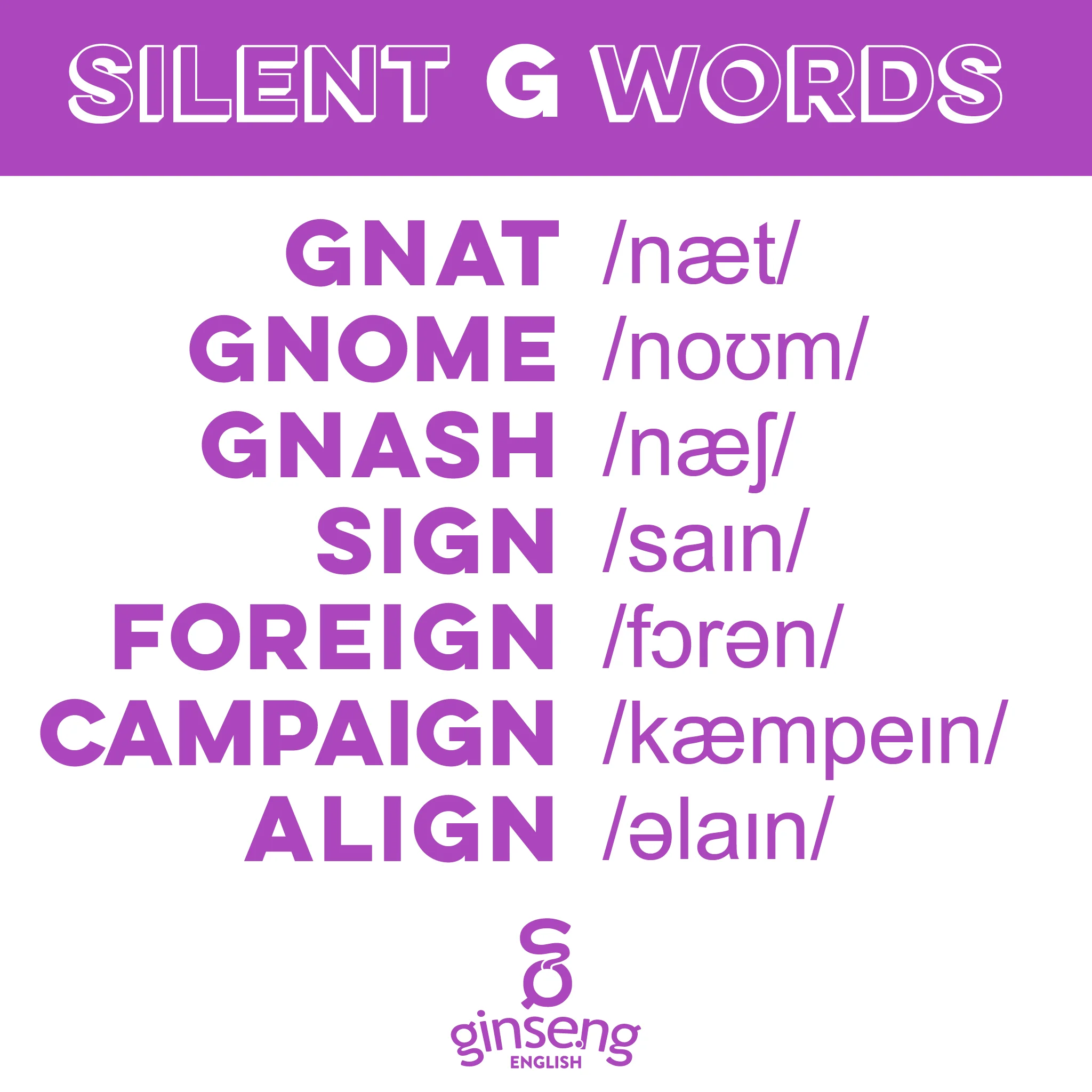
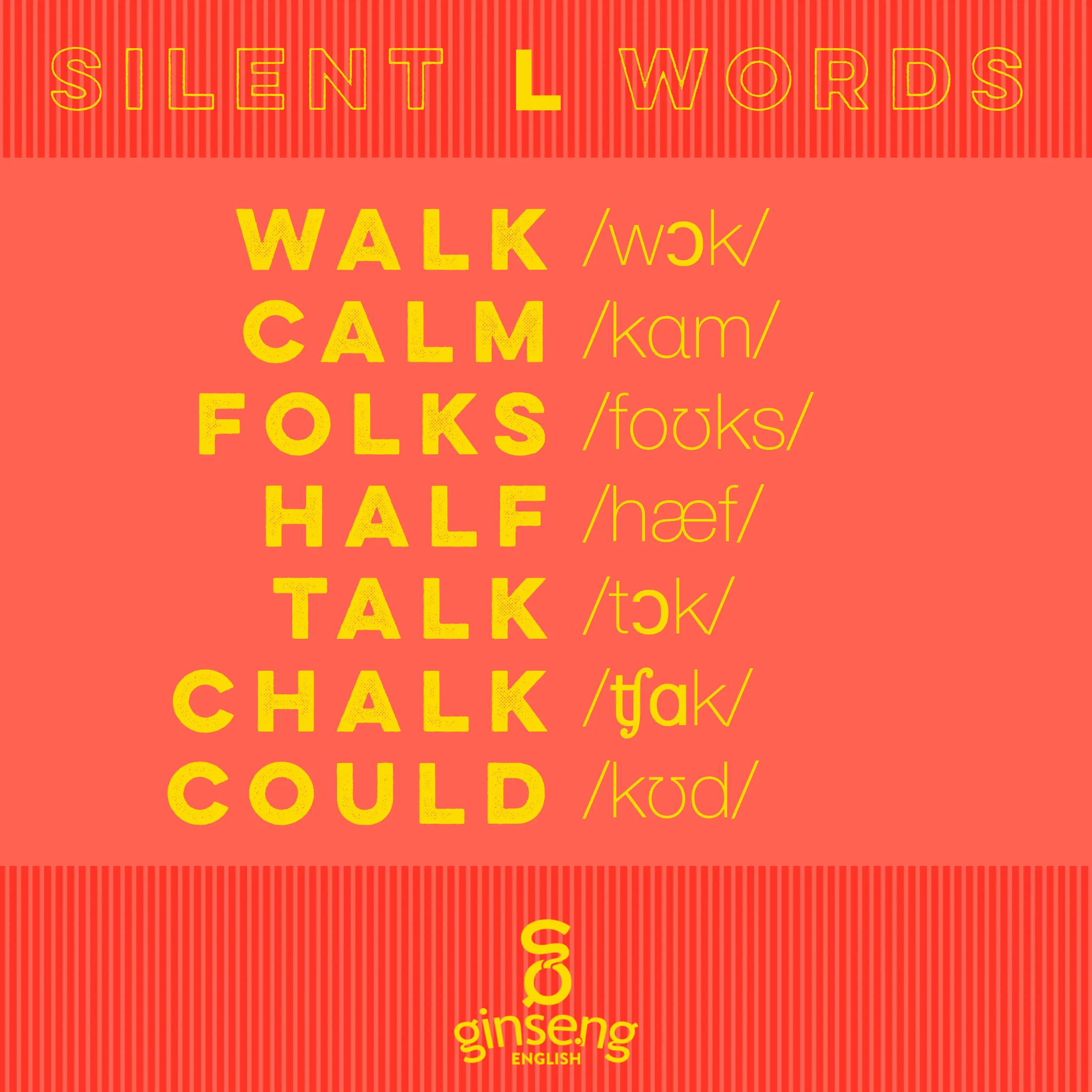
Silent T Words
Stop pronouncing these words wrong! If you’re looking for explanations and examples of words with silent T, you’ve come to the right place. Charts, definitions, a word list of over 20 examples, and the history of how silent T became silent.
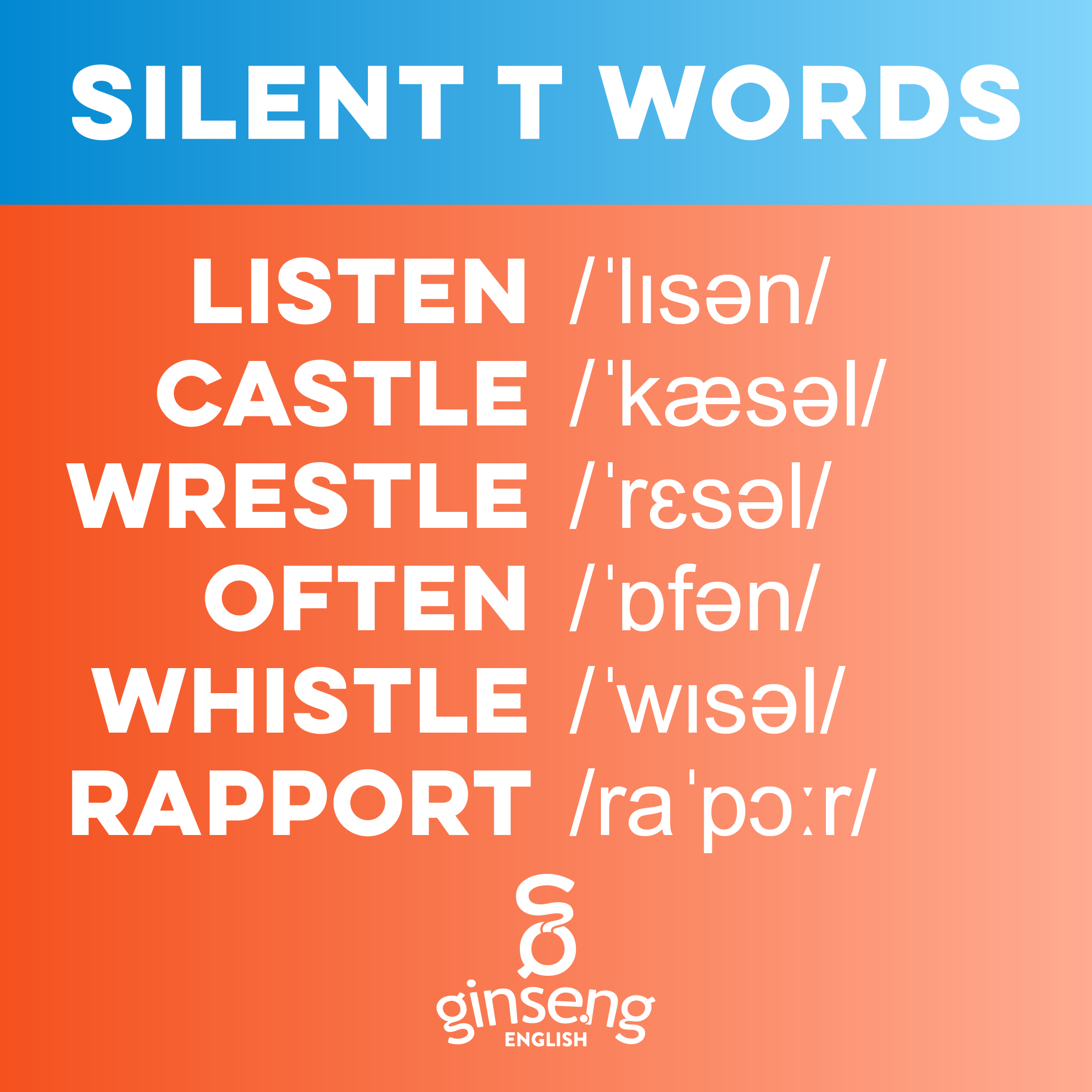
Silent T words are tricky even for native speakers. It's not at all uncommon to hear native speakers pronounce the word often off-ten. There are a few simple patterns you can learn to make sure that you're keeping those silent Ts silent! Read on!
When Is T Silent?
The "rules" for silent T are these: if you see -STEN, -FTEN, or -STLE, you should assume that the T is silent.
A lot of other silent letters are silent at the beginning (like G and K) or end (like B and N) of words. Silent T is a little different. It usually becomes silent because it gets "sandwiched" between two other consonant sounds, and it's easier to say if you leave out that T, which requires a lot of effort.
Examples
The chart below contains a word list of over 20 examples of words with silent T. Are you pronouncing them all correctly?
| Word | IPA | PoS | Definition | |
|---|---|---|---|---|
| listen | /ˈlɪsən/ | v. | to pay attention to sound | |
| fasten | /ˈfæsən/ | v. | to connect | |
| hasten | /ˈheɪsən/ | v. | to hurry | |
| glisten | /ˈglɪsən/ | v. | to shine with wetness | |
| moisten | /ˈmɔɪsən/ | v. | to make moist | |
| christen | /ˈkrɪsən/ | v. | to make Christian or give a name | |
| chasten | /ˈtʃeɪsən/ | v. | to moderate or restrict in behavior | |
| soften | /ˈsɒfən/ | v. | to make softer | |
| often | /ˈɒfən/ | adv. | frequently | |
| whistle | /ˈwɪsəl/ | v. | blow air through the lips to make sound | |
| thistle | /ˈθɪsəl/ | n. | a common prickly plant | |
| castle | /ˈkæsəl/ | n. | a large fortified medieval building | |
| wrestle | /ˈrɛsəl/ | v. | to fight using grappling | |
| nestle | /ˈnɛsəl/ | v. | lie comfortably within something | |
| pestle | /ˈpɛsəl/ | n. | heavy tool for crushing food in a mortar | |
| gristle | /ˈɡrɪsəl/ | n. | tough cartilage in meat | |
| mortgage | /ˈmɔːrɡɪdʒ/ | n. | a contract to borrow money for a house | |
| rapport | /raˈpɔːr/ | n. | a friendly relationship | |
| gourmet | /ˈɡɔːrmeɪ/ | adj. | of a refined taste in food | |
| ballet | /ˈbæleɪ/ | n. | an artistic dance form | |


| Singular | Plural | |||
|---|---|---|---|---|
| 1st person | I | am working. | we | are working. |
| 2nd person | you | are working. | you | are working. |
| 3rd person | he | is working. | they | are working. |
| she | is working. | |||
| it | is working. | |||
When adding -ing to C-V-C words, you should double the last consonant. When adding -ing to silent E words, drop the silent E.
Other Forms of the Present Continuous
Questions
To make questions in the present continuous, we already have the helping verb be, so all we have to do is move it to before the subject.
Are you wearing a tie?
Is she having a party?
Why is he crying?
What are they eating?
Negative Sentences
When forming a negative in the present continuous, not goes between the helping verb be (am, is or are) and the main verb.
I am not wearing a tie.
She’s not having a party.
The Passive Voice
To make a passive sentence in the present continuous, use be in the present continuous (am being, is being, or are being) and then the perfect form of the main verb.
A party is being planned.
The trash is being collected.
We are being attacked.
You are being lied to.
Signal Words
If you use the present continuous, it is generally clear that the time is right now, so it is not necessary to use any signal words. But for emphasis, we can say right now, currently, at the moment, as we speak, for the time being.
We can use the present continuous with always to talk about things that happen again and again, especially to show that we are annoyed by the repeated action:
He's always interrupting me whenever we try to have a serious conversation.
She's always showing up 10 minutes late. It's so inconsiderate.
To specify the time when the current action will end, use until.
I am working until 9:00.
If you want to specify when the current action began, using since, do not use the present continuous:
I am working since 5:00.
The present perfect continuous is better for situations like this.
CHECK OUT THESE OTHER FREE GRAMMAR RESOURCES:
Related Content
Present Perfect Tense in English
Dog Idioms
Today’s idiom posts are all about dogs! Check out this post for several example sentences, definitions. and images to help you remember these idioms!
English Idioms About Dogs
There are tons and tons of idioms in the English language about dogs, but here are 5 of our favorites!
The Dog Days of Summer
Happy Summer! In honor of the start of summer, we want to talk about the idiom dog days of summer. The expression the dog days of summer is used to describe the hottest days of summertime.
Examples
During the dog days of summer, you can either find me at the beach, or inside my air conditioned house! It's way too hot to do anything else.
It is recommended that you drink a lot of water and stay cool during the dog days of summer to aoid heatstroke.
Once the dog days of summer hit, many people take s vacation to the mountains where it is cooler.
Barking Up the Wrong Tree
We use the expression barking up the wrong tree if someone is making a wrong choice, pursuing the wrong thing, or making a false assumption about someone.
You might have seen dogs chasing animals, such as squirrels or rabbits. The squirrels often run up one tree to escape, and then jump to another tree once it's high enough. The dog might not notice this, and continue barking up the wrong tree without realizing that his prey has moved to a different tree!
Examples
Nicholas asked me to help him cheat on the test. I told him, no way, you're barking up the wrong tree! I'm an honest student and I don't want to get kicked out of school.
I accused my dog of destroying the couch, but I realized I was barking up the wrong tree when I saw pieces of the couch pillows in my cats hair!
Rick had been flirting with Jodi all night, but realized he was barking up the wrong tree because she actually had a crush on his best friend.
Can’t Teach an Old Dog New Tricks
Have you ever heard the idiom, you can’t teach an old dog new tricks? We use this to describe someone who is not open to change or improvement. This kind of person usually doesn’t want to learn a better way to do something and is very stubborn, so we are comparing them to an "old dog" who doesn't want to learn "new tricks"! 🐶
In contrast, some people say "you're never too old to learn!" Which expression do you agree the most with?
Examples
Mr. Gonzalez had been taking attendance on paper for 30 years and he refused to start using a computer. Like they say, you can’t teach an old dog new tricks.
We tried to teach our grandmother how to use her iPhone, but it was nearly impossible! I guess you really can’t teach an old dog new tricks.
Let Sleeping Dogs Lie
Let sleeping dogs lie, which means that you should not bring up old fights or conflicts. Instead, it is best to just forget them and let them be. This is especially common if an argument has been dropped, but not resolved. Letting sleeping dogs lie is a way of keeping the peace and avoiding conflict.
Examples
My sister was wearing the shirt that I know she stole from me, but we were having a peaceful family dinner so I decided to just let sleeping dogs lie and not bring it up.
Hannah got her test back and noticed that the teacher made a mistake on her grade. She was getting an A in the class anyway, so she decided to let sleeping dogs lie and not bother asking the teacher to correct it.
Alex knew that him and his girlfriend would never come to an agreement about whose turn it was to do the dishes, so he thought it was best to let sleeping dogs lie and just do them himself.
Sick as a Dog
Today's idiom is sick as a dog. This expression actually dates back to the 1700s when there weren't many veterinarians to help sick dogs, so it was common for dogs to be very sick. Now, if someone is very, very ill, we say that they are "sick as a dog." 🐶😷
Examples
Rebecca ate a bad hamburger and got food poisoning. Her boss said to her, "Rebecca, you look as sick as a dog, you need to go home right now!"
Jennifer was very tired while traveling in Costa Rica. She thought she was just homesick, but realized she was running a fever. She finally admitted that she was sick as a dog and went to the hospital. 🤒
I don't know what was in that seafood dinner, but afterwards, everyone in my family was sick as a dog!
Other free English resources:
Cat Idioms
English has tons of idioms about animals. Have a look at these idioms about cats. Check out this post for several example sentences, definitions. and images to help you remember these idioms!
English Idioms About Cats
There are tons of fun idioms about cats in English, but here are five of our favorites!
Curiosity Killed the Cat
The first cat idiom that we will talk about today is curiosity killed the cat. This is a funny way to warn someone that if you are too curious, you might end up getting hurt, or in trouble. Too many questions, or too much curiosity can lead to dangerous situations.
We use this idiom because we often we joke that cats have nine lives and can live forever. However, they actually get hurt quite often for doing things they aren't supposed to, such as getting stuck up in trees, or falling off tall shelves. Therefore, sometimes being too curious can actually kill a cat!
Examples
Andrew was very curious about the abandonded building and wanted to sneak in to explore. His friend told him that it's very dangerous, and he shouldn't go because it's not safe. After all, he said, curiosity killed the cat!
Alexis kept asking her friends about what her boyfriend is planning for her birthday. They knew he was throwing a big surprise party and would be heartbroken if she found out, so they told her to stop asking so many questions, curiosity killed the cat!
I was very curious to hear about why my coworker get fired, but my boss warned me that curiosity killed the cat and that it was none of my business.
Scaredy-Cat
Do you have a friend who is always scared? You could call them a scaredy-cat, but they probably wouldn't appreciate it very much! 😹 Someone who is overly nervous, or always frightened is known as a scaredy-cat. You can also call this type of person a fraidy-cat
This expression alludes to the skittishness and anxious behavior of cats.
Examples
Don't be such a scaredy-cat, just give spicy food a chance!
At the amusement park everyone except for Sandra went on the biggest roller coaster. We made fun of Sandra for being a fraidy-cat, but she's so afraid of heights that she couldn't help herself.
Michael was not feeling well, and needed to go to the doctor, but he's a scaredy-cat and is afraid of needles, so he stayed home and just got sicker!
Let The Cat out of the Bag
Have you ever accidentally told a secret, or shared something you shouldn't? If you have, you let the cat out of the bag. We use this phrase to say that you let a secret 'escape'. Someone who constantly lets the cat out of the bag could be called a blabbermouth or a gossip.
Examples
Christine told us not to tell anyone that she is pregnant, but I accidentally mentioned it to a friend and let the cat out of the bag. I felt awful!
Lynn told me that she was quitting her job. I didn't realize this was a secret, and I let the cat out of the bag by telling her coworker. Luckily, her boss wasn't mad!
My fiancé and I weren't ready to tell our parents we were engaged, but when I forgot to take off my engagement ring, the cat was out of the bag💍
CatNap
The next idiom is catnap. If someone takes a very short nap, you can say that they took a catnap. We use this expression because cats are known for sleeping for short periods of time throughout the day.
Catnaps are great because even though they are very quick, you can usually get a good boost of energy from them!
Examples
I have a half hour before my next meeting and I'm exhausted! I guess I'll try to squeeze in a quick catnap!
Wow, I only slept for 10 minutes, but I feel so refreshed! What a great catnap!
Jolene had a long drive ahead of her, so she took a catnap so she could stay awake.
Cat Got Your Tongue
To close out this post, we will talk about the idiom cats got your tongue. We use this idiom when someone has nothing to say, or when they are unusually quiet.
This may be an easy one to remember, because it's quite visual! If the cat has your tongue, you are literally unable able to speak! 👅 😸
Examples
I had a big speech prepared, but when I got up on stage, I froze! Cat got my tongue!
Why are you so quiet? Cat got your tongue?
Lilly was very opinionated but today she didn't have much to say. I wondered if the cat got her tongue!
We have to make decisions every day, but sometimes it’s so hard to just make up your mind! If you’re on the fence about a big decision, then these idioms might help your thought process! (Or at least help you procrastinate making a difficult decision😂)