
Silent B Words
If you’re looking for explanations and examples of words in English with silent B, you’ve come to the right place. Charts, definitions, word lists, and the history of how silent B became silent.
One of the most frustrating and interesting things about English is the crazy pronunciation. Silent letters can be particularly difficult. They are there. You can see them. But you don't hear them!
There are two situations in which B is silent. Silent B at the end of words is one common pattern. If you see -MB at the end of a word, usually you do not pronounce the B. The other common silent B pattern is -BT.
Examples of Silent B Words
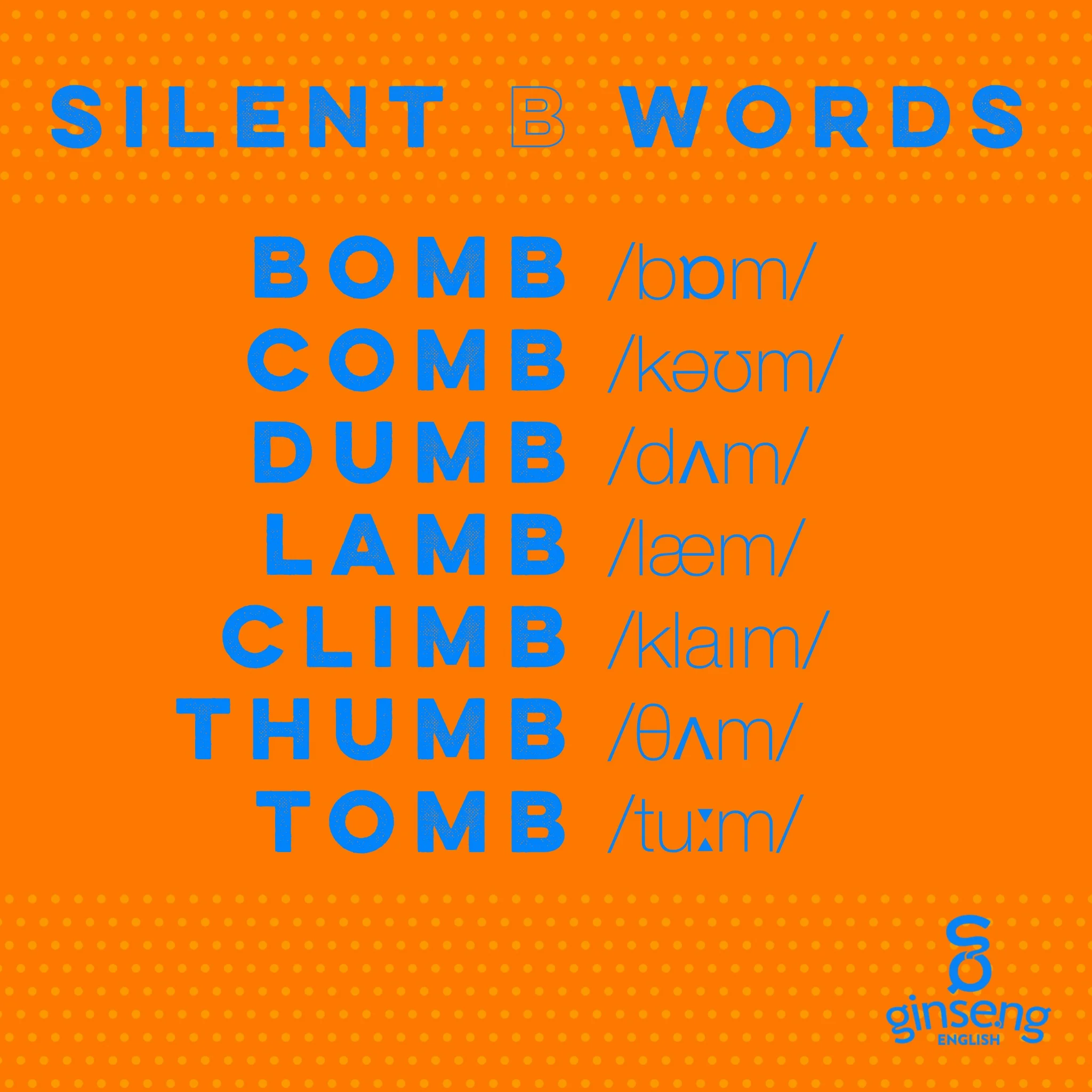
Here is a word list with 17 examples of silent B words:
| Silent B Word List | |||
| Word | IPA | PoS | Definition |
|---|---|---|---|
| bomb | /bɒm/ | n. | a machine that explodes |
| comb | /kəʊm/ | n. | a device for making hair neat |
| dumb | /dʌm/ | adj. | not smart |
| lamb | /læm/ | n. | a young sheep |
| climb | /klaɪm/ | v. | to go up |
| tomb | /tuːm/ | n. | a building for dead bodies |
| thumb | /θʌm/ | n. | finger on the side of the hand |
| crumb | /krʌm/ | n. | a small piece of food |
| limb | /lɪm/ | n. | an arm or leg |
| numb | /nʌm/ | adj. | not feeling |
| plumber | /ˈplʌmər/ | n. | someone who fixed pipes |
| womb | /wuːm/ | n. | the uterus |
| debt | /dɛt/ | n. | owing money |
| doubt | /daʊt/ | n. | uncertainty |
| subtle | /ˈsʌtəl/ | adj. | delicate; not obvious |
| jamb | /dʒam/ | n. | the side of a doorway |
Notice that the silent B doesn't tell us anything about the vowel in the word. The vowel sounds can be very different, for example in bomb, comb, and tomb.
Please share the picture with #ginsenglish if you find this helpful!
Why is B Silent Sometimes?
In the past, the B in these words was not silent. Over time, pronunciation changes. For example, bomb comes from the Italian bomba, in which the second B is pronounced, and climb was climban in Old English. By about 1300 C.E., the B had become silent.

Silent B Words in English
Learning English
5 Myths About Learning English
Learning English on Instagram
Learning English on Twitter
Best Blogs about Learning English
2018 Best Blogs to Learn English
2017 Best Blogs to Learn English
Can You Learn English with Duolingo?
Studying English Abroad
Choosing Where to Study Abroad

Chunking
Chunking
I just stumbled across an article from The Economist and had to share this quote about one of the most important strategies for achieving fluency in language learning: chunking. Chunking is thinking about and studying the language in common phrases, instead of single words.
A common example is good morning . We don't have to learn the word good and then the word morning and put them together: we simply learn it as a phrase, and we can say it quickly, without thinking much.
This can be applied deliberately to other phrases, too though. Here are some common phrases you might want to study as chunks:
on the other hand
contrary to popular belief
the thing about that is
http://www.economist.com/blogs/prospero/2015/10/johnson-language-pedagogy
more free english resources:


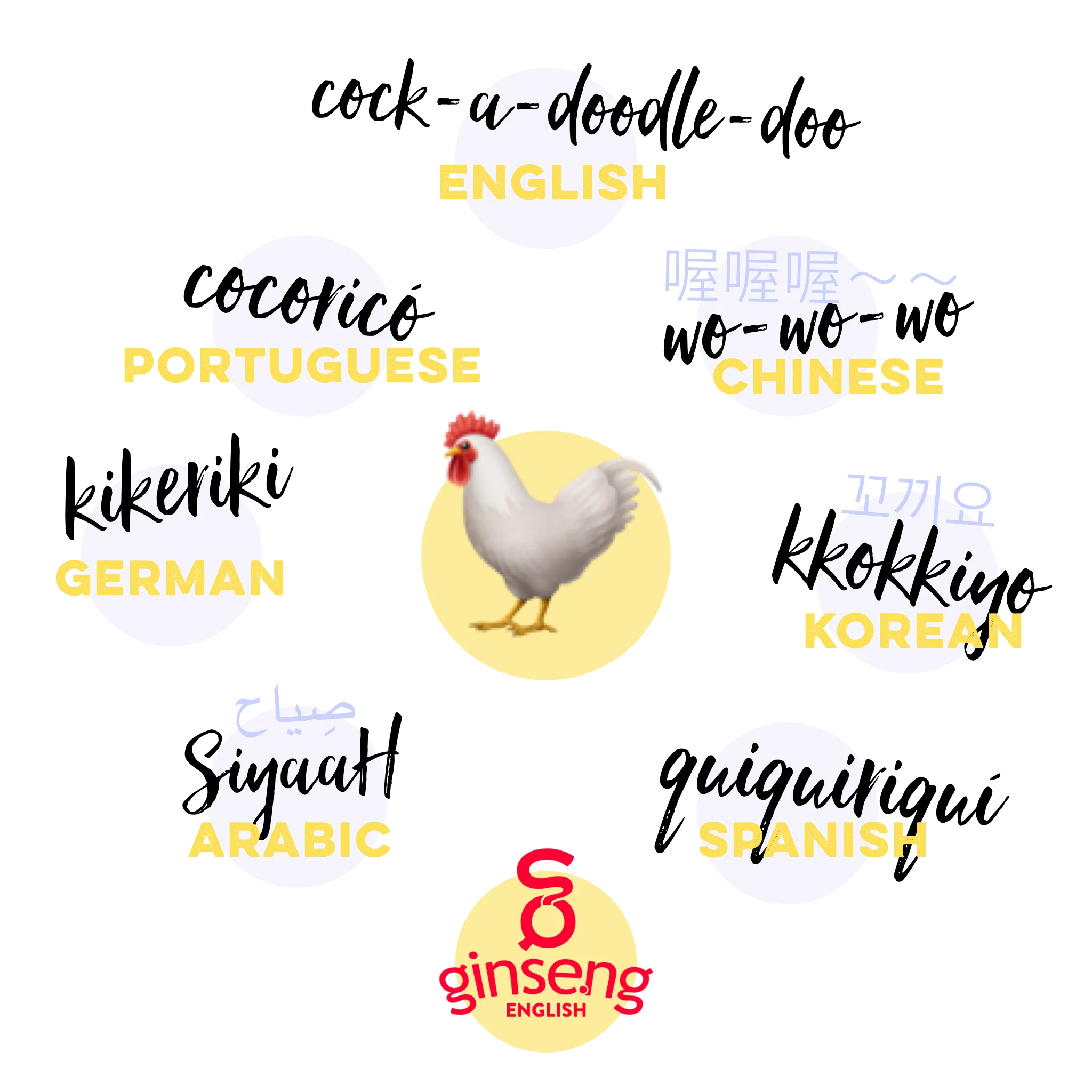
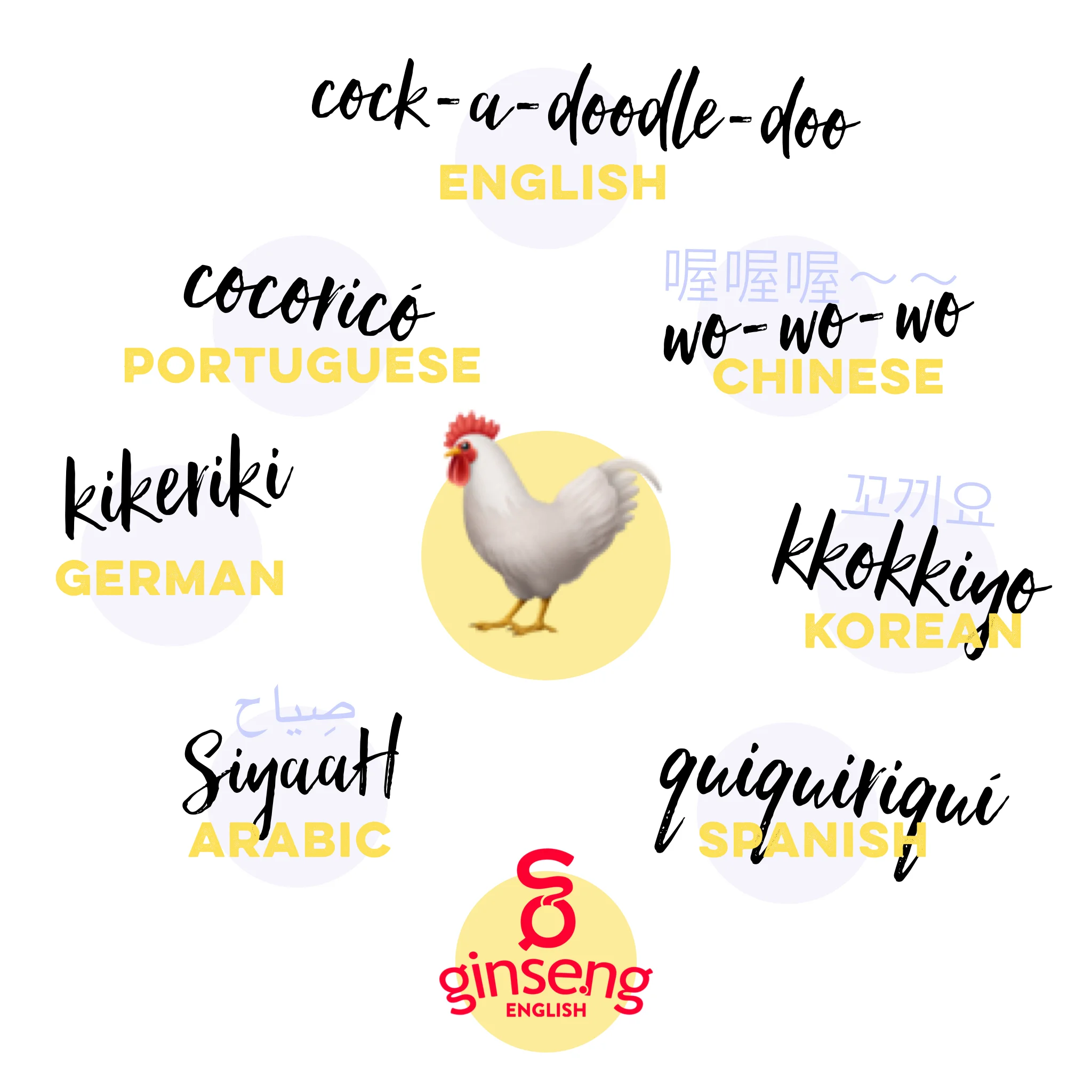
International Roosters!
Check out the sounds that roosters make in different languages around the world!
international roosters
Have you ever wondered what sounds animals make in different languages around the world? Check out this Ginseng English post about the different sounds a rooster makes in different languages!
In English, a rooster says cock-a-doodle-doo.
In Portuguese it says cocoricó.
In Chinese, roosters say wo-wo-wo.
In German they say kikeriki.
In Korean it's kkokkiyo.
Arabic-speaking roosters say SiyaaH.
And in Spanish, roosters say quiquiriquí.
more free english resources
Gerunds
Need to know what a gerund is? You've come to the right place!
gerunds in English
There are three common functions for -ing verbs:
participial adjectives
gerunds.
Let’s look at gerunds in a little more detail about gerunds.
We like to think a verb is a verb, and an adjective is an adjective, and a noun is a noun right? That would make sense. But by now you probably know that English doesn't always make sense!
Form vs. Function
Words can have both a form and a function. For a simple example, think about the word dog. A noun, right? But what about in the sentence Pablo bought some dog food? Here dog is describing the type of food. It works like an adjective. The form is a noun, but the function is an adjective.
So...What exactly is a gerund?
A gerund has the form of an -ing verb, but it functions is like a noun. That is, it does things that a noun usually does. What do nouns usually do? Often they work as subjects, direct objects, or objects of prepositions in sentences. And gerunds can do the same.
Take a look at these examples:
Rowing is hard work!
Clara loves sewing.
I'm thinking about going on vacation.
In the first sentence, rowing is the subject. In the second, sewing is the direct object of love. And in the third, going is the object of the preposition about . Notice that, even though the form of thinking looks like a gerund, it is not. It is a present progressive (or present continuous) verb.
So, one more time: a gerund is a verb ending in -ing that works like a noun, as a subject or object in a sentence.
If you've found this helpful, please share!


Ginseng Impact
Ginseng English commits 1 in every 10 class seats to those in need, completely free. They get the same classes as everyone else. We donate textbooks and materials to these students. By 2020, we want to increase that to 50% of students. We call this Ginseng Impact.
ginseng impact
So, you know Ginseng English gives you some of the best content out there for learning English, and you've probably heard that we have online English classes on the way.
But I want to share something you might not have heard about Ginseng. Ginseng is a social enterprise. When you register for English classes at Ginseng, you aren't just paying for excellent classes with happy, well-paid teachers; you're helping someone else to learn. The cost of your classes helps to support others who can't afford to pay for English but desperately need it.
In the United States, every single state has long waiting lists for free English classes. New immigrants often have to wait years to get into classes. For these immigrants, English isn't just a luxury; it's a survival tool. Likewise, in many other countries, English is an opportunity to escape from poverty, but there often aren't enough resources to reach all those in need.
That's why Ginseng English commits 1 in every 10 class seats to those in need, completely free. They get the same classes as everyone else. We donate textbooks and materials to these students. By 2020, we want to increase that to 50% of students. We call this Ginseng Impact.


Is Duolingo a Good Way to Become Fluent In English?
Duolingo is huge, counting over 170 Million users around the world. You can study over 20 different languages on Duolingo, but over 50% of users are studying English.
Many students ask, is Duolingo a good way to become fluent in English. The answer is not so simple. There are positive and negative aspects to the popular language-learning app.
Duolingo is a popular language learning app. Duolingo is huge, counting over 170 Million users around the world. You can study over 20 different languages on Duolingo, but over 50% of users are studying English.
Many students ask, Is Duolingo a good way to become fluent in English? The answer is not so simple. There are positive and negative aspects to the popular language-learning app.
Check out this article if you are looking for information on the Duolingo English Test
The Good
Let's start with the pros:
Price - Although they recently introduced a membership plan, you can still use the app completely for free. This is obviously a big benefit, because there are not many options for learning English for free.
Convenience - For convenience, Duolingo is hard to beat. It’s in your pocket on your phone and ready to go whenever you are. On the train or before bed, it’s right there.
Gamification - Duolingo uses what is called gamification (game + ification = making something into a game). It’s like playing a video game. You’re getting points and earning badges. It’s fun and some people believe this helps to motivate you to keep studying English.
Personalization - I think this is one of the biggest strengths of Duolingo. It knows you, and it knows your English level. As blogger Malingual says, “[Duolingo] knows exactly what I can and can't do because it constantly asks me.” This is called adaptive language learning. Another type of personalization is self-paced learning. With Duolingo, you don’t need to worry that the class will go too fast or too slow. You control how fast you go and how much you study.
Science - There is also some strong brain science behind Duolingo. They seem to take research seriously. One example is the app's use of spaced repetition. If you want to remember new English vocabulary, trying to remember them again and again, with more time in between each recall is a scientifically proven method for remembering. Duolingo uses this kind of science to make your studying more effective.
So these are some good things about Duolingo, but the app isn’t perfect, and some of the following points make me think that the app is not the best way to learn English for most students.
The Not So Good:
The Method - Duolingo is based on the grammar-translation method of learning language. Most experts today agree that grammar-translation is not the best way to learn a language. It certainly isn’t bad, but there are better ways.
Lack of Interaction - Most current theories of how we learn English put some emphasis on communication and interaction. With Duolingo, it’s just you and your phone. You have no classmates, no conversations, no group activities. Most experts agree that these are important elements to learning English. This is especially important if you want to become fluent. English fluency comes from speaking, not from translating sentences. If you want to become fluent, you have to speak!
No Teacher - Everyone is different, but most students like the ability to ask a question to the teacher when they don’t understand. Duolingo has some help options along the way, but it’s not the same as having a person to talk to.
Persistence - Persistence with apps like Duolingo tends to be quite low. This is bad, because learning a new language happens over a long period of time. That means you need a lot of persistence, or else you are wasting your time.
Duolingo founder Luis Von Ahn says the users who persist are the ones that make Duolingo part of their daily routine. Users who “binge — spending hours on the site, cramming in French or German or Chinese language lessons — tend to disappear fast.”
Inauthenticity - As one blogger says, “Duolingo is horribly inauthentic. You'll quickly find yourself getting sick of 'red apples'.” You are almost always looking at sentences made up only to teach you language. This is definitely useful sometimes. I make similar sentences when teaching my students basic English grammar rules. But in a class, we make sure to mix in some authentic English.
The vocabulary you find in Duolingo is also very different from the most common words in English, because it depends on theme-based units about food and animals. That means the language you are learning is often incredibly useful.
Conclusions
Duolingo is fun. And with it you can definitely learn some useful things about English, like vocabulary and common grammar structures.
But Duolingo will probably not help you to become fluent in a language. It isn’t good for people who aren't highly self-motivated.. It’s good for an app. It might be a good way to get extra practice at home or learn basic grammar, but by itself it’s certainly not the best way to learn a new language.
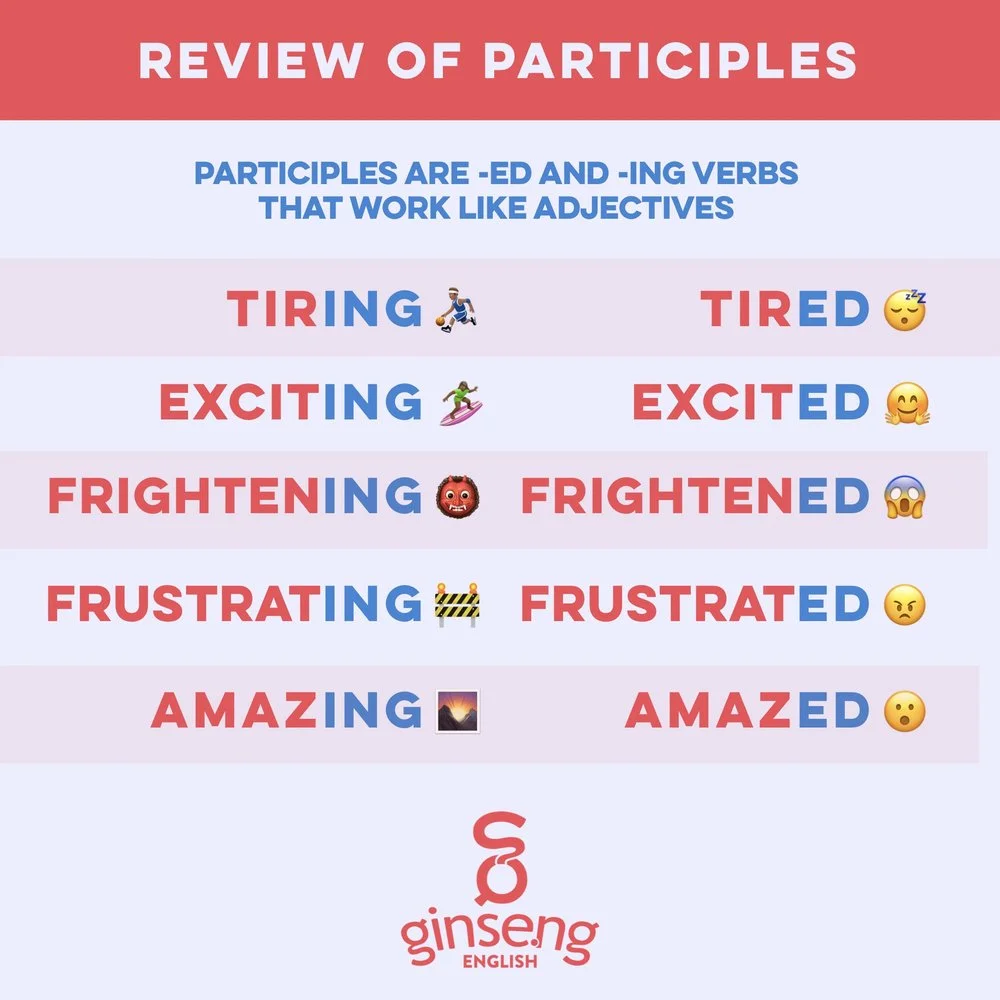
Review of Participles
Remember:
Participles (or participial adjectives) are verbs with -ED and -ING endings that can work like adjectives, describing people and things.
-ED participles (past participles) usually describe how we feel, as in, "I feel exhausted."
-ING participles (present participles) usually describe things that make us feel that way, as in, "That hike was exhausting."
If you found this Ginseng English tip helpful, please share with #ginsenglish and follow @ginsenglish on Twitter, Instagram, and Facebook! Also, consider signing up for our online English courses!


Anatomy of an Email - Greeting
The punctuation you use at the end of an email greeting is important!
If you found this Ginseng English tip helpful, please share with #ginsenglish and follow @ginsenglish on Twitter, Instagram, and Facebook! Also, consider signing up for our online English courses!






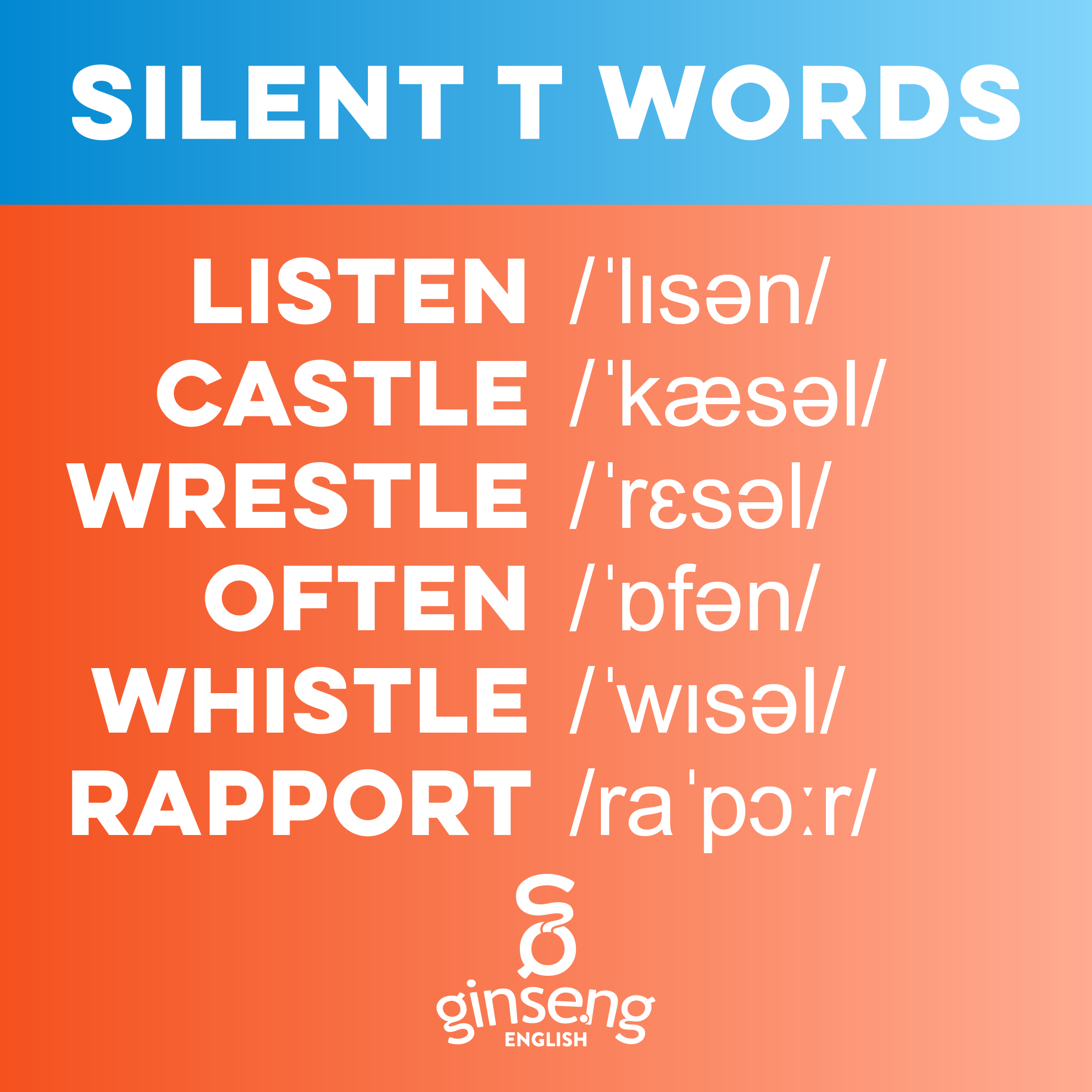
Stop pronouncing these words wrong! If you’re looking for explanations and examples of words with silent T, you’ve come to the right place. Charts, definitions, a word list of over 20 examples, and the history of how silent T became silent.