
POTUS, FLOTUS, and SCOTUS
You may have seen some strange acronyms floating around on the internet. If you are curious what POTUS, FLOTUS, SCOTUS, SGOTUS, FGOTUS, or even SCROTUS means, this is what you’re looking for!
POTUS, FLOTUS, and SCOTUS
If you spend any time on Twitter, you may have heard some funny words that all look the same: POTUS, FLOTUS, and SCOTUS.
What do these strange words mean? Well, they are all acronyms. Acronyms are abbreviations, in which each of the letters represents a word. The -OTUS in these three words stands for of the United States.
POTUS
POTUS means president of the United States. This abbreviation originated in telegrams, to save time. This is the most common -OTUS acronym. POTUS is pronounced /ˈpōdəs/. The abbreviation is even used as the president’s official Twitter handle: @POTUS.
Sometimes we will use VPOTUS, meaning Vice President of the United States, in writing. This is somewhat rare, though, because it is difficult to pronounce in English.
SCOTUS
SCOTUS is Supreme Court of the United States (the most important court in the US). SCOTUS is pronounced /ˈskōdəs/.
FLOTUS and SLOTUS
When the president has a wife, she is referred to as the First Lady. FLOTUS stands for first lady of the United States. FLOTUS is pronounced /ˈflōdəs/.
President Joe Biden’s wife, Dr. Jill Biden, is a professor of English. This has earned her the fun nickname Professor FLOTUS.
Although the term is much less common, the vice president’s wife is sometimes called the second lady, so the acronym SLOTUS can be used for second lady of the United States.
FGOTUS and SGOTUS
For many years the president and vice president were heterosexual men, so our terms are very heteronormative. Today, we have a female vice president and have had at least one serious presidential contenders who is a gay man. This means that we may be seeing some new -OTUS terms arising!
Gentleman is the typical counterpart to lady in English, so the terms
FGOTUS, meaning first gentleman of the United States, will be used for the president’s husband. SGOTUS, meaning second gentleman of the United States, can be used for the vice president’s husband.
History of POTUS and SCOTUS
English has many acronyms like this. Many of them began in the military. SCOTUS and POTUS were first used in the late 19th century, in telegrams. FLOTUS didn't come into the language until almost a hundred years later. VPOTUS has been used here and there to refer to the vice president, but because it isn't exactly easy to pronounce, it hasn't caught on.
SCROTUS
As you may know, Donald Trump was a very unpopular POTUS, and this has led to many jokes about him. In 2017, a Twitter user came up with a new -OTUS word for Trump: SCROTUS. This joke works for two reasons: first, it stands for so-called ruler of the United States, and Trump really doesn't like when people suggest that he is an illegitimate president. But the much funnier part of this joke is that it sounds like the word scrotum. You can click here to find out what that one means; this is a family website!
Other -OTUS Words
COTUS has been used to mean constitution of the United States.
FDOTUS (and DOTUS) been used jokingly to refer to the president’s dog, first dog of the United States.
more free english resources


This That These Those - Demonstrative Determiners
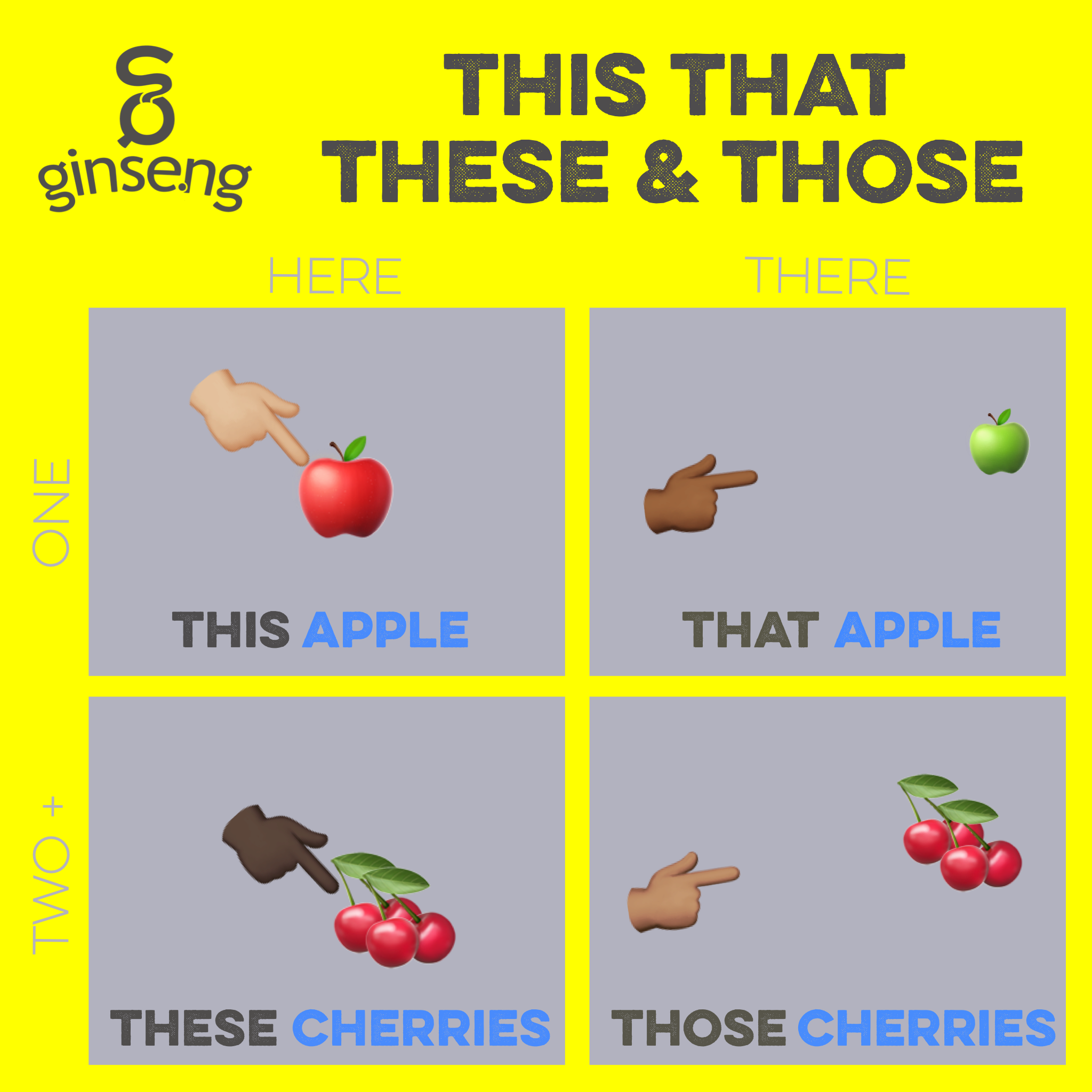
Demonstrative determiners are this, that, these, and those. They come before a noun to indicate quantity and location.
What on earth is a demonstrative determiner!? Don't worry, it's not nearly as scary as it sounds, and this Ginseng English post will explain it!! Demonstrative determiners (which are sometimes inaccurately called demonstrative adjectives) are just the words this, that, these , and those.
This and that are both singular, meaning they only talk about one thing. This is for a thing that is close to us, and that is for a thing that is far away. These and those are both plural, used to talk about many things. These is for things that are close to us, and those is for things that are far away.
This, that, these, and those are all demonstratives: they demonstrate where things are and how many there are. In the examples above, they all come before nouns, which makes them determiners. But these same four words can also be used without nouns, acting as pronouns. In that case they are called demonstrative pronouns.
If you like this, share the image below with #ginsenglish!
More Free English Resources






Anatomy of an Email - Greeting
The punctuation you use at the end of an email greeting is important!
If you found this Ginseng English tip helpful, please share with #ginsenglish and follow @ginsenglish on Twitter, Instagram, and Facebook! Also, consider signing up for our online English courses!



You may have seen some strange acronyms floating around on the internet. If you are curious what POTUS, FLOTUS, SCOTUS, SGOTUS, FGOTUS, or even SCROTUS means, this is what you’re looking for!