
Contractions with Two Meanings
Lots of contractions!
Contractions are two words put together in a shorter form. We use lots of contractions in English: isn't (is not) doesn't (does not), didn't (did not), can't (cannot), won't (will not). I'm (I am), you're (you are), we're (we are). There are tons of them!
Confusing contractions
Apostrophe -s
But let's (let us!) talk about some tricky contractions. Contractions with apostrophe -s ('s) and apostrophe -d ('d) are difficult because they have two meanings. Think about it: what does he's mean? Look at these two sentences:
He's studying English.
He's visited England.
In the first sentence, he's means he is. In the second sentence, he's means he has. When we see 's it can mean either has or is.
Apostrophe -d
I'd been working for hours.
I'd like a glass of champagne.

Sensory Verbs in English
Verbs related to the five senses can be really difficult in English. This post covers all five senses, including active and passive sensory verbs, complete with charts and examples!
We know the world through our eyes, our ears, our fingers, our noses, and our mouths. Sensory verbs (or sense verbs) are the verbs we use to talk about our five senses in English.
With our eyes, we see.
With out ears, we hear.
With our fingers, we feel.
With our noses, we smell.
And with our mouths, we taste.
These are the five basic sensory verbs in English. But we use slightly different sensory verbs depending on the situation.
Using Sensory Verbs in English
Passive/Unintentional
There are three basic ways that we can use sensory verbs in English.
The first is for when we unintentionally sense something. For instance, I am sitting in my room and I hear a truck outside. I'm not trying to hear the truck. I am just sitting here, and the sound reaches my ears. Hear is the way we describe the passive sense of hearing. Here are some more examples of passive, unintentional sensory verbs:
I see a rainbow!
The dog hears someone at the door.
I can feel the floor vibrating!
Do you smell something cooking?
I think I taste cinnamon in this bread.
Active/Intentional
The second way we talk about sensory verbs is when we actively, intentionally use our senses. For example, my soup comes, and I am excited to try it. I put my nose close to the bowl and I smell the soup. Then I take my spoon and I taste my soup. I am actively trying to pay attention to the sensation. These are sometimes called dynamic sensory verbs. Here are examples of the five sensory verbs we use for intentionally using our senses:
She looked out of the window.
Shh! I am listening to a lector for my homework!
Here, taste this before it gets cold.
She smelled the milk to see if it was okay to drink.
He touched the grass, and it was wet.
Stative Sensory Verbs
The final type of sensory verb is a bit different. The first two types describe what people do. with their senses. But the third type of sensory verb talks about the things that we sense, the cause of what we are feeling. I can listen to music, and the music sounds good to me. I can touch the ice, and the ice feels cold to me. These are called stative sensory verbs, because they describe the state of the thing. Here are five more examples:
She was wearing her new dress. She looked beautiful.
What is that music? It sounds terrible.
Wow, this sauce tastes incredible!
Ew, that trash smells awful.
This blanket feels so soft!
Notice that in each of the examples above, the thing is the subject, not a person.
Adjectives and Stative Sensory Verbs
Another thing to notice about stative sensory verbs is that we use adjectives with them. Other verbs often have adverbs after them (adverbs describe verbs). But with stative verbs, we use adjectives. Adjectives describe nouns, and the stative verb is connecting the noun to the adjective that describes it.
Look again at the examples in the last section. We say It sounds terrible, not It sounds terribly. We say It tastes good, not It tastes well.


English Grammar Guide
Grammar is a set of patterns that show how we can put words together in a language. This guide, completely written by expert English teachers, is a great place to start to learn all about English grammar.
Nouns & Pronouns
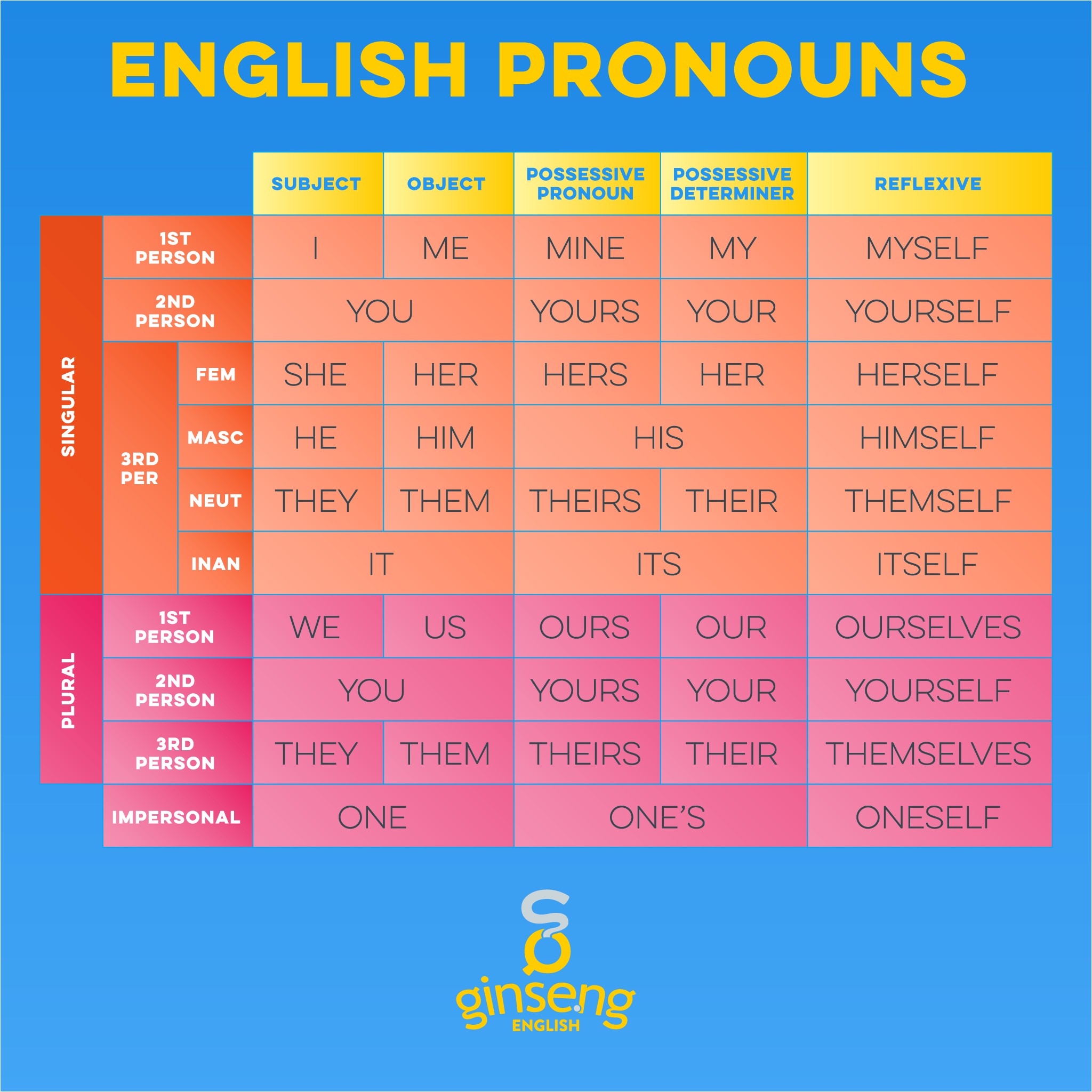
A noun is a person, place, thing, or idea, such as singer, Boston, apple, or fun. A pronoun is a word that stands for a noun or refers back to a noun, like they, he, she, them, or it.
Parts of Speech
There are 9 parts of speech in English: nouns, pronouns, verbs, adverbs, adjectives, articles, prepositions, conjunctions, and interjections.Verbs
Verbs show the action in a sentence. We show how actions relate to each other with 12 different verb forms in English.
Adjectives & Adverbs
We use adjectives and adverbs to describe. Adjectives describe nouns. For example, blue, hot, tall, thoughtful, and scary are all adjectives. Adverbs describe verbs. Some examples are slowly, often, calmly, clearly, and soon.
Demonstratives
The English demonstratives are this, that, these, and those.Future Perfect Tense
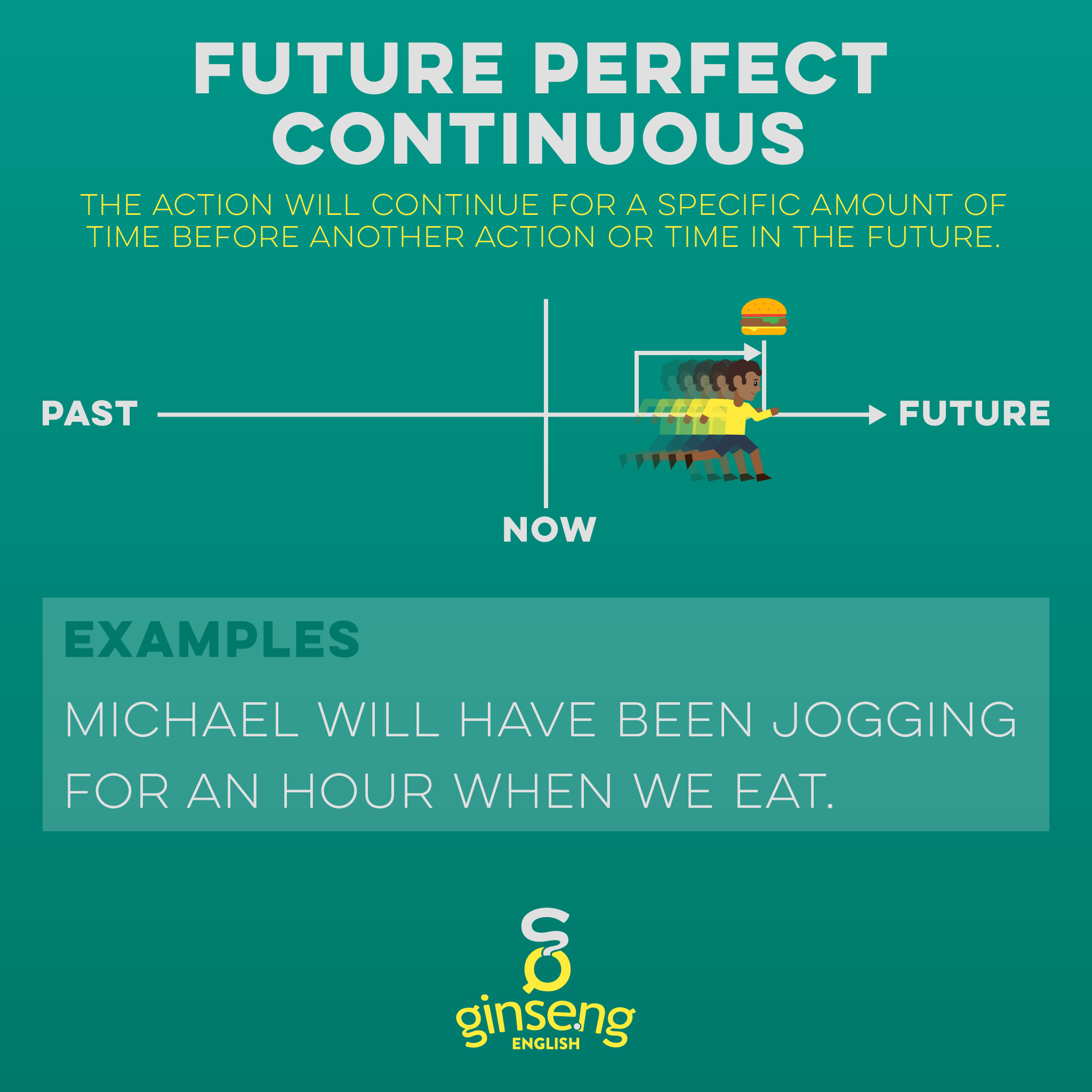
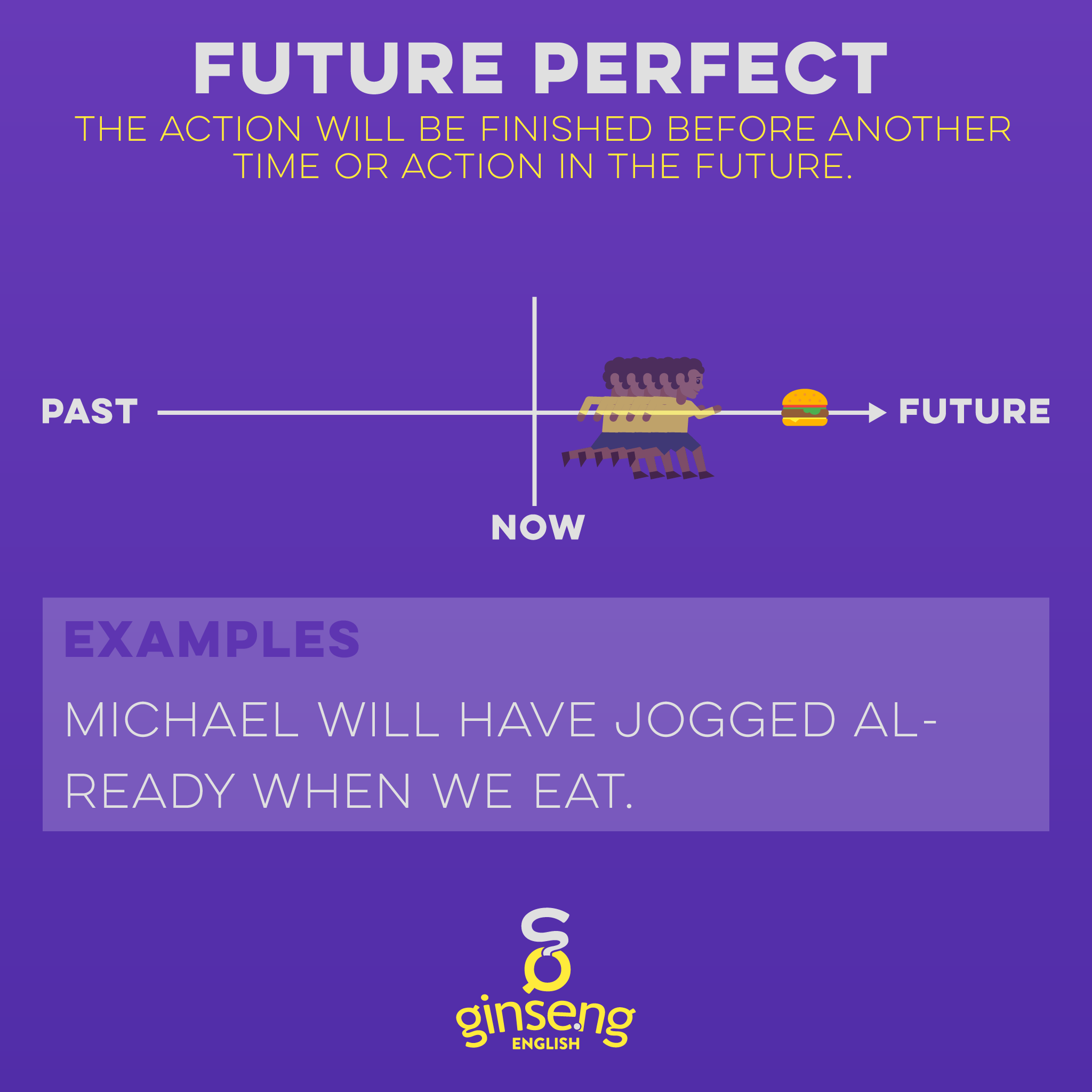
The future perfect is an English verb form used to describe actions that will be complete at a particular moment in the future. This can be a time or date, or it can be another action.
This is not a common verb form. Less than .1% of English verbs are in the future continuous.
Keep reading to learn the rules and reasons for using and forming the future continuous, including loads of charts and examples!
Using the Future Perfect
Perfect verb tenses are used to describe an action that is complete before another action or point in time. With the future perfect, that time is in the future. This can be a time or date (next weekend, tomorrow at 5, on November 3rd) or it can be another action in the future.
Chart for Future Perfect Tense In English

Here are some example sentences:
The skyscraper isn't completely built yet, but when I go in June, they will have finished it.
You can come over at 8. We will have eaten dinner by then.
In these examples, the perfect action (will have finished, will have eaten ) will be complete before the other specific action (when I go in June) or time (at 8).
Forming the Future Perfect
Formula with Will
To form the future perfect, we use the future form of the helping verb have—will have—and the perfect form of the main verb. No matter what the subject is, the verb form is:
subject + will have + perfect VERB
Conjugation
That means the conjugation chart is really easy!
| Singular | Plural | |||
|---|---|---|---|---|
| 1st person | I | will have worked. | we | will have worked. |
| 2nd person | you | will have worked. | you | will have worked. |
| 3rd person | he | will have worked. | they | will have worked. |
| she | will have worked. | |||
| it | will have worked. | |||
Formula with Going to
Because forming the future tenses with be going to is more complex and wordy, we almost never form the future perfect with be going to. In the rare situation that we might use it, the formula is:
subject + am/is/are + going to have + perfect VERB
Conjugation
Here is a conjugation table for the verb work with going to.
| Singular | Plural | |||
|---|---|---|---|---|
| 1st person | I | am going to have worked. | we | are going to have worked. |
| 2nd person | you | are going to have worked. | you | are going to have worked. |
| 3rd person | he | is going to have worked. | they | are going to have worked. |
| she | is going to have worked. | |||
| it | is going to have worked. | |||
Other Forms
Questions
In the future perfect, you have more than one helping verb. To make a question, move the subject after the first helping verb, will, but before the second helping verb, have.
Will you have eaten by 8?
Will they have finished the construction by the end of the year?
Will she have completed her degree by that time?
What will they have accomplished with this senseless war?
When will they have made a decision?
Negative Sentences
To form a negative, insert not between the first helping verb will and the second helping verb have. Here are some examples.
I will not have eaten by 8.
They will not have finished the construction by the end of the year.
She will not have completed her degree yet.
The Passive Voice
Making a passive sentence in the future perfect is extremely complex and extremely rare. We do not recommend making future perfect passive sentences. If for some reason you do need to make a passive sentence in the future perfect, use be in the future perfect (will have been) and then the perfect form of the main verb.
The package will have been delivered by Friday afternoon.
All the food will have been eaten by the time we get there.
CHECK OUT THESE OTHER FREE GRAMMAR RESOURCES:
The Most Frequent Freshman Writing Errors
A lot of us make it to college without being taught some of the expectations of college writing. That’s not your fault! We can’t be blamed for the things we don’t know. So let’s take a moment to knock out some really common mistakes in undergraduate writing!
This article will help you to identify and fix 15 of the most common errors that freshman writers make, including grammatical, mechanical, and stylistic errors!
Research on Frequent Writing Errors
If you want to eliminate common errors from your writing, it’s a good idea to look at the research that has been done on the topic.
An important 1984 study by Connors and Lunsford identified and quantified the most common errors in the writing of college freshmen. Lunsford and Lunsford updated that study in 2006 and came up with a more complete list. In the table below are the 10 most common errors from each of those studies:
| Connors and Lunsford 1984 | Lunsford and Lunsford 2006 | |
|---|---|---|
| 1 | No comma after introductory element | Wrong word |
| 2 | Vague pronoun reference | Missing comma after an introductory element |
| 3 | No comma in compound sentence | Incomplete or missing documentation |
| 4 | Wrong word | Vague pronoun reference |
| 5 | No comma in non-restrictive element | Spelling error (including homonyms) |
| 6 | Wrong/missing inflected endings | Mechanical error with a quotation |
| 7 | Wrong or missing preposition | Unnecessary comma |
| 8 | Comma splice | Unnecessary or missing capitalization |
| 9 | Possessive apostrophe error | Missing word |
| 10 | Verb tense shift | Faulty sentence structure |
We have used this research as the basis for this article, in which we share 15 of the most common errors in college writing, explanations, along with tips and resources for correcting them in your own work! This is the guide for freshman writers!
The Wrong Word
Homophones
Many errors involving the wrong word are the result of confusion caused by homophones. Homophones are words that sound the same but have different meanings and spellings. Here is a quick list of 10 of the most common homophone groups to make sure you get them right!
| 1 | your | you're | |
|---|---|---|---|
| 2 | there | their | they're |
| 3 | effect | affect | |
| 4 | than | then | |
| 5 | here | hear | |
| 6 | accept | except | |
| 7 | to | too | two |
| 8 | its | it's | |
| 9 | aloud | allowed | |
| 10 | break | brake |
Overusing Ten-Dollar Words
‘Ten-dollar words’ are big words, fancy words—the words that you use to impress people. There is nothing wrong with big, fancy words; sometimes using the right big word really can impress your reader. But very often, developing writers are trying so hard to stack their essays with big, impressive words, and in the process they sacrifice precision. Then, the effect on the reader is not to impress, but to frustrate. Only use big words if they are the right big words.
For example:
Florence is notorious for its plethora of churches.
The organization donated unutilized writing implements to schools that necessitate them.
Notorious means famous for something bad, so it’s strange to call a city notorious for it’s churches. Necessitate isn’t exactly the same as need. Necessitate is more like to make something necessary, rather than being in need of something.
Here are the same sentences rewritten with simpler (and, in these cases, better) words:
Florence is famous for its many churches.
The organization donated unused pencils to schools that need them.
As you build your vocabulary and use the new words that you learn, impress your reader with the precision of your vocabulary choices, not the fanciness of your words.
Quotation and citation errors
Incorporating ideas, findings, and quotations from the work of other scholars is an essential academic writing skill. Doing it wrong can be clumsy. Doing it really wrong can be plagiarism!
Missing Attributions
When you are reading and using the work of others to write a paper, the most important principle to understand when it comes to attribution and citation is that you need to give credit for any ideas that are not yours. This can apply to quoting exact words, but it also includes ideas and research. That’s what attribution is: giving people credit for their work.
Sometimes students from other cultures are surprised by how important attribution is in U.S. academic culture. If you are studying at a university in the U.S., it is important to understand that we take attribution very seriously. If you include someone else’s words or ideas in your writing without including a citation, this is called plagiarism. In American universities it is considered the same as cheating or stealing someone’s ideas. In a university, you can fail your class and even be permanently expelled for plagiarism. You should read your school’s academic honesty policy to understand the expectations at your particular college.
Mechanical Errors in Citations
While attribution is sort of a general practice of giving people credit where it is due, citation is how we do that. In practice, this often looks like putting the name and date of the work in parentheses in your text and at the end of your paper in a bibliography or works cited list. This usually involves some very specific formatting, and it’s really easy to make mechanical errors. In writing, mechanical errors are issues with spelling, capitalization, and punctuation.
There are different ways of doing this, different citation styles. These tend to change according to the discipline you are working in. For example, if you are writing a paper for an English literature class, you will probably be asked to use MLA style for your citations, but if you are working in the social sciences, you will probably have to use APA style.
Here’s an example of an in-text citation in MLA style:
"To err is human; to forgive, divine" (Pope 15).
And here’s an example of an in-text citation in APA style:
"He that has eyes to see and ears to hear may convince himself that no mortal can keep a secret" (Freud, 1915, p. 142).
Notice that both MLA style and APA style require you to put the author’s name and the page number in parentheses after a quotation (and before the period!). But also notice that APA style requires the year as well, commas between the elements of the citation, and the letter P and a period before the page number. These may seem like minor details, but you can lose points for getting them wrong in some classes!
Generally your professor will tell you on their syllabus which style to use for your course. A fantastic resource for citations is Purdue OWL (Online Writing Lab).
Not Using Your Own Words
Another important aspect of attribution is phrasing. When you are working with other people’s ideas, you mostly want to try to summarize and paraphrase them in your own words.
Sometimes this isn’t possible, though, and you need to use the author’s original words. That is okay, but when you use someone else’s words, even a combination of just a few words, you must use quotation marks. Look at your style guide to better understand other details about how to indicate when you are quoting someone else’s words.
Lack of Integration
You also need to incorporate the quotation into a sentence of your own. That is, if you want to use this quote from Hamlet, you can’t just put it into your paper as a sentence by itself. This would be wrong:
Hamlet was thinking about suicide. "To be, or not to be."
You need some introductory text, like this:
Hamlet was thinking about suicide. He asked himself, "To be, or not to be."
Skillful writers develop a range of different ways to integrate quotations into their work so that the reader doesn’t get bored!
Unclear References
You likely know that pronouns are an essential part of speech that make your writing flow more smoothly. But if you’re not careful, pronouns can introduce ambiguity—lack of clarity—into your writing. In this sentence it’s clear that the pronoun they refers to the noun cigarettes, its antecedent:
You shouldn't smoke cigarettes because they are unhealthy.
The reason it is clear is that they is a plural pronoun and there is only one plural noun (cigarettes) in the sentence before that plural pronoun. Generally a pronoun refers back to the nearest previous noun that it agrees with (in terms of gender and plurality).
But take a look a this example:
My father says we need really strict drug laws because they are really dangerous.
This kind of unclear pronoun reference is a common problem in freshman writing. What does the pronoun they refer to? The writer probably means drugs, but hasn’t actually used the word drugs as a noun (in drug laws, drug works like an adjective). We can figure out what he means, but grammatically, this is a problem. Pronouns generally need to refer back to nouns that have already been said. Here is how we can fix the above example:
My father says that, because drugs are so dangerous, we need to regulate them with strict laws.
Now that we have used the word drugs, we can then use the pronoun them to refer back to it.The rule here is to be sure that your pronouns have clear references that are in grammatical agreement.
Spelling
Spelling errors are extremely common in English. That is no surprise, because English spelling is so irregular.
Here is a list of 201 of the most commonly misspelled words in English. Study up!
Commas!
A whole lot of errors are related to missing commas. The tough thing about commas is that sometimes there is an inflexible rule that makes a comma either required or not allowed, and in other situations, it’s your choice (we call this a style choice).
Here’s a breakdown of some of the most common ones.
Commas after Introductory Phrases
When you use a long introductory phrase in a sentence, a comma is often necessary to help your reader follow your sentence. Learn how to recognize the subject and main verb in your sentence. If you have a long phrase before that, consider adding a comma at the end of it. Take a look at this example:
At the beginning of the class we introduced ourselves.
This sentence is a little disorienting for readers, because the introductory phrase (At the beginning of the class) is so long and the subject (we) comes so late. A comma can help the reader to recognize the end of that introductory phrase:
At the beginning of the class, we introduced ourselves.
Unfortunately there isn’t a perfect rule for distinguishing a “long” introductory phrase from an acceptably short one. This is more of a style choice, but you should try to be conscious of how commas can help your reader to break up (or parse) your sentences. In general, you can always choose to add a comma, even after a short introductory phrase (Like in general in this sentence!).
Commas for Restrictive Elements
This is a tricky one. The rule here is that you don’t put commas around restrictive elements in a sentence. But what is a restrictive element!? A restrictive element is a part of a sentence that contains information that is essential to understanding or defining a noun. Here’s an example:
The Beatles' song "Yesterday" has been covered by many other musical artists.
In this case, “Yesterday” is a restrictive element. Why? Because it is essential to the meaning of The Beatles’ song. If you removed “Yesterday”, the sentence wouldn’t make sense.
The Beatles' song has been covered by many other musical artists.
The Beatles’ song isn’t enough information. Your reader wants to know, “Which song?” because the Beatles had many songs. Since Yesterday is a restrictive element (essential to the meaning of The Beatles’ song), we do not put commas around it. Compare that with this example:
The Beatles' first album, Please Please Me, was a huge hit.
This example is different. We have already specified The Beatles’ first album. They only have one first album, so the title of that album, Please Please Me, is not essential to understanding the sentence. It is not a restrictive element. The sentence works just fine without it:
The Beatles' first album was a huge hit.
For non-restrictive elements, we put commas before and after to show that this is extra information. The commas work almost like parentheses in this case. Here is one more example of a restrictive element (in this case a restrictive relative clause):
The book that I bought yesterday is missing two pages!
If we took out that I bought yesterday this sentence would be missing something. The reader would ask Which book? So that I bought yesterday is a restrictive element and does not have commas around it. If we put commas around it, this is an error:
The book, that I bought yesterday, is missing two pages!
Other Unnecessary Commas
Some people have been taught that you should use a comma where you would pause in a sentence. Sometimes this works out, but often it doesn’t. This really isn’t a very good rule for using commas, because people speak and pause in different ways, but commas do follow some rules!
One common mistake with unnecessary commas is to place a comma between the subject and the verb of a sentence. This example is wrong:
That new movie with Brad Pitt, is on Netflix now!
The subject of your sentence is movie, but the full noun phrase for that subject is that new movie with Brad Pitt. Putting a comma between the subject and the verb (is) is a problem. This sentence should have no comma, like this:
That new movie with Brad Pitt is on Netflix now!
Run-ons and Fragments
Run-On Sentences
Run-on sentences are sentences that combine more than one independent clause without the necessary conjunction.
Here is a typical run-on sentence.:
I really love windsurfing, the wind is in your hair, the sun is overhead, the sea beneath you feels solid and supportive.
In this example, all four clauses can simply be sentences on their own (they are independent clauses). If you join more than one independent clause like this, with only commas, this is a special kind of run-on sentence called a comma splice. So one way to correct the run-on sentence above is to use periods and capital letters with each independent clause and turn this run-on into four separate sentences:
I really love windsurfing. The wind is in your hair. The sun is overhead. The sea beneath you feels solid and supportive.
Of course, we don’t usually write in short simple sentences like this, but this is one correct way to write these clauses. You could also join some of them with conjunctions:
I really love windsurfing. The wind is in your hair, and the sun is overhead. The sea beneath you feels solid and supportive.
You can also join them all together into a single sentence, but you need conjunctions connecting them:
I really love windsurfing because the wind is in your hair, the sun is overhead, and the sea beneath you feels solid and supportive.
Sentence Fragments
A sentence fragments os strings of words that is presented as a sentence (that is, written a capital letter and period like a sentence is) but is not actually a sentence. This is usually because it does not contain an independent clause, which is required in English to make a complete sentence. Here are a few examples of sentence fragments:
Because we needed to feed the dog.
Although the power was out.
Seems like a lost cause.
The symptoms of the disease, which causes rashes that need to be treated with steroids.
And here is how we can rewrite them as complete sentences:
We had to go home because we needed to feed the dog.
Although the power was out, we had a fun game night by candlelight
That campaign seems like a lost cause.
The symptoms of the disease, which causes rashes that need to be treated with steroids, also include headaches and difficulty breathing.
Informal Language in a Formal Context
One of the most challenging aspects of English for many learners is that we use different registers. This basically means that we use different types of language in different situations. In academic writing, we generally use a formal register. That means we usually avoid certain aspects of informal English. Some examples of informal English are:
contractions, especially gonna, wanna, gotta
leaving out subjects in sentences
less attention to “rules” about verb tenses and grammar
use of slang, nonstandard spelling, and abbreviations
It’s also important to recognize that the distinction between formal and informal English is not politically neutral or objective. Language and the “rules” for using it come from people, and people have biases. Ideas about formal and informal language can often be used to perpetuate racism, classism, and sexism, so it is worth looking critically at these rules.
Simple Past Instead of Present Perfect
Another extremely common issue has to do with verb tenses. In spoken English (especially in the U.S.) we often use the simple past tense in situations where the present perfect is more standard. Here’s an example:
The wheat crop this year is smaller this year because it didn't rain.
We didn't win for the last three seasons.
It’s important to be clear here: the issue isn’t that the examples above are wrong. It’s that, by some more conventional standards, the present perfect is more acceptable. And very often professors will mark your paper against conventional standards, meaning they will mark sentences like those as wrong. Here are those examples rewritten to align with standard written English:
The wheat crop this year is smaller this year because it hasn't rained.
We haven't won for the last three seasons.
You can read in more detail here about when we use the simple past and when we use the present perfect.
Overuse of the Passive Voice
This is a tricky one. Many developing writers overuse the passive voice, and this is a bad thing. They probably do this because they notice that, compared with their everyday English, formal academic English tends to use the passive voice more frequently, and it does. As we attempt to master a new form of the language, we sometimes overdo it a bit. So it is good advice to be careful not to overuse the passive voice, and not to use the passive voice simply to sound more academic.
However, this reasonable advice has led to an oversimplified piece of bad advice: “Avoid the passive voice.” The passive voice is a perfectly useful construction in English, and there are lots of situations where using it is a good idea. The basic principle here is similar to the principle for using big words above: Don’t use the passive voice just to sound smarter. This will not make you sound smarter. Learn how the passive voice is used in English, and use it when it is appropriate for your purpose in writing.
References
How Can I Learn English Online
The internet makes it possible to learn a language online like you never could before. But make sure you are using your time wisely! Use these five tips to help learn English as quickly and easily as possible.
1. Watch Videos
One of the best things about the internet, when it comes to language learning, is that there is more video than ever. One of the most important things you can do to learn a language is expose yourself to as much of it as possible, and with YouTube you could watch videos in English for years on end!
Turn on the English subtitles to help yourself understand and to build multiple skills at once!
2. Set Goals
Technology also helps us to track and plan our behavior. Consistency is important to language learning, and tools like Google Calendar can help us to build the regular study skills and habits that will result in faster, lasting language learning.
Google Calendar has this really cool Goals feature that is helpful for everything from exercising to learning English!
3. Communicate in Groups
Interaction is an essential part of language learning, and a whole lot of the internet is in English. This means you have a massive environment for learning and using English online. Use whatever website or social network you like! There are even Facebook groups dedicated to learning English!
4. Record Yourself
Recording yourself, watching yourself, and noting where you need to improve are great ways to develop your English. It can be uncomfortable at first, but you need to get outside of your comfort zone to develop your language! This can be especially helpful for your pronunciation!
5. Read!
It’s great that you’re reading about English, don’t forget to read in English.
Many students underestimate the importance of reading in English, but reading is essential for building your vocabulary! Spoken English is mostly just the first 2,000 words in English. You need much, much more than that to become fluent, and the more advanced words are more common in written English.
The internet is full of accessible texts in English! Get lost on Wikipedia and start building that vocabulary!

How Many Verb Tenses Are There?
Sixteen verb tenses in English? Twelve verb tenses? Three verb tenses? Only two verb tenses? This article will explain the various answers you may find to the question, How many verb tenses are there in the English language.
The English verb tense system can be really intimidating for learners. The different verb tenses and aspects really are tricky, but it can be difficult even to get an answer to a simple question: How many verb tenses are there in English?
Below we will discuss the various answers to this questions that you might find to this question and a brief explanation of each.
2 Verb Tenses in English
Occasionally you might hear someone say “technically, there are only two verb tenses in English.” This is not a very helpful answer if you are learning English, but let’s talk about what they mean when they say this.
When someone says that there are only 2 tenses in English, they are referring to morphological tense, that is, tense that can be expressed in a single word, by adding a suffix. In this case, the verb tenses are the present tense and the past tense. Because we talk about the future in English using will or going to—that is, we use helping verbs, rather than changes to the form of the main verb—the way we express the future in English does not meet the definition of morphological tense.
For some linguists, this is a valuable distinction. For English learners, it is not helpful.
3 Verb Tenses
Many English teachers will answer that there are 3 verb tenses. In this case, we are thinking of the three time frames in which an action can take place. By this definition, the three verb tenses are:
Past Tense
Present Tense
Future Tense
If you are talking about tenses in particular (not aspects) then the most useful answer for English learners is that there are three verb tenses.
12 Verb Forms
The answer that we think is most helpful for English learners is that there are 12 verb forms. More precisely, these are not 12 verb tenses but 12 combinations that can be produced by combining the 3 verb tenses and the 4 verb aspects.
16 Verb Tenses

One other answer that you will see sometimes is that there are 16 tenses. This response includes the 12 tense/aspect combinations mentioned above, as well as the 4 future-in-the-past constructions:
Future in the Past
Future Continuous in the Past
Future Perfect in the Past
Future Perfect Continuous in the Past
These are not generally treated as verb tenses in English, although they are tenses in other languages.
24 Verb Tenses
If you find a website that claims there are 24 verb tenses in English, this is wrong. They are probably confusing verb tenses with grammatical voice. You can transform each of the 12 verb forms into both passive and active voice, but grammatical voice is importantly difference from tense.
The Perks of Starting at an ESL School
the perks of starting at an Intensive English Program
Once you decide to study abroad in the US, you will need to choose a school. It's very important to have an in-depth look at the college admission requirements for your desired schools. Many will require an English exam, such as TOEFL or IELTS, if English isn't your first language. This isn't just to inconvenience you and make you study for an obnoxious and expensive test; it's to make sure that you are truly prepared to cope with the demands of having all of your classes in English!
To give you a (very) brief idea of some English exam score requirements, heres a couple of numbers for you.
Harvard recommends (but doesn't require) a TOEFL score of 109 (internet based). Keep in mind that Harvard is what Ivy League school (one of the seven most prestigious colleges in America) one of the hardest colleges in to get into.
Pennsylvania State University requires a minimum TOEFL (iB) of 80 and a minimum IELTS score of 6.5 on the academic test.
As I mentioned earlier, I believe that it’s important to tell it to you straight in these blog posts. So, it's time for some real talk. How is your English level? Have you taken TOEFL or IELTS recently, and how did you do? Are you honestly ready to go to an American college and take all of your classes in English? If so, then that’s amazing! If you’re on the fence about your current English abilities, you may want to consider what I’m about to say.
I remember when I studied abroad in Spain and tried to take a history class in Spanish for the first time. Man, was I in for a shock! It turns out that taking a class in Spanish IN Spain is a very different experience than learning beginner level Spanish in high school. Not only did I have to learn about Spanish history, which was a whole new topic for me, but I also had to learn it all in a language that, as it turns out, I wasn’t very good at! (Thankfully, I had the option to switch out of that class for one in English, but not everyone is always that lucky!)
So, this is where my plug for ESL schools come in. Did you know that it’s super common for international students to start first at an English as a Second Language (ESL) school in America? Students might study at an ESL schools for a semester, or two, and after they have gotten their TOEFL scores up, they will then transfer to to an American college. You may ask yourself, ok well then why don’t I just take more ESL classes in my home country first, and then just go directly to an American college?
Sure! That’s another great option too, but I think ESL schools are amazing because not only are you learning intensive English, but you’re also immersed in American life. If you’re studying English at home, you can learn the English vocabulary for how to order food at a restaurant all you want, but you probably aren’t putting it to use on a daily basis. There’s no better way to improve your English than to learn it while in an English speaking country where you are forced to use it every day. Don’t you remember the idiom “sink or swim”? 🤓
So, at the end of day you have a lot to consider, but I hope that this blog will help you to start narrowing down your choices! Like I said, try making a list of the top 3 things that are most important for you when considering where you want to study abroad. Everyone has different priorities! What are yours?
Hi! My name is Sarah and I have 8 years of experience working with international students studying in the United States, most recently at Berklee College of Music in Boston. I share your passion for adventure, and am currently traveling through Asia as part of the Ginseng English Anywhere tour! I’ll be writing many blog posts about studying abroad, so if you’ve decided to study abroad in the US, then this is the place is for you!
If have any questions about studying abroad, or are interested in scheduling an advising appointment with me, e-mail me at sarah@ginse.ng

OTHER FREE RESOURCES ABOUT STUDYING ABROAD


Do You Spell COVID with Capital Letters?
We all know COVID-19 at this point, but many of us are still unsure how to write it!
First of all, COVID stands for Corona (CO) Virus (VI) Disease (D). The 19 indicates the year that this virus was discovered, 2019.
An important distinction is that coronavirus is a type of virus—there are many coronaviruses—but the disease currently spreading is referred to as COVID-19.
But what about capitalization? Should you write COVID in uppercase or lowercase letters? This depends who you ask! The Modern Language Association (MLA), an important style authority, recommends all capital letters, COVID-19. The Associated Press agrees. However, in some newspapers, like the New York Times and The Guardian, you will find only the C capitalized: Covid-19. The New Yorker loves to be difficult about matters of style, and their preference is for small caps: ᴄᴏᴠɪᴅ-19.
Note that the word “coronavirus” is generally not capitalized.

The Duolingo English Test
The Duolingo English Test is a popular test of English proficiency for university admissions. What is the test like? How much are the fees and other costs to take the test? Should you take it? How can you prepare for it?
What is the Duolingo English Test?
The Duolingo English Test is a computer adaptive test of English language proficiency. Computer adaptive basically means that while you are taking the test a computer is constantly adjusting to what it thinks your level is, making the questions more difficult or easy as it gets a better idea of your proficiency. As you might guess, this test was developed by the company that developed the popular language-learning app, Duolingo.
Some of the benefits of the Duolingo English Test are
you can take it online, from home
it takes only an hour
you get your results in only 2 days
it costs only $49 USD
Preparing for the Duolingo English Test
To take the test, you will need the following:
a laptop or desktop computer
either Google Chrome or Opera as a web browser
a webcam and built-in computer speakers/microphone
a quiet place with a flat surface
What are the question types?
The Duolingo English Test is a little different from other English tests. Some of the questions are strange. There are seven different scored question types and two unscored questions.
Complete the Words - In these questions, you will be given a short text where some words are incomplete. You will need to complete these words with the missing letters.
Identify Real Written Words - In these questions, you will see a list of words. Some are actual English words and some are invented. You need to identify the real English Words.
Identify Real Spoken Words - This task is the same as the previous one—you need to identify the actual English words. But in these ones, you listen to an audio recording of the words instead of reading them on your screen.
Take Dictation - In these questions, you will hear an audio recording and you will have one minute to type what you hear.
Read Aloud - For these tasks, you will see a sentence on your screen, and you have to record yourself saying the sentence aloud.
Extended Speaking - You will be shown different prompts (a picture, a written prompt, an audio recording) and you will need to speak for at least 30 seconds in response.
Extended Writing - These are similar to the extended speaking questions; you will see a prompt, and instead of speaking, you need to write at least 50 words in response.
What is the Duolingo English Test For?
Most notably, the Duolingo English Test is used for admission to English-language universities. When it first came out, Duolingo struggled a bit to break into the university market, but when the COVID-19 crisis forced many countries into lockdown, IELTS and TOEFL became much more difficult to take, and many universities rapidly began to accept Duolingo.
According to Duolingo, over 2,000 institutions accept the test for admission. Some of the more prestigious universities on the list are Columbia, MIT, Yale, Stanford, UPenn, Duke, Cornell, and Brown.
Is Duolingo a good test?
This is tough to know. Most of what has been written about the Duolingo English Test has been published by Duolingo, so it is not independent or peer-reviewed.
The most authoritative independent reviews of the Duolingo English Test are Wagner and Kunnan (2015) and Wagner (2020). Among their most important conclusions were that “the test does not assess test takers’ academic language ability.” This is pretty important for a test being used for university admissions. Because the test is a series of activities completed on your computer, the test doesn’t assess your ability to interact in English. They also note that the Duolingo English Test “is susceptible to cheating and test preparation” (p. 300). Wagner concludes with, “in its current formulation, I cannot recommend that DET scores be used for university admissions purposes” (p. 314). Similarly, on forums for English teachers and program administrators, many have expressed concerns that the test is too easy or that students’ scores are not representative of their actual English proficiency.
POTUS, FLOTUS, and SCOTUS
You may have seen some strange acronyms floating around on the internet. If you are curious what POTUS, FLOTUS, SCOTUS, SGOTUS, FGOTUS, or even SCROTUS means, this is what you’re looking for!
POTUS, FLOTUS, and SCOTUS
If you spend any time on Twitter, you may have heard some funny words that all look the same: POTUS, FLOTUS, and SCOTUS.
What do these strange words mean? Well, they are all acronyms. Acronyms are abbreviations, in which each of the letters represents a word. The -OTUS in these three words stands for of the United States.
POTUS
POTUS means president of the United States. This abbreviation originated in telegrams, to save time. This is the most common -OTUS acronym. POTUS is pronounced /ˈpōdəs/. The abbreviation is even used as the president’s official Twitter handle: @POTUS.
Sometimes we will use VPOTUS, meaning Vice President of the United States, in writing. This is somewhat rare, though, because it is difficult to pronounce in English.
SCOTUS
SCOTUS is Supreme Court of the United States (the most important court in the US). SCOTUS is pronounced /ˈskōdəs/.
FLOTUS and SLOTUS
When the president has a wife, she is referred to as the First Lady. FLOTUS stands for first lady of the United States. FLOTUS is pronounced /ˈflōdəs/.
President Joe Biden’s wife, Dr. Jill Biden, is a professor of English. This has earned her the fun nickname Professor FLOTUS.
Although the term is much less common, the vice president’s wife is sometimes called the second lady, so the acronym SLOTUS can be used for second lady of the United States.
FGOTUS and SGOTUS
For many years the president and vice president were heterosexual men, so our terms are very heteronormative. Today, we have a female vice president and have had at least one serious presidential contenders who is a gay man. This means that we may be seeing some new -OTUS terms arising!
Gentleman is the typical counterpart to lady in English, so the terms
FGOTUS, meaning first gentleman of the United States, will be used for the president’s husband. SGOTUS, meaning second gentleman of the United States, can be used for the vice president’s husband.
History of POTUS and SCOTUS
English has many acronyms like this. Many of them began in the military. SCOTUS and POTUS were first used in the late 19th century, in telegrams. FLOTUS didn't come into the language until almost a hundred years later. VPOTUS has been used here and there to refer to the vice president, but because it isn't exactly easy to pronounce, it hasn't caught on.
SCROTUS
As you may know, Donald Trump was a very unpopular POTUS, and this has led to many jokes about him. In 2017, a Twitter user came up with a new -OTUS word for Trump: SCROTUS. This joke works for two reasons: first, it stands for so-called ruler of the United States, and Trump really doesn't like when people suggest that he is an illegitimate president. But the much funnier part of this joke is that it sounds like the word scrotum. You can click here to find out what that one means; this is a family website!
Other -OTUS Words
COTUS has been used to mean constitution of the United States.
FDOTUS (and DOTUS) been used jokingly to refer to the president’s dog, first dog of the United States.
more free english resources



Passive Voice
What is the passive voice?
The passive voice is a way of expressing yourself in English (some people say passive form or passive tense, but the correct term is voice).
Active vs. Passive Voice
There are two voices in English grammar: active and passive. Voice is different from tense. There are 12 verb tenses in English, and any of these can be either active or passive (though some of these combinations almost never occur in actual usage).
Grammatical voice is a way of showing the relationship between action expressed a verb and the subject of that verb. When the subject does the action, the active voice is generally used. When the subject receives or undergoes the action, the passive voice is generally used.
The vast majority of the time, we use the active voice: over 95% of verbs in speech and fiction are active, and over 80% in academic and specialized texts.
This article explains the grammar of the passive voice in English, with lots of examples in each verb tense and aspect.
Why Do We Use the Passive Voice in English?
There are many different reasons that we use the passive voice. Again, the overall effect of using the passive voice is to focus on the person or thing that receives the action (the receiver or target), rather than the person or thing that does the action (the agent). But there are many reasons we might want to do this.
Because the receiver is the topic:
Because the receiver is more important to the situation than the agent:
Because the agent is obvious:
Because you want to be vague or avoid mentioning the agent:
Because there is no known agent:
To create a more formal or academic style:
Forming the Passive Voice
When you want to transform a sentence from active form to the passive form: there are two main things to pay attention to.
First, we move the direct object to the subject position, before the verb. Simple. You can say that the object gets promoted to the role of subject, and the subject can be demoted to a prepositional phrase (including this is optional).
The second change is trickier: We also need to change the form of the verb. We need to put the main verb in the past participle. Be becomes been. Do or did becomes done. Go or went becomes gone. Cook becomes cooked. In a passive sentence, the main verb is always in the past participle.
Then we need to insert a be verb in whatever tense we are using before the main verb. If the sentence is in the simple past, use be in the simple past: was. If the sentence is in the simple future, use be in the simple future: will be. If the sentence is in the present perfect, use be in the present perfect: has been. If the sentence is in the present perfect, use be in the present perfect: is being.
The formula for a verb in the passive voice is [conjugated be verb] + [main verb in past participle].
The following section contains examples of every verb tense transformed into the passive voice.
The Get Passive
An alternate way to form the passive uses get as an auxiliary instead of be. With certain verbs, the get passive is very common. These include: get married, get hired, get fired, get picked up, get dropped off, get chosen, get arrested, get accepted.
In some situations, the get passive feels less formal than the be passive.
In some verb tenses, the auxiliary be is used to make the action continuous. When these tenses are made passive we still need to add another auxiliary. This means placing been and being together, which sounds awkward. For example the active sentence Trainees have been observing them. becomes the passive They have been being observed by trainees. Using the get passive can make sentences like this sound better: They have been getting observed by trainees.
Examples of Passive Voice for Each Verb Tense
Below you will find examples of every verb tense in the English passive voice. Some of these are so rare that we never use them. These are noted.
Simple Present
Simple Past
Simple Future
Present Continuous
Past Continuous
Future Continuous
Present Perfect
Past Perfect
Future Perfect
*This form is very unusual and awkward.
Present Perfect Continuous
Past Perfect Continuous
Future Perfect Continuous
Intransitive Verbs and the Passive
Remember, when we transform an active sentence into the passive, we are taking the direct object and moving it to the subject position. This means we must have a direct object to transform a sentence into the passive voice.
Transitive verbs have direct objects. Intransitive verbs do not have direct objects. This means that intransitive verbs cannot be transformed into the passive voice.
Imperative Mood and the Passive
How do you say “Shut the door.” in the passive? Learners try to quiz each other with questions like this.
The simplest answer is that you cannot put an imperative sentence in the passive voice in modern English because the passive voice requires an explicit subject and the imperative leaves out the subject.
Some people suggest that Let the door be shut. Is the passive form of Shut the door. This is a close workaround since it is an imperative sentence, and the verb shut is now passive. It is not, however, a direct transformation of the original sentence into the passive, because it introduces an entirely new verb: the causative let.
When Should You Use the Passive Voice?
This is a tricky question. Many inexperienced writers will overuse the passive voice to sound more formal or academic. This has led to the bad advice that you should “avoid the passive voice.”
There is no real answer except that you should use the passive voice when there is a reason to use it. Don’t just use it to sound smart. Good writing is always about making choices. Pay attention to how and when good writers choose to use it, and try to do the same!
How long does it take to learn English?
One of the most common questions we get from our students is "How long does it take to learn English?” There’s no simple answer, but read on to get a better idea of how you can learn English faster!
The Factors Influencing the Language Learning
Before you start on a major endeavor like learning a second (or third, or fourth, or fifth!) language, it’s good to have a long-term plan and a timeline for your goal. So really, how long does it take to learn a new language?
The answer depends on a number of factors:
What is your starting level?
What is your target level? Is your goal absolute proficiency or simply to be able to navigate everyday life?
How intensively will you be studying the language?
How are you studying?
Are you surrounded by the language in your life?
What individual factors might affect your learning?
No Simple Answer
Benigno, de Jong, & Van Moere (2017) write, “Although there is no unanimous consent as to how many hours are needed to gain increasing language proficiency, attempts have been made to produce learning time estimates.”
This is even more complicated because learning a language is not linear. This means we don’t simply go from zero English to fluent English and there’s a straight line in between. There are ups and downs; in some situations our English can be fluent, and in others we can struggle to express ourselves.
Your Starting Language Level
Are you a “true beginner” —someone who has never learned the language at all—or a “false beginner”—someone who has studied in the past, but forgotten a lot of it? People with some background in the language will progress more quickly.
Target Language Proficiency
What are you trying to do with the language? Do you want to be able to travel comfortably and get around on a vacation in Spain? Are you hoping to live in Italy and chat with locals in Italian? Or are you hoping to study abroad in English at a university level? These different language functions all require very different levels of proficiency.
Language Learning is influenced by First Language
Another important factor is the languages that you already know. Aspects of your first language can transfer to your new language in ways that make your progress faster or slower.
If you want to learn English, and you already speak Danish, there are many similarities between Danish and English that might help you to learn English more rapidly. If your first language is Arabic, and the Roman alphabet that we use in English is new for you, that could require a little more time for you to learn. But if you already speak both Arabic and French, that could speed up your acquisition.
The Defense Language Institute Foreign Language Center ranks languages by their similarity to English.
Category I (26 weeks) includes Spanish, French, Italian and Portuguese.
Category II (35 week) includes German and Indonesian
Category III (48 weeks) includes Dari, Persian Farsi, Russian, Uzbek, Hindi, Urdu, Hebrew, Thai, Serbian Croatian, Tagalog, Turkish, Sorani and Kurmanji
Category IV (64 weeks) includes Arabic, Mandarin, Korean, Japanese, and Pashto
There is no simple equation here, but your native language is one of the factors that can affect how fast you learn your new language.
Language Study Methods
Another major factor is the way you are studying. Duolingo can be a lot of fun, but it’s not going to make you fluent in another language. You’re also not going to get too far if you’re just studying grammar rules and vocabulary words.
Research shows that the best way to acquire a language is to use it. Talk to people in the language. Watch movies in the language. Listen to podcasts. Take classes with a real teacher or a group of learners.
(Note: Despite what you may read on other websites, there is NO evidence that native speakers make better English teachers. You simply need a good teacher who is proficient in the language.)
Meaningful interaction in the language is necessary to develop fluency.
Individual Factors in language learning
There are also individual differences that can make language learning easier for some people. Lots of research suggests that young learners acquire languages faster.
Personal motivation can be another factor. Perhaps surprisingly, students who have an internal motivation to learn a language tend to progress better than students who want to learn for a practical reasons like getting a better job.
Personality is another influence: are you outgoing and talkative or more of an introvert?
Intensity of language Study
When people ask, how long does it take to learn English (or Spanish, or Chinese), they sometimes think that the answer will be a number of weeks or months or years. But really, a major factor is the intensity of your study. Are you studying English full time, 20 or 30 hours per week? Or are you taking a class once a week for 2 hours? This makes a big difference, and the most meaningful answers are in the number of hours you study, not months or years.
Here are the estimated number of hours (from Cambridge English Language Assessment) for the number of study hours needed to reach different levels on the Common European Framework:
A1 - approximately 90-100 hours
A2 - approximately 180–200 hours
B1 - approximately 350–400 hours
B2 - approximately 500–600 hours
C1 - approximately 700–800 hours
C2 - approximately 1,000–1,200 hours
6 Tech Trends That Could Reshape English Language Learning
We may have come a long way from the days of filling the blackboard with Latin declensions, but the field of language teaching is still relatively young. The demand for language instruction is surging: the British Council anticipates two billion people studying English by 2020—and that’s just English. While this field is growing, new technologies are changing nearly every industry out there, so without a doubt, technology will dramatically reshape what language learning looks like within our lifetime. Let’s take a look at some developing technologies with the potential to transform the language-learning industry.
Immersive Video
Virtual reality—like other items on this list—first debuted decades ago, but back then it was a hefty investment in a clunky headset, cord-bound to a CPU that would transport you to a digital world of wonder. Or if not wonder, at least a world of pixelated polygons. Today, things are different: the necessary components— a magnetometer, a gyroscope, a hi-def screen, are commonplace, already built in to our smartphones. Facebook’s 360 Videos and YouTube 360 put VR videos (or “immersive video”) into our pockets and onto our feeds.
As for the connection to language learning, consider what the New York Times is doing with NYT VR: taking viewers from the inhospitable expanses of Antarctica to the heart of a battle with ISIS in Falluja. Once there, a voiceover and subtitles help to orient us, understand who’s who, what’s where.
But picture that journey going in the other direction: refugees studying English while they await relocation, transported to the new home that awaits them. Before they ever set foot on the plane, a welcoming voice orients them on a virtual tour of their new home: “This is Rutland, Vermont. We are standing on the corner of West Street and South Main Street. Look up and you can see the street signs. There is a CVS Pharmacy across the street to your right. You can buy medicine there.”
Videoconferencing
Until very recently, I would have argued that the effect of videoconferencing upon language learning was a net negative. The explosion of Skype and Google Hangouts drove a proliferation of online tutoring programs touting one-on-one lessons with “native speakers” whose credentials are often dubious or absent entirely.
Online group classes haven’t been a whole lot better. Your standard software options only allowed for a single speaker at a time, with all other participants listening. This inevitably leads to highly teacher-centered classes. In a physical class, a language teacher that rattled on at the front of the room for the whole lesson would be fired. But in group Skype classes it's tough to do much else.
That could be about to change. More advanced video-conferencing technology, like Zoom, is gaining traction. And it comes with tools that can better simulate the optimal conditions for language acquisition. At my startup online English school, Ginseng English, we’re capitalizing on a feature known as virtual breakout rooms. This allows teachers to easily arrange the class in pairs and small groups, maximizing student talking time and varying interaction types, hallmarks of effective language classrooms.
Chatbots
The teachers out there might be thinking, What? Chatbots? In an English class? Blasphemy!
A few years ago I would have said the same. But the world is changing in some unforeseen ways, and the idea of chatbots in the language classroom isn't nearly as scoff-worthy as it once was.
The biggest reason that chatbots are suddenly relevant to language learning isn’t that the tech has improved dramatically (though it has: some argue that bots are about to pass the Turing test). Rather, the reason chatbots now have a place in language learning is that they are suddenly a ‘population’ that students need to be able to communicate with.
Ten years ago, studying with a bot was a painfully artificial learning task: a poor approximation of real-world communicative tasks. But today we are regularly expected to talk to computers. You call the customer service line and an uncanny voice says, “Before I connect you with an associate, please tell me a little bit more about your problem.” Customer service chatbots are commonplace across the Web. Marketing has made household names of Siri, Alexa, and Cortana—well, maybe not Cortana. But the point is that bots are now common interlocutors, part of the linguistic landscape. If students will have to interact with them in English, teachers will need to prepare them for those interactions.
Optimized Study Habits
Gamified “brain training” is everywhere. Needless to say, much of it is garbage, but it doesn't have to be. Combined with good science, this trend holds some serious potential for language learners, which apps like Duolingo are already beginning to capitalize on.
Insights from cognitive psychology have shown us the the importance of spaced retrieval—quizzing at increasing intervals—to improve long-term vocabulary retention, and at recent conferences there has been a buzz around “spiraling” curriculum: spacing out retrieval activities while ratcheting up the rigor and engaging higher-order skills. Combined with something like Google Calendar’s recent Goals feature—which analyzes your schedule and automatically pencils in times for you to work toward long-term goals—we might even be able to boost persistence in apps like these.
Which reminds me: “Siri, please cancel my Lumosity subscription.”
Massive Audio-Visual Corpora
The fundamental questions of second language acquisition relate to how and why it differs from first language acquisition. Technology-driven research is yielding some fascinating new insights into first language acquisition, which could hold a great deal of potential in English language learning as well.
At MIT, Professor Deb Roy has led The Human Speechome Project, for which he recorded three years of the language his son heard around his home. Roy mapped that data visually onto a 3D rendering of his home, painting a picture of child language development in an unprecedented level of detail. He shared the results of that project in a popular and fascinating TED Talk, The Birth of a Word.
Similar technology is being applied to the “word gap”—the fact that children in low-income families tend to hear around 30-million fewer words than those born to affluent parents—which puts those kids at a life-long disadvantage. The Providence Talks project hopes to close the word gap: They provide low-income parents with wearables that analyze their child-directed speech. This raises parents’ awareness about their speech patterns and encouraged more vocabulary-rich language. This may sound ambitious, but the results to date are quite promising.
It's only a matter of time before similar studies are applied to second language acquisition, providing insights into acquisition patterns and teacher-speak that would have been impossible just a few years ago.
Web 2.0
The internet is now well into its second incarnation, known as Web 2.0: It’s no longer a series of static pages that can be thought of simply as “destinations.” Sites now are dynamic, collaborative, often user-generated tools and workspaces. We can collect data from multiple users and instantly generate sleek infographics. We can work together simultaneously and seamlessly on documents, artworks, corkboards. The potential here is massive.
Imagine: A teacher asks the class, “What are some of the most difficult words for you to pronounce?” But she doesn't then have to scramble to scribble the loudest suggestions on the board in whatever order she can manage. Instead, students submit their suggestions on their phones using Mentimeter, instantly populating a chart projected on the board. Then they upvote the suggestions that are most challenging for them, reordering the list according to the greatest level of need. All of this transpires in around 60 seconds. After class, the teacher doesn't just erase the board, losing that data forever. It is retrievable, and can easily be added it to an ever-growing corpus of words that her particular student population need to work on.

Where in America Should I study?
Where in America Should I study?
Where to start? Where to study?
Now that you’ve made the (correct 😎) choice to study in the U.S., you need to figure out where in the U.S. you want to be! Each of the 50 states in America is different, not only in size, weather, and population, but in culture too! Did you know that it is a 6 hour flight or a 5 day road trip from Boston to Los Angeles? Or that people in different states speak with different accents? Or that each state has their own flag!? The point is, America is HUGE!
You may have already read Choosing Where to Study Abroad: 7 Thoughts to Guide your Decision, but as you narrow down your choices, it is important to consider them again, and more specifically this time.
Half the battle is choosing where in the U.S. you want to study, but we'll also have another post soon on how to choose a specific school. Hopefully this summary of the culture and geography of America will help you to get your bearings!
Size and Population
You may be surprised to find out just how big and diverse the U.S. is. To get a handle on the geography of such a huge country, you can think of it in four general parts:
The Northeast: The eastern shoreline, along the Atlantic Ocean from Maine to Delaware.
The West Coast: The western shoreline, along the Pacific Ocean, from California up to Washington and Oregon.
The Midwest: the north western part of America, bordering Canada, including Illinois, Wisconsin, and Kansas, just to name a few. The Pacific Northwest also blends into the west coast, and the midwest with states such as Montana, Wyoming and Idaho.
The South: The states below the Mason-Dixon line, located between the West Coast and the Atlantic Ocean, including Texas, Louisiana and Alabama.
Here’s some math for you that hopefully won’t break your brain. There are almost 4 million people living in Los Angeles (L.A.), with a large land area of 1,200 km2. On the other hand, San Francisco, another big city in California, has only about 884,363 people, but has a much smaller land area of 121 km. What this means is that you will see a lot less people walking down the street in L.A. than in San Fransisco because even though the population is much larger, so is the land, so it is much more spread out city. If you love a big, bustling city with people everywhere and crowded streets, you would love San Fransisco, but if you prefer a quieter city with a lot of trees and peaceful streets, L.A. might be more your speed. Check out this wikipedia article for various city sizes and decide which size is right for you!
Culture

Mt. Rainier, so close to Seattle, you feel like you can reach out and touch it!
If you choose to go to school in a northern city on the West Coast, like Portland Oregon, or Seattle, Washington, be prepared for comfortable temperatures, and lots of rain, which means green parks everywhere! In California, there is typically less rain, and in fact, some people say that San Diego has the most perfect weather in the world! People in these cities, much like on the east coast, tend to be more open minded and liberal. There is a great music scene, lots of good seafood and ample outdoor activities such as hiking, boating, rock climbing, etc.
In cities on the East Coast, such as Boston, New York, Philadelphia or Washington, D.C., you will be surrounded by the bustling city life. You will get to experience a solid four seasons, especially the more north you are. People are friendly, but fast moving, however these cities have hundreds of colleges in them so making new friends won't be a problem! You can get just about any food you can dream of from a Philadelphia cheesesteak, to a New York City slice of pizza, or a New England lobster roll. 🤤 You will be close to the ocean, so you can take advantage of the beaches on Cape Cod or the New Jersey Shore during the summer!
With music playing at every street corner, New Orleans feels almost magical
The East and West Coast are fairly similar in terms of culture and people, but where you really start to feel a difference is in the South and the Midwest. If you go to school in a city in the South, such as Miami, Atlanta, Austin, or New Orleans, life will be a little slower. You will find great southern food, such as a Po'boy sandwich, shrimp and grits, or a nice big Texas steak. In many of theses cities, especially New Orleans there is a huge historical Jazz scene which can easily transport you back 100 years just by stepping into an old bar! People in the south tend to be more politically conservative, super friendly, and family oriented. Be prepared for high humidity in the summer, and lots of sunshine year round. If you hate snow, the South might be the place for you!
The Midwest is where you will find sprawling fields full of wheat, corn, and other various crops. If you go for a drive, you might reach Big Sky Country in Montana, which is named appropriately because the sky seems as if it could go on forever. There is a big focus on farming, wildlife and the beauty of nature in this part of the country, so life is a little slower and quieter. If you are looking to study agriculture, this is the place for you! People in the Midwest have a great accent, and are extremely friendly!
If farming isn't for you, Chicago is one of the most popular cities out here, with many great schools for you to choose from, great city life, and is also packed full of good food. Make sure you try out some Chicago deep dish pizza and their famous hot dogs and cheese curds! The four seasons are very intense here, so be prepared for a ton of snow in the winter, and hot summers!
Wheat fields of Idaho seem to go on forever
Weather
There's nothing like a snowy day in New England
The U.S. is so big that the weather can be completely different from one state to another, and especially one coast to the other! There are some places that experience a very intense four seasons (Fall, Winter, Spring and Summer), but other places that are warm all year round. If you're someone who is greatly affected by the weather, you'll want to take this in to consideration.
For example, If you were to visit Boston in March, you will most likely find it still freezing with 2 meters of snow on the ground, and this is after a longggg winter that started back in November! However, if you went over to the west coast in Las Vegas during the same time of year, you would find it hot and sunny. Even the summers are different, especially from north to south! Summer in Vermont, which is in the northern part of the country, is very beautiful, breezy, sunny, and not too hot. Summer in New Orleans, in the south, is very humid, which can make it very sticky and uncomfortable. (Can you tell that I’m more of a New England girl? 😉)
What's your preference?
City or town?
In the US, you will notice that there are many different types of areas to live and study in. There are over 50 large cities, but that doesn't mean you necessarily need to study in a city if you want to study in America!
Going to school in a city can be a great experience because not only are you getting the experience of studying at an American institution, but you're also experiencing life in an American city. Living in a city, you'll see something new everyday, and be surrounded by the excitement and hustle and bustle of the city culture. Of course, like in any country, living expenses are higher in a city. Finding an apartment to rent might be a little bit more of a challenge because city college students are usually expected to be more independent. Your college campus might be spread out throughout the city, so you'll get the fun of exploring the city as you walk to class! Here is a fun and informative quiz to help you find which American city is best for you!!
We often use the term "college town" to mean a small town that is built around a college. A college town can be an extremely fun place to go to school! In a college town, you can usually walk everywhere, and you will be surrounded by your fellow students wherever you go, There will be a ton of restaurants, bars, cute little shops, and theaters and most of them are built to cater to the college students. In a college town you will have no problem finding houses or apartments to rent with other students, and will usually get more for your money because there is a lot more space than in a city. In general, your money will probably go further if you study in a town because the cost of living is much lower than in a city. Here is a list of some of the most popular college towns in America.
Lastly, this is a list of the best colleges according to their location. These are all just general resources to get you started!
I think it's safe to say that no matter where you choose to study in the US, you will find something amazing. However, the choice can be very overwhelming, so stay tuned for more Ginseng English blog posts to help guide you in your study abroad process!
Hi! My name is Sarah and I have 8 years of experience working with international students studying in the United States, most recently at Berklee College of Music in Boston. I share your passion for adventure, and am currently traveling through Asia as part of the Ginseng English Anywhere tour! I’ll be writing many blog posts about studying abroad, so if you’ve decided to study abroad in the US, then this is the place is for you!
If have any questions about studying abroad, or are interested in scheduling an advising appointment with me, e-mail me at sarah@ginse.ng