
Most Common English Verb Tenses
English Verb Form Frequency
We spend a lot of time in English class studying all the different verb tenses. I can't tell you how many times my students have asked me, "How often do we really use the future perfect progressive?" My answer is usually that it is very rare, but it's meaningful, and it can be helpful to understanding how the past perfect progressive works as well. But that really is a good question:
How often do we use each verb tense in English?
This is an important question because there are 12 different verb tenses in English, and you want to study strategically, learning the most valuable ones!
Let's start by saying that there is no one answer. As you may know, the English we use for speaking is different from the English we use in writing. There are many different situations to be speaking or writing in, and in each of those situations we would see different verb frequencies. Even from person to person, our individual speaking style might lead one person to use, for example, the present tense more often than another person. We can, however, observe some useful patterns.
The 5 Most Commonly used English Verb Tenses
If you are looking for a quick answer, here it is:
| # | Tense | Frequency |
|---|---|---|
| 1 | Simple Present | 57.51% |
| 2 | Simple Past | 19.7% |
| 3 | Simple Future | 8.5% |
| 4 | Present Perfect | 6.0% |
| 5 | Present Continuous | 5.1% |
Some quick insights from the top 5:
The simple present accounts for more than half of the verbs used in English speech
The 5 most commonly used verb tenses total up to over 95% of usage
The simple tenses are the top three verb tenses
For a more in-depth analysis, read on!
The Source Material
For this post, we looked at an interesting research study by Krámský (1969). We have also updated this article to include findings from Alzuhairy (2016). Krámský took several different samples of three different styles (or registers) of English—novels, plays, and specialized (academic and technical) texts. He analyzed 20,000-word samples from each text, counting each form of each verb, and sharing all his data.
The results are complex, and grouped in ways that might not be too helpful, but I have tried to regroup them and show them in charts that are more useful for language teachers and learners.
Before we look at some of those patterns, I want to include a caveat, or warning. When compared to all the language in the world, Krámský's sample is actually very, very small. Ideally, we would get this information from a larger base of language called a corpus, like the Corpus of Contemporary American English. Unfortunately, information of this kind is currently difficult (if not impossible) to get from most corpora. Still, the general proportions and patterns that Krámský found should be fairly accurate. The one other warning is that the texts Krámský used as samples of spoken (or colloquial) English are actually plays, written to sound like spoken English. It is very possible that examples of actual spoken English would be different from the language found in the plays.
Ok, now let's get to the fun stuff!
Verb Tense Frequency
First, I've broken each text type down by verb tense: past, present, and future:

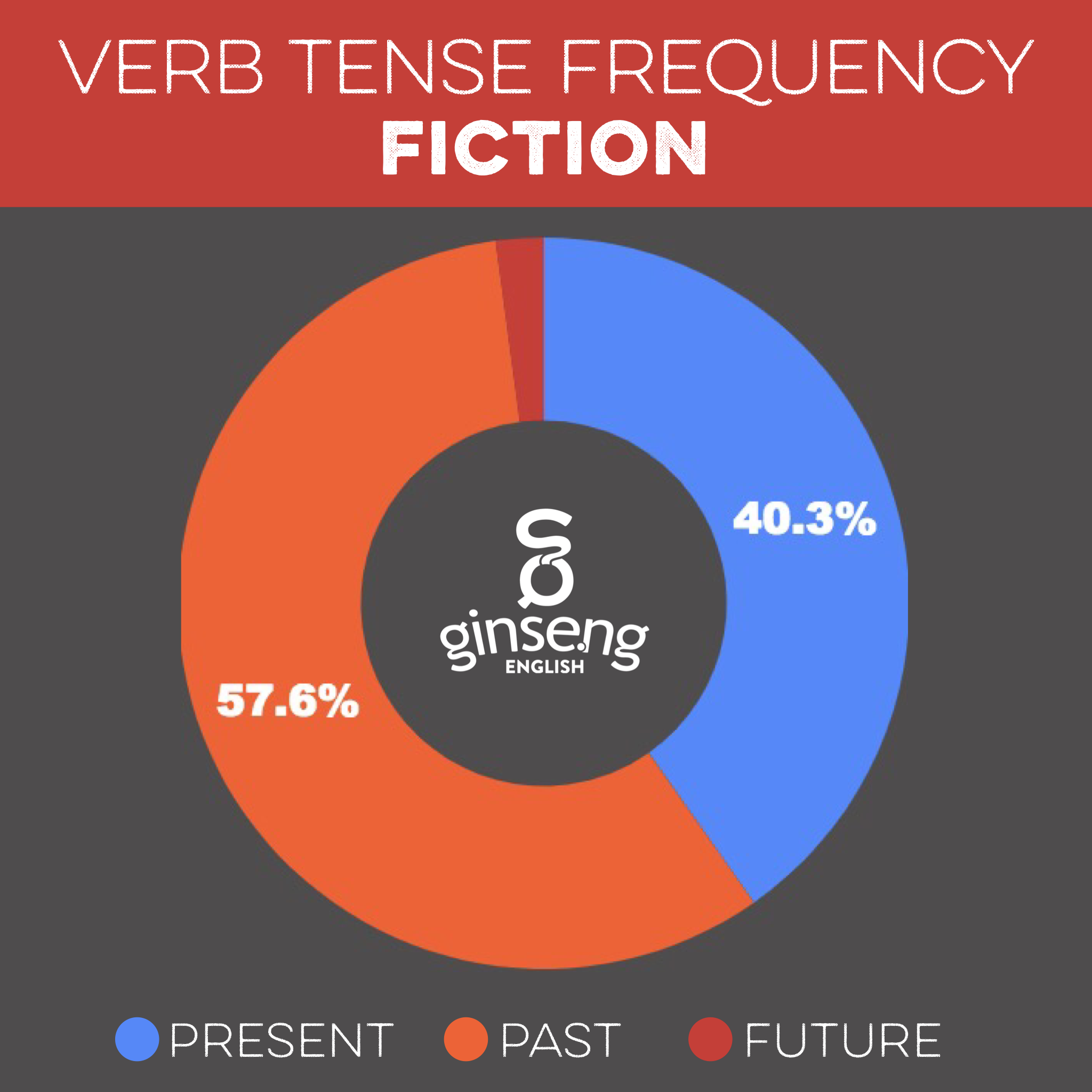

As you can see, there are some big differences between different text types. Spoken English is mostly in the present tense (68.9%), but fiction is mostly past tense (57.6%). Specialized texts overwhelmingly use the present tense (87.1%).
This makes a lot of sense. In fiction, we generally tell stories that take place before: first this happened, then that happened, then that happened. When we speak, though, we talk a lot more about what we think and feel and like, what we do, who people are, our experiences and all of these things are expressed in the present tense. In specialized texts, we are often writing about things that are generally true, and here again, we use the present tense a lot.
The future tense is less used in all text types: 9% in speech, 2% in fiction, and 4% in specialized texts.
This table breaks down each tense by frequency in all three text types:
| Tense | Speech | Frequency | Specialized |
|---|---|---|---|
| Present | 68.9% | 40.3% | 87.1% |
| Past | 22.4% | 57.6%% | 8.7% |
| Future | 8.7% | 2.1% | 4.3% |
Verb Aspect Frequency
The tenses are easy enough—past, present, future—but the really tricky thing about learning English verbs is the four aspects: simple, progressive, perfect, and perfect progressive. Thankfully, there isn't as much difference between the different styles of English when it comes to aspect. Take a look:

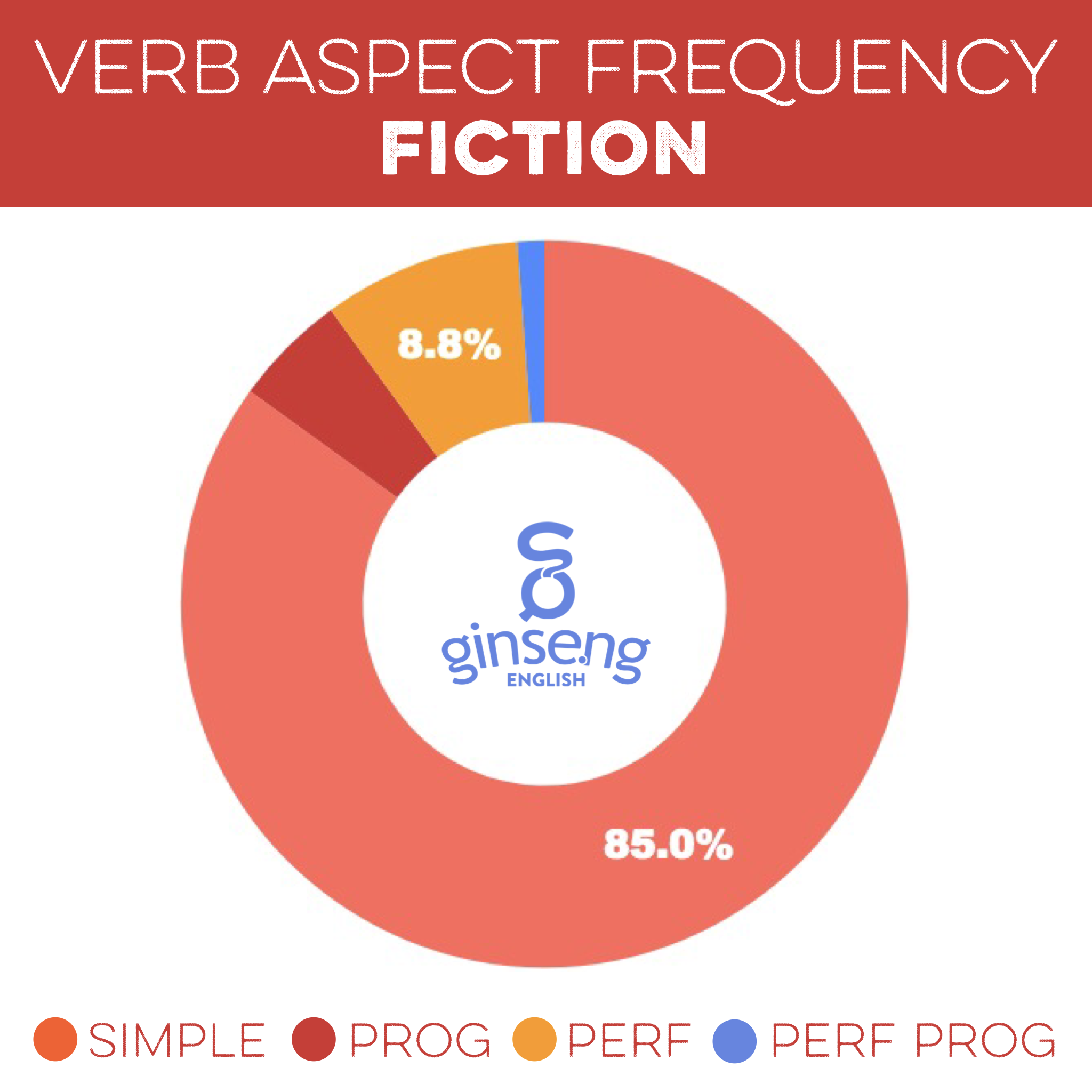
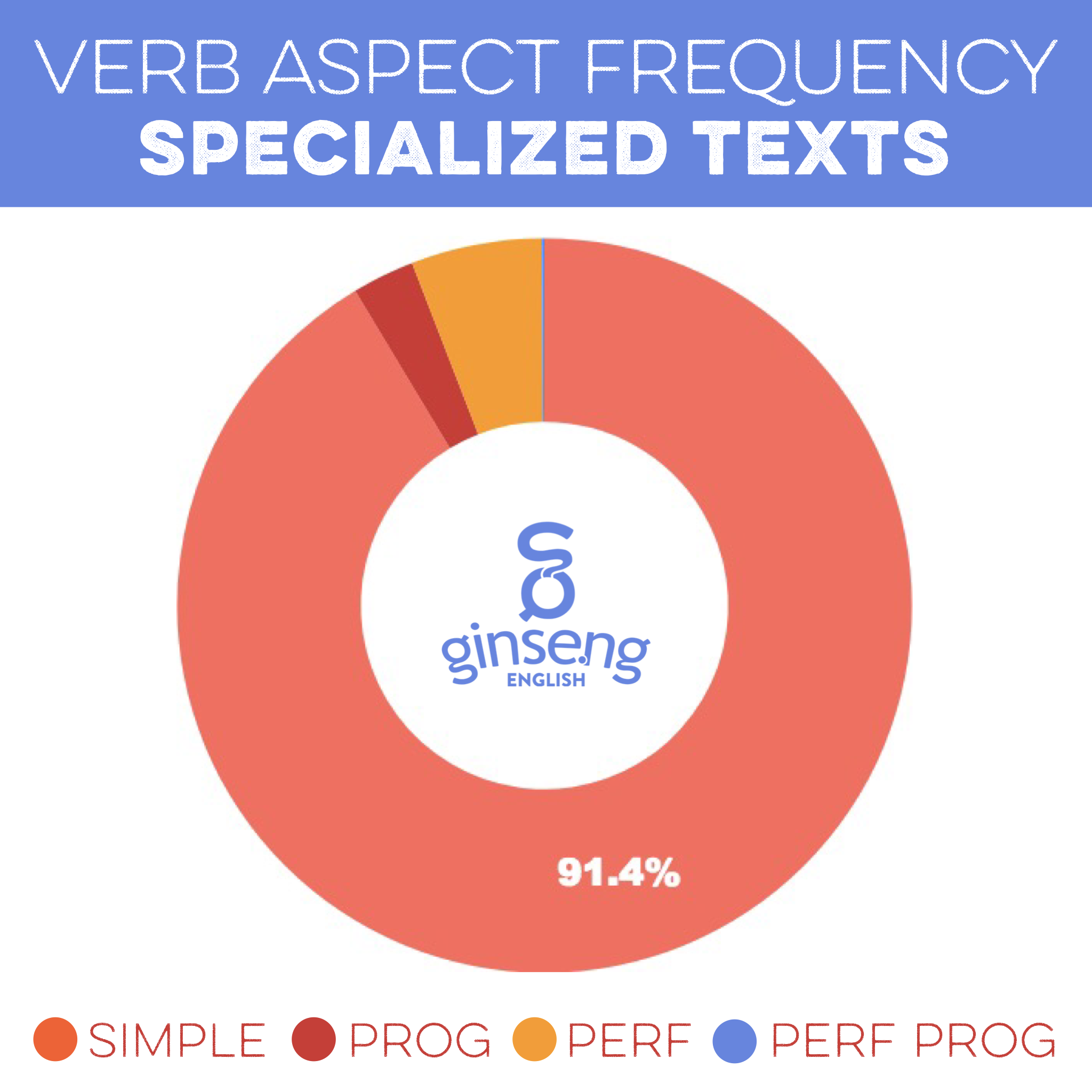
The charts look generally the same. In every style of English, the simple aspect—simple present, simple past, and simple future—makes up over 85% of verbs that we use. The lesser-used aspects all fall in the same order: after simple, it's perfect, then progressive, then perfect progressive gets a tiny little sliver of use. Biber and Reppen (2002) confirm this pattern, observing that the simple aspect is “more than 20 times as common as progressive in conversation.” (p. 204, cited in Alzuhairy (2016).
Alzuhairy (2016) studied academic texts in particular. The same general pattern applies, but simple present only accounts for about 50% of verbs in Alzuhairy’s findings.
Most Used Tenses and Aspects
5 verb forms make up 96% of all verbs in spoken English.
I think this may be one of the most useful insights from Krámský's work for teachers and students. Although there are 12 tense/aspect combinations in English, 5 of these cover around 96% of spoken English.
Notice that the simple present alone accounts for 57% of verbs. Next is the simple past (19.7%), then simple future (8.5%), followed by present perfect (6.0%) and then present progressive (5.1%). If you want to know which verb tenses to learn first, these five will definitely give you the most bang for your buck!
The remaining 7 tense/aspect combinations are each under 1.5% of spoken English verbs. Of course, it is valuable to learn all the combinations, but if you want to prioritize the most useful verb tenses, this should be helpful.
Active and Passive Voice
The passive voice is another of those constructions that challenges students and leads to the question, how useful is this? Well, again, Krámský's work gives us some idea how useful they are. Here is a breakdown of active and passive constructions in the three registers:
The vast majority of verbs in English are in the active voice.
It is not surprising that the vast majority of verbs are active. The most important takeaways that I see are these: 97.5% of verbs in spoken English are active, but the passive voice is much more common in specialized and academic texts, in which only 82.2% of sentences are active.
Complete Table of Most Used Verb Tenses in English
| # | Tense | Frequency |
|---|---|---|
| 1 | Simple Present | 57.51% |
| 2 | Simple Past | 19.7% |
| 3 | Simple Future | 8.5% |
| 4 | Present Perfect | 6.0% |
| 5 | Present Continuous | 5.1% |
| 6 | Past Continuous | 1.4% |
| 7 | Past Perfect | 1.2% |
| 8 | Present Perfect Continuous | 0.7% |
| 9 | Future Perfect | 0.2% |
| 10 | Future Continuous | >0.1% |
| 11 | Past Perfect Continuous | >0.1% |
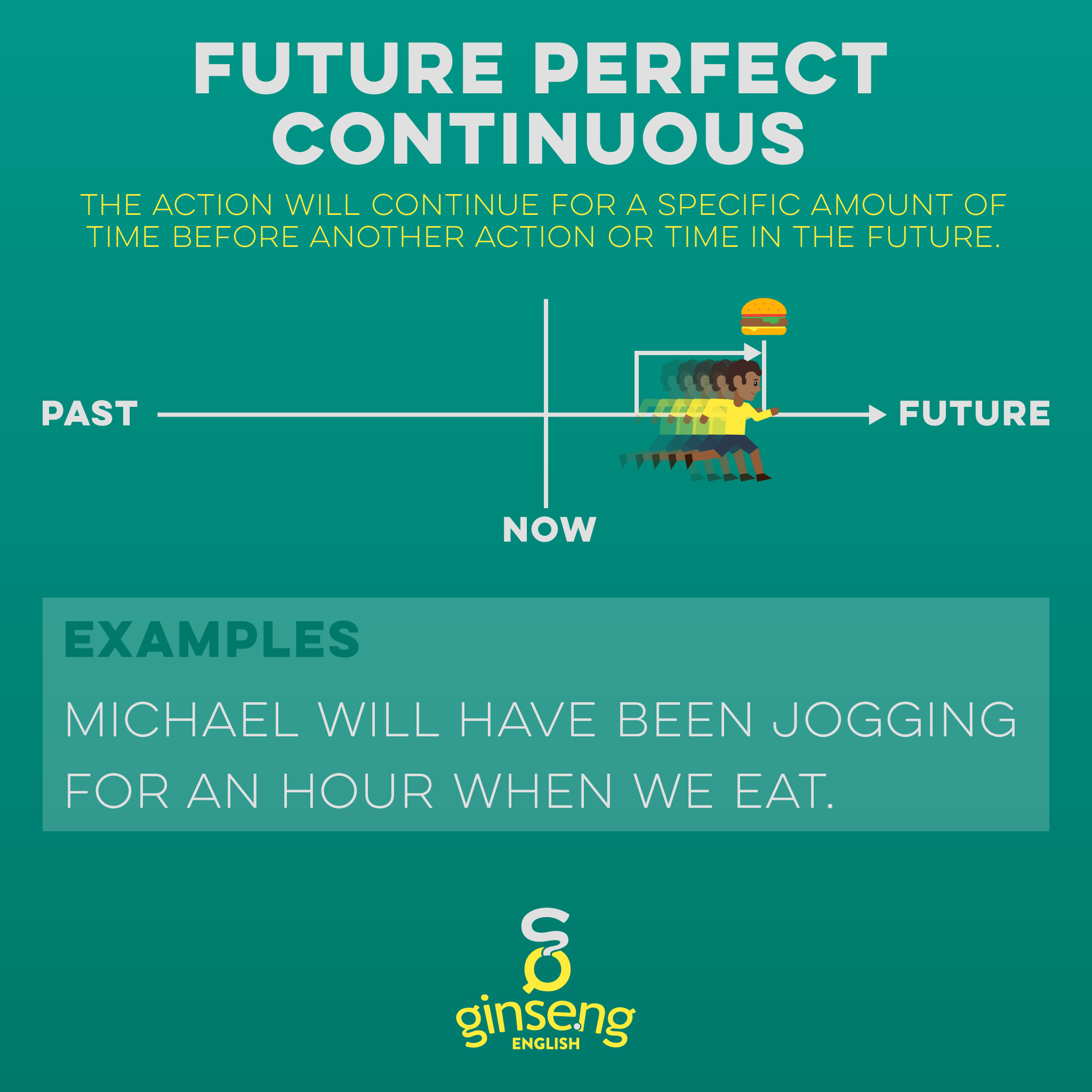
| 12 | Future Perfect Continuous | >0.1% |
More free grammar resources:

How Many Verb Tenses Are There?
Sixteen verb tenses in English? Twelve verb tenses? Three verb tenses? Only two verb tenses? This article will explain the various answers you may find to the question, How many verb tenses are there in the English language.
The English verb tense system can be really intimidating for learners. The different verb tenses and aspects really are tricky, but it can be difficult even to get an answer to a simple question: How many verb tenses are there in English?
Below we will discuss the various answers to this questions that you might find to this question and a brief explanation of each.
2 Verb Tenses in English
Occasionally you might hear someone say “technically, there are only two verb tenses in English.” This is not a very helpful answer if you are learning English, but let’s talk about what they mean when they say this.
When someone says that there are only 2 tenses in English, they are referring to morphological tense, that is, tense that can be expressed in a single word, by adding a suffix. In this case, the verb tenses are the present tense and the past tense. Because we talk about the future in English using will or going to—that is, we use helping verbs, rather than changes to the form of the main verb—the way we express the future in English does not meet the definition of morphological tense.
For some linguists, this is a valuable distinction. For English learners, it is not helpful.
3 Verb Tenses
Many English teachers will answer that there are 3 verb tenses. In this case, we are thinking of the three time frames in which an action can take place. By this definition, the three verb tenses are:
Past Tense
Present Tense
Future Tense
If you are talking about tenses in particular (not aspects) then the most useful answer for English learners is that there are three verb tenses.
12 Verb Forms
The answer that we think is most helpful for English learners is that there are 12 verb forms. More precisely, these are not 12 verb tenses but 12 combinations that can be produced by combining the 3 verb tenses and the 4 verb aspects.
16 Verb Tenses

One other answer that you will see sometimes is that there are 16 tenses. This response includes the 12 tense/aspect combinations mentioned above, as well as the 4 future-in-the-past constructions:
Future in the Past
Future Continuous in the Past
Future Perfect in the Past
Future Perfect Continuous in the Past
These are not generally treated as verb tenses in English, although they are tenses in other languages.
24 Verb Tenses
If you find a website that claims there are 24 verb tenses in English, this is wrong. They are probably confusing verb tenses with grammatical voice. You can transform each of the 12 verb forms into both passive and active voice, but grammatical voice is importantly difference from tense.
Past Perfect Continuous Tense
The present perfect continuous is an important verb form for talking about recent events and their durations. Read about the rules for using the present perfect continuous tense, how we form it, and tons of example sentences!
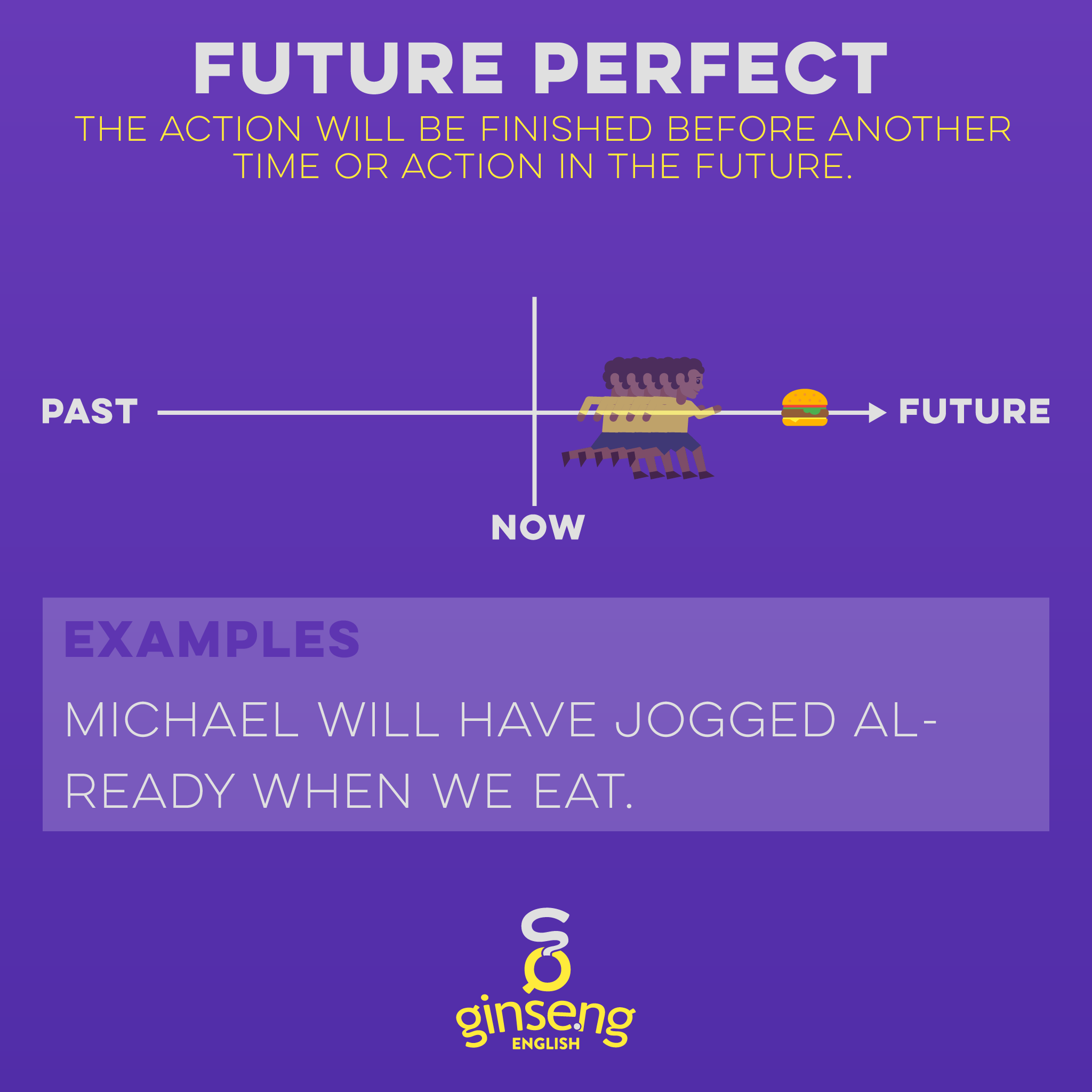
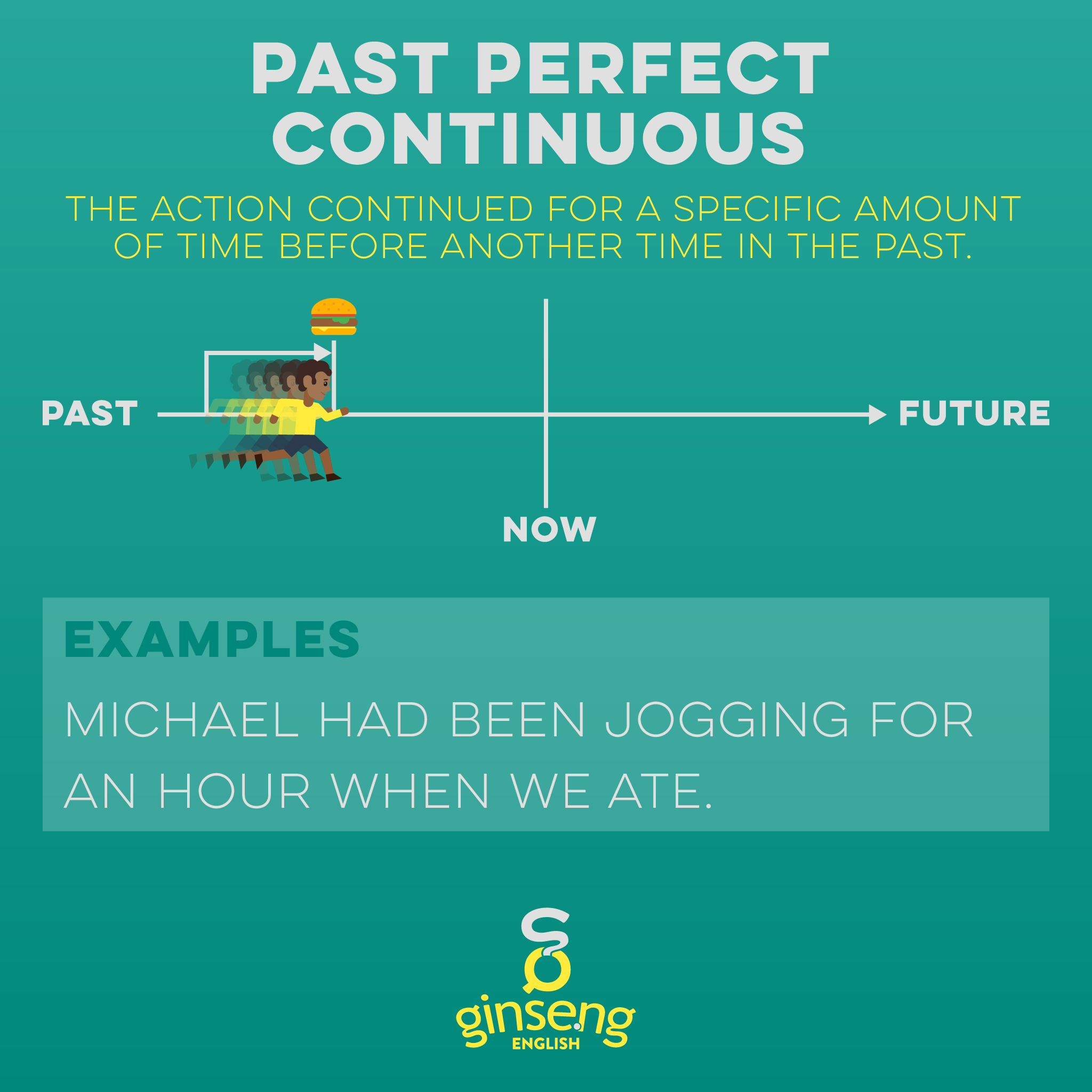
The past perfect progressive shows that an action started in the past and continued up to another time or action, also in the past. It does not specify if the action continues after that point. This is a very uncommon verb form: less than .1% of verbs in spoken English are in this form.
Continue reading to learn how to form the past perfect continuous and when to use it, including loads of examples and charts!
Just to be clear, continuous and progressive are just different names for this same thing. In some countries, one word is more common, but continuous is more common around the world, so we use that!
Chart for Past Perfect Continuous Tense in English

Using the Past Perfect Continuous Tense in English
The past perfect continuous is really difficult. Lots of websites will claim to explain this tense in just a quick article, and this just isn’t possible (sorry!). We use this verb form in a few different situations, and it can have different meanings depending on the situation. Here are some examples:
We were wet because it had been raining for hours.
I knew the city well at that point because I had been living there for a few years..
When I met your mom I was in pretty good shape because I had been working construction
Note that these correspond pretty closely with the different ways that we use the present perfect continuous form:
Recently Completed Actions
Actions Still Happening (with for/since)
New Routines and Habits
The past perfect continuous is basically the same, except shifted into the past time frame.
It is worth mentioning that, in many situations the past perfect and past perfect continuous are interchangeable.
Here are a few more examples:
That had been a difficult month. She had been working long hours.
I’d been going to the gym a lot back then.
We’d been cooking at home more at that point.
Forming the Past Perfect continuous
Formula
Forming the past perfect continuous isn’t difficult. You will always use the same formula:
had + been + VERBing
You could also think of it as simple steps, too:
First, use had (this is the past part)
Then use been (this is the perfect part)
Then use your main verb with -ing (this is the continuous part)
Conjugation
Here is the verb work conjugated into the past perfect continuous.
| Singular | Plural | |||
|---|---|---|---|---|
| 1st person | I | had been working. | we | had been working. |
| 2nd person | you | had been working. | you | had been working. |
| 3rd person | he | had been working. | they | had been working. |
| she | had been working. | |||
| it | had been working. | |||
Notice that we can see both the perfect and the continuous aspect in this form. Had been is the perfect aspect. Been verb-ing is continuous aspect.
Other Forms of the past Perfect continuous
Negative Sentences
You always have two helping verbs in the past perfect continuous: had and been. To make a negative, simply make it had not been.
I had not been practicing for very long.
I had not been living in Boston for years, and I missed it.
I had not been studying, so I was doing poorly in school.
Because the past perfect continuous uses so many words, we often use contractions with not to make it a little shorter:
I hadn't been practicing for very long.
I hadn't been living in Boston for years, and I missed it.
I hadn't been studying, so I was doing poorly in school.
Questions
To make a question, put had before the subject:
Why did they break up? Had he been cheating?
How long had the car been running for when it finally died?
Why had you been studying Chinese if you were planning to move to France?
Passive Voice
Making passive sentences with rarer and more complicated verb forms like the past perfect continuous is extremely uncommon and almost always a bad idea. We really recommend that you rephrase a sentence to avoid creating such an awkward sentence.
They had been being observed a lot at work.
Hopefully you can see how awkward this sentence is. If you really need to make a passive sentence in this form, you should use the get passive to avoid the awkward combination of been and being.
Put get in the past perfect continuous (had been getting) and then the perfect form of the main verb.
We had been getting observed a lot at work lately.
I'd been getting kicked off the internet every 5 minutes.
check out these other free grammar resources:

Present Perfect Continuous Tense
The present perfect continuous is an important verb form for talking about recent events and their durations. Read about the rules for using the present perfect continuous tense, how we form it, and tons of example sentences!
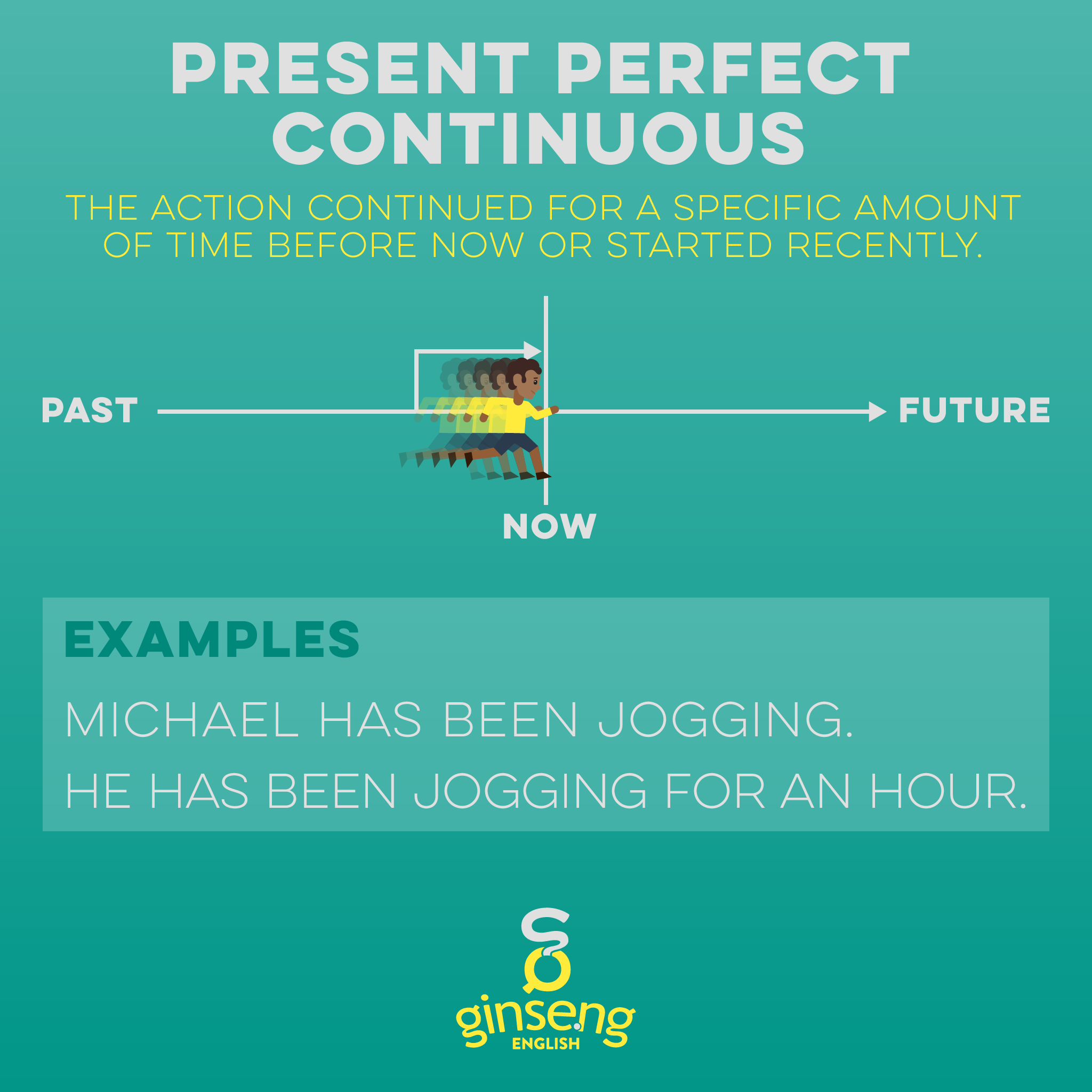
The present perfect continuous (also called the present perfect progressive) is a verb form that we use to describe an action that started in the past and either recently finished or is still continuing. Although only about .7% of verbs in speech are in the past perfect, this verb tense can be very useful in certain situations.
Continue reading to learn how to form the present perfect continuous and when to use it, including tons of examples and charts!
Just to avoid confusion, continuous and progressive are just different names for this same thing. In some countries, one term is more common than the other, but continuous is more common overall, so we use that term.
Chart for Present Perfect Continuous in English

Using the Present Perfect Continuous Tense in English
The present perfect continuous is a little bit tricky. If you find a website that claims to explain it in just a few sentences, you should be suspicious. We use this tense in a number of different situations, and it can have different meanings in those different situations. We can look at three common ways that the present perfect progressive is used:
to describe new routines,
to describe recently completed actions, and
for actions that are still continuing.
New Routines and Habits
In general, we use the simple present to talk about routines and habits: If I go jogging every day or a couple of times a week, I can simply say, I jog, right?
But what if this is a new habit? Maybe I have gone jogging every day for the past two weeks, so it is a routine, but it might feel funny to just say I jog. I am a jogger. In situations like this, where we want to demonstrate that a habit or routine is somewhat new, the present perfect continuous is the form that we want to use.
I have been jogging.
Here are a few more examples:
This has been a difficult month. She has been working long hours.
I’ve been going to the gym lately.
We’ve been cooking at home more recently
Recently Completed Actions
We also use the present perfect continuous to talk about actions that have just recently ended, especially when there is still evidence of that action. For example, after you paint, you may still have paint on your hands. To explain this, you would use the present perfect progressive:
Sorry, my hands are dirty. I've just been painting.
Take a look at these other examples:
The house is a mess because we've just been redecorating.
Sorry, I'm all sweaty. I've been exercising.
Why are you two crying? Have you been fighting?
Notice that in each of these examples, there is sensory evidence (the mess, sweating, crying) of the recently completed actions (painting, exercising, fighting). This is almost always the case when using the present perfect continuous in this way.
Actions Still Happening with For and Since
This is probably the most common way that this verb form is used. This is very important: When we see the present perfect continuous with for or since, the action started at a specific time in the past and is still happening. Here are some examples:
Michele has been living in Boston since June.
Juana's been writing her thesis for 6 months.
In the first example, Michele still lives in Boston. In the second example, Juana still works at Apple. Again, when you see for or since with this verb tense, the action or situation described by the main verb is still continuing. See Signal Words, below, for more information about how we use for and since.
Here are more examples with for and since:
Cara's been working at FedEx for 3 years now.
I've been thinking about changing jobs for a long time.
We've been developing a new strategic plan since late last year.
You have been traveling back and forth to California since you got married, right?
Forming the Present Perfect continuous
Formula
Forming the present perfect continuous isn’t difficult. You will always use the same formula:
have/has + been + VERBing
You could also think of it as simple steps, too:
First, choose either have (if the subject is plural or the pronouns I, you, we, or they) or has (if the subject is a singular noun, he, she, or it).
Then use been.
Then use your main verb with -ing.
Conjugation
Here is the verb work conjugated into the present perfect continuous.
| Singular | Plural | |||
|---|---|---|---|---|
| 1st person | I | have been working. | we | have been working. |
| 2nd person | you | have been working. | you | have been working. |
| 3rd person | he | has been working. | they | have been working. |
| she | has been working. | |||
| it | has been working. | |||
Notice that we can see both the perfect and the continuous aspect in this form. Have been is the perfect aspect. Been verb-ing is continuous aspect.
Other Forms of the Present Perfect continuous
Negative Sentences
You always have two helping verbs in the present perfect continuous: have/has and been. To make a negative, simply put not in between them!
She has not been living here for a long time.
I have not been reading much recently.
They have not been working late.
Because the present perfect continuous uses so many words, we often use contractions with not to make it a little shorter:
She hasn't been living here for a long time.
I haven't been reading much recently.
Questions
To make a question, simply put has/have before the subject.
Has she been living here for a long time?
Have you been working out lately? You look great!
What have you been reading?
When have you been going to bed lately?
Passive Voice
Making passive sentences with more complex verb forms like the present perfect continuous is extremely uncommon and almost always awkward in English. We really recommend that you rephrase a sentence to avoid creating such an awkward sentence.
We have been being observed a lot at work.
See the awkwardness in the sentence above? If you really need to make a passive sentence in this verb form, we often use the get passive to avoid the unnatural combination of been being.
Put get in the present perfect progressive (has been getting, have been getting) and then the perfect form of the main verb.
We have been getting observed a lot at work lately.
I've been getting kicked off the internet every 5 minutes.
Signal Words
Recently or Lately
When we are talking about new routines and habits, it’s common to use the word recently or lately, which both have the same meaning in this sense. There is some flexibility in where we can put these words in a sentence, but the beginning or end of the clause is a safe bet.
Take a look at these examples:
Lately, I've been thinking a lot about Aunt Maude.
We've been having second thoughts about moving recently.
Just
We can use the adverb just to emphasize that an action was completed in the immediate past, right before now. Because the present perfect continuous can talk about actions that stopped right before now, it is common to use just with it. Have a look at these examples:
Don't mind these ridiculous old clothes. I've just been gardening.
Hey Paul! I can't believe you're here. We've just been talking about you!
For
We already said, the most important signal words with the present perfect progressive are for and since. They are important because they change the meaning. Whenever you see for and since with this verb form, you know the action is still true.
When we use for, we specify the duration of the action. This could be the number of minutes or weeks or years. It could also be a more general phrase like a really long time or a little while.
People have been living on this land for thousands of years.
It's been raining for hours
I've been studying English for half my life!
Since
While for is used with a duration, since is used to specify the point in time when the action began. That could be a time or date. It can also be another event described with a clause, like since I was a child.
People have been living on this land since about 800 B.C.E.
It's been raining since noon.
I've been studying English since I was a child.
check out these other free grammar resources:
Past Perfect Tense
The past perfect is an important verb form for describing events in the past. Read about the rules for using the past perfect tense, how we form it, and tons of example sentences!
The past perfect is a verb form that we use to talk about an action that is complete before another action or event in the past.
It isn't one of the most common verb tenses in English (only about 1.2% of verbs in speech are in the past perfect), but it can be very important for narrating events in the past.
Chart for Past Perfect Tense in English
Using the Past Perfect Tense in English

Perfect verb forms are generally used to show that an action or situation is complete before another action or a point in time. In the past perfect, that one action happened before another action in the past. For this reason, we sometimes say the past perfect is “the past of the past.”
Here's an example:
Carla had already eaten when we arrived at her house.
There are two actions here: eating and arriving. Eat is in the past perfect, and arrive is in the simple past, so we know that the eating was completed first. When you have two verbs in a sentence, one in the simple past and one in the past perfect, the past perfect action finished before the simple past action.
The examples below illustrate the rules for how we generally use the past perfect tense.
Examples of the Past Perfect tense
First let's look at how we often use the past perfect in a sentence with other past tense verbs:
I had just left my house when it started to rain.
Notice that we have two clauses and two verbs. Started is in the simple past: it started and finished in the past. Left is in the past perfect (had left) which means that the action (leaving) was complete before the other action (starting to rain).
Sometimes there are two verbs in the same sentence, like in the example above, but not always. Look at this conversation:
Te: Hey, I called you last night, but you didn’t answer!
Banh: Oh, I went to bed pretty early last night. What time did you call?
Te: I think it was around 9.
Banh: Yeah, I had already fallen asleep.
In this example, the verb in the past perfect is had fallen asleep. We know that past perfect means this action was complete before another action or point in time in the past. In this case, we have both an action (Te called) and a time (around 9).
Forming the Past Perfect
Formula
Forming the past perfect is easy. We use had (the past form of the helping verb have) and the perfect form of the main verb.
subject + had + perfect VERB
Conjugation
This table shows the complete conjugation of the verb work in the past perfect.
| Singular | Plural | |||
|---|---|---|---|---|
| 1st person | I | had worked. | we | had worked. |
| 2nd person | you | had worked. | you | had worked. |
| 3rd person | he | had worked. | they | had worked. |
| she | had worked. | |||
| it | had worked. | |||
Other Forms of the Past Perfect
Negative Sentences
The helping verb in the past perfect is always had.To make a negative, put not after the helping verb had.
I had not studied French before I went to Morocco.
They had not seen each other for years.
I hadn’t eaten all night so I was starving.
Questions
To make a question, put had before the subject.
Had they dated long before they got married?
Had you expected the promotion?
Why had she bought so many extra tickets?
How long had you lived in San Francisco by then?
Passive Voice
To make a passive sentence in the past perfect, use be in the past perfect (had been) and then the perfect form of the main verb.
By 1945, the war had been won.
I had been fired, so I felt really depressed.
In the morning we learned that Kiki had been found by the neighbors.
Signal Words
The past perfect is often used with time words such as before, until, previously, etc. One word that is very common (and sometimes confusing!) with the past perfect is by.
We can use by with a specific time to show the completion of the action before that time.
By 1:00, everyone had left the party.
In this example, all the people left before 1:00.
The time isn't always a number, as these examples illustrate:
By dawn the rain had stopped.
By the end of the semester, she had completed all her prerequisites.
By then, I had figured out the solution.
By the time has a similar meaning, but it is used with a clause describing another action, rather than a time.
By the time I got home, everyone had gone to bed.
It had gotten dark by the time we finished eating.
Check out these other free grammar resources:
Simple Present Tense
The simple present is the most common and useful verb tense in English. It is used to talk about repeated actions and to describe people or states of being. Read about the rules for using the simple present tense, how we form it, and tons of example sentences!
One of the most important parts of English grammar is verb tenses, and the simple present tense (also known as present simple or present indefinite) is the most common verb tense in English. Over 50% of verbs in English are in this tense, so it's a really important tense to learn. It is used for several different situations.
Using the Simple Present Tense
The simple present can describe actions that happen regularly. This means things we do again and again, things we do every day, every week, every month. This can be routines and habits, and also things that are currently, always, or generally true.
Simple Present Verb Chart

This form is also used to describe feelings, emotions, and our senses. We can also use it for describing people and things in English.
It is important to note that we do not generally use this tense for actions that are happening right now. For this situation we use the present continuous tense. See this article about the difference between simple present and present continuous/progressive.
The examples below illustrate the rules for how we generally use the simple present.
Examples
Here are twelve example sentences showing different ways that we can use the simple present tense:
To state facts:
The earth moves around the sun.
Birds have wings.
Your mother's mother is your grandmother.
To describe habits and routines:
I wake up at 7:00.
I brush my teeth every day.
I take my vacation every August.
To describe people and things:
She has brown hair.
That car is red.
Sally is tall
To describe feelings and opinions:
She is angry.
We are cold.
I smell cookies.
Sarah loves movies.
Forming The Simple Present Tense
Formula
Regular verbs in English take the base form of the verb (the infinitive without to, sometimes called first verb form).
subject + VERB
The exception is the third person singular (he, she, and it), which add an -s.
subject + VERBs
If the word ends in -ch, -sh, -th, -ss, -o, or -z, you usually have to add -es.
Conjugation
The table below shows the verb to work conjugated in the simple present tense.
| Singular | Plural | |||
|---|---|---|---|---|
| 1st person | I | work. | we | work. |
| 2nd person | you | work. | you | work. |
| 3rd person | he | works. | they | work. |
| she | works. | |||
| it | works. | |||
If you don’t know the words I, he, she, it, we, you, and they, you can read more about pronouns.
Other Forms
Negative Sentences
If the main verb is a form of be, simply put not after the verb to make a negative sentence.
That is not pork.
I’m not Rebecca.
If the main verb is not a form of be, use the helping verb, do (or does), then not, then the base form of the verb.
He does not like cheese.
I do not have a lighter.
She doesn’t live near here.
Questions
Many simple present questions use the verb be. If the verb is a form of be, move the verb to before the subject to form a question:
Are you Rebecca?
Is this pork?
Where are you?
What is that?
If the main verb is not be, we need to use a helping verb to make questions. In the simple present, the helping verb is do (or does with he, she, or it).
Does he like cheese?
Do you have a lighter?
What do you think?
Where does she live?
Passive Voice
To make a passive sentence, use be in the simple present (is/are), and then the perfect form of the main verb.
Pineapples are grown in Hawaii.
Ice cream is made with milk.
The New York Times is read around the country.
Notes
Adverbs of frequency are often used with the simple present tense