
Gerunds
Need to know what a gerund is? You've come to the right place!
gerunds in English
There are three common functions for -ing verbs:
participial adjectives
gerunds.
Let’s look at gerunds in a little more detail about gerunds.
We like to think a verb is a verb, and an adjective is an adjective, and a noun is a noun right? That would make sense. But by now you probably know that English doesn't always make sense!
Form vs. Function
Words can have both a form and a function. For a simple example, think about the word dog. A noun, right? But what about in the sentence Pablo bought some dog food? Here dog is describing the type of food. It works like an adjective. The form is a noun, but the function is an adjective.
So...What exactly is a gerund?
A gerund has the form of an -ing verb, but it functions is like a noun. That is, it does things that a noun usually does. What do nouns usually do? Often they work as subjects, direct objects, or objects of prepositions in sentences. And gerunds can do the same.
Take a look at these examples:
Rowing is hard work!
Clara loves sewing.
I'm thinking about going on vacation.
In the first sentence, rowing is the subject. In the second, sewing is the direct object of love. And in the third, going is the object of the preposition about . Notice that, even though the form of thinking looks like a gerund, it is not. It is a present progressive (or present continuous) verb.
So, one more time: a gerund is a verb ending in -ing that works like a noun, as a subject or object in a sentence.
If you've found this helpful, please share!

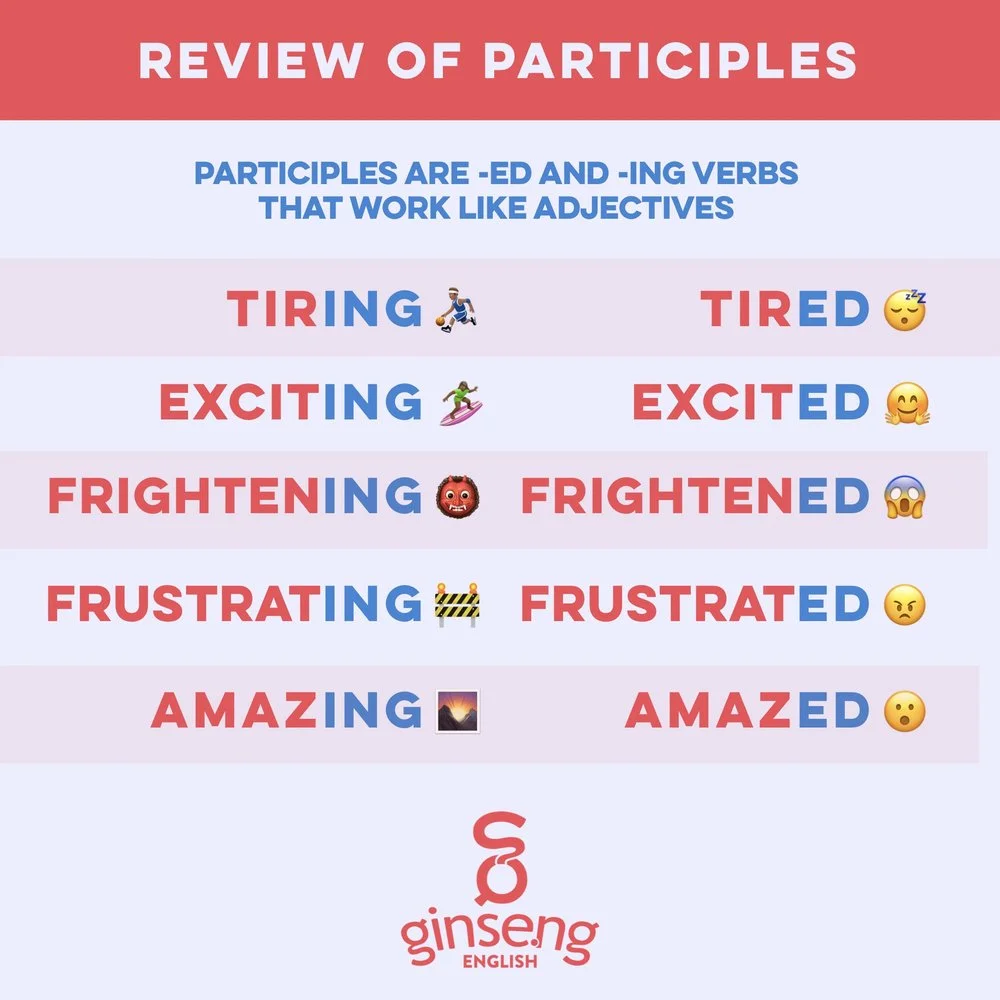
Review of Participles
Remember:
Participles (or participial adjectives) are verbs with -ED and -ING endings that can work like adjectives, describing people and things.
-ED participles (past participles) usually describe how we feel, as in, "I feel exhausted."
-ING participles (present participles) usually describe things that make us feel that way, as in, "That hike was exhausting."
If you found this Ginseng English tip helpful, please share with #ginsenglish and follow @ginsenglish on Twitter, Instagram, and Facebook! Also, consider signing up for our online English courses!
