
This post teaches basic English vocabulary for describing our closest family members. Lots of examples and images!
Learn English for free online with the Ginseng English blog!
This post teaches basic English vocabulary for describing our closest family members. Lots of examples and images!
We have to make decisions every day, but sometimes it’s so hard to just make up your mind! If you’re on the fence about a big decision, then these idioms might help your thought process! (Or at least help you procrastinate making a difficult decision😂)
They say some friendly competition never hurt anyone. In fact, sometimes, people even thrive on a little competition! If you’re one of these people, these idioms about competition might come in handy…
Today we bring you a variety of English idioms featuring black and white images to help you visualize the meanings, along with sample sentences and definitions!
The simple present tense and present continuous tense can be difficult for English learners. This article explains the differences in how we form and use these two tenses.
The time has come for Americans to kiss summer goodbye and welcome fall (also known as autumn). Here are some idioms about the fall season!
Adverbs are an important part of speech in English. Just like adjectives describe nouns, adverbs are words that describe verbs. There are of course many different ways we can describe a verb. We can talk about how something happens, why it happens, when it happens. Adverbs of frequency tell us how often—or how frequently—an action happens.
Some of the most common adverbs of frequency are shown in the image. It is very common for teachers and textbooks to show adverbs of frequency with percentages next to them to explain their meaning; for example: 80% of the time = usually. Be careful. It is important to note that these can only be very rough estimates. It is more useful and accurate to say that usually is more than sometimes but less than always. The exceptions are always, which means 100% of the time, and never, which means 0% of the time.
Adverbs of frequency often describe habits, routines, and repeated actions, so they are frequently used with the simple present tense.
It is sometimes difficult to know where to put adverbs of frequency in a sentence. When describing a simple verb tense, with no auxiliary verbs, adverbs of frequency generally come between the subject and the verb. Look at these examples:
We never travel in the fall.
Lydia generally takes the train to work.
They sometimes have wine with dinner.
The exception to this rule is when the main verb in the sentence is to be. If the sentence is a subject + BE + noun or subject + BE + adjective sentence, put the adverb of frequency after be.
Munir is always late.
This is never a good sign.
We are usually the first ones in line.
The adverbs often, sometimes, generally, frequently, usually, and typically can go at the beginning of a sentence, as you can see here:
Generally Lydia takes the train to work.
Sometimes they have wine with dinner.
Usually we are the first ones in line.
Note that no comma is necessary when an adverb of frequency starts a sentence.
It is also possible to put these same adverbs at the end of a sentence, though this is more common in spoken English than in writing:
Lydia takes the train to work generally
They have wine with dinner sometimes
We are the first ones in line usually
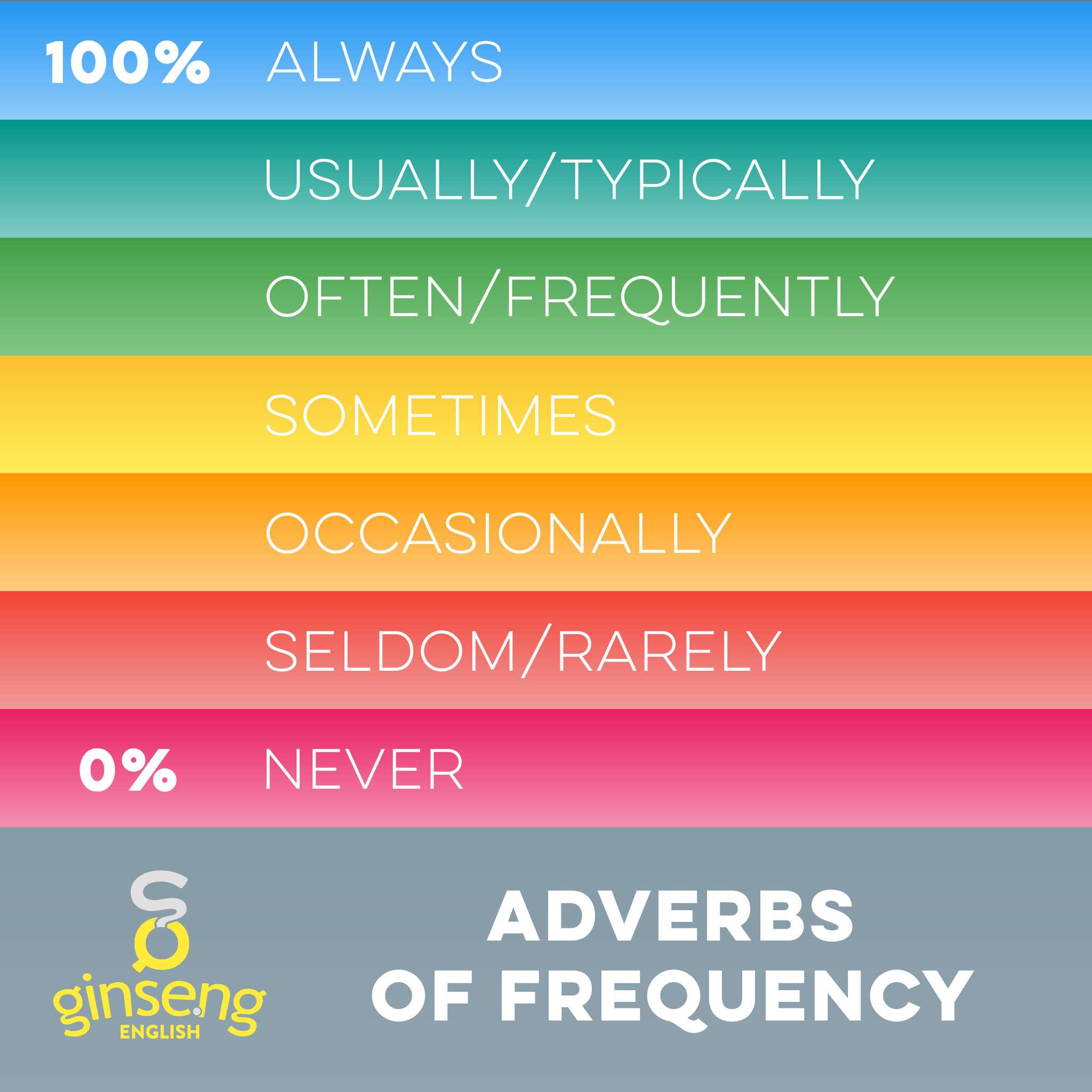
Chart Showing Common Adverbs of Frequency
The present perfect continuous is an important verb form for talking about recent events and their durations. Read about the rules for using the present perfect continuous tense, how we form it, and tons of example sentences!
Podcasts are not only a great way to enjoy a car ride with friends, make a task like cleaning the kitchen more bearable, and help pass a long bus ride. They are also a great way to learn English!
Learning English online isn't easy, and your best options are generally actual online classes with real teachers, but Twitter does have some great ESL accounts you can follow to help improve your English in 280 characters! Here's a list of our favorites.
The past perfect is an important verb form for describing events in the past. Read about the rules for using the past perfect tense, how we form it, and tons of example sentences!
选择出国留学是一个害怕但令人兴奋的决定!如果你正在考虑到某一个国家留学,让我看看能不能帮助你做决定。我们有成百上千的理由去留学,但下面六个理由是你决定留学之前所需要考虑的。
既然你已经下定决心要出国学习,你就需要决定你想去哪个说英语的国家学习!
你可能会想,“我是不是应该去可以和袋鼠一起玩的澳大利亚?”或者“要不加拿大?贾斯丁 特鲁多很帅…”或者爱尔兰怎么样?我喜欢倒一杯吉尼斯黑啤酒 …”或者“也许美国!一个芝士汉堡现在听起来很棒!
这一切在理论上听起来都很不错,但重要的是要撇开对这些国家的刻板印象,再确定哪个才是最适合你的留学国家。让我们多谈谈如何获得你想要留学的国家的现实情况。最终,由你来决定哪个国家对你来说是最合适,但你首先要考虑以下几点。
In America, summer officially ends on September 22nd, though in many places it starts to feel like fall much earlier than that! To make sure we enjoy summer for as long as possible, here are some fun summer idioms!
The past continuous is an important and challenging verb form in English. It is used to describe actions that were in progress at a specific point in the past. Read about the rules for using the past continuous tense and how we form it, with charts and over 25 example sentences!

