
How Can I Learn English Online
The internet makes it possible to learn a language online like you never could before. But make sure you are using your time wisely! Use these five tips to help learn English as quickly and easily as possible.
1. Watch Videos
One of the best things about the internet, when it comes to language learning, is that there is more video than ever. One of the most important things you can do to learn a language is expose yourself to as much of it as possible, and with YouTube you could watch videos in English for years on end!
Turn on the English subtitles to help yourself understand and to build multiple skills at once!
2. Set Goals
Technology also helps us to track and plan our behavior. Consistency is important to language learning, and tools like Google Calendar can help us to build the regular study skills and habits that will result in faster, lasting language learning.
Google Calendar has this really cool Goals feature that is helpful for everything from exercising to learning English!
3. Communicate in Groups
Interaction is an essential part of language learning, and a whole lot of the internet is in English. This means you have a massive environment for learning and using English online. Use whatever website or social network you like! There are even Facebook groups dedicated to learning English!
4. Record Yourself
Recording yourself, watching yourself, and noting where you need to improve are great ways to develop your English. It can be uncomfortable at first, but you need to get outside of your comfort zone to develop your language! This can be especially helpful for your pronunciation!
5. Read!
It’s great that you’re reading about English, don’t forget to read in English.
Many students underestimate the importance of reading in English, but reading is essential for building your vocabulary! Spoken English is mostly just the first 2,000 words in English. You need much, much more than that to become fluent, and the more advanced words are more common in written English.
The internet is full of accessible texts in English! Get lost on Wikipedia and start building that vocabulary!

Silent E Words
English spelling is crazy but there are patterns. Silent E words follow a very common pattern. Check out this explanation with charts and over 200 of examples.
As we have established, English pronunciation is crazy, and silent letters can sometimes seem extra crazy. Silent E isn't quite as crazy as some other words. Silent N and silent B and silent K are a little useless in English.
But silent E is different. It's a very useful pattern to learn. Unlike some other letters, silent E tells us some very important information about the other vowels in the word.
C-V-C Words
Before reading on about silent E, we really recommend reviewing consonant-vowel-consonant (C-V-C) words. This article will give you a strong background for understanding how silent E works in English.
However, if you don't have time for that, the short version is this: In 3-letter words that are made of a consonant, then a vowel, then a consonant, the vowel is usually pronounced with a short vowel sound.
Silent E Words
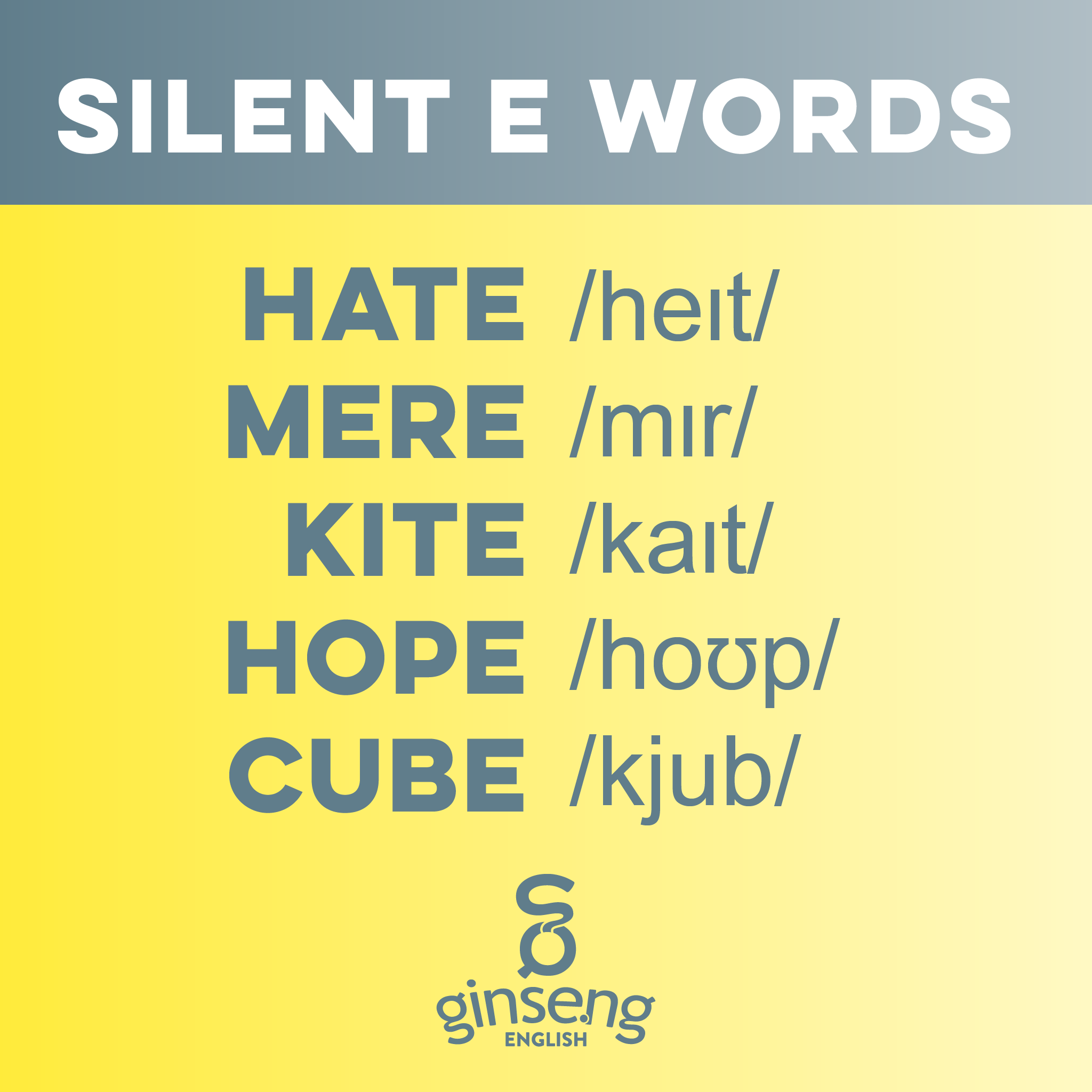
Silent E words follow the C-V-C pattern, but with an E at the end, so they become C-V-C-E words. Adding the -E at the end changes the short vowel sound to a long vowel sound.
For example:
Hat /hæt/ has a short A sound, and hate /heɪt/ has a long A sound.
Bid /bɪd/ has a short I sound, and bide /baɪd/ has a long I sound.
Hop /hɑp/ has a short O sound, and hope /hoʊp/ has a long O sound.
Adding Suffixes to Silent E Words
So when we learned about C-V-C words, we learned that you must double the last consonant. For example, rap, becomes rapped in the simple past and rapping in the present continuous. When you see an unfamiliar word with a double consonant before the suffix -ed or -ing (maybe stropped or thrumming, for example), you can safely guess that the vowel sound is short and that the base form is a C-V-C word (that is, strop and thrum).
With silent E (or C-V-C-E words), we do not double that last consonant when adding a suffix, such as -ed or -ing (or -er or -est for adjectives). Compare these examples of C-V-C and C-V-C-E words to notice the pattern:
hope ➞ hoped and hoping (no E)
hop ➞ hopped and hopping (double P)
Here's another:
pine ➞ pined and pining (no e)
pin ➞ pinned and pinning (double N)
Complete list of Silent E Words
Here are over 200 examples of silent E words:
Silent E Words with Long A
babe, bade, bake, bale, bane, bare, cage, cake, came, cane, cape, care, case cave, dale, dame, dare, date, daze, face, fade, fate, fake, fame, fare, fate, faze, gale, gape, gate, gave, gaze, hare, hate, have, haze, jade, jane, kale, lace, lake, lame, lane, late, mace, made, mage, make, male, mane, mare, mate, maze, name, nape, nave, pace, page, pale, pane, pare, pate, race, rage, rake, rape, rare, rate, rave, raze, safe, sage, sale, same, sane, sate, save, take, tale, tame, tape, tase, tare, vale, vane, vape, vase, wade, wage, wake, wane, ware, wave
Silent E Words with Long E*
cede, here, lede, meme, mere, mete, we're, we've
*see note below.
Silent E Words with Long I
bide, bike, bile, bite, cite, dice, dike, dime, dine, dire, dive, fife, file, fine, fire, hide, hike, hire, hive, jibe, jive, kite, lice, life, like, lime, line, lite, live, mice, mike, mile, mime, mine, mire, mite, nice, nine, pike, pile, pine, rice, ride, rile, ripe, side, sire, site, tide, tile, time, tine, tire, vile, vine, vise, wide, wile, wine, wipe, wire, wise, wive
Silent E Words with Long O
bode, bone, bore, code, coke, cone, cope, core, cove, dole, dope, dote, doze, fore, hole, home, hone, hope, hose, joke, lobe, lode, lone, lore, mode, mole, mope, mote, node, nope, note, poke, pole, pope, pore, robe, rode, role, rope, rose, rote, rove, sole, toke, tore, tote, vote, woke, wore, wove
Silent E Words with Long U
cube, cuke, cure, cute, dude, duke, dune, dupe, fume, huge, june, lube, luge, lure, mule, muse, mute, nude, nuke, puke, pure, rube, rude, rule, sure, tube, yule
Exceptions and notes
-ORE words do not have a long O sound. Bore, core, fore, lore, more, tore, and wore rhyme with four.
You may notice that there are very few silent E words with a long E in the middle. This is because we have many other common ways to spell the long E, such as the -EA- in dear and meal and the -EE- in seen and feet.
More Free English Resources
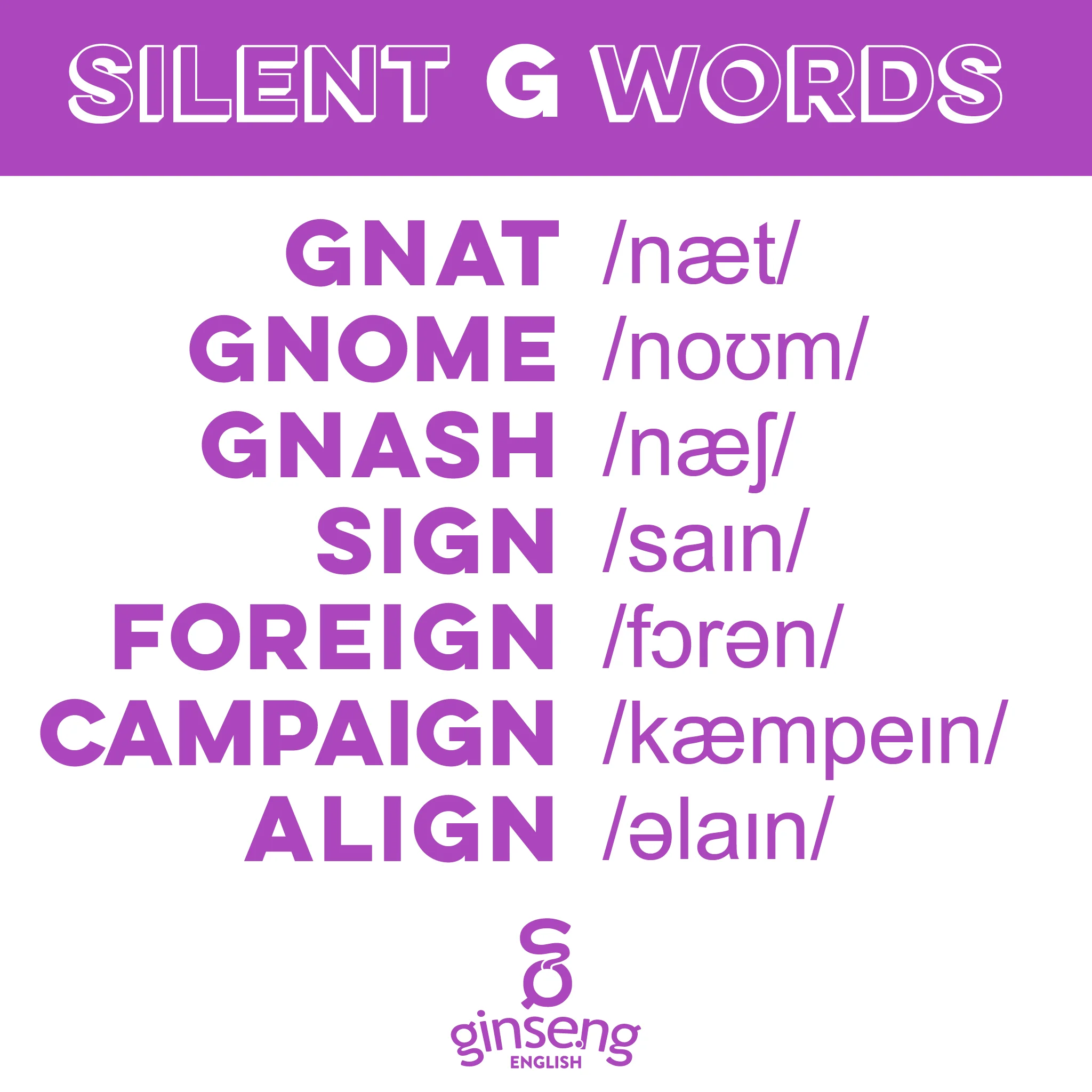
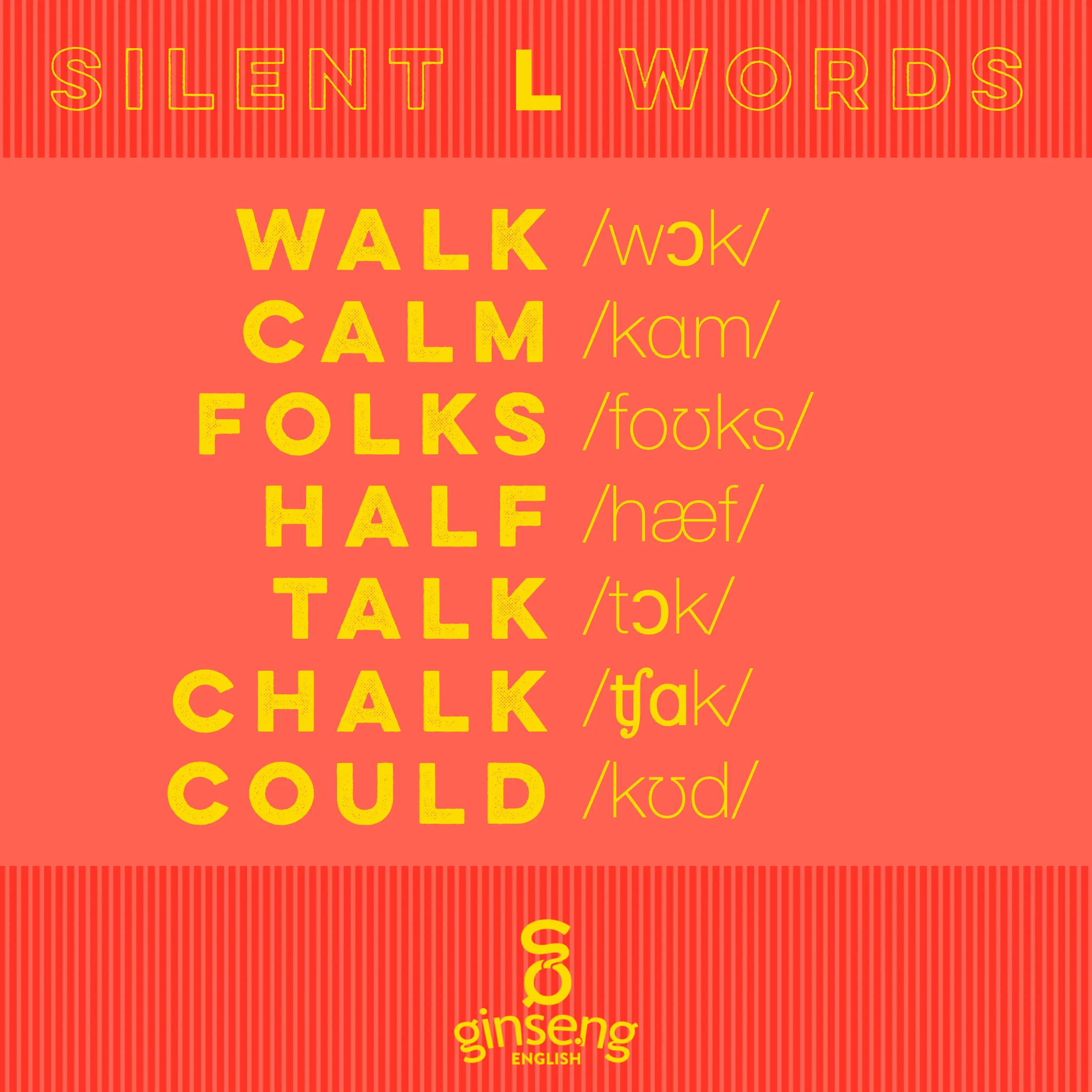
Have you read our other posts on English pronunciation? If not, take a look at Silent K, Silent N, Silent G and Silent L, and Deleted Syllables.

Silent E Words in English

5 Myths About Learning English

Learning English is tough. And it's even tougher because there's lots of bad information about what makes good education. Today, let's look at five myths—things that many people believe, but that are not true—about learning English.
1. We learn vocabulary and grammar in the order that we study.

Many students assume that there is a logical order to the English grammar items and vocabulary words that you should try to study. They think that if we arrange things from "simple" to "complex" and study them in that order, we will learn them in that order. Most English textbooks are designed around this idea, but that simply isn't how it works.
Research shows that, yes, there are some basic patterns. But many factors, such as your first language, can really change the order that you learn grammar or vocabulary. This does not necessarily mean that we should not study grammar or vocabulary directly, but most experts now say that the curriculum should be based around something other than grammar topics.
“Some studies suggest that second language learners acquire a second language in different orders depending on their native language.”

2. Native speakers are better teachers

There are English schools around the world that advertise, "English Lessons with Native English Teachers!" These are especially common online (see below). And many English learners seem to share the idea that native speakers are the best teachers. But why?

An ad emphasizing "native speakers."
35 #Languages. Flexible Schedules. Engaging, Native-Speaking Teachers. The Best Location in #LA. Next term Oct 30th! https://t.co/TlriJjFIMS pic.twitter.com/3kXqc2Tiq3
— BH Lingual Institute (@BevHillsLingual) September 20, 2017
A native speaker of English did not have to study and learn the language as an adult. They haven't necessarily experienced all the same challenges and struggles as someone who learned the language at a later age. Native speakers can often follow English grammar patterns without knowing what that grammar pattern is, so they can do it but they cannot teach it.
“‘All sorts of people are fluent, but only a tiny proportion of them are sufficiently aware of the structure of the language that they know how to teach it.’ ”
They can probably pronounce TH, but they might not be able to tell you how to pronounce TH. In other words, a native speaker might have the ability to speak English very well, but they often don't have the skills needed to teach English well. As linguist David Crystal puts it, "All sorts of people are fluent, but only a tiny proportion of them are sufficiently aware of the structure of the language that they know how to teach it." In many ways, a non-native English speaking teacher can be more helpful than a native speaker! Of course, there are very good native and non-native teachers, but skill and qualification as a teacher is much more important than your first language.
Check out this article at TEFL Equity Advocates to learn more about how we select the best teachers at Ginseng.
3. Accuracy is the most important thing

So many of my students tell me that they want me to correct them every time they make a mistake in their speaking or writing. My response is, "No, no you don't want that." When students ask this, they assume that English is all about accuracy, and that improving your English means eliminating errors from your English.
But English is about a lot more than accuracy. In fact, focusing too much on accuracy can really limit your fluency, your ability to speak rapidly and naturally, and fluency is an important part of language learning. If you are too worried about making mistakes, you might also avoid more challenging, complex structures, and complexity is another important part of language learning. As your understanding of the language develops, you need to try more complex sentences and structures, and you will make mistakes as you experiment. Those mistakes are important, and if you have someone correcting you every time you make a mistake, you won't experiment as much!
Accuracy is important but it's not everything! We need to balance accuracy, fluency, and complexity as we learn English.
4. Learning English should be a constant challenge

Learning a language can be a challenge, but that doesn't mean that everything you do in English class should be as difficult and challenging as possible. Generally, you just want small challenges: new language that is just a little above your current level. This is called comprehensible input. Comprehensible means you can understand it. Input is language that you take in.
But there is also a lot of important language acquisition that happens when you are doing things in English that are not challenging at all! Extensive reading, or easy pleasure reading, is very important to developing your English. So is casual conversation, which can really develop fluency!
Make sure that you spend some time challenging yourself with English that is just above your level, and some time using the English that you already know. Again, it's all about balancing those two!
5. Progress in English is linear

This can be really frustrating, but learning English is not a straight line from no English to fluent English. Some parts of the language you will learn quickly. Others will take years. Generally we learn a lot in the first year or two that we study, and our learning slows down after that. Sometimes it will even seem like your English is getting worse! Don't worry. All of this is common and part of the process.
Silent B Words
If you’re looking for explanations and examples of words in English with silent B, you’ve come to the right place. Charts, definitions, word lists, and the history of how silent B became silent.
One of the most frustrating and interesting things about English is the crazy pronunciation. Silent letters can be particularly difficult. They are there. You can see them. But you don't hear them!
There are two situations in which B is silent. Silent B at the end of words is one common pattern. If you see -MB at the end of a word, usually you do not pronounce the B. The other common silent B pattern is -BT.
Examples of Silent B Words
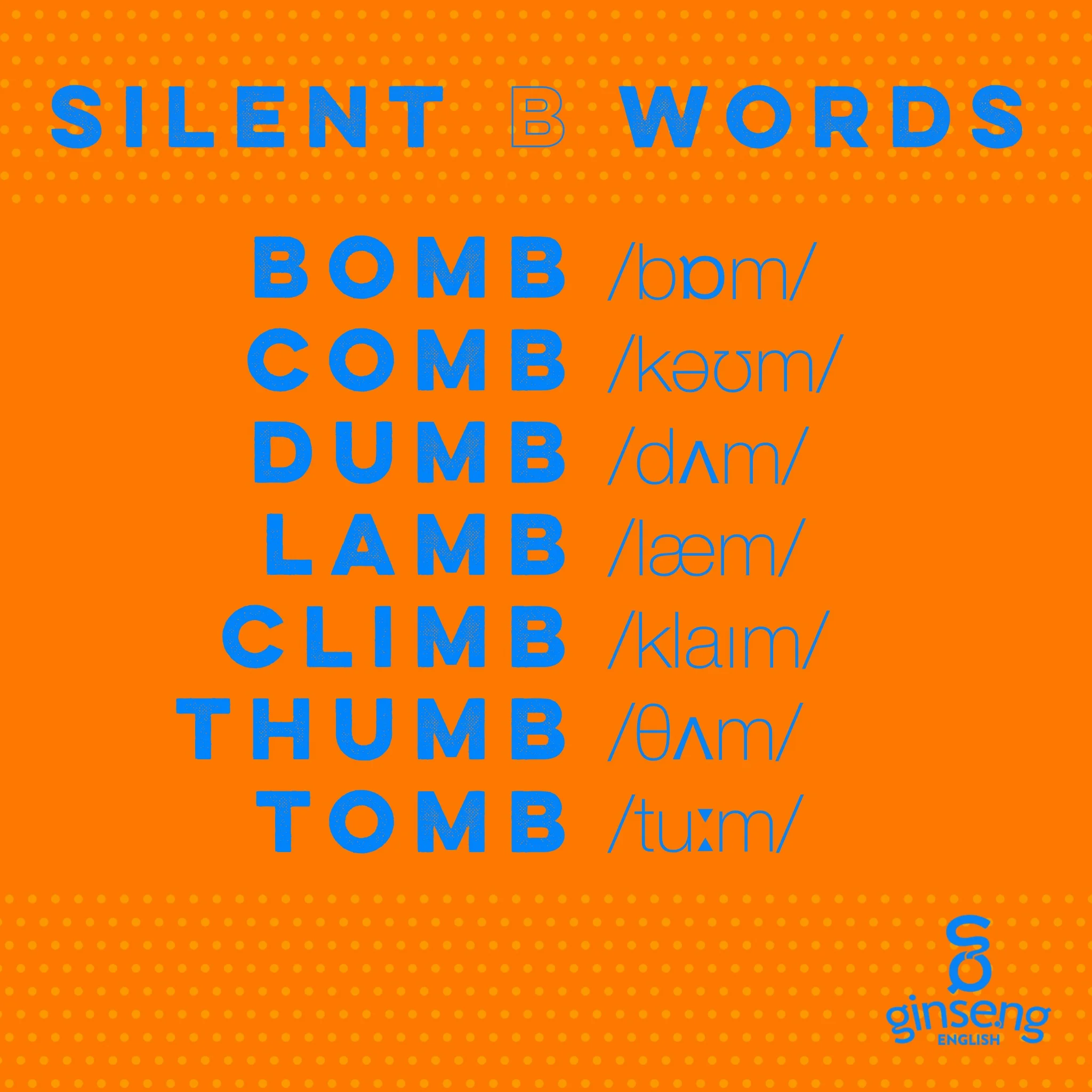
Here is a word list with 17 examples of silent B words:
| Silent B Word List | |||
| Word | IPA | PoS | Definition |
|---|---|---|---|
| bomb | /bɒm/ | n. | a machine that explodes |
| comb | /kəʊm/ | n. | a device for making hair neat |
| dumb | /dʌm/ | adj. | not smart |
| lamb | /læm/ | n. | a young sheep |
| climb | /klaɪm/ | v. | to go up |
| tomb | /tuːm/ | n. | a building for dead bodies |
| thumb | /θʌm/ | n. | finger on the side of the hand |
| crumb | /krʌm/ | n. | a small piece of food |
| limb | /lɪm/ | n. | an arm or leg |
| numb | /nʌm/ | adj. | not feeling |
| plumber | /ˈplʌmər/ | n. | someone who fixed pipes |
| womb | /wuːm/ | n. | the uterus |
| debt | /dɛt/ | n. | owing money |
| doubt | /daʊt/ | n. | uncertainty |
| subtle | /ˈsʌtəl/ | adj. | delicate; not obvious |
| jamb | /dʒam/ | n. | the side of a doorway |
Notice that the silent B doesn't tell us anything about the vowel in the word. The vowel sounds can be very different, for example in bomb, comb, and tomb.
Please share the picture with #ginsenglish if you find this helpful!
Why is B Silent Sometimes?
In the past, the B in these words was not silent. Over time, pronunciation changes. For example, bomb comes from the Italian bomba, in which the second B is pronounced, and climb was climban in Old English. By about 1300 C.E., the B had become silent.
Silent B Words in English
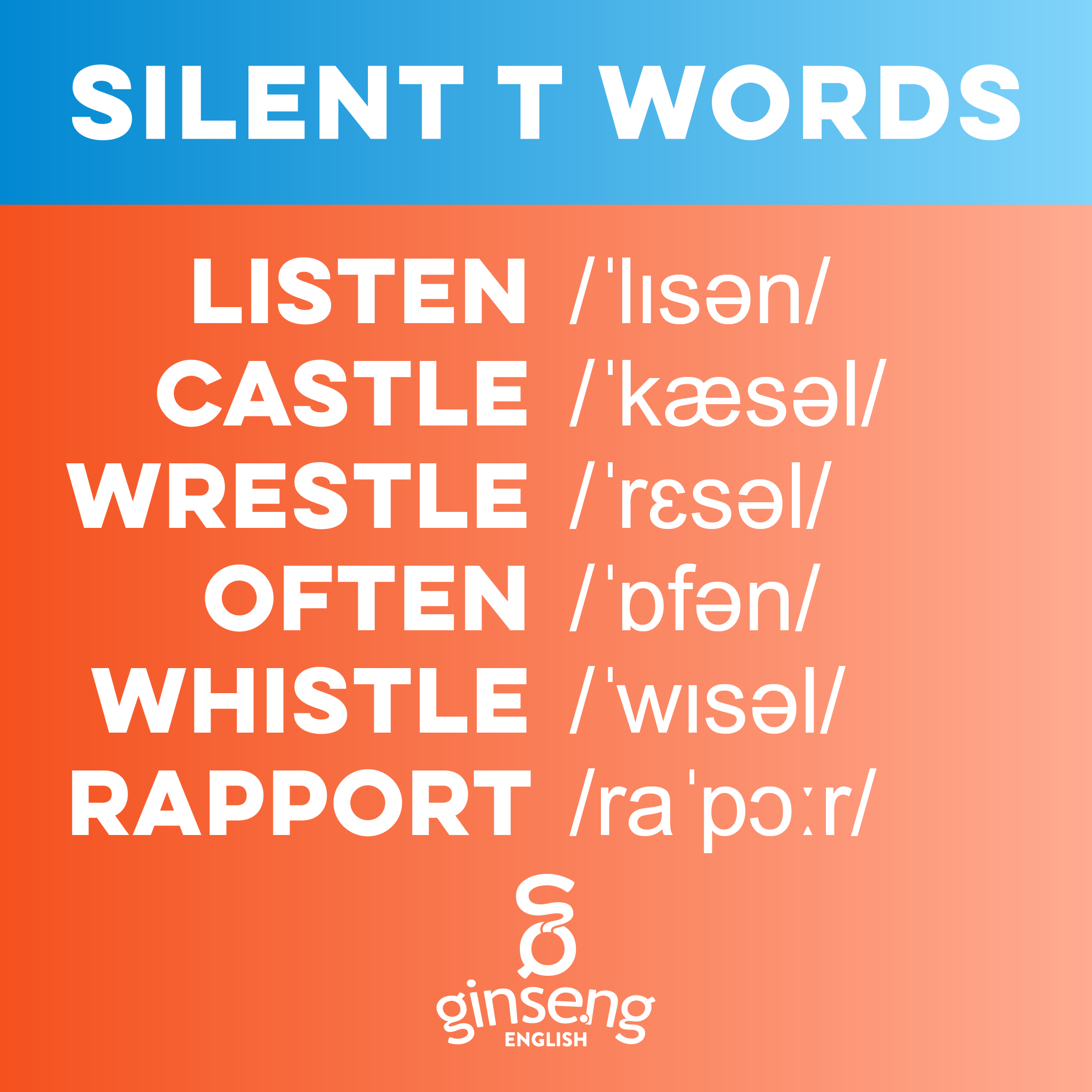
Stop pronouncing these words wrong! If you’re looking for explanations and examples of words with silent T, you’ve come to the right place. Charts, definitions, a word list of over 20 examples, and the history of how silent T became silent.